The diesel-or-petrol question comes up every single day — with every buyer who walks up to the workshop and says: I have a budget, I want something reliable, and I do not know what to choose. The answer is never simple because it depends on how much you drive, where you drive, and how much you are willing to invest in maintenance. What we can say, after years of working on both engine types, is that there is a clear pattern by which the cost-effectiveness of one or the other can be assessed in advance, before you put down a deposit.
This analysis was prepared by the Auto Gas Gaga workshop in Banja Luka, based on years of experience servicing and performing pre-purchase inspections on diesel and petrol used cars.
Quick Answer
| If you are buying... | Better choice |
|---|---|
| A used car under 10,000 KM for city driving | Petrol |
| A car for a daily commute of 40+ km each way | Diesel |
| A used car with 200,000+ km and no service history | Petrol |
| A family car for mixed driving, 15,000-20,000 km per year | Diesel conditionally, with a thorough inspection |
| A car for short city trips under 10 km | Petrol or petrol with LPG |
| A used car with documented services and long-distance driving | Diesel |
Table of Contents
- Why This Question Has No Universal Answer in 2026
- Diesel on a Used Car, Advantages That Still Hold
- The Price You Pay for Diesel, Typical Faults and Repairs
- Petrol on a Used Car, Why It Is Back in the Game
- Weak Points of Petrol Engines You Need to Know
- The Third Option Most Buyers Forget, Petrol with LPG
- Fuel Consumption and Annual Fuel Cost in BiH 2026
- How to Make the Final Decision
- What to Check Before Buying, Regardless of Fuel Type
- Frequently Asked Questions
- Related Articles
Why This Question Has No Universal Answer in 2026
Fifteen years ago, the answer was more straightforward. Diesel consumed significantly less fuel, parts were more affordable, and engines were mechanically simpler than they are today. Since then, almost everything has changed. Modern diesel engines carry a DPF filter, EGR recirculation, a variable-geometry turbo, a high-pressure common rail system, and in many cases an AdBlue SCR system. Each of these components is a potential expense that older diesels never had.
At the same time, petrol engines have become more economical. Direct injection, turbochargers, and smarter engine management have narrowed the consumption gap between diesel and petrol from the former 30-40% down to today's 15-25%, depending on the model and driving conditions.
On top of that, LPG remains available at favourable prices in BiH, giving petrol cars the potential to be the cheapest option per kilometre driven. There is no excise duty on LPG in BiH, making it a structurally privileged fuel compared to both petrol and diesel.
All of this means that the answer to "diesel or petrol" in 2026 depends on the buyer's specific situation rather than any general rule that would apply to everyone.
Diesel on a Used Car, Advantages That Still Hold
The diesel engine still has its strengths, and they do not disappear simply because the technology has become more complex. For a certain driver profile, diesel remains the better choice.
Lower fuel consumption on long journeys. On the open road, a good diesel consumes 4.5-5.5 litres per 100 km where a comparable petrol engine uses 6-7.5 litres. Over 20,000 km per year with predominantly long-distance driving, that difference translates into a tangible annual saving. For a driver commuting 50+ km each way, this advantage is felt every month.
Higher torque at lower revs. Diesel is more flexible on the road. Fewer gear changes, easier overtaking on the open road, a better feel when towing a trailer or driving with a full car. For a driver who regularly travels with family or tows a trailer, this still carries significant weight. A diesel at 2,000 rpm delivers as much power as a petrol engine needs 3,500-4,000 rpm to produce.
Engine block durability. Diesel engines are built for higher loads. The block is heavier, the pistons stronger, the crankshaft more robust. Under favourable conditions, a quality diesel engine can cover 300,000-400,000 km without an engine rebuild, provided it is maintained properly and operates in the regime it was designed for.
Better residual value. In BiH, used diesels still hold a somewhat higher resale value than comparable petrol cars of the same age and mileage, particularly in the family car and larger vehicle segments. This means that when the time comes to sell, a diesel owner loses less to depreciation.
The Price You Pay for Diesel, Typical Faults and Repairs
Every advantage of diesel comes with an associated cost. This is not a reason to avoid buying a diesel, but it is a reason to know what awaits you and to factor those costs into your budget before purchasing.
DPF filter is the component that captures soot particles from exhaust gases. On a used car with 150,000-200,000+ km, the DPF is often at its limit or already requires attention. Short city trips are this filter's worst enemy because regeneration cannot complete. You can read more about how the DPF works and why it clogs in our guide to DPF filters on used diesels.
EGR valve becomes clogged with soot and condensate, especially on cars that spend most of their time in city traffic. Symptoms include power loss, rough running, and an illuminated check engine light. Cleaning the EGR is a relatively affordable intervention, but if it is postponed, the consequences for the engine can be more serious.
Dual-mass flywheel is a wear part that most buyers do not include in their budget. On a used diesel with a manual gearbox, a flywheel that vibrates on start-up or rattles at idle is a sign that replacement is due. We wrote about recognising this problem in more detail in our article on dual-mass flywheels.
Turbocharger on a diesel operates under high load and high temperatures. Quality oil, regular changes, and proper cool-down after intensive driving extend its life, but on a used car with 200,000+ km you should expect the turbo to be in the second half of its service life.
Injectors and high-pressure pump are precision components of the common rail system. Poor-quality fuel, water in the tank, and postponing fuel filter replacement accelerate their wear. A single faulty injector can trigger a chain reaction across the entire injection system.
DPF Problems on Used Diesels in BiH
In BiH, DPF problems are particularly common for two reasons. First, the average age of the vehicle fleet is around 17 years, meaning many DPF filters are well past their optimal lifespan. Second, a large proportion of drivers use their cars predominantly for short city trips, which is precisely the regime in which the DPF cannot perform regeneration. The result is clogged filters, illuminated warning lights, and interventions that include cleaning or replacement. If you are buying a used diesel in BiH, the condition of the DPF filter must be among the first things you check during a pre-purchase inspection.
Petrol on a Used Car, Why It Is Back in the Game
The petrol engine was long the "second choice" for BiH used-car buyers. The reason was clear: diesel consumed significantly less, and fuel cost about the same. Today the situation is different, and an increasing number of buyers are turning to petrol.
A simpler engine means cheaper servicing. A naturally aspirated petrol engine (no turbo, no direct injection) has no DPF, no EGR in the conventional sense, no common rail injectors. A minor service is cheaper, parts are more affordable, diagnostics are quicker. The difference in the cost of a single minor service may not be large, but over a five-year ownership horizon, those differences add up.
Ideal for city driving. A petrol engine reaches operating temperature faster. There are no issues with incomplete regeneration, no clogging from short trips. If you spend most of your time driving around town and the surrounding area, a petrol engine simply lasts longer without expensive interventions on emission components.
The option to convert to LPG. This is the factor that changes the entire equation from the ground up. A petrol engine with an LPG installation runs on fuel that costs half the price of diesel. Over 15,000 km per year, that saving eliminates diesel's consumption advantage and turns petrol into the cheapest option.

Wider selection on the market and a lower purchase price. Petrol used cars in BiH are on average cheaper than comparable diesels of the same age. This means that for the same budget you can buy a newer or better-maintained example, which in the long run can mean fewer surprises in the workshop.
We covered which petrol engines have proven most reliable for used-car purchases in our conditions in detail in the guide to the most reliable petrol engines for BiH 2026.
Weak Points of Petrol Engines You Need to Know
Petrol is not without its flaws either, and it is only fair to say so openly because every decision deserves the full picture.
Higher fuel consumption on long journeys. On the motorway, a petrol engine consumes 15-25% more than a comparable diesel. If you cover 25,000+ km per year predominantly on the open road without an LPG installation, that difference is felt in your monthly fuel budget.
Newer turbo petrols are not simple. Engines like TSI, TFSI, EcoBoost, and THP have a turbo, direct injection, and in some cases a problem with carbon build-up on the intake valves. The principle is similar to diesel: it is a precision injection system operating under high pressure. However, the design, software, oil, and typical faults differ from manufacturer to manufacturer. More on maintaining these engines in the guide to TSI/TFSI/GDI engines.
Weaker torque at low revs. A naturally aspirated petrol engine lacks diesel's flexibility at lower revs. For towing a trailer or driving with a full car on hilly terrain, this is noticeable. The engine has to work at higher revs to deliver the same power, which increases fuel consumption and fatigue on longer journeys.
Spark plugs, ignition coils, lambda sensor. These are wear parts specific to petrol engines. They are not expensive individually, but neglecting replacement can cause bigger problems with the catalytic converter or uneven engine running. Regular replacement according to manufacturer intervals is key.
The Third Option Most Buyers Forget, Petrol with LPG
When we talk to buyers weighing up diesel versus petrol, they often forget the third option: a petrol engine with an LPG (autogas) installation. This is an option that makes particular sense in BiH for several concrete reasons.
LPG in BiH carries no fuel excise duty, making it structurally cheaper than both petrol and diesel. The price per litre ranges around 1.15-1.71 KM (depending on the region), while diesel costs 2.20-3.50 KM and B95 petrol 2.19-3.13 KM. Yes, LPG consumes 15-20% more per litre than petrol, but even with that correction, the cost per kilometre driven is significantly lower than either fossil fuel.
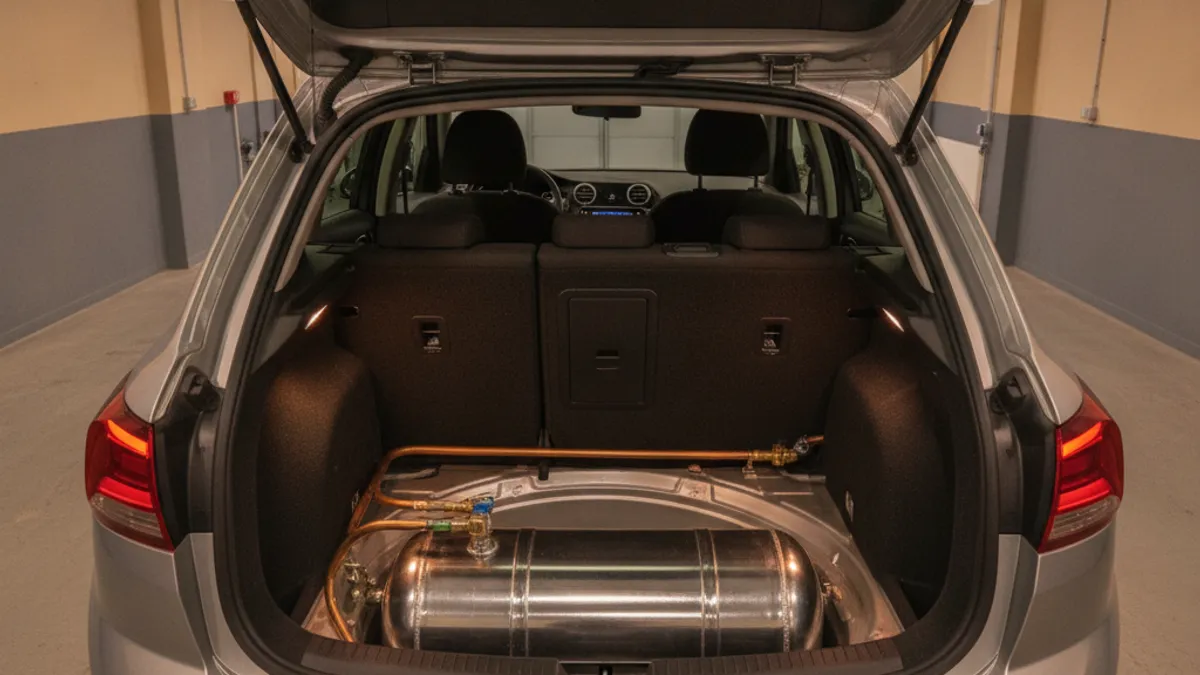
The return on investment for fitting an LPG system to an MPI engine (port injection, a conventional petrol engine) is around 9,000-10,000 kilometres driven. For GDI/TSI engines with direct injection, the installation is more complex and more expensive, but still cost-effective in the longer term. At our workshop we fit LPG systems to all types of petrol engines, including those with direct injection.
If you are considering this option, you can find a detailed cost breakdown and payback calculator in the LPG cost-effectiveness analysis for BiH 2026.
It is important to note that an LPG installation does not negatively affect engine longevity if the system is properly installed and regularly serviced. An engine running on gas operates more smoothly, combustion is cleaner, and the oil becomes contaminated more slowly. Naturally, a regular LPG service and installation check at the prescribed intervals is required.
Fuel Consumption and Annual Fuel Cost in BiH 2026
To keep this practical rather than theoretical, here are concrete figures for a typical BiH driver covering 15,000 km per year. Average fuel prices in BiH (May 2026, source: cijenegoriva.ba): diesel 3.24 KM/l, B95 petrol 2.96 KM/l, LPG 1.29 KM/l.
| Car class | Diesel (L/100km) | Petrol (L/100km) | LPG (L/100km) | Diesel annual | Petrol annual | LPG annual |
|---|---|---|---|---|---|---|
| Small city car (Polo, Fabia) | 5.0 | 6.0 | 7.5 | 2,430 KM | 2,664 KM | 1,451 KM |
| Compact (Golf, Octavia) | 5.5 | 7.0 | 8.5 | 2,673 KM | 3,108 KM | 1,645 KM |
| Family (Passat, Superb) | 6.5 | 8.0 | 10.0 | 3,159 KM | 3,552 KM | 1,936 KM |
| SUV (Tucson, Kuga) | 7.5 | 9.5 | 11.5 | 3,645 KM | 4,218 KM | 2,226 KM |
The consumption figures are real-world averages from workshop experience, not factory ratings. A Golf 1.6 TDI with a factory rating of 3.8 L/100km in practice consumes around 5.1-5.5 L/100km, which is roughly 34% more than the catalogue figure. The same applies to petrol engines: a factory 5.5 L/100km in reality means 7.0-7.5 on a mixed driving cycle.
The table shows that diesel is the cheapest fuel option only when compared to straight petrol. As soon as LPG enters the equation, a petrol car with autogas becomes the cheapest option across all classes, and by a significant margin. The difference between diesel and LPG in the compact class exceeds 1,000 KM per year in favour of LPG.
You can find a more detailed breakdown of annual costs across all categories (fuel, registration, insurance, servicing, depreciation) in our complete annual car cost calculator for BiH.
How to Make the Final Decision
After everything outlined above, the decision comes down to four questions you need to answer honestly.
How many kilometres do you drive per year? Below 15,000 km per year, a diesel in a city driving regime creates more problems than it saves. A petrol car (especially with LPG) is cheaper and more reliable in that regime. Above 20,000 km with predominantly long-distance driving, diesel starts to make economic sense.
What type of driving do you do every day? If short city trips are your daily routine (5-10 km to work, 3 km to school, 2 km to the shops), the diesel engine suffers. The DPF does not regenerate, the EGR clogs, the oil becomes contaminated faster. A petrol engine in that regime simply lasts longer without expensive interventions.
What is the condition of the specific car you are looking at? It is better to buy a well-maintained petrol car than a neglected diesel. This is a rule without exception. Documented services, regular filter and oil changes, and a known vehicle history are worth more than any fuel type. A neglected diesel with 180,000 km can require more investment than a properly serviced petrol car with 220,000 km.
What is your total budget, including the first repairs? A used diesel with 180,000 km that cost 8,000 KM can easily require an additional 1,500-2,500 KM in the first year for the DPF, flywheel, or turbo. A petrol car of the same class and age rarely demands that much up front. The purchase budget is not just the asking price.
The general rule for the BiH market in 2026: below 15,000 km per year go with petrol (with LPG as the ideal complement), between 15,000 and 20,000 it depends on the type of driving, and above 20,000 with predominantly long-distance driving diesel makes sense, but only with a verified example that has a documented service history.
What to Check Before Buying, Regardless of Fuel Type
Regardless of whether you are buying diesel or petrol, a pre-purchase inspection at an independent workshop is a step that should never be skipped. The inspection establishes the true condition of the engine, gearbox, suspension, braking system, electronics, and bodywork. It takes an hour or two that can save you thousands.
In addition to a physical inspection, we recommend checking the documented history of the car. Using the chassis number, international registries can pull the full record: actual odometer readings by date, recorded accidents, number of previous owners, and indicators of theft or total loss. We consider this an essential step before buying any used car. You can run such a check through carVertical using the code GAGA for a 20% discount on the report.
Found a car you are considering? Book a pre-purchase inspection or message us on WhatsApp with the listing link before you put down a deposit.
Frequently Asked Questions
Is a used diesel always more expensive to maintain?
Not always, but on average it is. A regular diesel service costs somewhat more due to pricier filters and a larger oil capacity. The key difference lies in diesel-specific faults: the DPF, EGR, turbo, and injectors are components that a petrol engine either lacks or has in a simpler form. On a well-maintained diesel that covers long distances, these faults occur less frequently.
How many kilometres per year do I need to drive for diesel to pay off?
The indicative threshold is 15,000-20,000 km per year with predominantly long-distance driving. Below that threshold, fuel savings do not compensate for the difference in service costs and potential repairs. With LPG on a petrol car, that threshold shifts even further in favour of petrol.
Are all petrol engines more reliable than all diesels?
No. Older naturally aspirated petrol engines (1.6 MPI, 1.4 16V, 2.0 Valvematic) genuinely have fewer components that can fail. But newer turbo petrol engines (TSI, TFSI, EcoBoost, THP) have their own list of weak points, including the turbo, direct injection, and sometimes a timing chain drive.
Can LPG be fitted to any petrol car?
Most petrol engines with port injection (MPI) can be converted quickly and straightforwardly. Engines with direct injection (TSI, TFSI, GDI) can also be converted, but require a more complex system and a more experienced installer. At our workshop we fit both types.
Why is diesel bad for short city trips?
A diesel engine needs more time to reach operating temperature. On short trips of 5-10 km, the engine never fully warms up. This means the DPF filter does not regenerate (it cannot burn off accumulated soot), the EGR clogs faster, and the engine oil becomes contaminated more quickly with condensate and fuel.
Does a used diesel hold better resale value?
In BiH market conditions, diesels in the compact and mid-size classes still hold a somewhat higher resale price than comparable petrol cars. The gap is narrowing year on year as more buyers recognise the advantages of petrol with LPG, but for now diesel still has the edge at resale.