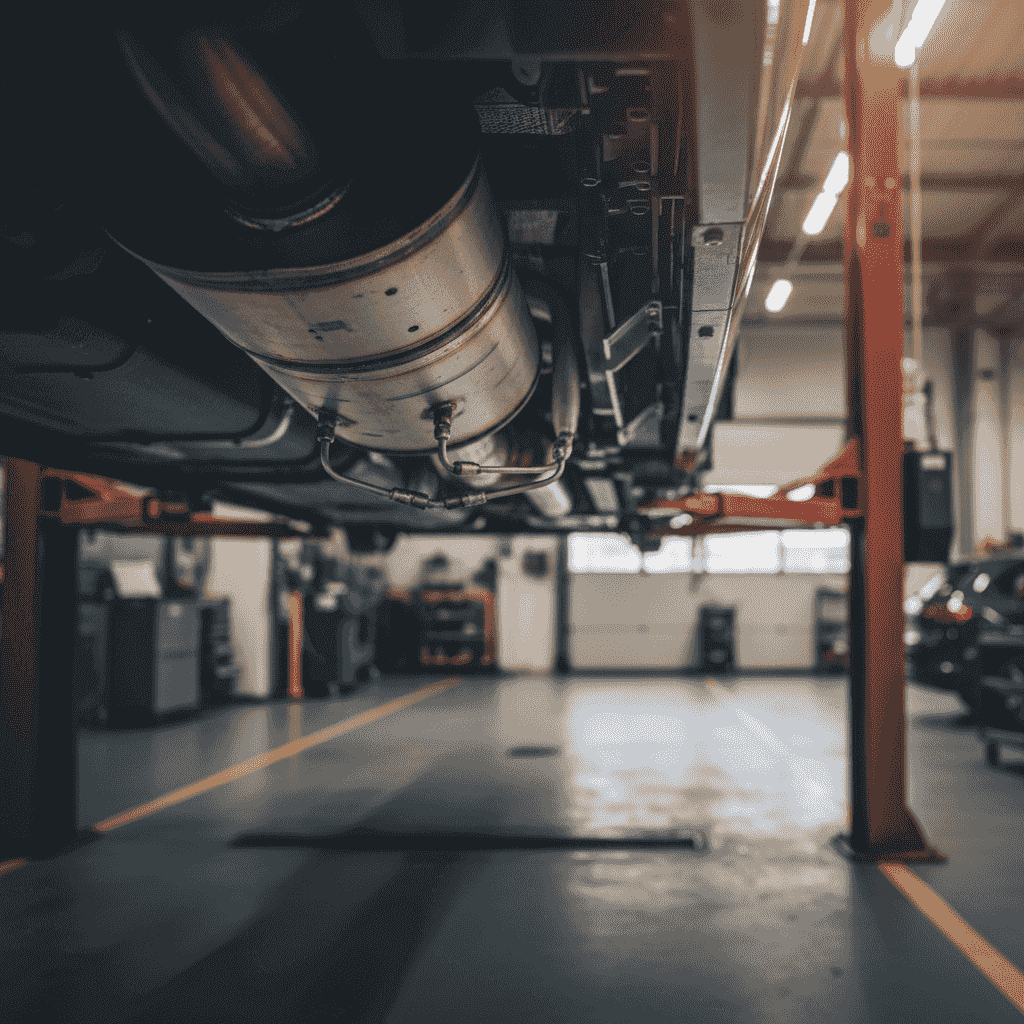
The owner of a used German diesel staring at a yellow DPF light on the dashboard has three questions: how serious is it, how much will it cost, and is deleting the DPF really such a bad idea. This article answers all three, with price ranges in BiH and Croatia as of May 2026 and a clear stance on filter deletion.
This guide was prepared by the Auto Gas Gaga workshop in Banja Luka, based on years of experience with diesel diagnostics and preparing vehicles for DPF service at partner workshops across the region.
Table of Contents
- What a DPF Is and Why It Hits Imported German Diesels Hardest
- Five Signs of a Clogged DPF an Owner Notices Before the Workshop
- Passive vs Forced Regeneration, How to Tell Them Apart and What to Do
- DPF Error Codes Your OBD2 Reads and What They Mean for Your Wallet
- Cleaning, Replacement or Delete, Three Routes and Their Real Cost in BiH
- Why Deleting the DPF in 2026 Is Not a Smart Move for a Used Car in BiH
- How to Extend the Life of Your DPF, Workshop Advice
- Frequently Asked Questions
- Related Articles
What a DPF Is and Why It Hits Imported German Diesels Hardest
The DPF is a diesel particulate filter in the exhaust: a ceramic monolith with hundreds of narrow channels that let gas through but trap soot particles. It has been fitted to European diesels built from roughly 2005-2006 onwards, when the Euro 4 standard made the filter mandatory. For a deeper introduction to how the filter works, see our advice page What a DPF filter is and why it clogs.
The reason an imported German used car is more vulnerable does not lie in the engine, but in how it was driven before it reached BiH. The typical path: the first owner in Germany drives daily on the motorway, regeneration runs automatically. The second and third owners already cut down on driving, then comes a rotation through dealers and transport to BiH where the car sits on a lot for weeks, and finally an owner in Banja Luka, Tuzla or Sarajevo who uses it to drive three kilometres to work. A filter that was regularly cleaned in Germany is now just collecting soot for months on end.
The second reason is engine type. The best-selling engines in BiH imports (VW 1.6 and 2.0 TDI, BMW 2.0d and 3.0d, Mercedes 2.2 and 3.0 CDI) were designed around the assumption of regular motorway driving. Drop the same engines into a short-trip city pattern and the problem arrives faster than on Japanese or Korean diesels. We cover this in detail in Why short trips kill a diesel engine.
The third issue is service history. For imported examples, the easiest way to check the actual DPF condition, the number of past forced regenerations and whether the filter was previously cut open or "reset" with software is through carVertical. Using the VIN, it pulls the documented vehicle history from international registries: mileage by date, recorded accidents, number of previous owners and indicators of theft or write-offs. We consider this a mandatory layer of due diligence before buying any used diesel. When paying for the report you can use code GAGA for a 20% discount.
Five Signs of a Clogged DPF an Owner Notices Before the Workshop
A filter does not seize overnight. The signals arrive months before the workshop visit.
- Yellow DPF light on the dashboard. It typically comes on when the filter reaches around 55% soot capacity. It is not an alarm to stop immediately, but it is a call to change your driving pattern within the next few dozen kilometres.
- Noticeable loss of power, especially uphill. The engine breathes through an overloaded filter, back-pressure spikes, and the software cuts power to protect the turbocharger and the filter itself. When you feel the car "doesn't pull like it used to", that is not just habit.
- Higher fuel consumption for the same driving style. When regeneration fails to complete, the system keeps trying and injects extra fuel into the exhaust. An unexplained extra litre per hundred kilometres is a classic signal.
- Smell of unburnt fuel after driving. When somebody tells you your car "smells like heating oil", that is excess fuel from a failed regeneration cycle.
- More frequent active cycles the driver can feel. A small jump or dip in idle revs, a cooling fan that runs for a minute or two after you switch off, a faint ticking. If this happens several times a week, the filter is not breathing properly.
When these five symptoms line up with a short-trip city driving pattern, the picture is clear even before any OBD2 reading.
Passive vs Forced Regeneration, How to Tell Them Apart and What to Do
A DPF cleans itself by burning the accumulated soot at high temperature. The term regeneration covers three different processes.
Passive regeneration is the ideal case. It happens by itself when the exhaust gases are hot enough, typically during steady motorway driving at 100-120 km/h. The temperature in the DPF reaches 550-650 degrees and the particles smoulder, burning into ash. The driver notices nothing. If you drive this way regularly, the filter never needs to be forcibly cleaned.
Active or forced regeneration kicks in when passive regeneration cannot keep up. The ECU injects extra fuel into the exhaust to force the particles to burn off. A successful cycle needs around ten kilometres of continuous motorway driving, with the engine in the 1,500-2,500 rpm range, and without switching off the engine until the cycle finishes. An interruption mid-cycle means part of the fuel ends up in the engine oil and the filter is now even closer to a complete blockage.
Forced service regeneration is what we do in the workshop. Through a diagnostic tool the engine is put into a special mode and the filter is burned clean with the patient still in the workshop, no driving needed. This is the last chance before pulling the filter for cleaning or replacement.
What to Do When the DPF Light Comes On on the Motorway
If the light comes on while you are already on the open road, the situation is in your favour. The best move is to hold 100-120 km/h in a lower gear that keeps the engine at 2,000-2,500 rpm, for the next twenty minutes or so, and not switch off the engine until you reach your destination. There is a real chance the regeneration will finish the job and the light will go out by itself.
If the light comes on in town, there is no point crawling around Banja Luka in third gear. The most practical move is to take the first opportunity to get on the motorway. If the light is still on after twenty kilometres of clean open road, the filter is too clogged to regenerate on its own and it is time for the workshop, before a second light comes on and the car drops into limp mode.
DPF Error Codes Your OBD2 Reads and What They Mean for Your Wallet
When you pull codes with an OBD2 reader, there are four classics that keep showing up on DPF problems.
P2002 and P2463 Errors on OBD2
P2002 means "DPF efficiency below threshold". The differential pressure sensor reports that the pressure difference before and after the filter is too high. This is the most common DPF code we see, and it does not necessarily mean replacement. Very often the fix is a successful forced regeneration in the workshop.
P2463 means "soot accumulation has exceeded the allowed level", similar to P2002 but stricter. If it appears alongside an already-lit DPF light and a power loss, the combination suggests that passive and active regeneration have been failing for some time.
P244A and P244B add context about the regeneration process itself, that the process is unsuccessful or that the count of consecutive failed cycles has been exceeded. They show up more often on BMW and the VW Group.
P2452 is a fault on the differential pressure sensor itself. If the sensor is faulty, cleaning the filter will not solve anything, and replacing the sensor is significantly cheaper. Our approach in the workshop is to first verify whether the problem really is the DPF, because often it is not. A combination with P0299 (insufficient turbocharger pressure) suggests that back-pressure from a clogged DPF is already affecting the turbo, a clear sign you need to act within the next few hundred kilometres.
Cleaning, Replacement or Delete, Three Routes and Their Real Cost in BiH
When the filter is genuinely clogged and forced regeneration has not helped, three routes remain. Each has its own price tag and its own legal status.
DPF Cleaning Cost in Croatia and BiH
Professional machine cleaning means the filter is physically removed from the car and taken to a specialist workshop with a pressure cleaning machine and chemical agents. According to data from Croatian workshops (autoportal.hr and NonCarbon, April 2026), the service itself costs around 160 euros, plus 100-200 euros for removal and refitting. The procedure takes a working day and leaves 1-5% soot in the filter. Biggest advantage: the OEM housing is preserved, the manufacturer warranty stays intact. In BiH the same range translates into an equivalent price in convertible marks, but the precise cost depends on the workshop and the model. Get in touch for a quote if you are considering this step.
We recommend this route first, especially for a used car with a missing service history. The filter can be saved in 80-90% of cases if you act in time.
DPF Replacement Cost
According to local sources (automobili.ba, March 2026), for standard mid-range VW, Opel, Ford and Renault diesels, a new genuine part costs roughly between 800 and 1,500 KM. FAP filters on the PSA Group (Peugeot, Citroën, plus some Ford, Volvo and Fiat models) come in at 1,000-2,000 KM because of the Eolys additive, plus 200-350 KM for the fluid and coding. For premium diesels with an SCR system integrated into the DPF (e.g. BMW M-Sport, certain Mercedes models), the full assembly can reach 2,500 euros. On top of that comes the labour cost, which you should ask for on site after diagnostics.
Replacement makes sense when the filter has crossed the critical point and machine cleaning no longer restores flow, or when it was previously cut open and the ceramic is physically damaged.
DPF Delete
Deleting means physically gutting the ceramic monolith out of the housing and remapping the engine so the ECU "thinks" the DPF is still working. The black-market price is lower than any replacement, hence the popularity. We do not do this, and here is why.
Why Deleting the DPF in 2026 Is Not a Smart Move for a Used Car in BiH
Three concrete reasons.
First: the BiH technical inspection in 2026 checks the exhaust. Under the current procedure, the test line measures opacity and verifies the presence of the catalyst and the particulate filter. A vehicle with a deleted DPF and non-compliant emissions in principle does not pass the technical inspection. That means every year before registration you face two bad choices: either flash the software back to stock and re-weld the filter, which is an extra cost, or count on a tester looking the other way, which is no longer the rule. We cover this in more detail in Most common reasons cars fail technical inspection.
Second: the car loses value. When you come to sell the car, a serious buyer will ask about the DPF and want proof it is genuine or professionally serviced. Many buyers in 2026 pull a vehicle history report before putting down a deposit, and these often show the DPF status was changed or that the car visited specific workshops. A car with a deleted DPF is worth a few thousand KM less than a comparable example with the original filter.
Third: real engine health. A DPF delete also means an engine remap. It is not the original map, but one of dozens of variants workshops buy on the black market. The quality of these maps varies wildly. We have seen plenty of engines that, after a delete, suffered premature turbocharger wear, elevated exhaust temperatures and EGR valve problems. In the worst cases, cylinder head failures on 2.0 TDI engines that were already on the edge of their thermal limit from the factory.
A delete is a shortcut that turns into a bigger bill.
How to Extend the Life of Your DPF, Workshop Advice
Most of these tips are free and recover thousands of kilometres of filter life.
Drive at least once a week for twenty kilometres on the motorway. Steady driving at 100-120 km/h with the engine at full operating temperature for 30+ minutes enables passive regeneration, which is free. If you live in Banja Luka, that is a trip to Laktaši and back. It is worth more than any additive.
Use quality engine oil with Low SAPS specification. Oil with high sulphated ash clogs the DPF faster. Look for ACEA C2, C3 or C4. We cover this in detail in How to choose engine oil.
Do not switch off the engine in the middle of a forced regeneration. If the cooling fan is louder than usual, if instantaneous fuel consumption is unusually high, or if idle revs are slightly elevated, you are most likely in the middle of a regeneration cycle. Let it finish.
Do not ignore the EGR and intake flaps. A clogged EGR pushes too much exhaust back into the engine and increases the amount of soot heading into the DPF. Servicing the EGR and flaps before the DPF collapses is typically several times cheaper than replacing the filter.
A Five-Minute DPF Check Before Putting Down a Deposit on a Used Car
If you are still considering buying a used diesel, a few minutes before the inspection can save you thousands. Ask the seller to start the car cold and listen to it run: an uneven idle, a loud cooling fan from the moment of cold start, or excessive smoke when cold are clear warning signs. Look under the DPF housing and check for welding marks or new unwelded joints, which suggest the filter was opened in the past. Open the service history and look for a "DPF" entry. The cheapest single step: a vehicle history report by VIN.
Found a car you like? Book a pre-purchase inspection at our workshop or message us on WhatsApp with the listing link, an hour now beats a DPF repair later.
Frequently Asked Questions
Can the DPF Light Switch Off on Its Own Without a Workshop?
Yes, in the early stage it can. If the light came on for the first time and you head straight onto a longer open road, keep the engine warmed up and run it for 20+ minutes at 1,500-2,500 rpm, the regeneration will often complete on its own. If it returns within the next few days, the filter is already in an advanced stage and self-cleaning will not be enough.
How Often Should a DPF Be Cleaned?
Routine machine cleaning is not a service interval, it is a response to symptoms. On an imported diesel driven in mixed conditions, the first professional cleaning typically arrives in the 150,000-200,000 km range. On a car driven exclusively in town, it can come before 100,000 km. A car with regular motorway driving often does not need cleaning before the end of the engine's working life.
Is It Legal to Delete a DPF in BiH?
No. A vehicle with faulty emission control in principle does not pass the technical inspection, and a DPF delete also includes the software side of the same procedure. Although it is still done on the black market, that does not mean it is legal, it means every case is not currently actively penalised. The rule is shifting, and a vehicle that passes today may fail tomorrow.
What Is the Cheapest Route When the Filter Clogs?
If you act early, professional machine cleaning is the cheapest proper option and the most common solution we recommend. A delete looks cheaper on paper, but the total cost over the next few years (registration problems, faster turbo and EGR failures, lower resale value) makes it more expensive in practice.
What Is the Difference Between a DPF and a FAP Filter?
DPF is the generic name for a diesel particulate filter and uses passive regeneration at 550-650 degrees. FAP is the label used by the PSA Group (Peugeot, Citroën) and some Ford, Volvo and Fiat models, and comes with an Eolys additive in a separate tank that lowers the particle ignition temperature to around 450 degrees. In practice, FAP filters regenerate more easily in mixed driving than a classic DPF, but their maintenance includes topping up the additive and coding it, an extra cost a DPF does not have.
Does the AGG Workshop Do Professional DPF Cleaning?
Our approach is to do proper diagnostics first, because it often turns out the problem is not the filter itself but the pressure sensor, the EGR or the intake flaps, where the fix is faster and cheaper. If the filter really is clogged, we run a forced regeneration in the workshop and, when that is not enough, send the filter out for professional machine cleaning to trusted partners in the region. What we do not do is delete the DPF.