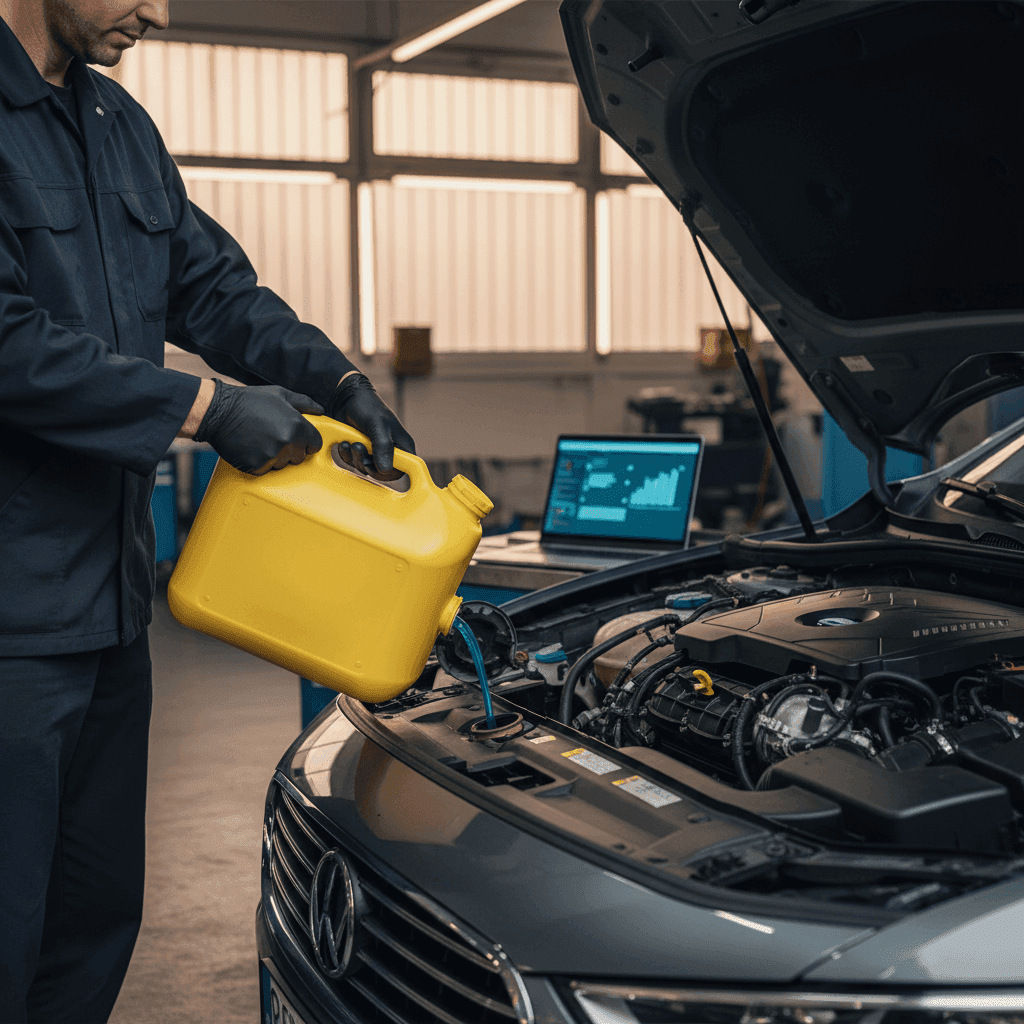
Used diesels from Germany, Austria or Italy with the Euro 6 standard come with an AdBlue system that can fail well before the car has covered half a million kilometres. AdBlue problems leave BiH owners with three recurring questions in the workshop: what does the yellow warning light mean, is it safe to drive, and how much does it cost to put right.
This guide was prepared by the Auto Gas Gaga workshop in Banja Luka, based on service experience with Euro 6 diesels and indicative prices from current sources across the region.
Table of Contents
- What AdBlue Is and Why Almost Every Used EU Diesel Has It
- How the SCR System Works and Where It Most Often Fails
- Most Common AdBlue Warning Symptoms on the Dashboard
- What the Car Does When AdBlue Fails
- Real Repair Costs in BiH
- What to Check on a Used Diesel Before Buying
- How to Extend the Life of the AdBlue System
- Winter, Short City Routes and Crystallisation
- Frequently Asked Questions
- Related Articles
What AdBlue Is and Why Almost Every Used EU Diesel Has It
AdBlue is a colourless fluid (a urea solution, around 32.5%, in demineralised water) injected into the diesel exhaust. It is not fuel; it has its own separate tank with a blue cap, next to the fuel filler, in the boot or under the car.
The Euro 6 emissions standard, in force for new diesel cars from 2014-2015, requires a drastic reduction of nitrogen oxides (NOx) in the exhaust. The EGR valve and DPF filter are no longer enough, so an SCR catalytic converter that uses AdBlue has been added to the system. In practical terms: every Passat B8, Octavia 3, Golf 7, Peugeot 308 BlueHDi, Citroën C4, Opel Astra K, Mercedes E-Class W213, BMW 3 Series F30 and Ford Mondeo from that period has an AdBlue tank.
The most problematic in practice are Peugeot, Citroën, DS and Opel BlueHDi models, then the VAG group (VW, Audi, Škoda, Seat), followed by Mercedes-Benz, BMW and Ford. The SCR system on these cars has more characteristic faults than the average owner would expect.
How the SCR System Works and Where It Most Often Fails
The system has an AdBlue fluid tank with a heater and a level sensor, a pump that sends fluid under pressure towards the exhaust, a dosing injector ahead of the SCR catalytic converter, and NOx sensors (two of them, before and after the converter) that measure efficiency.
The control unit calculates how much urea to inject based on engine load and exhaust temperature. The urea breaks down in the hot exhaust into ammonia, which in the SCR catalytic converter converts nitrogen oxides into nitrogen and water vapour. Three things must work simultaneously: the pump must build pressure, the injector must dose cleanly, and the sensors must report correct readings.
Typical fault points we see:
- NOx sensors. The most common failure. They tolerate neither vibration nor road salt. When they fail, the system enters protection mode.
- AdBlue pump. From regional sources, problems typically appear after around 250,000 kilometres, especially on vehicles older than six years.
- Dosing injector. The most sensitive to poor-quality fluid or long periods of standing. It clogs with urea crystals.
- Tank heater. Without the heater, AdBlue freezes in winter. The heater is integrated into the tank; when it fails, the entire assembly is usually replaced.
- SCR catalytic converter. Fails less often, but when it gets contaminated or burns out, the repair is the most expensive item in the story.
The principle is similar across all manufacturers. The execution, software, fluid specification and typical faults vary from manufacturer to manufacturer; the Mercedes system is not the same thing as the PSA BlueHDi.
Most Common AdBlue Warning Symptoms on the Dashboard
The driver almost never hears the SCR system failing - they find out from a warning light. Symptoms in order of appearance:
- Yellow AdBlue light or "AdBlue: top up" message. A low-level warning, not a fault.
- Engine warning light (check engine) together with the AdBlue message. The system has noticed something is off, most often a NOx sensor, the pump or the heater.
- "AdBlue system fault, visit service" message. The system has registered a fault and started a countdown.
- Countdown of starts or kilometres until lockout. "Starting will not be possible in X km" or "Remaining starts: N". The car still runs, but if the fault is not cleared, the system will block engine starting.
- Reduced power (limp mode). Some manufacturers reduce engine power as a final warning before final lockout.
Rule of thumb: the more direct the message and the more numbers in it, the less time you have.
What the Car Does When AdBlue Fails
Euro 6 diesels are not allowed to bypass the AdBlue system, because the car would emit more NOx than the EU standard permits. That is why manufacturers programmatically block the engine from starting when the fluid level reaches zero or when the system registers an uncleared fault.
The practical sequence:
- The system issues a warning at 1,500 to 2,400 km until lockout. The light is yellow.
- At around 800 to 1,000 km the light may turn red or start flashing.
- At around 100 to 200 km the driver gets a countdown of remaining engine starts.
- When the counter drops to zero and the engine is switched off, starting is blocked until the fault is cleared and the control unit is reset.
AdBlue Has Blocked Engine Starting
The lockout cannot be bypassed legally. There is software erasing that some offer for cheap, but that is illegal at the technical inspection in BiH and in every EU country. The car fails the emissions test, and a buyer who later takes on such a car will have problems registering it. We do not recommend this to anyone. If the car is already counting down or has blocked starting, the only correct path is diagnostics and clearing the actual cause of the fault.
Real Repair Costs in BiH
There is no unified price list for AdBlue repairs in BiH. The following range is indicative, based on regional sources from the 2022-2025 period, and should be treated as a guideline, not a definitive invoice.
- NOx sensor. The cheapest intervention, but not trivial; the price of the sensor itself is significant.
- Dosing injector and system cleaning. Mid-range, depending on how much crystallisation there is.
- AdBlue pump. From regional sources, on vehicles over 250,000 km the pump replacement runs over 1,000 EUR, before labour.
- Complete AdBlue tank with integrated pump and heater. The heaviest item. According to regional sources, on some models the assembly ranges between 2,000 and 3,500 EUR for the part alone, which on older vehicles can exceed half the car's market value.
The reason is that on most modern diesels the pump, heater and level sensor are designed as a single integrated module, so the individual part is not replaced - the entire assembly is.
The price for your car depends on the make, year and how far the crystallisation has spread. Get in touch for a quote with a photo of the dashboard message and details of the car.
AdBlue Light On - What to Do
If only the yellow AdBlue light is on, in 90% of cases it is a low level. Top up 5 to 10 litres of original fluid, wait a couple of starts and drives for the system to register the new level, and the light goes out. If the engine warning light is also on, or if the light stays on after topping up, it is time for diagnostics; this is no longer a question of level, but of system condition.
What to Check on a Used Diesel Before Buying
A buyer of a used Euro 6 diesel with a hidden AdBlue problem pays for a fault the seller never mentioned in the listing. A pre-purchase inspection is the safest route, but here is what the driver can check on their own.
What good signs look like:
- The car does not start with the AdBlue or engine warning light on.
- The owner can produce a receipt for a recent AdBlue top-up.
- The AdBlue tank is full or near the top (checked through the on-board menu or diagnostics).
- The service history records NOx sensor replacements or SCR system software updates.
- The car has been driven in mixed conditions, not exclusively around town on 3 to 4 km trips.
What to watch out for:
- A warning light that "disappeared" while you were getting behind the wheel, with the owner claiming it never came on. Lights do not vanish on their own; often someone has run the car through diagnostics ahead of the sale.
- An owner who insists that AdBlue "does not need" topping up or that they have "switched the system off". This is either ignorance or a technical problem for future registration.
- A car with over 250,000 km and not a single service entry related to SCR.
- Buying a car in winter that has been standing outside in below-zero temperatures for a long time, with an AdBlue tank that has not been topped up for months.
- A "showroom" where the seller cannot answer the question "When was AdBlue last topped up?".
The best move is a pre-purchase inspection on diagnostics. A good tool reads fluid pressure from the SCR module, tank temperature, heater status, NOx values, dosing, catalyst efficiency and the countdown to lockout. That is the difference between "the car drives now" and "the car is healthy".
Book a pre-purchase inspection before you put down a deposit, or message us on WhatsApp with the listing link.
How to Extend the Life of the AdBlue System
The AdBlue system is not something the owner services themselves, but driving style and maintenance habits have a strong effect on how long it will last before the first failure.
- Use only quality AdBlue. The fluid at BiH stations typically costs 1 to 2 EUR per litre at the dispenser, 1.5 to 3 EUR in a canister. Cheap or diluted fluid is the main reason injectors crystallise.
- Do not mix fluids of different origin in the same tank. If you have doubts about quality, first run the tank dry, then fill with another brand.
- Drive longer routes at least once a week. Half an hour on the open road helps both the SCR catalytic converter and the DPF filter to warm up and self-clean.
- Keep up with service intervals and software updates. Manufacturers periodically issue software bulletins that optimise SCR system operation.
- Do not leave the tank near empty in winter. Fluid in a near-empty tank freezes and crystallises faster.
Consumption averages 1 to 1.5 litres per 1,000 km. Drivers who often use the motorway use more; city drivers use less, but run a higher risk of crystallisation due to the poorly heated exhaust.
Winter, Short City Routes and Crystallisation
The two worst things for the AdBlue system in BiH's climate are winter and exclusively city driving. They often go hand in hand and kill used diesels.
AdBlue freezes at around -11°C. That is the figure from the specification. In practice, freeze-thaw cycles, typical for a car that spends the night outside at -5°C and goes out during the day at +3°C, deposit fine urea crystals that do not fully dissolve when the heater warms the tank. These crystals build up in the line, on the injector and on the valves. The result is a winter fault that starts as "the warning light goes out once the car warms up" and ends as a replacement of the dosing injector or the entire assembly.
Short city routes work from another angle. The SCR catalytic converter requires a high exhaust temperature; on trips of two to four kilometres it does not even get a chance to warm up. Dosing is then reduced, AdBlue sits in the system and deposits crystals. The same logic as with the DPF filter and short trips on a diesel.
Driving a Euro 6 diesel and looking for a service that knows the SCR system? Auto Gas Gaga handles AdBlue system diagnostics and repairs on VAG, PSA, Mercedes, BMW and Ford models. Book an appointment or message us on WhatsApp before the countdown reaches zero.
Frequently Asked Questions
Can I drive a car with the AdBlue light on?
If only the yellow low-level light is on, you can, but get to the nearest filling station as soon as possible and top up. If the light is red or combined with the engine warning light, drive straight to the workshop. A red AdBlue light almost always means that the countdown to a starting lockout has already begun.
Can I top up AdBlue fluid myself?
Yes, it is straightforward. Open the AdBlue filler cap, pour the fluid from the canister until you hear the pump shut off the flow. Take care not to spill it on paint or rubber; AdBlue is mildly corrosive.
How much AdBlue does a diesel car use?
On average 1 to 1.5 litres per 1,000 km. A car with a 15 to 20 litre tank typically covers 10,000 to 20,000 km between top-ups, which for most drivers means one top-up between two services.
Can AdBlue be replaced with ordinary water?
No, under no circumstances. Water in the SCR system instantly triggers a fault and can permanently damage the dosing injector and the catalytic converter. AdBlue is a precisely defined urea solution (around 32.5%) in demineralised water.
How much does AdBlue pump replacement cost in BiH?
The price depends on the make and model. From indicative regional sources, the part alone on vehicles over 250,000 km often exceeds 1,000 EUR before labour; on some models the entire tank with the integrated assembly is replaced, in a range of several thousand euros. Get in touch for a quote with the details of your car.
What do I do if the car is already counting down engine starts?
Drive straight to the workshop. When the counter drops to zero, the control unit blocks starting in software. For the car to start again, the fault must be cleared and the system reset with diagnostics; topping up the fluid alone will not help here.