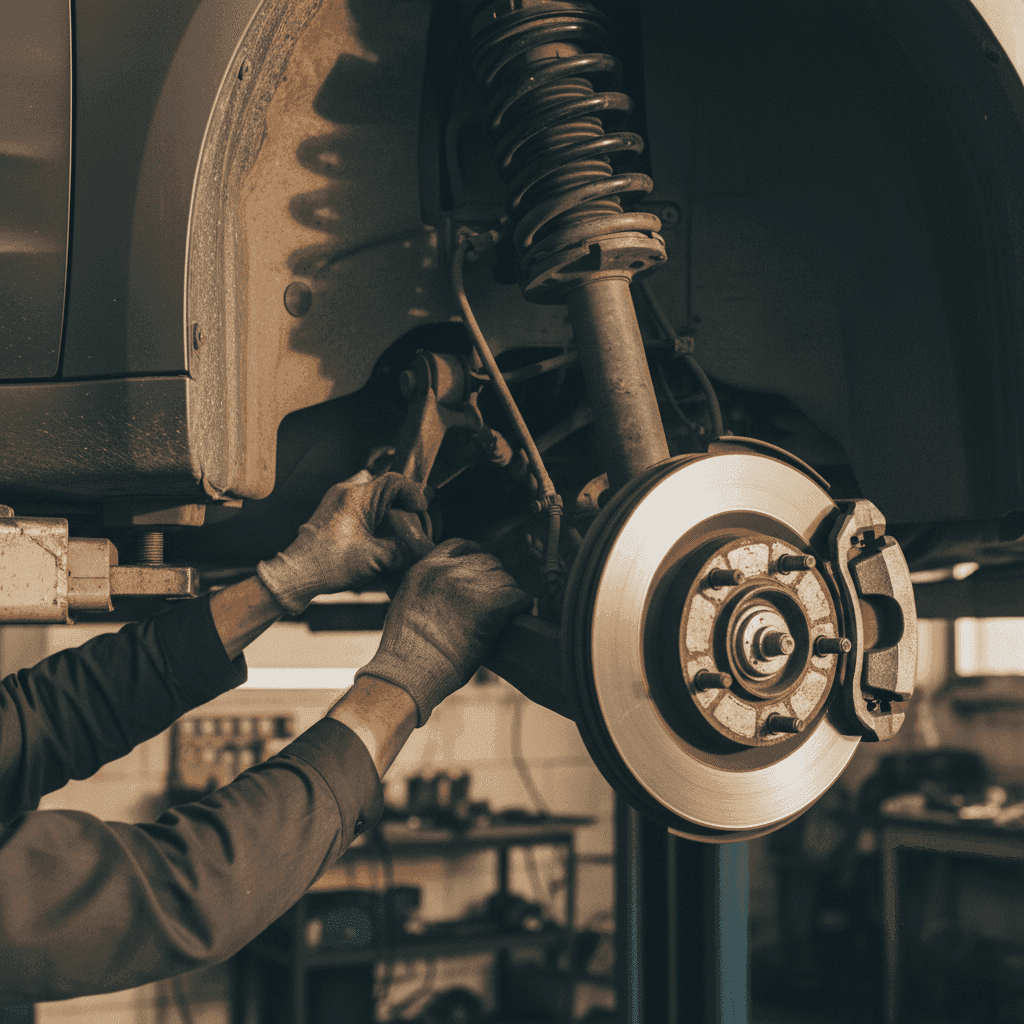
What Keeps You on the Road
Suspension and brakes are the systems that directly affect driving safety. When they are worn, the car handles differently: it tracks poorly, takes longer to stop, and is harder to control. These are not things to ignore.
Common Signs of Suspension Problems
- Knocking or clunking over bumps - if you hear impacts when going over uneven surfaces, something in the suspension is worn
- Car pulls to one side - instead of going straight, it drifts left or right
- Uneven tire wear - the inside or outside edge of a tire wears faster
- Body roll in corners - the car leans too much through turns
- Vibration through the steering wheel - especially at higher speeds
- "Floating" on the road - after a bump, the car keeps bouncing instead of settling immediately
Parts We Inspect and Replace
Shock Absorbers
Shock absorbers dampen the movement of the springs. When they are worn, the car "bounces" over bumps, stopping distances increase, and tires wear faster. They typically last 60,000-80,000 km, but on our roads often less.
Springs
Springs carry the weight of the vehicle. They can snap or sag. If you notice the car sitting lower on one side, a spring is likely the cause.
Bushings and Rubber Mounts
Rubber components that connect the metal parts of the suspension. They wear gradually and start knocking. A cheap part that makes a big difference to how the car behaves.
Stabilizer Bars and Drop Links
Drop links are one of the most common causes of front-end knocking. A worn drop link produces a metallic clunking over every bump.
Ball Joints and Wheel Bearings
Ball joints connect the main suspension components. When they wear, the steering becomes loose and the car tracks poorly. A worn wheel bearing produces a constant humming that gets louder with speed.
Brakes
Brake Pads
Pads wear during normal use. Signs they need replacing: squealing when braking, longer stopping distances, and vibration when braking. Read more in our guide on how to tell when brakes need servicing.
Brake Discs
Discs last longer than pads, but they wear too. If you feel vibration or pulsing through the pedal when braking, the discs are likely warped or worn.
Brake Fluid
The fluid should be changed every 2 years regardless of mileage. Old fluid absorbs moisture and loses effectiveness, especially under heavy braking.
When the Situation Is Dangerous
Do not put off an inspection if:
- The brakes squeal constantly, not just occasionally
- Stopping distances have noticeably increased
- The steering wheel shakes when braking from speed
- You hear metal-on-metal contact when braking. That means the pads are completely worn through.
- The car suddenly pulls to one side under braking
These are situations where safety is directly at risk.
Price of Suspension and Brake Work
The price depends on what is worn and on the vehicle model. Replacing drop links or bushings is relatively affordable since they are inexpensive parts with moderate labour. Replacing shock absorbers, springs, or ball joints costs more because the parts are pricier and the job is more involved.
For brakes, pad replacement is a standard item that does not cost much. If the discs need replacing, the price goes up and depends on whether they are front or rear and what type of vehicle it is. Brake fluid is the cheapest item in the whole package.
For an exact price, let us know the make, model, and year, and we will inspect the car and tell you what is needed and how much it costs. We do not replace anything without your agreement.
Frequently Asked Questions
How long does it take to replace shock absorbers?
Replacing a pair of shocks (they are always done in pairs) takes 2-3 hours, depending on the vehicle.
How do I know if the shocks are worn?
The simplest test: push down on one corner of the car and let go. If the car bounces more than once, the shock absorber is probably worn.
Do I have to replace the discs when I change the pads?
Not always. If the discs are within the minimum thickness and are not warped, they can stay. We inspect them and let you know.
How often should the suspension be checked?
We recommend a check every 20,000 km or once a year. Also before long trips and before the technical inspection.
Hearing Knocking or the Car Not Tracking Straight?
Come in for a suspension check. In 20-30 minutes we can tell you what is worn and how urgent it is. Some things can wait, some cannot. We will give you an honest answer.