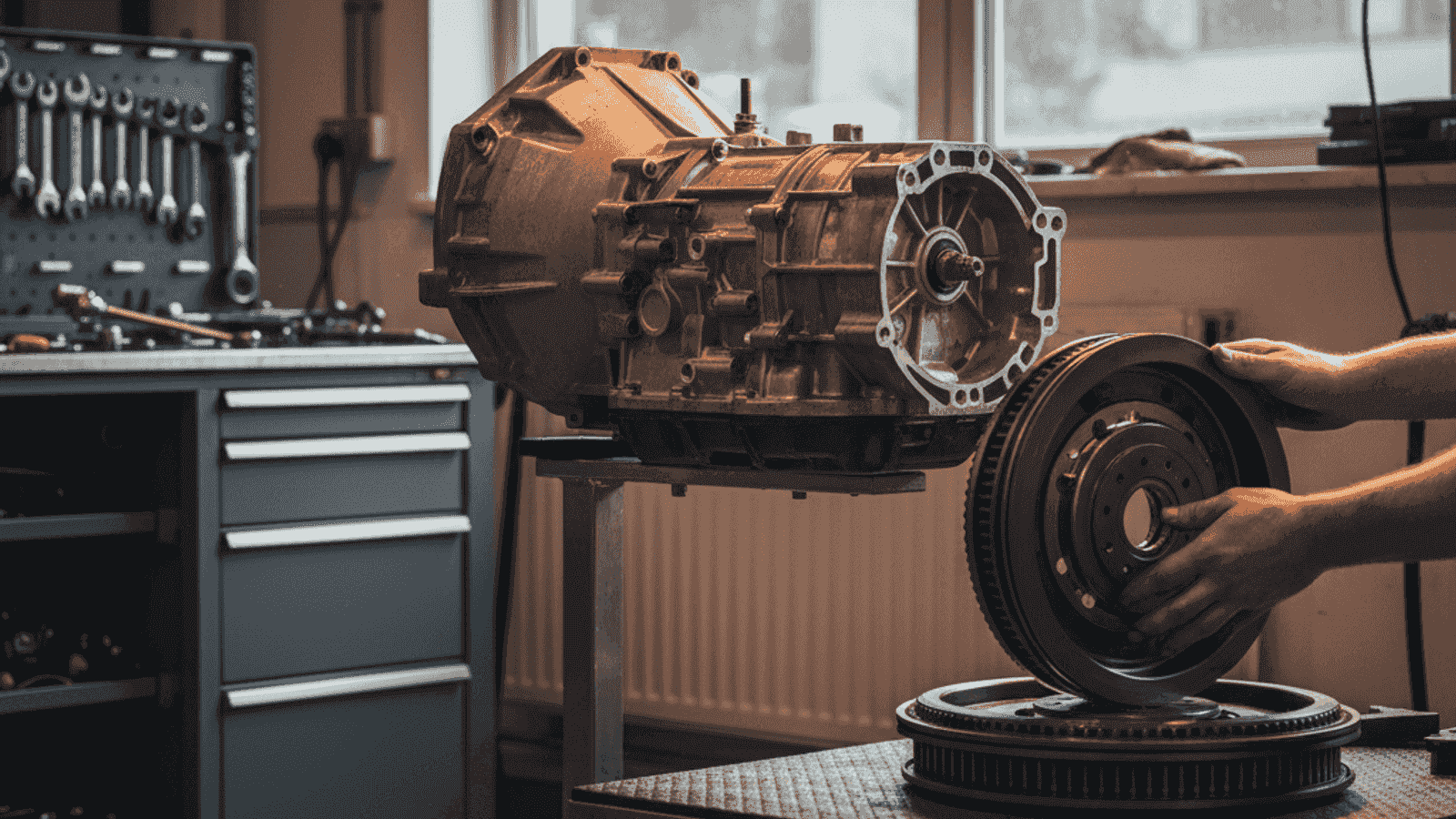
The test drive lasted fifteen minutes and the car ran like new. Then the buyer brought the Golf 5 into the workshop, the mechanic started the engine, released the clutch at idle, and there it was: that distinctive metallic rattle coming from the gearbox area. The dual-mass flywheel was on its last legs, and the buyer had already put down a deposit. This guide is here so you can avoid that scenario: how a dual-mass flywheel on a used diesel gives away signs of wear, which tests to run before you sign anything, and what to expect if replacement turns out to be unavoidable.
This guide was put together by the Auto Gas Gaga workshop in Banja Luka, based on years of experience with pre-purchase inspections of used diesels and clutch-and-flywheel kit replacements on the European models most common on our market.
Table of Contents
- What a Dual-Mass Flywheel Is and Why Almost Every Modern Diesel Has One
- Seven Signs the Flywheel Is on Its Way Out
- The Test You Can Run Before Test-Driving a Used Car
- What Replacement Really Costs in BiH
- Driving That Kills the Flywheel and Driving That Preserves It
- When a Solid-Flywheel Conversion Pays Off, and When It Doesn't
- Frequently Asked Questions
- Related Articles
What a Dual-Mass Flywheel Is and Why Almost Every Modern Diesel Has One
A dual-mass flywheel, often called a floating flywheel in everyday speech, is an assembly of two masses connected by a system of springs and bearings. The primary mass is bolted to the engine crankshaft, the secondary mass to the clutch and gearbox, and between them springs damp the torsional vibrations that a diesel produces at low rpm. Without that damping, the entire drivetrain and the cabin would jolt with every start, shutdown and pull-away in first gear, and the synchros in the gearbox would wear out disproportionately faster.
The reason practically every modern turbodiesel with a manual gearbox uses one comes down to the nature of these engines. High torque at as little as 1500 to 1800 rpm creates impacts that a classic solid flywheel cannot smooth out on its own. That is why engineers fit it to TDI engines from the Volkswagen group, to HDi and BlueHDi units from PSA, to CDTi and CDi engines, and to every diesel in the Ford EcoBlue family. The principle is similar across the board, but the implementation and the typical failures differ from one manufacturer to another.
Service life is not a fixed number. The British RAC quotes around 160,000 kilometres as a typical lifespan in its own guide, but in practice we have seen assemblies running flawlessly past 300,000 km, as well as units that gave up at 120,000 because the driving style wore them down. Mileage alone is not decisive: what matters is the combination of how the car was driven and how careful the previous owner was with the clutch.
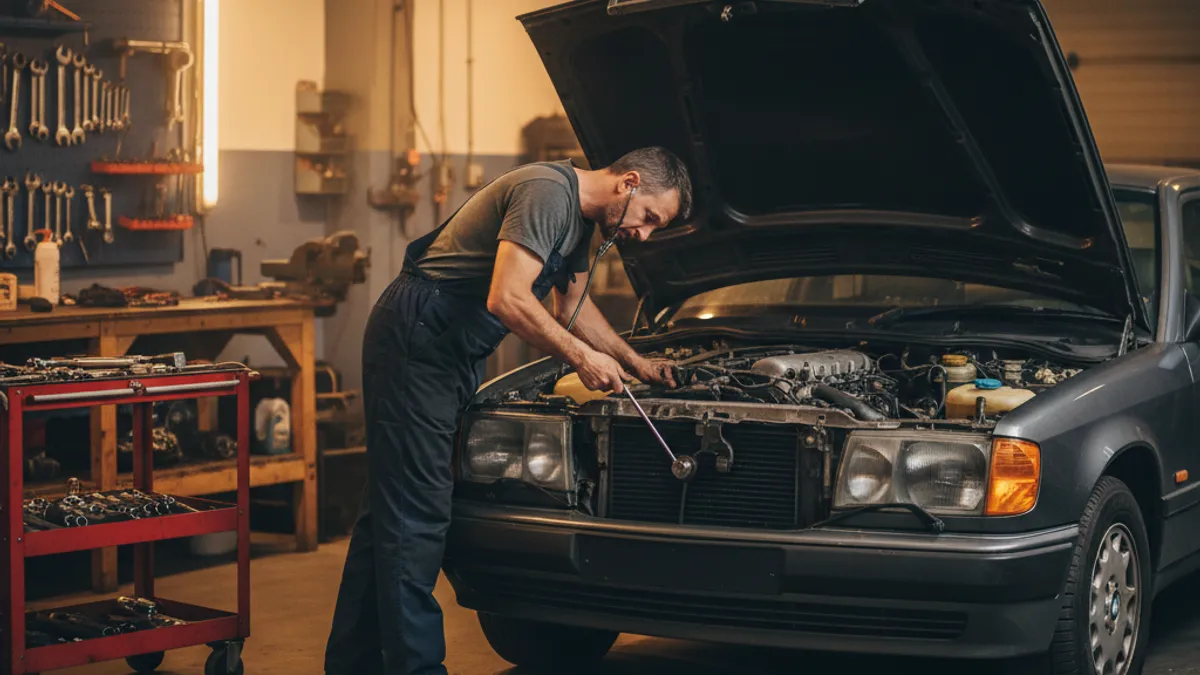
Seven Signs the Flywheel Is on Its Way Out
A buyer who knows what to listen for in the first five minutes next to the car filters out half of the problem cars. Here are the symptoms in the order you usually notice them.
1. A metallic rattle at idle that disappears when you press the clutch. The most classic symptom. The engine idles, a dull rattling sound comes from the gearbox bell housing, and when you press the clutch pedal the sound drops or goes silent altogether. Pressing the clutch separates the secondary mass from the gearbox, the load on the flywheel springs drops and the rattle fades.
2. A dull thud on engine start and shutdown. On startup it feels as if something in the gearbox knocks, and it is most obvious at shutdown, when the engine passes through low rpm and briefly "punches" through the drivetrain. A new flywheel damps that pass through resonance; a worn one lets it through.
3. Juddering when pulling away in first gear. The driver feels a rough start, as if the clutch grabs and then slips, especially on a gentle uphill. This is often blamed on the clutch, but when the friction disc is still holding yet the car judders, the source is the flywheel springs that no longer maintain a linear power transfer.
4. Vibration through the floor and cabin between 1200 and 1800 rpm. That is where the torsional impacts from a diesel are at their worst. If you feel a tremor through the pedals that disappears as soon as you take the revs over 2000, suspicion falls on the flywheel, not on the engine mounts.
5. A drone that changes with engine speed. A low-pitched drone that tracks the rpm points to a worn central bearing between the two masses. That bearing is not replaced on its own; it only goes together with the whole assembly.
6. Hard engine starting in the morning, especially on cold starts. If the starter cranks and the engine "thumps" into the compressions a few times before it catches, part of the blame lies with a worn flywheel that no longer damps the crankshaft impacts at startup.
7. Traces of fine metal dust or black powder on the underside of the gearbox bell housing. This is visible only with the car up on a lift. When the primary and secondary masses move more than they should, the bearing and springs throw off fine particles that escape through the breather hole. A trail of dust under the bell housing is a very bad sign.
Important: none of these symptoms on its own is proof. The symptoms often overlap with worn engine mounts and the clutch itself, so professional diagnosis before pulling the gearbox saves money. Two or three symptoms at once are reason enough to take the car to your mechanic before handing over a deposit.
The Test You Can Run Before Test-Driving a Used Car
A proper test drive over a real climb is worth more than half an hour in a showroom with the seller. Here is the sequence we use when someone brings a used diesel in for a pre-purchase inspection, and it dovetails with the general approach to gearbox and clutch failure symptoms.
Idle test with the clutch. Sit behind the wheel, start the cold engine, wait through the first thirty seconds of elevated idle. When the revs drop to 800 to 900, open the window and listen. If you hear a metallic rattle that stops when you press the clutch, the symptom is there. If it only stops when you engage first gear, the problem is more likely in the clutch or the release bearing.
Start and shutdown test. Start the engine five times in a row, with about ten seconds between each cycle, and sit still after every shutdown. Listen for and feel the dull thump through the steering wheel and gear lever. A new assembly goes through that sequence smoothly; a worn one produces a characteristic dull thud on every shutdown.
Pulling-away test in first. On level ground, slowly let the clutch out without touching the throttle and watch how the car moves off. If the engine grabs and then slips, if the cabin shakes more than you would expect, if you have to add more throttle than usual for that model to stop the engine stalling, the flywheel springs are no longer doing their job.
Resonance test. In second or third gear let the engine drop to 1100 to 1200 rpm, then slowly add throttle and watch how the car pulls through the range up to 2000. If you feel a dull rhythmic thud through the drivetrain in that range, suspicion of the flywheel grows. A smooth pull through the same rpm range clears it from the suspect list.
Lift test, if the seller agrees. The best test takes five minutes and requires access to the underside of the car. The mechanic grabs the toothed ring of the primary mass by hand and tries to turn the secondary mass. All new and healthy dual-mass units have a small controlled free travel, usually around ten degrees. If the secondary mass turns too loosely, or you feel it "wobble" inside before the springs engage, the assembly is finished.
An experienced seller can hide a lot, from service history to the true mileage. A pre-purchase inspection at a workshop covers the physical condition today, but the documented past of a car by VIN is easiest to pull through carVertical. From international registries it usually returns the real odometer readings by date, recorded accidents and total losses, the number of previous owners and theft indicators. We treat it as a mandatory layer of verification before signing on a used diesel. When paying for the report you can use the code GAGA for a 20% discount.
What Replacement Really Costs in BiH
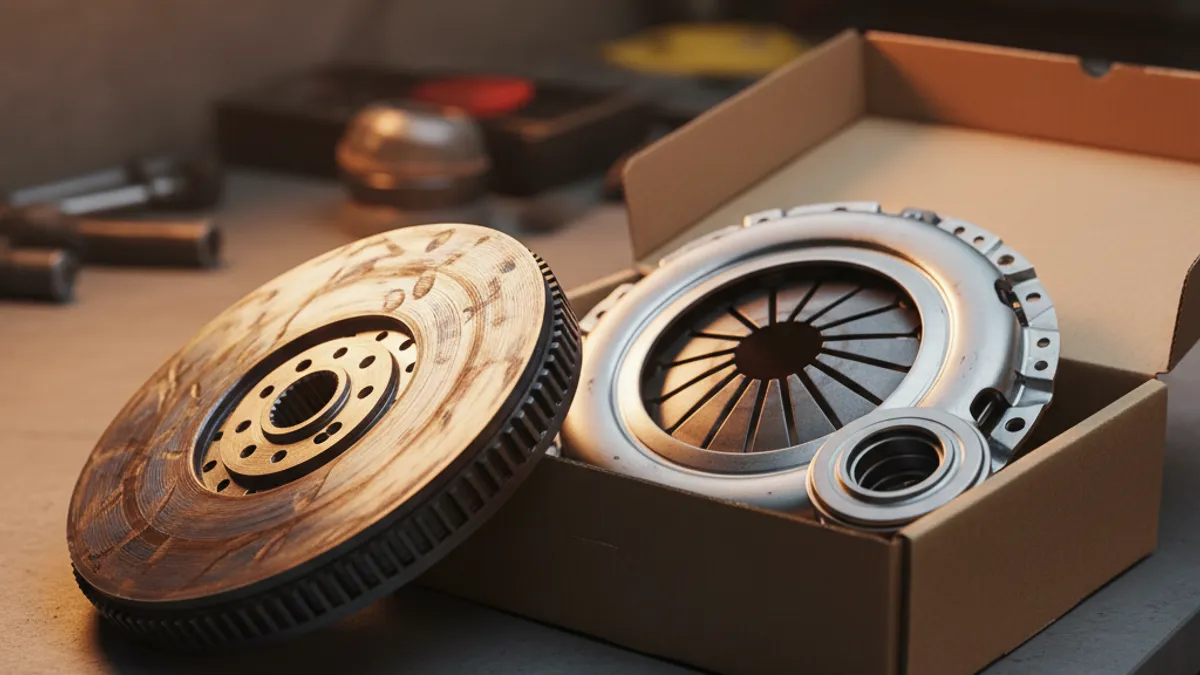
The cost of replacing a dual-mass flywheel comes down to three items that always go together: the part itself (the flywheel), the clutch kit (friction disc, pressure plate, release bearing) and the labour hours. The gearbox has to come out completely to reach the flywheel, and once it is out, replacing the clutch is technically a must, because the old clutch is at that point always more worn than the new flywheel and putting it back into the assembly would be pointless.
The job is not a quick one. A complete replacement of the clutch kit and flywheel can take up to ten labour hours, especially on models with a transverse engine where dropping the gearbox requires removing the subframe, drive shafts and part of the exhaust system. On longitudinally mounted engines the work is somewhat faster, but rarely under six to seven hours.
The price depends on the specific model and the choice of part, so the final figure comes from the workshop after inspection and identification of the engine code and gearbox type. Get in touch for an estimate if you are thinking about buying a car where you suspect the flywheel, or if your current car is showing any of the symptoms from this guide, and we can give you a ballpark figure for your case based on the model and engine code.
What drives the final figure. An original LuK, Sachs or Valeo part costs noticeably more than an aftermarket replacement, but it lasts longer and in practice it rarely pays to save on it, because on a repeat replacement you pay the same ten hours of labour. The clutch kit is always replaced in the same job, even if the old one still looks decent. The flywheel bolts are single-use and must be replaced with new ones.
When buying a used car the workshop rule is this: if the flywheel is suspect and the asking price is in the range of cheaper examples of the same model, the cost of replacement is exactly what you negotiate with the seller about.
Driving That Kills the Flywheel and Driving That Preserves It
Driving style is the single biggest factor in the lifespan of a dual-mass flywheel. Excessive eco-driving at very low rpm can shorten the assembly's life by a multiple, just like rough clutch work, chip tuning beyond factory specs and frequent start-stop cycling. This matches what we see on the assemblies that come into the workshop.
Driving that kills a dual-mass flywheel usually involves one or more of these habits. The first sin is pulling at high speed in a disproportionately low rev range. A diesel in fifth gear at 60 km/h pulling at 1100 rpm creates torsional impacts that turn the flywheel springs into consumables. The second is tuning without adapting the assembly: if engine torque is raised by a fifth and the assembly stays factory, its life drops fast. The third is rough clutch release in reverse and first gear, that snatching the driver feels as "shudder" but which actually slams straight into the flywheel springs.
Driving that preserves the flywheel is straightforward. Keep the revs above 1500 when pulling in higher gears. Do not shift up too early, especially uphill with a load. Release the clutch in a linear way, with right-foot control that tracks the left-foot release. Regular maintenance that extends the life of a diesel engine automatically helps the flywheel too, because a clean engine with healthy injection burns more evenly and produces fewer torsional impacts.
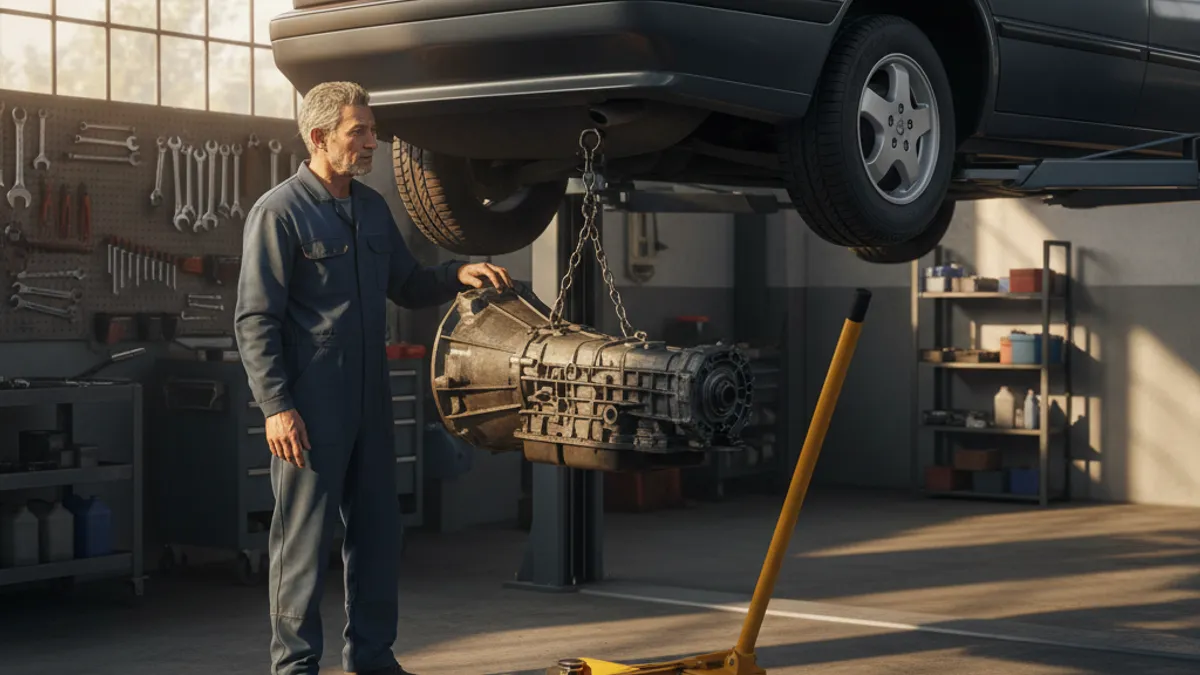
When a Solid-Flywheel Conversion Pays Off, and When It Doesn't
Converting a dual-mass flywheel to a rigid solid one is a topic people have been arguing about on forums for years. Short answer: it is technically feasible for some models, mainly older TDI engines, but it is not a free lunch.
The upsides of the conversion. A complete solid-flywheel kit with a reinforced clutch is usually cheaper than the original dual-mass assembly. The solid flywheel itself is practically eternal, it does not wear like the dual-mass version and you will not have to replace it again at 200,000 km. For drivers who treat the car as a work tool and have no patience for the history of unknown flywheels, this is tempting.
The downsides of the conversion. Without damping of torsional vibrations, the engine starts to "hammer" through the entire drivetrain. Cabin vibrations increase, especially at idle and at low rpm. The synchros in the gearbox take the impacts that used to go into the flywheel springs, so the gearbox wears faster. The clutch, especially a reinforced one, bites higher and demands more force from the foot. On diesels with a start-stop system, ignition becomes rougher. On some newer models the engine ECU expects a signal from the flywheel sensor and may throw faults if the assembly is physically changed while the sensor stays in its old position.
Who it really pays off for. The driver of an older TDI or HDi who covers a lot of miles, treats the car as a work tool, does not mind mild extra vibration, and would otherwise be facing another assembly replacement in a few years.
Who it does not pay off for. The driver who uses the car for comfort, who takes the family on longer trips, or whose model has not yet exceeded the typical lifespan of the first flywheel. For that driver it is more rational to stay on the original dual-mass assembly and not complicate the electronics.
Our recommendation when someone asks us: if the car is seven years old with 250,000 km, the diesel engine is from an older generation without complex start-stop logic, and the driver knows what they want and accepts the extra vibration, the conversion makes sense. In every other case, the original assembly is the safer route.
Frequently Asked Questions
Can a worn dual-mass flywheel be repaired or balanced?
No. The assembly is factory-built under special conditions and is not opened up. If the springs or the bearing are gone, the only correct path is replacing the whole assembly. Attempts at balancing or "repairs" that are sometimes offered on the grey market bring more problems than solutions and last only briefly.
Can I drive the car with a worn flywheel until I get it replaced?
You can, up to a point, but every day you risk damage to other drivetrain components. If the symptoms are mild, it is worth planning the replacement for the next few months. If the car is already producing strong thumps and metallic noises, it is time to book the workshop before the bearing breaks up and sends debris into the gearbox housing.
How long does a dual-mass flywheel replacement take in the workshop?
In most cases a full working day, and on more complex models even two days. Six to ten labour hours is a realistic range, plus time to source the part if it is not something kept in stock.
Does the clutch always have to be replaced together with the flywheel?
Practically always. The gearbox has to come out to gain access, and at the moment the flywheel is replaced the old clutch kit is already partially worn, so putting it back together with a new assembly would be pointless. A clutch kit with a release bearing is standard in the package.
Does a dual-mass flywheel fail suddenly or does it give warning signs?
Almost always it gives warning signs, and the driver often knows about them for several months before the assembly gives up. Rattling at idle, juddering at pull-away and a dull thump at shutdown are the early signals. A genuine bearing collapse is rare and usually comes after a long period of ignored symptoms.
Does chip tuning shorten the life of a dual-mass flywheel?
Yes, if engine torque is raised above the factory specs of the assembly. The flywheel is sized for a specific torque figure, and when you exceed it the springs and the bearing operate outside their design range. Serious tuners in that case recommend a reinforced flywheel, but that is an extra cost which often gets overlooked.