
Many drivers see regular car servicing as an unnecessary expense, especially when the car seems to be running without problems. This misconception ends up costing more than people think. In reality, regular maintenance directly affects fuel consumption, vehicle reliability and the safety of everyone in the car. In this article we show you exactly how servicing protects your wallet, why diagnostics is a necessity rather than a luxury, when the right time for a service is, and how to choose a workshop that suits you.
Table of Contents
Key Takeaways
| Point | Details |
|---|---|
| Regular servicing saves money | Proper maintenance prevents expensive breakdowns and extends the car''s life. |
| Diagnostics catches problems early | An early vehicle check allows simpler and cheaper repairs. |
| Adjust intervals to conditions | Take your driving style and the season into account when planning a service. |
| An independent workshop is not necessarily worse | Choose trusted mechanics even if they are not official service centres. |
How Regular Servicing Affects the Engine, Fuel Use and Costs
First and most important: regular servicing reduces fuel consumption, extends engine life and improves driving safety. This is not a marketing phrase, it is a measurable benefit confirmed in practice. An engine running on fresh oil and clean filters uses less fuel because every component is lubricated and internal resistance is lower. Dirty oil becomes thicker and more viscous, which means the engine has to work harder for the same result.
Regular maintenance particularly affects three key systems:
-
Engine: Changing oil and filters on time prevents sludge build-up that damages pistons and bearings. A clogged oil filter can cause a pressure drop and a serious breakdown.
-
Suspension and steering: Worn shock absorbers and joints not only reduce ride comfort, they also increase braking distance. This is a direct safety risk.
-
Braking system: Worn brake pads and discs are one of the most common causes of traffic accidents. Timely replacement costs far less than repairs after a crash.
The most common breakdowns that regular servicing prevents are: timing belt failure, engine overheating due to a clogged cooling system, alternator failure and turbocharger damage. Each of these breakdowns can cost anywhere from 500 to several thousand KM, while a regular service would cost many times less.
"A driver who services their car regularly pays less per year than one who waits for something to break."
Professional tip: Follow the oil and filter change intervals as specified by the manufacturer, but always take real-world driving conditions into account, because city driving consumes more than long-distance trips.
| Item | Regular maintenance | Irregular maintenance |
|---|---|---|
| Annual service cost | 200-400 KM | 150-250 KM |
| Average breakdown over 5 years | 300-600 KM | 1,500-4,000 KM |
| Fuel consumption | Optimal | Up to 15% higher |
| Engine life | 300,000+ km | 150,000-200,000 km |

As you can see from the table, saving on servicing in the short term means far higher costs in the long term. A fuel consumption difference of just 10% over a year can amount to 300-500 KM, which on its own covers the cost of a basic service.
Diagnostics as the Foundation for Preventing Breakdowns in Banja Luka
An oil change is useful, but it is not enough. Modern vehicles are complex systems in which electronics control the engine, brakes, airbags, air conditioning and dozens of other functions. Without diagnostics, many problems stay invisible until they escalate into an expensive breakdown.
Vehicle diagnostics is the procedure in which an OBD2 scanner and specialised equipment read error codes from the car''s control units. These errors often do not trigger warning lights right away, but they accumulate and flag problems that are coming. Diagnostics can uncover:
-
Issues with an oxygen sensor that increases fuel consumption
-
Ignition system faults that reduce engine power
-
ABS faults that may not be noticeable during normal driving
-
EGR valve issues that cause excessive emissions and power loss
-
Early signs of turbocharger failure on diesel engines
The benefit of early detection is enormous. A faulty oxygen sensor costs 50-150 KM to replace. If the problem is ignored, it can damage the catalytic converter, whose replacement costs up to 1,500 KM. The same logic applies to almost every electronic fault on a vehicle.
There are several workshops in Banja Luka offering diagnostics, and workshops in Banja Luka such as ČAMBER, AUTOSERVIS MARIĆ and Dizel Servis Stevo are known for quality diagnostic equipment. It is important to have diagnostics done at a workshop with up-to-date equipment and experienced technicians who know how to interpret the results, not just read out the codes.
Professional tip: Run diagnostics at least once a year, even if the car is driving without any visible issues. Catching a fault early almost always means a smaller repair bill.
Recognise the early signs of a fault that call for diagnostics:
-
Increased fuel consumption with no obvious reason
-
Warning lights flashing intermittently
-
Unusual noises during a cold start
-
Loss of power during acceleration
-
Uneven engine running at idle
All service offerings including diagnostics should be part of a regular maintenance plan, not just a reaction to a breakdown.
Service Intervals and Special Cases for Regular Maintenance
A standard minor service covers the engine oil and oil filter change and is recommended every 10,000 to 15,000 kilometres or once a year, whichever comes first. A major service, which includes changing the fuel filter, air filter, spark plugs, cabin filter and a check of all systems, is usually performed at 30,000 to 60,000 kilometres, depending on the car''s make and model.
However, these intervals are not the same for every driver. Service intervals get shorter in city driving and in winter because all components wear faster. The reason is simple: city driving involves frequent stops, short trips on which the engine does not reach its optimal operating temperature, and greater load on the gearbox and the braking system.
"In the city and in winter, we recommend changing the oil at 7,000 to 10,000 kilometres, because short trips and cold starts wear oil out faster than long journeys."
Planning a service by mileage also has to take into account the type of oil you use. Synthetic oils last longer than mineral oils, but they are not eternal either. If you drive mostly in the city, go for shorter intervals regardless of the oil type.
| Vehicle usage type | Minor service (oil) | Major service |
|---|---|---|
| City driving | Every 7,000-10,000 km | Every 25,000-30,000 km |
| Mixed driving | Every 10,000-12,000 km | Every 30,000-40,000 km |
| Motorway, long trips | Every 12,000-15,000 km | Every 40,000-60,000 km |
| Winter period | Shorten by 20-30% | Pre-winter inspection |
There are also three signals telling you that you need a service ahead of the usual due date:
-
The oil on the dipstick is dark black and thicker than usual, meaning it has lost its lubricating properties.
-
The car is consuming more fuel than usual without any change in driving style or route.
-
You hear unusual noises during start-up or driving, especially on a cold start.
For a minor service and all specialised work, it matters that the workshop has experience with your make of vehicle and uses oil of the correct specification, because the wrong oil can do more harm than good.
Why Discipline Matters More Than the Service Brand
Years of working in the shop have taught us one thing: it does not just matter where you service your car, it matters that you do it regularly. We have seen vehicles from authorised service centres arrive with serious faults because the owner kept skipping appointments. And the opposite: older cars with high mileage that are still reliable because their owners were disciplined.
The biggest mistake drivers make is putting off a service. "Just a bit longer, until summer" or "I''m waiting for payday" are phrases we hear all the time. And then a breakdown arrives costing many times more than the service that was put off. Critical problems on a car almost always have their roots in neglected maintenance.
Not even the most reliable car on the market can survive without regular oil and filter changes. Maintenance discipline is the only thing that really decides how long and how reliably you will drive.
Perfect Regular Service and Diagnostics in Banja Luka
At Auto Gas Gaga, we have been servicing vehicles in Banja Luka since 1996 with a focus on transparency and reliability. We explain every job before we start it, so you always know what we are doing and why.
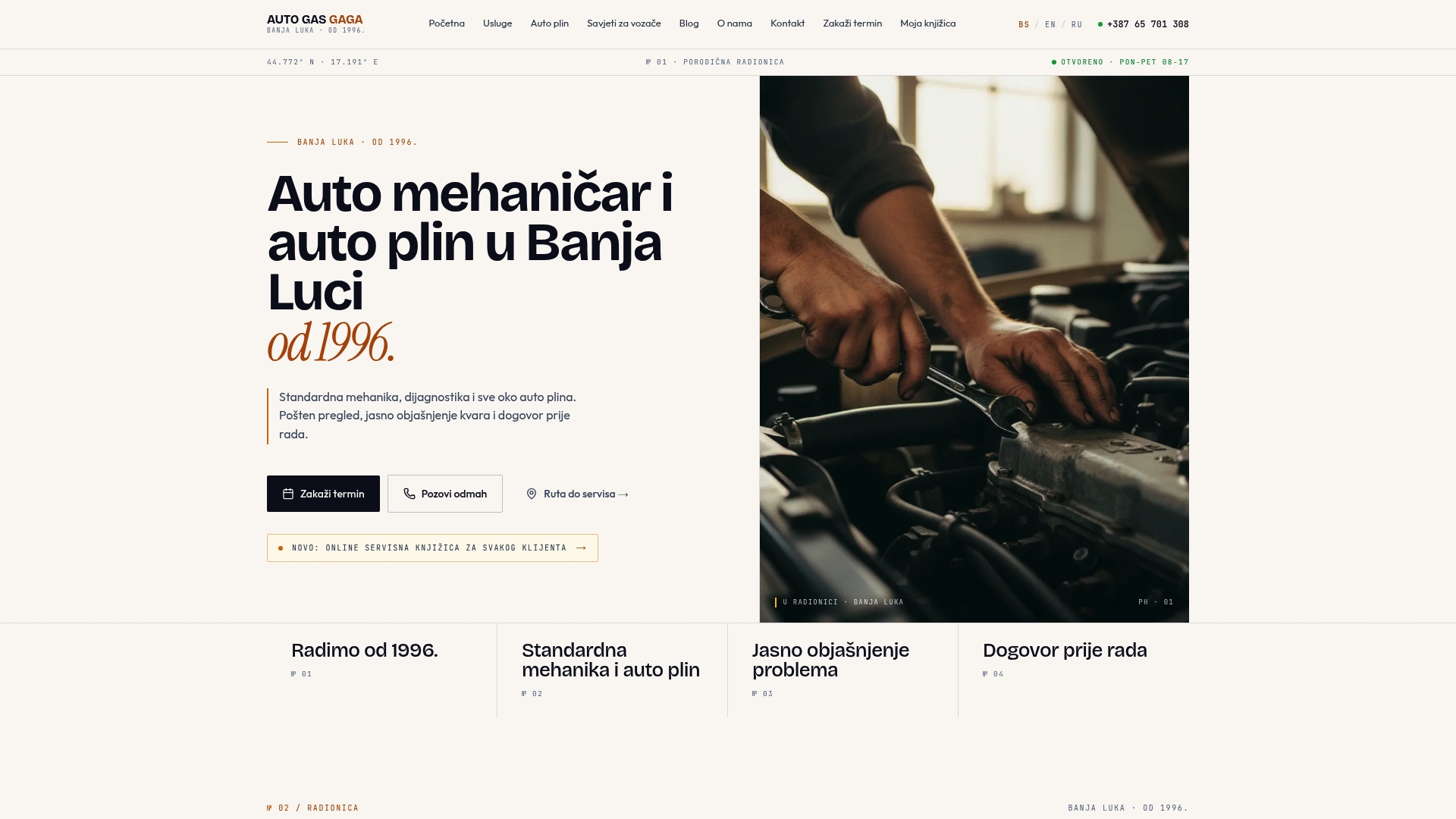
Whether you need a minor service with an oil change, full vehicle diagnostics or advice from an experienced car mechanic in Banja Luka, we are here for you. We also offer LPG servicing and installation, an online service book and easy appointment booking. Get in touch and arrange a no-obligation vehicle inspection.
Frequently Asked Questions
What exactly does regular car servicing involve?
Regular servicing includes an oil and filter change, a technical check of vital parts and a basic system diagnostic. Thanks to the benefits of regular servicing, this kind of maintenance directly reduces fuel consumption and extends engine life.
How do I know when it is time for a service?
Service time usually falls at 10,000-15,000 kilometres or once a year. Intervals get shorter with city driving and in winter because components wear more intensively.
Does an authorised workshop always mean better quality?
Authorised workshops offer a warranty and original parts, but independent workshops can be just as good if you check the reputation and experience of the mechanic.
Why do I need diagnostics if the car is driving normally?
Diagnostics reveals hidden faults that do not trigger warning lights immediately. Early problem detection prevents escalation into costlier repairs and keeps the vehicle reliable for longer.