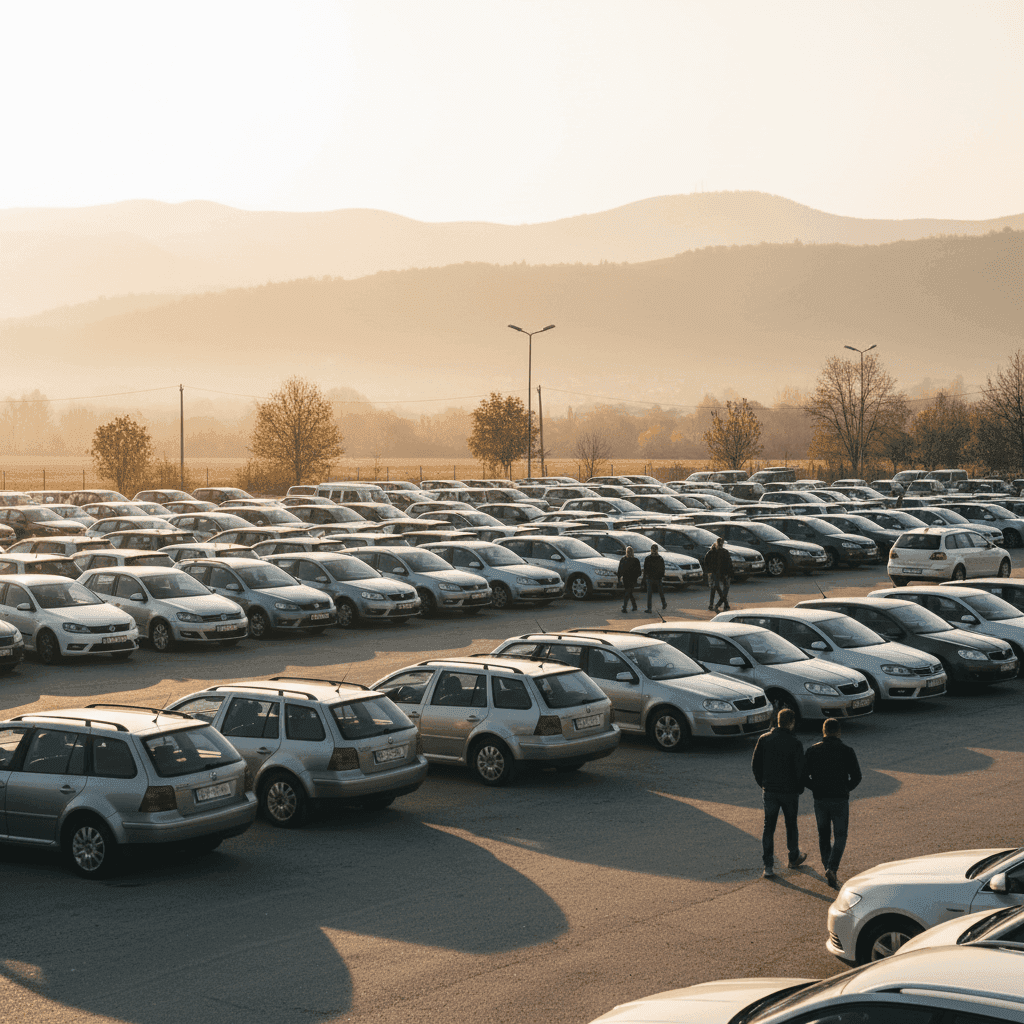
The used car market in Bosnia and Herzegovina in 2026 is a market of diesels, the Volkswagen Group and patient buyers. Of 6,858 first-time registered passenger vehicles in February 2026, only 752 were new, giving a ratio of one new car for every nine used cars. While Europe is fleeing diesel, BiH is importing it at a record pace: in the same month, fully 80% of first-time registrations were pure diesels. In this guide we synthesise a cross-section of hundreds of olx.ba listings across all six price brackets from KM 4,000 to 50,000, registration data, and what we as a workshop see every day when owners bring a freshly bought car in for inspection.
This guide is based on a cross-section of hundreds of olx.ba listings across all six price brackets, BiH registration data for 2026, and the experience of the Auto Gas Gaga workshop in Banja Luka with pre-purchase inspections.
Table of Contents
- Market Overview of Used Cars in BiH 2026
- What Drove Prices in the Last Two Years
- How to Choose by Budget
- Complete Guide by Price Range
- Recommendations by Buyer Profile
- Fuel and Maintenance - Total Annual Cost
- How to Inspect a Used Car Before Buying
- Where and How to Buy in BiH
- Common Issues on the 2026 Market
- Frequently Asked Questions
- Related Articles
Market Overview of Used Cars in BiH 2026
To understand how to choose a used car in BiH 2026, you first have to understand what the market really looks like. The numbers from February 2026 speak clearly: of 6,858 first-time registered passenger vehicles, only 752 were new - meaning only one in nine cars first registered in BiH comes off a showroom floor. Everything else is imported used vehicles, most often from Germany, Italy, Austria, Slovenia and the Netherlands, arriving through an import channel that is a mix of private buyers, intermediaries and used-car dealers.
The second indicator shaping the market is the fuel mix. In February 2026, of 6,960 first-time registered vehicles, fully 5,572 were pure diesels - that is 80%. If mild-hybrid diesels are added, the diesel share rises to 82.1%. There were just 1,028 petrol cars, around 15%. The remainder are electric, hybrid and autogas in smaller shares. That means when you scroll listings in BiH, you are not looking for a cheap car - you are looking for a cheap diesel car, because that describes almost every other listing.
The third pillar of the market is the Volkswagen Group. In February 2026 Volkswagen registered 2,173 vehicles, Audi 936 and Škoda 808. Together, more than 56% of all first registrations that month belonged to the VW Group. Across the price brackets, that share rises with budget: in the KM 4,000-6,000 bracket the VW Group holds around 32%, in the KM 6,000-10,000 bracket around 42%, in the KM 15,000-20,000 bracket it climbs to 52.5%, and in the KM 20,000-30,000 bracket it reaches as much as 70%. Only in the highest bracket, KM 30,000-50,000, does the VW Group share fall to about 36.6%, because premium SUV alternatives such as BMW, Mercedes and Volvo appear there.
At the model level, the absolute ruler of the market is the VW Golf, which appears in every bracket from the cheapest to the most expensive, with shares between 8 and 16%. Second strongest is the VW Passat, particularly the B6 and B7 generations in the mid bracket and B8 in the upper. The Škoda Octavia holds a steady 5-8% share across the entire mid-segment. Non-VW alternatives that appear consistently include the Audi A4 as a budget premium choice, the Opel Astra as the main non-VW pick in the lower brackets, and the BMW 3 and 5 Series in the upper brackets. The SUV segment in BiH is relatively young, but the VW Tiguan and Audi Q5 dominate the offer above KM 20,000.
The transmission of choice in BiH is still manual, but it is slowly changing. In the bracket up to KM 6,000 only around 5% of listings have an automatic gearbox. In the KM 6,000-10,000 bracket the share rises to 18%, in KM 10,000-15,000 to 22%, and in KM 20,000-30,000 already nearly 47%. In the highest bracket of KM 30,000-50,000 around 60% of listings are automatics. The reason is not pure wealth - the automatic (especially DSG and similar dual-clutches) is becoming a normal part of the newer diesels BiH is importing from the EU.
What Drove Prices in the Last Two Years
If you feel that used car prices in BiH are higher than five years ago, you are not imagining it. The price rise in 2024-2026 has several intertwined causes, and understanding them helps you decide whether it makes sense to buy now or wait.
The first reason is the fallout from the pandemic years, when new car prices rose by 20-40%. A used car is priced as a percentage of a new one, so every rise in new-car prices automatically pulled used-car prices up too. The second reason is stricter European emissions legislation (Euro 6d and Euro 7), which is shutting down production of cheap diesels in Western Europe. The consequence is that the supply of decent older diesels in Germany and Austria is shrinking, and those that remain head to markets where they are still loved - such as BiH.
The third reason is rising import costs. Customs duty, excise, the eco tax and VAT on importing a car into BiH together mean that a car which has an accessible price in Germany often arrives in BiH significantly more expensive even before any dealer margin. That means that even a cheap car in BiH is almost never truly cheap if it is even somewhat driveable and has clean paperwork. Anything below KM 4,000 is a risk you are knowingly accepting.
The fourth reason is foreign currency. KM is pegged to the euro, but the purchasing power of BiH consumers has not grown at the same pace as prices in the eurozone. That means an average BiH buyer today pays a higher share of their annual salary for the same car than was the case in 2018 or 2019.
The fifth, and perhaps most important reason is information asymmetry. The used car market in BiH is still fairly unregulated - rolling back the odometer, hiding accident history and reshuffling paperwork are widespread practices. Concrete examples from 2026 show how serious the problem is: there are documented cases where a Mercedes V-Class showed mileage 281,000 km lower than the actual figure, a Ford Transit 249,000 km lower, and a Volvo XC40 238,000 km lower. Knocking 100,000 to 280,000 km off before the car appears on olx.ba is common enough that specialised portals report on it. The result is that a buyer without knowledge or someone to help them often pays a price for a car that is objectively much worse than the listing claims.
How to Choose by Budget
Our approach is simple: set a budget, then within it follow what the market offers statistically, not what catches your eye visually. These are aggregate recommendations from a cross-section of 2,712 listings across six brackets.
The KM 4,000-6,000 bracket is the bracket of the first car and the working-class car. Here the VW Group holds less than half the offer (around 32%), and alternatives like the Opel Astra, Ford Focus, Renault Megane have a clear presence. Diesel share is 77%, lower than in the higher brackets because older petrols and petrol-LPG combinations also appear here. Automatic is just 5%, and around 3.1% of listings have an LPG system fitted. Realistic expectation: a car from 2003-2010, with mileage of 200-350 thousand km on the clock, with potential for an expensive failure (DSG, DPF, EGR, dual-mass flywheel) within the first year or two if you do not check what you are buying.
The KM 6,000-10,000 bracket is the everyday car bracket for the average buyer. Here the VW Group takes the lead with around 42%, diesel rises to 80%, automatic to 18%. The VW Passat B6 and Škoda Octavia 2 dominate the offer. Realistic expectation: a car from 2008-2013, with mileage of 180-300 thousand km, with a major service either already done or just upcoming (timing kit, water pump, clutch, DPF treatment).
The KM 10,000-15,000 bracket is the family car and premium-entry bracket. Diesel rises to 90%, automatic to 22%. The typical mix is the VW Passat B7, Škoda Octavia 3, Audi A4 B8, or VW Touran as a family option. Realistic expectation: a car from 2010-2015, with mileage of 150-250 thousand km. Here the DSG gearbox becomes statistically significant and demands serious checking.
The KM 15,000-20,000 bracket is the bracket of a quality family car. The VW Group share jumps to 52.5%, diesel sits at 91.5%, automatic at 18.4%. The leading models are the VW Passat B8, Škoda Octavia 3 facelift, Audi A4 B8, and SUVs such as the first-generation VW Tiguan and Škoda Yeti.
The KM 20,000-30,000 bracket is the bracket of premium mid-class cars and SUVs. Here the VW Group is strongest with around 70% share, diesel at 90.5%, automatic at fully 47%. The Audi Q5 (8R) holds around 8.75%, the BMW 5 F10 around 7%. This is the bracket where DSG becomes the rule, not the exception.
The KM 30,000-50,000 bracket is the bracket of young, well-equipped vehicles. The VW Tiguan II takes the lead with 7.3% share as the only SUV that leads in this bracket. Automatic is in 60% of listings, diesel in 90%. LPG is practically non-existent here (0.1%), because buyers in this segment rarely opt for a powertrain conversion.
Complete Guide by Price Range
This section is the hub of the whole guide. For each price bracket there is a separate, more detailed post with models, engines, model years, typical failures and aggregate olx.ba data. If a particular bracket interests you, go straight to it.
Best used car KM 4,000-6,000 - the bracket of the first car, the student car and the working-class car. Here we explain why in 2026 it is realistic to expect the Golf 4, Astra G/H and Octavia 1 as the basic candidates, what to watch for on the 1.9 TDI engine without a DPF, and why a petrol car with LPG in this bracket is often the smartest decision for city driving. We break down in detail why odometer rollback is the biggest risk here and which checks you must always run before paying a deposit.
Best used car KM 6,000-10,000 - the everyday car bracket. The VW Passat B6 with 14.2% share is the undisputed ruler, but here we also analyse why the B6 with the 1.9 TDI engine and a manual gearbox is the safest choice, while the B6 with the 2.0 TDI PD engine and a DSG gearbox is the biggest risk for an unprepared buyer. We also write about the Škoda Octavia 2 as a smarter pick for a first family car.
Best used car KM 10,000-15,000 - the family car bracket. Here it is worth looking at an SUV option for the first time (VW Tiguan I with 1.4 TSI or 2.0 TDI), but we explain why the family Touran or Octavia 3 is the statistically safer choice. We analyse the difference between CR engines and PD engines, and why the timing kit in this bracket must be either done or documented.
Best used car KM 15,000-20,000 - the bracket of a quality family car. We cover in detail the VW Passat B8 and its early AdBlue system issues, the Škoda Octavia 3 with 1.6 TDI as the most reliable choice, and why the Audi A4 B8 with 2.0 TDI requires special attention because of timing chain problems.
Best used car KM 20,000-30,000 - the bracket of premium mid-class cars and the first SUVs. The Audi Q5 8R, VW Tiguan I facelift, BMW 5 F10, and why in this bracket you must seriously think about maintenance costs, because more systems mean more potential failures. DSG and automatics become standard.
Best used car KM 30,000-50,000 - the bracket of young, well-equipped vehicles. The VW Tiguan II, Audi Q5 8R facelift, BMW 3 Series F30 and 5 F10 LCI, and why here you face the paradox that a more expensive car does not mean less worry - electronics, infotainment, driver assistance and adaptive systems can be more expensive to repair than the entire engine on an older car.
None of these six brackets is "the best" - each serves a different buyer profile. In the next section we help you understand who you are.
Recommendations by Buyer Profile
Instead of talking about cars, it is better to start with you. Most people who call us for a pre-purchase inspection fall into one of four profiles.
First car for a new driver or student. Budget is usually KM 4,000-7,000, driving is urban with occasional intercity trips, annual mileage 8,000-15,000 km. Our recommendation is a 1.4 to 1.6 litre petrol, ideally with LPG already fitted or to be fitted, model years 2008-2013. The VW Polo, Škoda Fabia 2, Opel Astra H 1.6 petrol, Renault Clio 3 - all are reliable choices. A diesel makes no sense in this profile. The reason is the maths: a diesel only saves money once you exceed 25,000-30,000 km a year, and you do not drive anywhere near that. If you only do short city trips, why short trips kill a diesel engine is essential reading before you even consider a diesel.
Family car for an average BiH family. Budget is usually KM 10,000-18,000, driving is a mix of city, work, school runs, weekend trips and the family holiday by car. Annual mileage is 18,000-25,000 km. Our recommendation is a 1.6 to 2.0 litre diesel, model years 2012-2017. Škoda Octavia 3 with 1.6 TDI or 2.0 TDI, VW Passat B7 or B8 with 2.0 TDI, VW Touran with 2.0 TDI if you need a seventh seat. In this profile a DSG gearbox is a realistic option, but only if the seller can prove the DSG oil service was done on time - otherwise it is an expensive risk.
Workhorse for a tradesman, taxi driver, field worker or commercial driver. Budget is usually KM 8,000-15,000, annual mileage 30,000-60,000 km, a mix of motorway and city driving, loads are part of daily life. Our recommendation is a VW Passat B6 or B7 with 1.9 TDI or 2.0 TDI with a manual gearbox, Škoda Octavia 2 1.9 TDI, or VW Caddy 1.9 TDI if you need a van. A manual gearbox is mandatory in this profile - DSG at 50,000 km a year means you will be replacing the clutch and mechatronics every other year. The timing belt or chain is an investment from day one - it cannot be postponed. Consult the guide on timing chain and belt replacement before buying.
A car bought out of passion, a second car in the household, a weekend vehicle. Budget is usually above KM 15,000, annual mileage is below 12,000 km. Here market rules lose primacy - you buy what you love. But even here it holds: if you choose a BMW, Audi or Mercedes premium, look at the service history as the most important document, not the model year or mileage. A car with a complete service history at a single workshop is always worth visibly more than an identical car without paperwork.
Fuel and Maintenance - Total Annual Cost
The purchase price of the car is only one third of the story. The other two thirds are fuel and maintenance, and those decisions are made for the long term.
Current average fuel prices in BiH according to goriva.ba (April 2026): 95-octane petrol KM 2.79 per litre, diesel KM 3.22 per litre, and autogas KM 1.39 per litre. That means diesel is 15% more expensive than petrol, and LPG is almost half the price of petrol. These ratios matter because they translate into real annual cost.
Take as an example a family car at 20,000 km a year with typical consumption: a petrol car uses about 7.5 litres per 100 km, a diesel about 6.0 litres. At that mileage, petrol costs noticeably more than diesel, but LPG delivers the biggest saving because the price per litre is almost half that of petrol with somewhat higher consumption (9-10 litres per 100 km). This maths is why in the lower brackets we recommend a petrol car with LPG instead of a diesel for city driving.
For annual maintenance you also need to budget for routine costs - oil, filters, brake pads, seasonal tyre changes, registration and the technical inspection. An older car in a lower bracket can have larger unforeseen costs in the first year because old components start reaching the end of their life. A car in a higher bracket has fewer unforeseen failures, but when one happens, the repair is more expensive. A DSG oil service, for example, is not a trivial cost, and overhauling the mechatronics if it is not serviced on time can be a serious line item in the budget. We also write about reducing fuel consumption in the tip on efficient driving.
The DPF filter on diesels is a separate item. In BiH owners often run into a clogged DPF when they buy a car previously driven mostly in city traffic in Germany. Checking DPF condition, including the differential pressure sensor and number of regenerations, should be part of the pre-purchase inspection. We explain the topic in detail in what is a DPF filter and why it clogs.
The clutch and gearbox are the other zone that quickly eats money if ignored. The DSG gearbox with its mechatronics is brilliant when working, but expensive when it fails. Watch for symptoms such as jerking when changing gears, hesitation when pulling away, unusual noise - all of these are early signs you must not ignore. More detail in the guide on gearbox and clutch failure symptoms.
How to Inspect a Used Car Before Buying
This is the section we wish every buyer in BiH would read before they pay the first deposit. A pre-purchase inspection at a workshop is a small investment. A bad buying decision without an inspection can cost you many times more in the first six months.
Verify the mileage. Do not trust the number on the dashboard. Ask for service history from Germany or Austria if the car was imported, because in those countries every annual TÜV or Pickerl records the mileage. Check a VIN-based vehicle history report from a specialised service. A 50,000 km gap between actual and shown mileage is enough to void a sale at a conscientious dealer, while with sellers who deliberately rolled back the odometer, gaps of 100,000 to over 250,000 km are often discovered, as published cases in BiH in 2026 have shown.
An experienced seller can hide a lot. An odometer rolled back by tens or even hundreds of thousands of kilometres, a total-loss accident repainted and sold as an "import from Germany", welds masked under fresh lacquer, even theft with a tampered chassis number. You will catch some of this at a pre-purchase inspection, but the easiest way to check the vehicle history itself is through carVertical. Using the VIN, it pulls a documented history of the car from international registers: actual odometer readings by date, recorded accidents, the number of previous owners, and indicators of theft or total loss. We consider this the basic layer of defence before buying absolutely any used car. When paying for the report you can use the code GAGA to get 20% off.
Check accident history. The colour of the paint and the thickness of the lacquer on each panel - check with a paint thickness gauge. A difference greater than 30 microns at certain spots compared to the factory layer indicates repair work. Open the bonnet and the boot, look at the seams - original seams are uniform; if you see uneven welding marks, the car has been in a crash. Underneath the car look at the wheel arches and crossmembers - bending or an uneven layer of underbody coating is a red flag.
Check the engine on a cold start. The most reliable way is to arrange the inspection early in the morning when the car has stood overnight. Cold starting reveals problems that a warm engine successfully hides: smoke, oil weeps, dull glow plug noises, injector knocking. If the seller insists you come later and the car is already warm, that is a warning signal in itself.
Check the diagnostics. An OBD-II scan reveals stored fault codes the engine does not display on demand. Pay particular attention to DPF regeneration data, lambda sensor faults, the EGR valve, and on modern cars data on the AdBlue system. Codes P0299 (turbo), P2002 (DPF efficiency), P0401 (EGR low flow) and P2463 (DPF soot accumulation) are among the most common and indicate expensive repairs.
Check the gearbox and clutch. The test drive must include stopping on a hill and pulling away, changing gears under load, and on automatics all programs (D, S, M). Jerks, slipping, hesitation, dull noises - all are reasons for a more detailed check. On DSG gearboxes especially, ask for proof of an oil service.
Check the suspension, running gear and geometry. Vibrations under acceleration point to drive shafts, vibrations under braking to a warped disc, knocking when crossing bumps to worn bushings.
Check the paperwork. The vehicle registration document, insurance policy, previous registrations, proof of import duty paid, the LPG certificate if the car has a gas system. Any item that is missing or unclear - demand an explanation before you pay a deposit.
Finally, the pre-purchase inspection at a workshop. We do this every day and in 60-90 minutes you get a written report on the vehicle's condition, a list of recommendations and an estimate of expected costs in the first year. If the seller does not allow you to take the car for an inspection at an independent workshop, simply walk away from the deal - that is a signal something is being hidden.
Where and How to Buy in BiH
In BiH there are four main channels for buying a used car: olx.ba and similar listings sites, used-car dealerships, direct import from the EU, and acquaintances and family. Each has its own characteristics.
Listings sites (olx.ba) are the largest market with a huge volume of ads, but also the least oversight. The seller has to guarantee nothing, paperwork is your responsibility, and odometer rollback and hidden damage are most common here. A plus is price transparency - you see what is on offer, you see how long the listing has been up, you see whether it has been reduced. Our advice: use olx.ba as a research platform, not as a place of purchase without verification. Filter listings by year, mileage, transmission and location, but every concrete candidate must pass a pre-purchase inspection.
Used-car dealerships offer greater security in terms of paperwork and the appearance of a guarantee, but for that you pay a margin above the price of the same car on olx.ba. The dealership typically takes the car in, sorts the paperwork, occasionally does some refreshing (polishing, engine cleaning, suspension renewal) and sells it with an abbreviated dealer "guarantee" that is often not legally binding. The plus is that you have an actual seller you can hold accountable.
Direct import from the EU (most often Germany) can be a good option if you are willing to take the risk and have someone helping you with verification. Mobile.de and AutoScout24 are the main platforms. The price in Germany is usually lower than the BiH price for the same car, but after adding transport, customs duty, excise, eco tax and VAT, the gap shrinks. It can be worthwhile for more expensive cars in the upper brackets. There is a separate, more detailed guide to the German import procedure on the blog.
Acquaintances and family is the option that is often overrated. The advantage is trust and knowledge of the car's history. The downside is that the emotional component often blocks objective assessment. Our advice: even a car from someone you know goes through a pre-purchase inspection. That protects your relationship.
On the payment procedure: a deposit is paid against a written deposit agreement that lists the VIN, the agreed price, the date of completion and what happens if either side withdraws. The final payment is most often made at a bank or at a notary, with the simultaneous signing of the transfer of ownership. Never pay cash without signing the transfer - regardless of how honest the seller seems.
Common Issues on the 2026 Market
From what we see in the workshop every day, these are the issues currently most frequent on the BiH used car market in 2026. Most are not new, but their combination with the particular conditions of 2026 has turned them into a systemic problem.
Clogged DPF on diesels. Cars imported from urban parts of Germany (Berlin, Hamburg, Munich) often had a driving pattern that never let the DPF regenerate properly. When such a car arrives in BiH and starts running an average BiH profile (a mix of city and intercity), if the DPF is already in a critical state, forced regeneration starts happening every few thousand kilometres, which accelerates wear. Codes P2002, P2463, P2453 are typical signs.
DSG gearbox and mechatronics failures. The DSG7 (DQ200) dry-clutch from the 2009-2013 period is particularly problematic when not serviced. The three typical symptoms are jerking when pulling away from a stop, hesitation shifting from second to third, and an unusual noise from the underside of the gearbox. A mechatronics rebuild can be a serious budget item, which on a car in a lower bracket can be the deciding factor.
The EGR valve and its consequences. A clogged EGR causes loss of power, increased consumption, and in the longer term a more expensive DPF failure. Typical engines with the issue are the 1.6 TDI CAYC and 2.0 TDI CFFB from the 2010-2014 period.
Timing chain problems on 1.4 TSI and 1.8 TSI engines. The VW and Audi 1.4 TSI engines from the 2008-2012 period have a documented problem with the timing chain stretching and ultimately jumping, which destroys the engine. If you are buying any of those engines, proof of timing kit replacement is mandatory. We cover the topic in the article on the timing chain and belt.
Rolled-back mileage. This is not a technical fault on the car, but it is a problem of the entire market. A gap of 100,000 to 280,000 km between actual and shown mileage is documented practice with certain categories of imported vehicles, particularly vans and fleet vehicles that rack up high mileage in Germany as work tools, then are sold in BiH as family cars with an inauthentic reading on the odometer.
Bad or improvised LPG system. In the KM 4,000-10,000 brackets around 3-4% of listings have LPG fitted. Most systems are good, but occasionally we encounter improvised installations with invalid certificates or worn components. Verifying the certificate and homologation of the gas system is mandatory.
AdBlue system on newer diesels. Cars with the Euro 6 standard imported after 2015 require AdBlue fluid, and failures of the pump, quality and level sensors are increasingly common. Ignoring the problem leads to the engine going into limp mode.
Frequently Asked Questions
Is it worth buying a diesel in BiH 2026?
It is worth it if you drive more than 25,000-30,000 km a year, if you do longer trips, and if you buy a car in good condition with a service history. It is not worth it if you drive under 15,000 km a year in city traffic, because diesel in that combination wears the DPF and EGR faster than it saves on fuel.
Which is the most reliable used car for a first car in BiH 2026?
Statistically, small petrol cars up to 1.6 litres in the lower price bracket. Specifically: the Toyota Yaris from the 2006-2011 generation, Honda Jazz 2002-2008, Mazda 2 2003-2007 are, according to the ADAC analysis for 2026, the most cost-effective choices in that segment. The Volkswagen Polo and Škoda Fabia are popular local alternatives, especially if you plan to fit LPG.
How much does a pre-purchase inspection at a workshop cost?
The price depends on the workshop and the scope of the inspection. A standard inspection takes 60-90 minutes and includes a visual check, OBD-II diagnostics, DPF check, paint thickness measurement, suspension and brake check, and a written report. Contact us for pricing information at Auto Gas Gaga.
How much can I really negotiate the price down on olx.ba?
On average between 5 and 10% below the listed price, if the car has concrete defects you can back up. A larger reduction is realistic on cars that have been on olx.ba for more than 60 days, on cars with obvious upcoming repairs, or with sellers who are in a hurry for personal reasons.
Is a petrol car with LPG a better choice than a diesel?
In certain profiles, yes. If you drive 15,000-25,000 km a year mostly in the city, petrol with LPG produces a lower total annual fuel cost than diesel, has fewer expensive components to maintain (no DPF, EGR, AdBlue), and tolerates short trips. If you drive 30,000+ km a year on intercity routes, diesel is still mathematically more cost-effective.
Where can I verify the true mileage of an imported car?
The most reliable source is a VIN-based check through specialised VIN services that draw on international databases. For German imports, data from service records and annual TÜV inspections also help. If that documentation is missing, treat listings showing unusually low mileage on older cars with scepticism.
Are electric cars a realistic option in BiH 2026?
For now still a niche. The electric car market in BiH has serious limitations regarding the charging network, winter range, and battery cost in case of a possible replacement. In 2026 we still do not recommend used electric cars except in very specific profiles.
What is the most important thing before buying a used car?
A pre-purchase inspection at an independent workshop. If the seller does not allow an inspection, that is reason enough to walk away. Any workshop that does pre-purchase inspections can deliver a written report on the vehicle's actual condition in a relatively short time.
Related Articles
- How to maintain a diesel car so it lasts a long time - practical advice every diesel owner in BiH should know
- What is a DPF filter and why it clogs - a detailed explanation of one of the most frequent issues on diesel vehicles
- Why short trips kill a diesel engine - why your driving profile decisively affects diesel reliability
Bringing the car you are about to buy to a workshop is the most valuable thing you can do before paying a deposit. Auto Gas Gaga in Banja Luka carries out pre-purchase inspections of used cars with a written report on the vehicle's condition and an estimate of expected costs in the first year. What is on offer to you is the experience of a workshop that has spent years watching what is really happening on the BiH used car market. If you are planning a purchase, book an appointment or contact us before you sign anything.