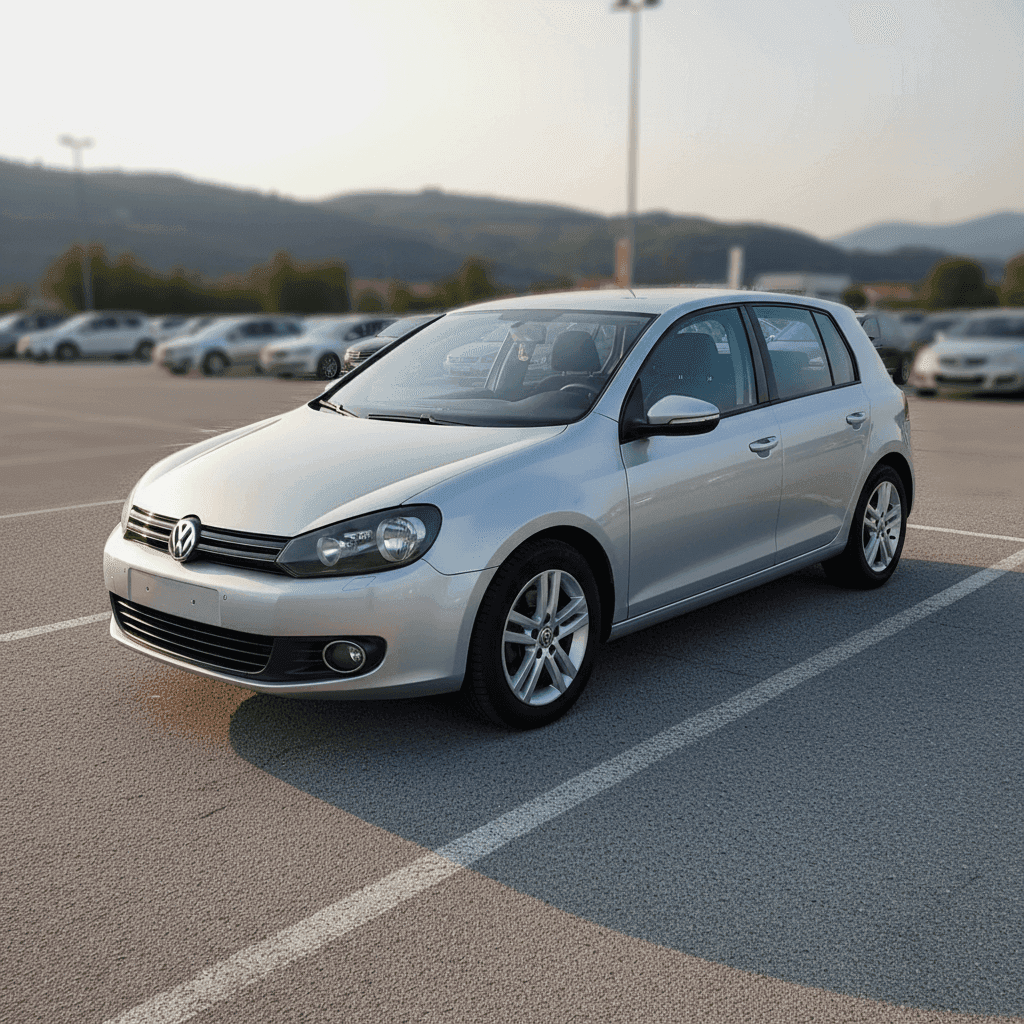
In the 10,000 to 15,000 KM range, a used car in BiH is no longer a compromise. In this class, the buyer crosses the line of the "workhorse" and enters the generation of common-rail diesels from 2010-2014, when the VAG family had solved the biggest factory flaws from the PD era. Used car 10000-15000 KM BiH buyers in 2026 mostly choose between compact hatchbacks (Golf 6, Octavia 2, A3 8P, C4, 308) and family saloons/estates (Passat B7, A4 B8, A6 C6). The offering is almost entirely diesel, with a typical mileage of 250,000 to 290,000 kilometres and model years 2009-2013.
This analysis was prepared by the Auto Gas Gaga workshop in Banja Luka, based on a cross-section of hundreds of active listings on olx.ba and years of experience with pre-purchase inspections.
| Model | Year | Typical Price | Typical km | Recommended Engine | What to Watch For |
|---|---|---|---|---|---|
| VW Golf 6 | 2009-2012 | 10,500-13,500 KM | 250,000-280,000 | 2.0 TDI CR + manual or DSG-6 | 1.6 TDI + DSG-7 dry clutch |
| Skoda Octavia 2 | 2010-2013 | 11,500-14,500 KM | 240,000-290,000 | 1.9 TDI PD or 2.0 TDI CR from 2008+ | 2.0 TDI PD pre-2008 (cylinder head) |
| VW Passat B7 | 2010-2013 | 12,500-14,500 KM | 250,000-290,000 | 2.0 TDI CR with Bosch injectors | EGR, secondary water pump |
| Audi A3 8P | 2008-2012 | 11,000-14,000 KM | 250,000-290,000 | 2.0 TDI CR + DSG-6 wet clutch | Hex-key oil pump drive |
| Audi A4 B8 | 2009-2011 | 12,900-14,900 KM | 280,000-320,000 | 2.0 TDI CR 143/170 HP manual FWD | CVT Multitronic automatic |
| Citroen C4 | 2013-2015 | 10,500-13,000 KM | 210,000-250,000 | 1.6 HDi (DV6) newer series | Early HDi turbo failures |
| Peugeot 308 | 2013-2015 | 11,500-13,500 KM | 190,000-230,000 | 1.6 BlueHDi post-2013 | 1.2 PureTech timing chain |
Table of Contents
- What You Get for 10,000-15,000 KM in BiH in 2026
- How We Built This Assessment
- Top Models - What Dominates the Offering
- Small City Car and First Car
- Family Car and Workhorse
- Older but Still Strong
- Car with Character
- What to Check Before Buying
- Fuel, Transmission and Annual Cost
- Frequently Asked Questions
- Related Articles
What You Get for 10,000-15,000 KM in BiH in 2026
This is the class where a used car 10000-15000 KM BiH buyer stops buying "just something that drives" and starts buying a vehicle with serious reserves under the bonnet. The dominant offering is compact and mid-size models from 2009-2013, with common-rail diesels that are the successors of the PD generation. On average you will find Golf 6, Skoda Octavia 2 Combi, Audi A3 8P Sportback, VW Passat B7, Audi A4 B8, and the occasional A6 C6 facelift.
The technical step up from the lower price range is noticeable. In the under-10,000 KM group, Passat B6 and Golf V with PD diesels still rule the market, with cylinder heads that require caution and older mechatronics. In the 10,000-15,000 KM range, the largest share of the offering comes from engines produced after 2008, when VAG removed two main factory flaws from the 2.0 TDI: cylinder head cracking on the 16V PD variant and the oil pump integrated into the balance shaft module. That does not mean risks are gone, but the nature of the problems changes from "factory flaw" to "matter of maintenance".
The mileage is realistically high. The sample average sits between 250,000 and 290,000 kilometres. That is not a disqualification, but it shifts the buying logic: you no longer pay for low mileage but for proven service history and the spare works (timing belt, secondary water pump, DPF regeneration, dual-mass flywheel) that the previous owner has already completed.
The offering is almost entirely diesel. In our sample, diesel accounts for around 90% of listings, petrol around 9%, and petrol-LPG combinations less than 1%. Manual transmission dominates at around 78%, and automatic (DSG, Tiptronic, Multitronic) covers the remaining 22%. This is the class where a buyer can realistically consider an automatic in the VAG family for the first time, but with clear criteria: prefer DSG-6 wet clutch over DSG-7 dry, and avoid Multitronic CVT.
How We Built This Assessment
This guide draws on a cross-section of hundreds of current passenger vehicle listings on olx.ba in the 10,000-15,000 KM range, captured on 23 April 2026. Commercial and borderline vehicles (Caddy panel van, Touran passenger-cargo) were removed from the sample, so the guide applies strictly to passenger cars that are realistically available to the average buyer in Banja Luka, Sarajevo, Tuzla, Mostar and other centres.
The olx.ba snapshot shows what is on the market - which models dominate, which model years are typical, which mileages are realistic for a given price. What the snapshot does not show, and what the workshop sees every day, are the technical details that separate a good example from a bad one. That is where experience with pre-purchase inspections comes in: which engines crack cylinder heads, which transmissions have known mechatronic issues, which production years to skip.
For each model in this guide we considered four criteria: (1) market availability - whether there are enough examples for a realistic choice, (2) technical reliability confirmed by service experience, (3) spare parts availability in BiH and the region, (4) character of the vehicle - whom the model specifically suits. The result is not a ranked list of the best car, because there is no ideal model. Instead, we offer categories: small city car, family car, older but still strong, and car with character.
One thing has to be said openly. This price range sits at the intersection of two buyer profiles. One is looking for a newer compact for the city, the other is looking for an estate or saloon for long trips and family use. The compromise between those two profiles often ends in a bad decision. That is why the first question is not "which car", but "what do I need the car for". Only once that is clear does the candidate list narrow down on its own.
Top Models - What Dominates the Offering
VW Golf (mostly the sixth generation) is by volume the biggest player in this price range and makes up around 16% of the entire offering. It is followed by VW Passat B7 at around 9%, Skoda Octavia second generation at around 7-8%, Audi A3 8P at around 5-6%, and Audi A4 B8 at around 4%. Everything else - Citroen C4, Peugeot 308, Ford Focus Mk3, Renault Megane III, Opel Astra J, BMW 3 Series E90 - comes in smaller shares, but is still represented enough for the buyer to have a choice.
The fact that the VAG family (Golf, Passat, Octavia, A3, A4) makes up over 40% of the offering is no coincidence. This is a generation of vehicles that set the industry standard for common-rail diesel in 2008-2013, together with the infrastructure of service, parts, and mechanic experience in the region. For a VAG car in BiH you can find diagnostics and parts practically everywhere, which is often not the case with French and Japanese models outside the larger cities.
French models (Citroen C4, Peugeot 308, Peugeot 3008) occupy a special niche - they offer a newer model year and a more modern interior design for the same price, but are less service-popular in smaller towns. Ford Focus and Opel Astra of this era are solidly undemanding, but do not attract buyers looking for status, so they are more of an option for a practical, simple car without complications.
Small City Car and First Car
In this category we look at vehicles below the mid-size class - ones that are easier to park in the centre of Banja Luka or Sarajevo, consume less fuel, and are a realistic first car for a young driver or a second car in the family.
VW Polo (2011+). The fifth generation of the Polo (type 6R/6C) in this range reaches model years 2011-2014 and mileages around 180,000-230,000 kilometres. The recommended engines are the 1.2 TDI (CFW) and 1.4 TDI (CUSB) from the common-rail generation. What is good: a robust platform shared with the Fabia and Ibiza, cheap maintenance, a durable diesel. What to watch for: avoid the first-generation 1.2 TSI (timing chain and thermostat housing), as well as the DSG-7 dry clutch in combination with any diesel.
Citroen C4 (2010+). The second generation of the C4 (type B7) in this class brings model years 2013-2015, which means a car 3-5 years newer than the VAG competitor for the same money. Engine: 1.6 HDi (DV6) newer series. What is good: a modern interior for its years, low consumption, good regional parts support. What to watch for: the early 1.6 HDi from 2007-2010 (DV6ATED4) had serious turbo and oil sludge issues, so it is important to choose a post-2013 variant; the DPF on HDi engines is sensitive to short city trips.
Peugeot 308. The second generation 308 (type T9, from 2013) sits at the lower end of this range. Engine: 1.6 BlueHDi. What is good: the most modern interior and infotainment in the class, good suspension comfort on bad roads, lower parts prices than the VAG equivalent. What to watch for: the 1.2 PureTech turbo petrol has a timing chain that is already showing problems at high mileages in the region; same rule - choose the BlueHDi variant, not the earlier HDi.
Renault Clio IV. In this range the Clio IV is already a relatively new car (2013-2015), but with a smaller offering than VAG. The recommended engine is the 1.5 dCi from the K9K family. What is good: low consumption, cheap parts, suitable for city driving. What to watch for: the EGR on the K9K clogs up on short trips, and the clutch on smaller Clio variants wears quickly in stop-and-go driving; the EDC automatic (dual-clutch) has known mechatronic issues.
For a first car and city driving our practical advice is clear: VW Polo because of the parts and service ecosystem, Citroen C4 or Peugeot 308 if a newer model year and comfort matter, and Renault Clio IV only if kilometres are reduced to short city trips with an owner who understands diesels and maintains the DPF.
Family Car and Workhorse
This is the category that makes most sense in the 10,000-15,000 KM range. A family car in BiH means an estate or a larger saloon, with enough space for children, luggage, and occasional longer trips to the coast or into Europe.
Skoda Octavia 2 Combi (1Z, facelift 2008-2013). One of the most popular cars in the entire region and the dominant family choice in this class. Typical model year 2010-2013, mileage 240,000-290,000 kilometres. Engine: 1.9 TDI PD (BXE/BLS) - legendary for durability, or 2.0 TDI common-rail from 2008+ (CFHC/CBDC/CLCA). What is good: a huge boot, simple serviceability, parts available in every service workshop in BiH. What to watch for: pre-facelift variants up to 2008 with 2.0 TDI PD 16V had cylinder head cracking and oil pump issues - avoid; on all TDI engines check the dual-mass flywheel above 220,000 kilometres and the secondary water pump on CR engines.
VW Golf 6 Variant and Golf 6 Hatchback. The Golf 6 with the 2.0 TDI CR engine (CBAB, CFFB) paired with a manual or DSG-6 wet clutch is one of the safest choices in this class. The Golf 6 Variant is rarer and more expensive than the hatchback, but offers space close to the Octavia Combi. What is good: a more modern interior than the B6 Passat and Octavia from the same period, the last VW generation without widespread TSI petrol complications. What to watch for: the known 1.6 TDI (CAYC) plus DSG-7 dry clutch (DQ200) combination - the mechatronics have a factory flaw, avoid without confirmed replacement paperwork; check the EA189 software update (Dieselgate) - examples without the update will be a problem at stricter technical inspections in the EU part of BiH and in case of export.
VW Passat B7 (2010-2014). A direct successor to the B6 in this range, with one important difference: the B7 2.0 TDI CR received Bosch injectors instead of the problematic Siemens injectors from late B6s. Typical model year 2010-2013, mileage 250,000-290,000 kilometres. What is good: a quality interior, stability on long trips, an economical diesel. What to watch for: the EGR valve is a weak link around 180,000-200,000 kilometres and replacement is not cheap; the secondary water pump is another wear item; shock absorbers and suspension bushings above 200,000 kilometres are practically a mandatory job; check the service record for the timing belt and oil - missing documentation alone is reason to negotiate the price down.
Peugeot 3008 (first generation, 2009-2016). A smaller crossover, with a body between an estate and an SUV. Good for families who want a higher seating position but without the weight of a true SUV. Engine: 1.6 HDi or 2.0 HDi. What is good: a comfortable ride, a large rear bench, economical. What to watch for: same notes as for the C4/308 regarding the engines; the history of French cars in regional markets brings occasional electrical issues (sensors, windows, multimedia).
VW Caddy (Life variant). The Caddy as a family vehicle (not as a commercial one) comes in the Life version with five or seven seats. Engine: 1.6 TDI or 2.0 TDI. What is good: the largest cargo space in the class, simple serviceability, a high driver position. What to watch for: same notes as for the Polo/Golf 1.6 TDI + DSG-7; usage history (commercial/family) drastically affects the state of the cabin and suspension.
For pure family driving, our workshop choice in this range is the Skoda Octavia 2 Combi with the 2.0 TDI CR engine from 2008+. The combination of space, reliability, and parts availability is unmatched in this price bracket.
Older but Still Strong
This category is for the buyer who wants a higher-class car but understands they will pay for an older model year and slightly higher mileage. The reward is a more serious chassis, better materials, and an engine that can go a long way without major interventions - provided you enter the purchase prepared.
Audi A4 B8 (2008-2015). Within this range, model years 2009-2011 are reachable, mostly with the 2.0 TDI common-rail engine (143 HP CAGA/CAGB/CJCA or 170 HP CAHA). Typical mileage is 280,000-320,000 kilometres. According to German TUV statistics, the B8 shares 19-20th place among 124 used cars for reliability - ahead of the BMW 3 Series (E90, 48th place) and Mercedes C-Class W204 (28th place). What is good: manual plus FWD is the simplest combination to maintain, the 1.9 TDI (rarer in the B8) is the same excellent engine as in the Octavia and Golf, quattro drive is an option for those who want winter security. What to watch for: the CVT Multitronic automatic - avoid without exception, expensive maintenance and frequent failures; early 2.0 TDI from 2008-2009 with piezo injectors had occasional issues, request injector replacement history; 1.8 TFSI and 2.0 TFSI from 2008-2011 - problematic timing chains, research the service record thoroughly if considering a petrol.
Audi A6 C6 facelift (2008-2011). An older, larger, more luxurious car. In this range the A6 C6 facelift comes with a 2.0 TDI or, more rarely, a 2.7/3.0 TDI engine. What is good: space and comfort from a higher class for the money of a family estate, 2.0 TDI economy combined with an E-class saloon. What to watch for: mileage often exceeds 320,000 kilometres, meaning upcoming suspension work, air suspension (if fitted - that is an expensive question), and A/C compressor; the MMI generation 2G multimedia system occasionally fails. The rule is simple - an A6 C6 in this range is bought only with documented service history.
VW Passat B7 4motion. Same as the standard B7, but with all-wheel drive. Rarer on the market, but a realistic choice for a buyer for whom the winter route Banja Luka-Sarajevo or Tuzla-Mostar over mountain passes is not exceptional. What is good: safety on snow and ice, extra traction for towing a trailer. What to watch for: higher fuel consumption, more expensive differential and joint parts, worn AWD driveline bushings above 250,000 kilometres are a potentially expensive job.
Car with Character
A category for the buyer who is not looking for the most rational choice but for a car that means something to them. In this range, those are mostly sportier or premium-styled versions, with awareness that maintenance will be more expensive than average.
Audi A3 8P Sportback. The most sought-after variant in this price range is model years 2008-2012 with the 2.0 TDI CR engine (CBAB) and DSG-6 wet clutch. What is good: a premium interior feel in a compact, the Sportback (five-door) body combining style and practicality, DSG-6 as an alternative to manual when properly maintained. What to watch for: early 2.0 TDI (up to 2008) had an oil pump drive via a hexagonal key that wears out prematurely and can cause an oil pressure drop - the post-2008 CBAB engine fixed this; DSG-7 with 1.6 TDI has the same known flaw as on the Golf 6; 1.8 TFSI and 2.0 TFSI petrols from 2008-2011 had timing chain issues, not recommended without documented service.
BMW 3 Series (E90, 2008-2011 facelift). In this range the E90 comes with the 320d N47 engine or the petrol 320i N43. What is good: rear-wheel drive that gives a specific driving character, a higher-quality chassis feel than the VAG competition. What to watch for: the N47 diesel engine has a well-documented timing chain problem located on the flywheel side (the service job requires removing the engine) - ask for confirmation of the replacement or an example where this has already been done; suspension bushings on the E90 show wear before 200,000 kilometres; BMW parts in BiH are more expensive than VAG equivalents, and BMW-specialised mechanics are fewer - this shows up in maintenance bills.
Peugeot 3008 (first generation). Already mentioned in the family category, but deserves a second mention for its styling. A French crossover with a recognisable identity, especially in red or dark grey. What is good: a look that stands out from the VAG sea in the car park, a high seating position, a comfortable ride. What to watch for: the same French notes - electrics, sensors, early HDi engine generation.
Mini Cooper (R56 generation). An entry into the range at the lower end. What is good: a character that no other car in the class can offer, front-wheel drive with a response close to a go-kart, an interior that stands out visually. What to watch for: the Prince engine developed by PSA/BMW (N12/N14) has known problems with the thermostat, oil pump, and timing chain; service costs are above the compact car category; the boot and rear bench are symbolic - the Mini is not a family car.
What to Check Before Buying
A pre-purchase inspection in this price range is not a luxury but a prerequisite. On a car with 250,000+ kilometres, the difference between a good and a bad example can be huge in post-purchase costs in the first year. This is the list we work through on every inspection in the workshop:
Service documentation. Service book, receipts for oil, timing belt, dual-mass flywheel, DPF cleaning, secondary water pump. If the seller cannot show this paperwork, the price should be reduced by the estimated amount of those jobs, or walk away. On diesels above 200,000 kilometres, the timing belt and dual-mass flywheel are the most important records.
EA189 update on VAG diesels (2009-2015). The Dieselgate software update is mandatory on a significant share of 1.6 and 2.0 TDI engines from that period. On examples that did not receive the update, problems are possible at stricter emissions inspections and on eventual export to the EU.
Computer diagnostics. Reading all controllers (engine, transmission, ABS, airbag, A/C), not just clearing faults. The workshop motto: "if the fault was cleared before arrival, the buyer pays twice". Ask to see current faults and freeze-frame data before purchase.
DPF condition. On all diesels above 180,000 kilometres, a mandatory check of the DPF filter condition: soot loading value, number of regenerations, differential pressure. A DPF approaching the end of its service life means a serious expense for cleaning or replacement - this must be known before the deposit is handed over.
EGR valve. On common-rail diesels the EGR valve is one of the most common causes of unstable running, power loss, and fault codes. Visual check of deposit quantity, functional test on diagnostics. EGR replacement on the 2.0 TDI CR is a serious cost.
Transmission. Manual - check the fluid change (should have been done at least once by 200,000 kilometres), the feel of all gear engagements, clutch slip in rapid acceleration under throttle. DSG - check transmission service (DSG-6 wet requires oil change every 60,000 kilometres), feel the behaviour at low speeds and during pull-away (jerks, hesitation). Multitronic CVT - we do not recommend a purchase without an expert inspection and accepting the risk of a very expensive repair.
Chassis and suspension. A lift inspection of bushings, shock absorbers, steering joints, tie rod ends. On cars above 200,000 kilometres there is always something - the question is how much. The estimated cost of suspension work should enter the price negotiation.
Bodywork and accident history. VIN check in available databases, inspection underneath the car for impact signs, check of paint uniformity on fender and bonnet joints. Buyers in BiH often overlook light impacts that were not registered but significantly affect value.
In this band, the buyer usually knows what they want, but the difference between a safe and a bad purchase is the layer of checks beyond physical inspection. A pre-purchase inspection in the workshop reveals what the car currently is. The car's past itself, kilometres by year, registered crashes, number of previous owners, and indicators of theft or total loss, is most easily obtained through carVertical. Using the chassis number, it pulls a documented vehicle history from international registers in countries where the car was registered. In our view, this is an unavoidable step before buying any used car, especially in a price range where you are paying for the paperwork and history, not just the current condition. When paying for the report, you can use the code GAGA for 20% off.
Found a car you are considering? Book a pre-purchase inspection or message us on WhatsApp with the listing link before you hand over a deposit.
Fuel, Transmission and Annual Cost
The offering in this range is diesel (around 90%), a direct consequence of the structure of the BiH vehicle fleet. Diesel engines from 2010-2013 in good condition realistically return 5.5-6.5 litres per 100 kilometres in combined driving, or 4.5-5 litres per 100 kilometres on the motorway without load. For a regular driver covering around 15,000 kilometres a year, a diesel car in this range is noticeably cheaper than a petrol in terms of fuel cost.
Petrol is a smaller part of the offering (around 9%), mostly 1.4 MPI/TSI and 1.6 MPI from the VAG family. Realistic consumption is 7-8.5 litres per 100 kilometres, which at annual level means a noticeably higher fuel bill compared to diesel. The difference in annual fuel cost between a comparable diesel and petrol can be significant for a regular driver.
Petrol-LPG combinations make up less than 1% of the offering in this range, for an objective reason: for a buyer who wants LPG, it is more rational to buy a quality petrol and install the system to their own specification than to inherit an existing installation of unknown quality. If you are considering this, our workshop team can work out an individual profitability calculation for a specific vehicle.
As for transmissions, manual is practically a carefree choice in this range. DSG-6 wet clutch (code DQ250) is the next best choice, provided regular oil changes every 60,000 kilometres. DSG-7 dry clutch (DQ200) has a documented factory mechatronic flaw on the 1.6 TDI variant and should be avoided without clear paperwork on mechatronics replacement. The Multitronic CVT on the Audi A4 B8 is a risk that simply does not justify the purchase saving - an expensive repair arrives sooner or later.
Annual maintenance cost for an example with 250,000-290,000 kilometres depends on the current condition - regular jobs (oil, filters, brake pads, shock absorbers or tie rod ends as needed) are the baseline, and alongside them a reserve should be planned for unforeseen works: EGR, DPF, secondary water pump, possible transmission repair. A buyer who has that reserve in the bank enters the purchase calmly. A buyer who does not, enters stress.
Frequently Asked Questions
What is the difference between PD and CR diesels, and why does it matter in this range?
PD (pump-nozzle, Pumpe-Duse) is the older generation of VAG diesels up to 2008, and CR (common-rail) is the newer generation from 2008 onwards. The difference matters because VAG, with the switch to CR, solved two main factory flaws of the 2.0 TDI engine: cylinder head cracking on the 16V PD variant and the oil pump integrated into the balance shaft module. In this price range, the buyer realistically chooses between late PD and early CR examples. The recommendation is clear: the 2.0 TDI CR from 2008+ is the safer choice. On the 1.9 TDI PD the story is different - that is a legendary reliable engine and does not share the flaws of its bigger brother.
Is a DSG transmission a risk at this mileage?
It depends which DSG. The DSG-6 wet clutch (code DQ250, most often on the 2.0 TDI variant) is a relatively reliable transmission when maintained with regular oil changes every 60,000 kilometres. At 250,000-290,000 kilometres it is realistic that the transmission has received one to two service oil changes - verifying that record is enough for a confident purchase. The DSG-7 dry clutch (DQ200, in combination with the 1.6 TDI) is another story - it has a known factory mechatronic flaw and the recommendation is to simply skip such a model, unless it has a documented mechatronics replacement.
Is a BMW or Mercedes worth it in this range?
Short answer: worth it only if you have a mechanic who does not raise the price at the sight of the badge. The BMW 3 Series E90 with the N47 diesel has a documented timing chain problem on the flywheel side - the service job requires engine removal, which costs many times more than a timing belt change on a VAG. The Mercedes C-Class W204 in this range comes with high mileages, and parts and specialist labour costs are above the VAG and French average. Both brands can deliver an excellent car in this class, but only if the service history is complete and the buyer realistically understands the higher future maintenance cost.
What about French and Japanese models?
Citroen C4, Peugeot 308 and 3008 in this range offer a car 2-4 years newer for the same price compared to the VAG competition. The trade-off is a lower service network density outside the larger cities and occasional electrical issues (sensors, windows, multimedia). Japanese models (Toyota Auris, Mazda 3) are rarer in the offering and often more expensive for the same kilometres, but they deliver a very reliable engine. For a buyer in a smaller town or with less technical knowledge, VAG remains the easiest choice because of the parts and mechanic ecosystem.
How much repair reserve should be planned for the first year?
A reserve should be planned for first-year service costs that can be surprising. This includes potential items such as the EGR valve, secondary water pump, DPF cleaning, timing belt replacement if not just done, brake pads and discs, dual-mass flywheel and clutch if near the end of service life. This is not a cost that is necessarily spent - on a good example everything can pass without major work - but it is a reserve the buyer should have before entering the purchase to avoid ending up in stress.
Do I need all-wheel drive (quattro, 4motion) in BiH?
It depends on location and usage. For a buyer in Banja Luka, Sarajevo, or Tuzla who does not regularly cross mountain passes in winter, pure front-wheel drive with good winter tyres is entirely sufficient. Quattro/4motion is justified for drivers who regularly drive mountain routes during winter months, tow trailers, or live in settlements at higher altitudes. The cost is higher fuel consumption, more expensive driveline parts, and extra attention to worn joints and bushings of the drive system above 250,000 kilometres.
How much time does a proper purchase realistically take?
From the first listing review to handing over a deposit, realistically 2-4 weeks. That period includes: filtering listings by model, engine, and year, checking 3-5 specific offers in person, selecting 1-2 most serious candidates for a pre-purchase inspection, performing the inspection in the workshop, and price negotiation. Buyers who rush and buy the first example they see on the same day in practice pay the most - both in the price itself and in unforeseen costs afterwards.
Related Articles
- Best Used Car 6,000-10,000 KM - Buyer's Guide for BiH (2026) - the previous price range in the same series, focused on Passat B6, Octavia Mk2, Focus Mk3.
- VW Passat B6 Common Faults and What to Watch For When Buying - a detailed technical analysis of the B6 as a basis for understanding the progress the B7 brought.
- How to Maintain a Diesel Car to Last Long - a practical guide to maintaining the common-rail diesels bought in this range.