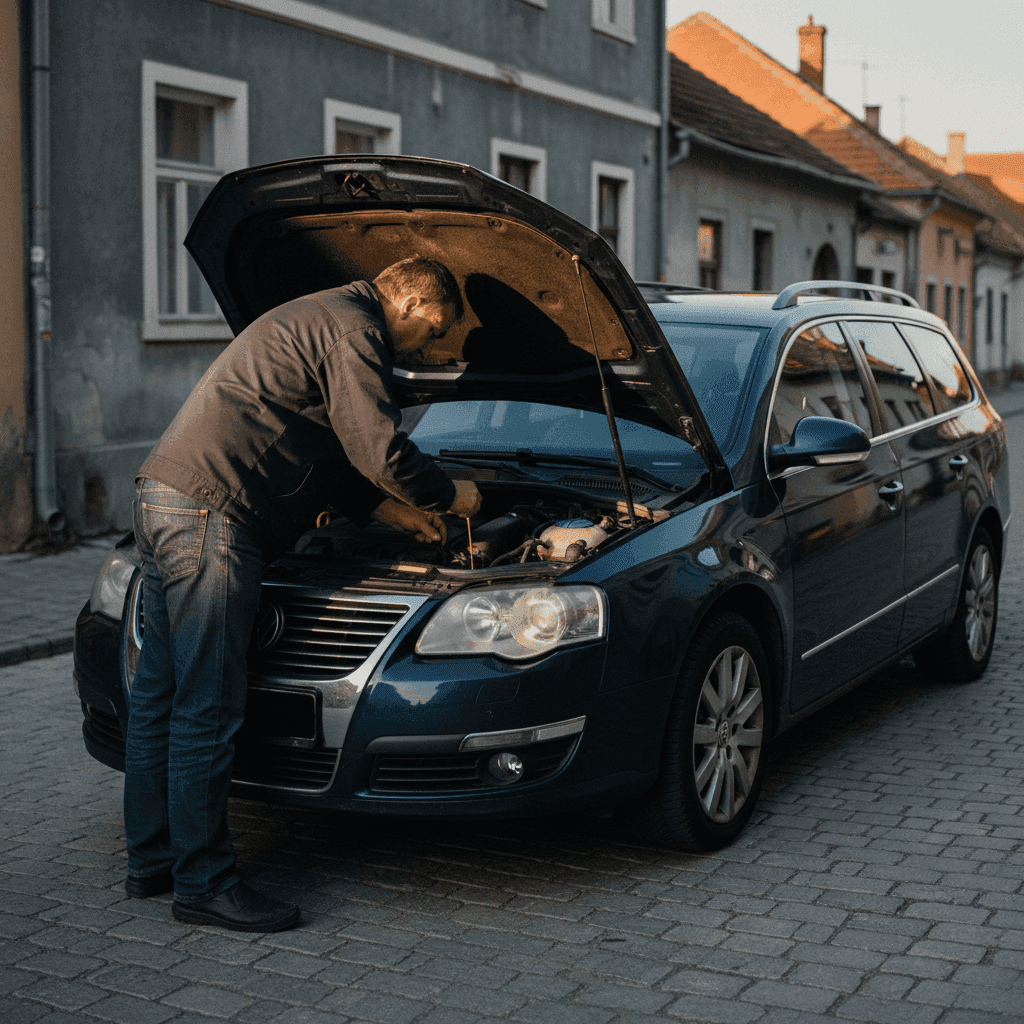
In the six-to-ten thousand KM range on olx.ba, every seventh used car in BiH is a Passat B6. That dominance is no accident - it is roomy, it drives well and parts are easy to find. But half the engine variants under that same bonnet have inherent weaknesses that can swallow a couple of months of budget in one go. If you understand Passat B6 common faults by engine code, you can buy a car that lasts, or pay the same money for a machine that bleeds you every month.
This guide was put together by the Auto Gas Gaga workshop from Banja Luka, based on years of service experience with this generation of Passat.
Table of Contents
- Why the Passat B6 still dominates the used-car market in BiH
- Which engines to buy and which to avoid - PD vs CR
- 1.9 TDI PD (BXE, BKC, BLS) - a reliable workhorse with a few traps
- 2.0 TDI PD (BKP, BMP, BMM) - oil pump and cylinder head
- 2.0 TDI CR (CBAB, CBDB) - the most mature B6 diesel variant
- Petrol 1.6 and 2.0 FSI - when they make sense
- DSG DQ250 gearbox - oil every 60,000 km or a new mechatronic
- Dual-mass flywheel - the most common expensive fault on manuals
- Electronics, suspension and bodywork - small things that wreck the budget
- Pre-purchase inspection checklist (13 points)
- Realistic annual maintenance cost in BiH
- Frequently Asked Questions
- Related Articles
Why the Passat B6 still dominates the used-car market in BiH
The B6 is a favourite here for three reasons. The first is space - the estate version (Variant) swallows weekend tools and children without drama. The second is the price of spare parts; used and aftermarket parts exist for every centimetre of this car, and mechanics know it inside out. The third is the drive - the chassis is calm on the motorway and the car feels like a larger vehicle than it actually is.
But popularity is a double-edged sword. On the market in this price range, some examples have already passed through two or three owners without proper paperwork. So you are not just looking at the body - you are looking at the engine code, the service history and exactly what tends to fail on that engine code. This is not a car you buy at first glance. This is a car you buy only once you know what to look for under the bonnet.
The Passat B6 in BiH is almost exclusively an import, which means you practically never buy a car with local service history, but a machine that has 5-15 years of driving on German or Austrian roads behind it. That past is easier to pull from the VIN than from the seller. A service like carVertical cross-references international registries and typically shows mileage by year, registered crashes and total losses, the number of previous owners and indicators of theft or rolled-back odometers. For an imported B6 we consider this mandatory, because this generation in particular carries a high share of examples sold off after serious engine or mechatronic work in Germany. When paying for the report you can use the code GAGA to get 20% off.
Which engines to buy and which to avoid - PD vs CR
The Passat B6 was produced from 2005 to 2010 and during that period it passed through two generations of diesel technology. The older one is PD (Pumpe-Düse, electro-mechanical unit injectors) - used in the early model years, roughly 2005-2008. The newer one is CR (Common Rail) - introduced during 2008 and kept until the end of B6 production.
The difference is not academic. PD engines, especially the 2.0 TDI, have two specific design weaknesses we will cover below: an oil pump integrated into the balance shaft module and a tendency for cylinder heads to crack on the 16-valve variants. The Common Rail generation (CBAB, CBDB and related CR codes) eliminated both flaws. The manufacturer also redesigned the oil pump with a reinforced shaft.
For a buyer on a tighter budget, that practically means this: if the price is similar, always choose a later B6 with a CR engine over an earlier one with the PD version, unless the PD is the 1.9 TDI (more on that shortly). The model year on the registration document and the engine code on the VIN are the first two pieces of information you check, before you even look at the car in person.
1.9 TDI PD (BXE, BKC, BLS) - a reliable workhorse with a few traps
The 1.9 TDI is the legendary 8-valve VAG engine that entered the B6 in 105 hp (BXE, BLS) and, more rarely, 90 hp (BKC) versions. This is the engine we most often see in the workshop with over 300,000 km on the clock - and still running regularly. If you have been told "you cannot kill a 1.9", that is partly true, but only if you know where its traps are.
The first trap is the EGR valve and intake manifold. PD diesels clog the intake manifold with soot and oil vapour from crankcase ventilation, enough that after 200,000 km the manifold physically has deposits several millimetres thick. The symptoms are a loss of power and smoking under acceleration. Cleaning is moderately priced, but if it is ignored too long the engine starts losing response as low as 1,500 rpm.
The second is the VNT turbo geometry. Those variable vanes can stick, especially if the driver kept the car on short trips. This is a related story - short trips kill a diesel and the turbo is the first to pay the price.
The third is the timing belt and tensioner. This is not specific to the B6 but to the whole VW/Audi family - the belt tensioner is a weak point and when it fails the consequences are expensive: bent valves and, in some cases, cracked pistons. The recommended replacement interval is every 130,000 km for the 2.0 TDI, similar for the 1.9 TDI PD; always with the full kit - tensioner plus water pump, not just the belt.
You choose the 1.9 TDI as a used buyer when longevity and low parts cost are your priority. It is not the most powerful and not the quietest, but it is the most predictable engine in the B6 range.
2.0 TDI PD (BKP, BMP, BMM) - oil pump and cylinder head
This is the engine where the most money and the most hope get broken. The codes BKP, BMP, BMM, BWV, BVD, BLB and related - these are all PD variants of the 2.0 TDI from the pre-2008 period. And they all share two serious inherent flaws you must understand before you sign anything.
The first flaw is the oil pump. On these engines the oil pump is integrated into the balance shaft module and driven by a hex shaft. Under load, that shaft can wear down the hub and lose drive to the pump. The symptoms are high oil consumption, oil in the intake manifold and loss of power - and in the worst case the engine loses oil pressure and rotating components are destroyed. In the workshop we recommend inspecting the oil pump after 150,000 km, with the shaft replaced if needed.
The second flaw is cracked cylinder heads. The 16-valve variants of the 2.0 TDI PD before 2008 have a documented head-cracking problem. Volkswagen fixed the issue during 2008, and the 8-valve versions do not have this defect at all. On the ground that means: if the car is from 2005-2007 and carries a 16V head, the risk is real and must be factored in.
The third thing specific to the 170 hp variants is the Siemens piezo injectors. Unlike the Bosch injectors on the 140 hp versions (which can be refurbished), Siemens piezo injectors are non-rebuildable - if one fails, it is a full replacement, and the cost difference per injector is significant. If you are going to buy a PD 2.0 TDI anyway, the 140 hp version is the financially smarter choice over the 170 hp.
2.0 TDI CR (CBAB, CBDB) - the most mature B6 diesel variant
The post-2008 Common Rail generation (CBAB and CBDB are the two most common, plus related CR codes) is the sweet spot when it comes to B6 diesel. With the CR generation, VW eliminated the main PD flaws - cracked heads and the injector problem - and redesigned the oil pump with a reinforced shaft.
That does not mean CR has no problems. The DPF filter is a weak point on cars that have spent years only in town, the EGR valve still clogs up and the DPF pressure sensor can mislead the control unit. But all these problems are "working character" issues - solved by servicing, not a full engine rebuild.
Practical advice: on the CR generation the recommendation is a full oil pump inspection after 200,000 km, which is 50,000 more than on the PD variants. Common rail injectors are more reliable but sensitive to fuel quality - to recognise injection-system issues, it helps to know the symptoms of faulty injectors.
For a buyer who needs a diesel, the CR 2.0 TDI (model years 2009-2010) is the safest choice in the B6 range.
Petrol 1.6 and 2.0 FSI - when they make sense
The petrol side of the B6 range is less represented on our market, but for a buyer doing mostly short trips, a petrol makes more sense than a worn-out diesel. The two main petrol options in the B6 are the 1.6 FSI (115 hp, code BLF/BLP) and the 2.0 FSI (150 hp, BLR/BVY).
The 1.6 FSI is enough for calm city driving. It is not the most economical for long trips, but it is mechanically much simpler to maintain than a diesel. The 2.0 FSI is livelier, but has direct injection that requires extra care - we have a separate article on maintaining direct-injection engines.
Petrols make sense in two scenarios: city driving up to 15,000 km a year, or a car you do not want to service often. If you drive 25,000 km or more a year, the maths pushes you back to diesel.
DSG DQ250 gearbox - oil every 60,000 km or a new mechatronic
The DSG DQ250 is a 6-speed wet-clutch automatic gearbox running in an oil bath, designed for torque up to 350 Nm. On the B6 it was mainly paired with the 1.9 TDI 105 hp, the 2.0 TDI 140 hp and the petrol 2.0 FSI variants.
Two things you must know. First: the oil in the DSG does get changed, no matter what the service book says. VW does not formally recommend a change, but specialists unanimously recommend replacing the oil and filter every 50,000-60,000 km. When you buy a B6 with DSG, the first question for the seller is: when was the last DSG oil and filter change, and is there a receipt. If there is no receipt, budget the service straight after purchase.
Second: the mechatronic. On the B6 generation, the DSG mechatronic had design issues up until 2008. Repair or replacement of the mechatronic can be a significant cost, and the faults most often show up after 100,000 km. The symptoms are jerks when changing gear, "selecting" neutral while slowing down, or an error on the dashboard. To assess the gearbox condition, book a diagnostic before buying.
A test drive on a DSG car must include: a cold start, twenty minutes of calm city driving with mandatory long waits at traffic lights, then five minutes of more aggressive driving with hard acceleration. Any jerk, delay or sound that is not a "clean" gear change is a reason for a diagnostic before purchase.
Dual-mass flywheel - the most common expensive fault on manuals
If you are choosing a manual B6 diesel, the dual-mass flywheel is a sensitive point you must test on the test drive. Symptoms that point to wear: knocking when starting and switching off the engine (as if someone were banging a metal hammer somewhere under the car), clutch vibration under acceleration and vibrations through the whole car at idle.
Replacing the full package (dual-mass flywheel, clutch and release bearing) is a significant cost - contact us for an estimate since the price varies with model year and engine code. If you hear knocking on start-up during the test drive, budget this service as unavoidable in the first six months, or look for another example.
Closely related: if the dual-mass has already been replaced with a single-mass plus clutch kit, that is a compromise which is cheaper but leaves vibrations in the cabin. It is not critical, just know that the car has been through that story.
Electronics, suspension and bodywork - small things that wreck the budget
Beyond the engine and the gearbox, the B6 has a few electronic "traditions" worth knowing. Typical problems include: a steering-column lock module fault that blocks start-up (symptom - you turn the key and absolutely nothing happens), a DPF pressure sensor that causes irregular engine running, and central locking that fails when the ignition is off. None of these faults is lethal, but each requires a workshop visit and diagnostics.
The suspension is generally healthy. The front multi-link setup uses several arms, and the silent-block bushings start giving out around 150,000 km. It sounds like "clock-clock" over bumps. Repair is cheaper if the whole package is done at once rather than one piece at a time.
Bodywork - the biggest weak point of the B6 is corrosion around the front wings (inner side), around the rear arches and on the rear section of the sill. On examples that have slept outside for ten years, this can reach serious rust-through. Knowing the signs of a battery nearing the end is a bonus because on B6 cars with a "smart" alternator the battery must be correctly coded after replacement, which many mechanics miss.
Pre-purchase inspection checklist (13 points)
Before you put down a deposit, go through this in order:
- VIN and engine code. Look for them on the registration document and on the engine itself. Compare them with the model year - if the car is 2005-2007 and the engine is a 2.0 TDI 16V PD, factor in the cylinder head risk.
- Service book or receipts. No service book - ask for receipts. No receipts - assume the car has not been serviced.
- Last timing belt change. A mandatory question, with a receipt. Without proof - plan the replacement immediately.
- DSG oil (if DSG). Date of the last change and a receipt.
- Engine oil level and colour. Clear golden is normal; black and thick or very thin is a reason for extra questions.
- Oil consumption. Ask how much oil gets topped up between services. Excessive consumption on a 2.0 TDI PD is an alarm for the oil pump.
- Cold start. The engine must fire straight away, without prolonged cranking.
- Knocking on start-up and shut-down. If you hear it, the dual-mass flywheel will need replacing.
- Test drive at least 20 minutes. The DSG must shift smoothly, the manual must engage without vibration.
- DPF and EGR check. OBD diagnostics is a must - ask for the error log.
- Cabin vibration at idle. If there is any, the engine has some imbalance.
- Bodywork underneath the car. Look at the sills, rear arches, inside surfaces of the wings.
- Electronics. Test the central locking (lock/unlock five times in a row), buttons, air conditioning.
If you cannot inspect any of these yourself, arrange a workshop check before you put down a deposit. An hour of diagnostics costs a fraction of fixing a fault you inherited "as part of the package" with the car.
Realistic annual maintenance cost in BiH
For a B6 with a 2.0 TDI CR engine and a manual gearbox, the realistic annual cost of routine maintenance (oil, filters, smaller services, tyres once every three years) falls within a range typical for models in that class - lower than for premium German competition, but higher than for a simple Japanese compact. The exact figure depends on mileage and driving style.
Major services come in cycles: timing belt every 130,000 km, DSG service (if an automatic) every 50,000-60,000 km, dual-mass flywheel once in the car's lifetime (typically 180,000-250,000 km). These services are not a monthly cost, but you must set them aside mentally when calculating the total cost of ownership.
For an accurate estimate on your specific example, get in touch for an assessment before you put down a deposit.
Frequently Asked Questions
Which is the most reliable engine in the Passat B6 range?
In the workshop we most often see the 2.0 TDI Common Rail (CBAB, CBDB, model years 2009-2010) as the most mature variant. The 1.9 TDI PD (105 hp) is also an excellent choice if your priority is longevity and low parts cost, with mandatory attention to the timing belt and EGR.
Should the 2.0 TDI PD be avoided entirely?
Not necessarily, but you have to know what to look for. The 8-valve version does not have the head-cracking problem, and the 140 hp variant (Bosch injectors) is cheaper to repair than the 170 hp (Siemens piezo). If you find an example with documented oil-pump service, it can be a good buy.
How do I spot a DSG problem on a test drive?
Start from cold, drive 20 minutes of combined use - city and open road. Any jerk when changing gear, hesitation to pull away from a standstill or unpleasant "hunting" for a gear is a reason for OBD diagnostics before purchase. Also ask for a receipt for the last DSG oil change.
Is the dual-mass flywheel always a replacement job when buying?
Not automatically. It depends on the symptoms - if there is no knocking on start-up and shut-down and no vibration under acceleration, the flywheel has life left in it. But if any of those symptoms appear, factor in the flywheel, clutch and release bearing package as a mandatory service in the first six months.
Which is better for city driving - PD or CR 2.0 TDI?
CR (Common Rail) is better for city use because it has a gentler character, fewer vibrations and fewer injector problems on short trips. PD engines are more sensitive to short trips - soot in the intake manifold and EGR issues are quicker candidates for cleaning.
Is it even worth buying an older-year Passat B6 in 2026?
It is worth it, if you know exactly which engine you are looking for and if you go through the full checklist. A lower model year gives you a cheaper entry price, but the risk of PD flaws (oil pump, cylinder head) is real. A 2008 or newer example with a CR engine lasts longer but costs more to buy.
Related Articles
- Best used car 6,000-10,000 KM - buyer's guide for BiH (2026)
- Most common diesel engine problems - what every owner should know
- When to replace a timing chain or belt
Driving a Passat B6 or planning to buy one and looking for a service that actually knows the car? Auto Gas Gaga services this generation regularly - book an appointment for a pre-purchase inspection or routine maintenance.