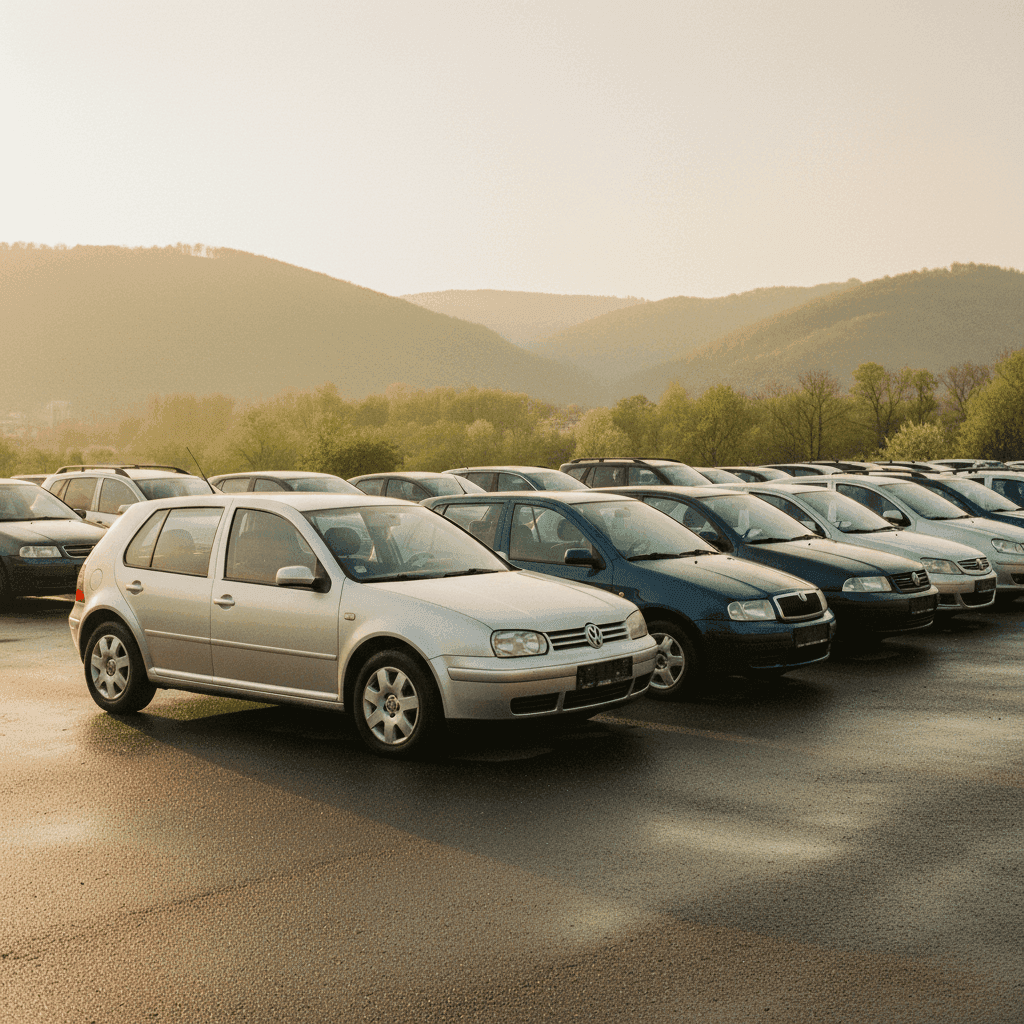
The 4,000 to 6,000 KM range is the busiest shelf of our used car market. In April 2026 there are over 2,700 active listings in that price class, and diesel accounts for nearly four out of five cars. This guide shows what is actually on offer, how to pick a model that suits you, and what you must check before buying, without getting stuck on individual listings.
Table of Contents
- What's Currently on Offer in This Range
- How We Conducted the Assessment
- Top Models - What Dominates the Offering
- Small City Car and First Car
- Family and Workhorse
- Older but Still Strong
- A Car with Character
- What to Check Before Buying
- Fuel, Transmission and Annual Cost
- Frequently Asked Questions
- Related Articles
What's Currently on Offer in This Range
A budget of 4,000 to 6,000 KM in BiH puts you in the mature used car market. A typical car in that class was built around 2005 and has roughly 283,000 kilometres on the clock, with the median asking price sitting around 5,000 KM. It is not scrap waiting for a rebuild, but it is not a newer vehicle with reserves either. The bulk of what is on offer consists of European compacts, mid-size saloons and estates that have survived two decades and several owners here.
What jumps out immediately is the dominance of diesel. In April 2026, diesel accounts for about 77% of listings in this range, pure petrol about 20%, and factory petrol plus LPG just 3%. In parallel, first registrations of new and used vehicles in BiH for February 2026 showed petrol leading at 41.6%, diesel down to 33.1%, and hybrids jumping to 22.3%. The market is slowly turning away from diesel, but in the 4-6k KM budget, diesel is still the default currency.
Why? Simply put, the cars that have stayed on the road for twenty years are mostly diesels with 1.9 TDI, 1.7 CDTI, 1.6 HDi and similar engines that were mass-market back then. Petrol cars from that period are just as good, but they were also worked under different assumptions, so there are fewer of them in this price class.
In BiH, 6,858 passenger vehicles were registered for the first time in February 2026, and only 752 of those were new - a ratio of 1:9 in favour of used cars. That means for every new vehicle, nine people buy used, and a large share of those buyers are in exactly this price class.
How We Conducted the Assessment
To keep this guide from staying at generalities, we took a real snapshot of the market. Here are the numbers we use throughout the guide.
About the methodology. The data covers the 4,000-6,000 KM price range, passenger vehicle category, in April 2026. We reviewed twelve pages of results on the largest domestic classifieds platform, which gives a sample of 480 listings (about 17% of the total offering in the range, which at that moment counted over 2,700 active listings). Every listing was logged with asking price, year, mileage, fuel type and model. From that sample we calculated the median price and mileage per model, as well as shares of the offering. Model shares carry an error of about two percentage points, and qualitative data such as transmission and condition are not reliably available from the listings and are treated descriptively.
In the workshop we most often see these same models on inspection and service, so we shaped the strengths and warning signs around what actually caused trouble for our clients, rather than forum theory.
Key figures for the 4,000-6,000 KM range:
- Over 2,700 active listings in April 2026
- Median price: around 5,000 KM
- Median year: 2005
- Median mileage: around 283,000 km
- Diesel share: 77%, petrol 20%, petrol+LPG 3%
Top Models - What Dominates the Offering
Nine models make up nearly half of the offering in this range. Here is how they stack up by share, median price and median mileage:
- VW Golf (all generations) - about 12.7% of the offering, median 5,000 KM, years 1998-2011, around 310,000 km. Golf 4 is the most represented generation (median 4,500 KM), Golf 5 pulls the price up and reaches 5,700 KM.
- VW Passat (all generations) - about 8.8% of the offering, median 4,900 KM, years 2000-2009, around 322,000 km. B5.5 dominates, B6 only peeks through at the top edge of the budget.
- Škoda Fabia - about 4.8% of the offering, median 5,300 KM, years 2002-2011, around 258,000 km. The lowest median mileage in the top ten and nearly half are petrol cars.
- Opel Astra - about 3.5% of the offering, median 4,500 KM, years 2004-2009, around 243,000 km. Predominantly 1.7 CDTI.
- Audi A4 (B6/B7) - about 3.5% of the offering, median 5,300 KM, years 1996-2005, around 320,000 km. Almost exclusively 1.9 TDI BKE/BRB.
- Ford Focus - about 3.3% of the offering, median 4,500 KM, years 2002-2010, around 270,000 km. Mk1 and Mk2 with 1.6 TDCi and 1.8 TDCi.
- BMW 3-Series (E46) - about 2.9% of the offering, median 5,400 KM, years 1997-2008, around 300,000 km. Mostly 320d with the M47 engine.
- Opel Corsa - about 2.5% of the offering, median 5,500 KM, years 2006-2012, around 236,000 km. The youngest model in the top ten by year.
- Citroen C4 - about 2.3% of the offering, median 5,200 KM, years 2005-2012, around 227,000 km. 1.6 HDi PSA engine shared with Peugeot 307/308.
Even from this list the market logic is clear - the more mainstream and widely known the car, the more of it in this budget. Fewer exotic brands does not mean they are absent, but do not chase them if you need fast repairs.
Small City Car and First Car
The first buyer profile is someone who wants small, economical and cheap to register. City driving, short routes, insurance based on a smaller engine displacement. The typical range in this profile is 4,500-5,800 KM, with mileage between 200,000 and 260,000 km.
Škoda Fabia (2002-2011). The first and second generation Fabia is the gold standard for this profile. A 1.2 HTP petrol or 1.4 16V is ideal for the city, servicing is among the cheapest in class, and parts are everywhere. It shares its gearbox and drivetrain with the Polo and Ibiza, so the knowledge pool is huge.
- Good: parts availability, simple electronics, painless servicing of the 1.2 HTP and 1.4 MPI engines.
- Good: low city consumption, the 1.4 MPI realistically returns 6 to 7 litres.
- Watch out: the three-cylinder HTP engine can shake when spark plugs or the coil pack fail, watch for smooth idling.
- Watch out: the 1.4 TDI PD diesel in the Fabia tends to snap the timing belt if it is not replaced on time, and the repair is expensive relative to the car's value.
VW Polo 9N/9N3. The Fabia's technological sibling, but it enters our market at a higher price because of the stronger brand. The 1.2 12V or 1.4 16V petrol can be a better option than the 1.9 SDI diesel, which is slow and smoky.
- Good: the bodywork handles corrosion very well, rarely rusts around the windows and sills.
- Good: servicing is like the Fabia, the same drivetrains.
- Watch out: window and central locking electronics can be temperamental after several owners.
- Watch out: the 1.4 TDI PD has the same weaknesses as in the Fabia, avoid it in this budget.
Opel Corsa D. A younger generation than those above (2006-2012), it holds up well in this range, especially the 1.2 and 1.4 petrol. This is one of the rare cases where petrol has the advantage on maintenance.
- Good: lower mileage than competitors at the same price.
- Good: the 1.4 petrol has proven durable, spark plugs and coils are not an ongoing hunt.
- Watch out: the 1.3 CDTI diesel in the Corsa has sensitive injectors and the EGR valve clogs frequently.
- Watch out: the Easytronic gearbox (semi-automatic) - steer clear, maintenance is expensive.
Family and Workhorse
The second profile is boot space, five seats, decent motorway dynamics, and an estate version if work is in the mix. The typical range is 4,300-5,800 KM, keeping in mind that mileage in this profile is almost always over 290,000 km.
VW Passat B5.5 (2000-2005). This is the best combination of space, price and robustness in the range. The 1.9 TDI PD with 105 or 130 HP is legendary for durability, and the B5.5 bodywork is galvanised better than the following generations.
- Good: rear seat and boot space are an extra class for this budget.
- Good: the 1.9 TDI PD with reasonable mileage and proper servicing easily reaches half a million kilometres.
- Good: parts are mainstream, nearly every workshop in BiH services the Passat.
- Watch out: the timing belt is due at 120,000-160,000 km; if it has been pushed past that on the last change, walk away.
- Watch out: the EGR valve, VNT turbo actuator and MAF sensor are the most common 1.9 TDI PD faults, ask the seller for service history.
Škoda Octavia I (1996-2010). Shares the PQ34 platform with the Golf 4 and Passat B5.5, but costs less than the Passat for the same year and condition. The estate (Combi) variant is the most cost-effective buy in the entire range.
- Good: servicing at the cheapest tariff of all VAG vehicles.
- Good: the same 1.9 TDI engine as in the Golf and Passat, a huge parts base.
- Watch out: the interior is spartan, and dashboard and steering wheel plastics can crack.
- Watch out: rear brake discs and drums are often neglected - check the handbrake on a slope.
Ford Focus Mk1/Mk2 estate. If how the car drives matters to you, the Focus estate is dynamically superior to the Octavia and Passat. It will cost a bit less, but parts for specific engine variants are slower to source.
- Good: the best steering and suspension in class, excellent dynamics.
- Good: the 1.6 TDCi engine is frugal and serviceable.
- Watch out: the 1.8 TDCi (Duratorq) has sensitive injectors, check the service report.
- Watch out: the bodywork around the rear arches on the estate version tends to rust, inspect carefully.
Older but Still Strong
The third profile is a premium interior for ordinary car money. Audi, BMW and Mercedes in this range are almost always older than 20 years and over 300,000 km, but the interior material, suspension and engine are still above class. Typical range is 4,900-5,900 KM.
Audi A4 B6/B7 (2001-2008). In the 4-6k KM budget it is almost exclusively the 1.9 TDI in BKE or BRB designation. Our recommendation is to stick to cars without a DPF filter, because in this range a DPF system costs more than the rest of the car's value.
- Good: the interior and materials creak far less than competitors of the same year.
- Good: the four-link multilink front suspension is comfortable and durable.
- Watch out: avoid the Multitronic (CVT) automatic at all costs, the rebuild exceeds the car's value.
- Watch out: timing belt plus all auxiliary belts in the same service - do not cut corners on this.
BMW 3-Series E46 (1998-2005). Mostly appears as the 320d with the M47 engine. The driving behaviour is still a benchmark, and a rebuild is manageable if done predictably.
- Good: suspension, steering and dynamics are still a class benchmark.
- Good: the M47 engine is long-lived with regular servicing.
- Watch out: intake swirl flaps can snap and fall into the cylinder, the recommendation is to fit blanking plates or verify that this has already been done.
- Watch out: the rear subframe mount can crack on cars with a hard history, a lift inspection is mandatory.
Mercedes C-Class W203 2.2 CDI. Prestige for pennies, but it is not for everyone. The OM611 and OM646 diesel engines are durable, but the electronics and the SBC brake system on earlier model years can become an expense.
- Good: outstanding insulation and comfort on long journeys.
- Good: with a reasonable history, the engine can pull over 500,000 km.
- Watch out: SBC brakes on 2001-2004 model years can hide a costly item, ask for the SBC reset counter.
- Watch out: timing belt plus water pump plus thermostat often come as a package, plan for it in the first year.
A Car with Character
The fourth profile is not pure reason - someone wants a coupe silhouette, a three-door, a sporty compact or Italian charm. Typical range is 4,500-5,900 KM.
Alfa Romeo 147. A small distinctive hatch; the 1.6 Twin Spark petrol is an easy machine to maintain, the 1.9 JTD diesel has specific weaknesses.
- Good: Italian design that still holds up today, a coupe line.
- Good: the 1.6 TS is durable with regular servicing.
- Watch out: the variable valve timing on the 1.6 TS needs precise servicing, preferably at an authorised mechanic.
- Watch out: central locking and window electronics are a chronic problem.
Audi A3 8P 3-door. A compact with character; a well-kept example holds its value. The 1.9 TDI PD and 2.0 TDI BKD fall into this range.
- Good: a sealed interior, good material finish, does not let motorway noise through.
- Good: a solid equipment package even in base trim.
- Watch out: the 2.0 TDI BKD has a high-pressure pump issue - check whether it has already been replaced.
- Watch out: the DSG gearbox (if fitted), service is mandatory every 60,000 km and is not cheap.
Seat Leon 1M/1P. The sportier sibling of the Golf on the same platform, costs less than the VW. Same engine, same servicers.
- Good: a more modern design than the Golf 4, with the same technical content.
- Good: quality VAG parts.
- Watch out: some examples have been driven hard, a service history review is essential.
- Watch out: front window electronics have a specific fault in the plastic insert of the regulator.
What to Check Before Buying
Do not fall in love with a listing - in the 4-6k KM range you are buying the car's history, not just the car. Here is the basic protocol we repeat to every client who comes in for a pre-purchase vehicle inspection.
- Service history. Ask for invoices from the last 60,000 km. Timing belt, oil, filters, brakes - at least one of these should be documented. If there are no invoices at all, budget 800-1,500 KM of servicing straight after purchase.
- Pre-purchase inspection on a lift. Most buyers skip this step and lose 500-1,500 KM in the first three weeks. The inspection takes about an hour and reveals the condition of suspension, brakes, exhaust, lower oil seals and the underbody.
- VIN check and damage history. Any specialist can tell whether the car was a write-off and repaired after an accident. It shows best in the gaps between panels under the bonnet and the colour of the seams.
- Computer diagnostics (OBD). Not just the check engine light, but the fault history, DPF counters on diesels, battery state and verification of basic sensors. Anyone offering "the lights can be wiped before sale" - walk away.
- Test drive of at least 20 kilometres. Half in town, half on the open road. Pay attention to whether the car wanders in the steering, whether gears jump, whether there is knocking over bumps. A cold morning start is mandatory if it is a diesel.
- Timing belt on PD engines. On the 1.9 TDI PD (Audi, VW, Škoda, Seat) it is replaced every 120-160,000 km. If it has not been documented as changed, budget 500-900 KM of service in the first few thousand kilometres.
In this range most of the offer is imported with 12-18 years on the clock, and that is exactly where the risk of rolled-back mileage is the highest in the entire used car segment. A local workshop and a pre-purchase inspection do an excellent job on the physical condition of the car today, but they cannot easily pull full records from Germany, Italy or the Netherlands. That is where carVertical comes in: through the chassis number (VIN) it pulls documented vehicle history from international registries, mileage by year, reported collisions and total losses, the number of previous owners and theft indicators. In a 4-6k KM budget we treat this as an essential step before putting down a deposit. When paying for the report you can use the code GAGA and you will get 20% off.
For details on the weaknesses diesels face in summer and winter, see our guide on how to maintain a diesel car so it lasts long, and for injector diagnosis see symptoms of faulty diesel injectors.
Fuel, Transmission and Annual Cost
In this price class diesel is not a saving by default. The maths works if you cover more than 20,000 km a year and if the car is not on short routes. Below that, you maintain an old diesel less pleasantly than you save on fuel.
Diesel (77% of the range). The average consumption of a typical 1.9 TDI or 1.7 CDTI from this period is between 6 and 7.5 litres on the motorway. Annual servicing costs are usually 600-1,200 KM with regular servicing, plus a larger one-off cost every 120-160,000 km for the timing belt and auxiliary belts.
Petrol (20% of the offering). Average 7-9 litres in mixed driving, but smaller one-off servicing hits. For drivers who cover less than 15,000 km a year, petrol is often cheaper overall, especially because insurance on older diesels can be more expensive.
Petrol plus LPG (3% factory, more through aftermarket fitment). LPG in BiH in 2026 is still the most cost-effective option on petrol cars covering 15,000 km and more. At the workshop we handle full LPG installation, homologation, regular servicing, certification and all repairs - whether the car is factory bi-fuel or going through aftermarket fitment.
Transmission. A manual gearbox on these years is almost always less risk than an automatic. The Multitronic on the Audi A4 and the Easytronic on the Opel Corsa are items that exceed the vehicle's value in this range. The DSG gearbox on older VAG vehicles is only worth it if DSG oil servicing is documented.
Frequently Asked Questions
What is the best used car up to 6,000 KM in BiH?
There is no single best, only the best for each buyer profile. For a small city car and a first car it is the Škoda Fabia 1.2 HTP or 1.4 MPI. For family use, the VW Passat B5.5 1.9 TDI or the Škoda Octavia I estate. If you want a premium feel, the Audi A4 B7 1.9 TDI BKE. For a car with character, the Alfa Romeo 147 or Audi A3 3-door.
How many kilometres is too many for a car in this range?
The median mileage in the 4-6k KM range is around 283,000 km, so that is more normal than excessive. Mileage over 400,000 km is not in itself a disqualifier if the service history is complete and if key overhauls (timing belt, clutch, turbo) are documented. Mileage under 200,000 km on a car older than 20 years is suspicious and needs verification.
Is a 1.9 TDI with high mileage worth it?
It is worth it if the timing belt has been changed on time and if there is no oil leaking from the engine, gearbox or rear main seal. The 1.9 TDI PD engine with regular servicing easily passes half a million kilometres. The most common failure points are the EGR valve (clogged with soot and carbon), the variable geometry turbo actuator and the MAF sensor - all fixable and relatively inexpensive.
Which diesel engine should I avoid in this range?
The Opel 1.3 CDTI from the earliest model years (Astra H, Corsa D) has sensitive injectors. Up to 90% of problems that look like injector failure actually come from a faulty ECU control unit, which is expensive to rebuild. Also avoid the PSA 2.0 HDi without a FAP filter in variants with a weak service history.
Do I need a pre-purchase inspection for a car this cheap?
You do, and it is essential. A pre-purchase inspection at the workshop costs 40-80 KM and regularly uncovers items worth 500-1,500 KM that the buyer would otherwise pay for later. In more than half of the inspections we do, we find at least one serious item - a cracked suspension component, expired brakes, topped-up oil masking consumption, or a sign of accident damage not declared in the listing.
Diesel or petrol plus LPG in this price class?
If you cover more than 20,000 km a year, with LPG a petrol car becomes a direct competitor to diesel on total costs, with smaller one-off hits on repairs. If you mostly drive in the city and short routes, petrol plus LPG is the winner. If you cover long stretches and motorway, diesel still wins the contest, but only if the car is healthy.