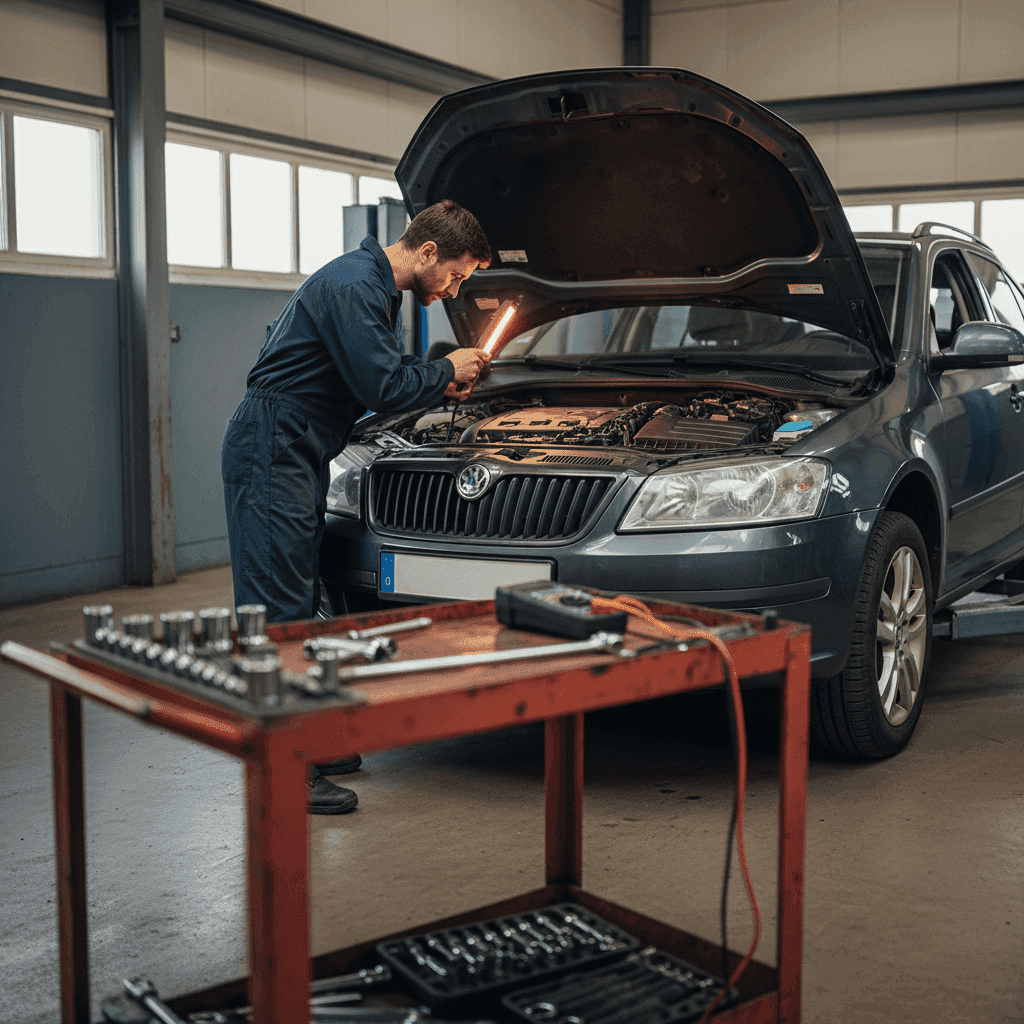
Nine out of ten cars registered in BiH in February 2026 were used vehicles - to be precise, of the 6,858 passenger cars registered, only 752 were new. That means virtually everyone buying a car in Banja Luka, Sarajevo or Tuzla is choosing a used compact. At the Auto Gas Gaga workshop we see the same three or four engines every week coming in with the same fault, and another three or four that behave as if they had 50,000 km less on the clock than the odometer shows.
Table of Contents
- What the Used Car Market in BiH Looks Like in 2026
- Three Engines We Recommend
- Three Engines to Avoid at All Costs
- Škoda Octavia III: Why It's Still the Sales Leader
- VW Golf VII and Seat Leon III: What to Check Before Buying
- Renault Megane IV and Dacia Duster: Budget Options With LPG Potential
- What ADAC Says About Three-Year-Old Cars in 2026
- Pre-Purchase Checklist: Service Book, DSG, Chain, Cooler
- Frequently Asked Questions
- Related Articles
What the Used Car Market in BiH Looks Like in 2026
In its February 2026 analysis, the automobili.ba portal confirmed the ratio every mechanic already knows from practice: for every new vehicle there are nine used ones. The single best-selling model is the third-generation Škoda Octavia, listed around 11,000 KM depending on mileage and engine. Behind it are the VW Golf VII, Passat B8, Audi A3 8V and Seat Leon III - almost the entire top list comes from the same VAG group.
When the market leans so heavily on one family of engines and gearboxes, it becomes important to know which combinations are genuinely reliable. In this article a used compact means the C-segment from the 2018-2023 period: Octavia III facelift, Golf VII and VIII, Leon III, Audi A3 8V, Megane IV, 308 II, Duster II.
Three Engines We Recommend
When someone asks us what to buy used, the list is short. Three engines that year after year come out of the workshop in good condition are the 2.0 TDI from the VAG family (engine codes CRBC, DFGA, DGCA), the Renault 1.5 dCi in its latest evolutions (Euro 6d, from 2019 onwards), and the 1.5 TSI MHEV mild-hybrid from Škoda/VW in the Octavia IV and Golf VIII.
VW 2.0 TDI is the workhorse of the segment. In the Audi A3 8V body it sips 4-5 litres per 100 km on the open road and clears 300,000 km without drama as long as the oil is changed every 15,000 km and the DPF isn't allowed to clog. In the Golf VII and Octavia III it performs the same, but only in combination with a manual gearbox or a properly maintained DSG.
Renault 1.5 dCi in the Megane IV generation after 2019 received serious improvements to the EGR, turbocharger and injectors. It uses 4.5 to 5 litres, doesn't demand exotic spare parts and handles city driving better than its predecessors. For a driver covering more than 20,000 km a year it's a sensible option.
1.5 TSI MHEV is the only new petrol unit from the VAG line-up we recommend without reservation. The mild-hybrid system takes load off the engine in the city, consumption stays around 6 litres, and the engine uses a reliable timing chain instead of a belt-in-oil. It carries the same caveats as any direct-injection petrol engine, but the underlying design is sound.
Three Engines to Avoid at All Costs
On the other side of the list are the engines we see in the workshop two or three times a week, always with the same story. The Peugeot 308 II with the 1.2 PureTech petrol is first. That engine uses a timing belt that runs submerged in oil, and once the belt starts to break down, tiny rubber particles travel through the lubrication system. The outcome is a damaged engine and a repair bill in the 3,000 to 5,000 KM range - and often higher in BiH because of the wait for parts.
The second engine we steer clear of is the older generation 1.4 TSI EA111 with a timing chain notorious for stretching. The third is the 1.2 THP from the earlier BMW-Peugeot collaboration, which also appears in the Mini Cooper of the same period. All three share the fact that the repair often exceeds the market value of the car, especially once the car is more than five years old.
The advice is simple: before you put down a deposit, compare the engine code against this list. If it's one of the problematic blocks, the cheaper price disappears with the first major repair.
Škoda Octavia III: Why It's Still the Sales Leader
The Octavia III, built from 2013 with a 2017 facelift, owes its popularity to the combination of a practical body, solid VAG engines and a price 20-30% below the equivalent Passat or A3. A budget of around 11,000-14,000 KM buys a car with 200,000 km on the clock that, with regular maintenance, still has at least another hundred thousand ahead of it.
The ideal choice is the 2.0 TDI with a manual gearbox or the 1.5 TSI with a manual. Versions with the DSG7 DQ200 gearbox require an oil change every 60,000 km, and if the previous owner skipped it, the first bill can be steep. You should also inspect the EGR cooler, a well-known weak spot on early Octavia III diesels. The newer Octavia IV with the 1.5 TSI MHEV is out of reach for anyone shopping for a used car now, but once it drops towards 20,000 KM it will be a first-rate option in the coming years.
VW Golf VII and Seat Leon III: What to Check Before Buying
The Golf VII and Seat Leon III share the same MQB platform as the Octavia III, which means the same engines, the same gearboxes and the same weak points. On the Golf VII, look for a service book showing the DSG oil change, check the timing chain on the 1.4 TSI EA211 generation (if the engine rattles on a cold start, the chain has probably stretched), and inspect the vacuum pump on diesel units.
The Seat Leon III is technically the same car with a sportier character. Prices are usually 1,000-2,000 KM below the Golf for the same year and mileage, making it a better buy for anyone who isn't chasing brand resale value. The rule here is the same - the 2.0 TDI or 1.5 TSI MHEV with a manual is the safest bet, and a well-serviced dual-clutch DSG is also fine.
The S-tronic seven-speed automatic in the Audi A3 8V is known to fail around 200,000 km, and the repair is measured in thousands of euros. If you're looking at an A3 with DSG and high mileage, negotiate the price hard or find another example. We cover those symptoms in more detail in our guide to the gearbox and clutch.
Renault Megane IV and Dacia Duster: Budget Options With LPG Potential
If your budget is under 10,000 KM, the VAG options quickly turn into a gamble. That's where the Renault Megane IV and Dacia Duster II come in, with the caveat that not every generation is worth looking at. On the Megane IV the choice is simple: the 1.5 dCi Euro 6d (from 2019) is a decent diesel, and the 1.3 TCe petrol developed with Mercedes is a worthy alternative. The earlier 1.2 TCe suffers from oil consumption problems similar to some VAG TSI engines, so it's worth avoiding.
The Dacia Duster II is a story of its own. The new Duster ECO-G 1.0 factory LPG version produces 100 hp, reaches 100 km/h in 13.2 seconds and consumes 7.9 l/100 km on gas, with a price starting from 49,900 KM in BiH. On the used market you'll find Duster II from 2018-2022 with the 1.6 SCe petrol, which is a good match for a retrofit autogas conversion - an ideal candidate for a fifth-generation LPG system. The same applies to the 1.5 TSI petrol in VAG models: a properly installed gas system cuts fuel costs by around a third, and the engine design handles it without issue. For more on what we check before installation, see the guide which vehicle is suitable for autogas, and the full cost-benefit picture is covered in the article on autogas in 2026.
What we don't do, and don't recommend any honest workshop to do, is install gas on engines where the manufacturer itself warns against it. The best-known example is precisely the 1.2 PureTech. That engine already has its own drama with the belt-in-oil timing system, and stacking an LPG installation on top of that solves nothing and raises the risk.
What ADAC Says About Three-Year-Old Cars in 2026
In a study published in April 2026, ADAC analysed 171 three-year-old models with mileage up to 33,000 km. Their headline conclusion is that below 12,000 euros (around 23,500 KM) no car meets their recommendations for a three-year-old. What does that mean for a buyer in BiH? That ADAC's advice should be read as a reference point for the German market, not as a rule that applies directly - here used cars are usually bought below exactly that threshold.
In the mid-size class, ADAC recommends the VW Golf 2.0 TDI at 20,843 euros and the VW Golf Variant 2.0 TDI DSG as the best family choice at 26,670 euros. Both picks confirm what we see in the workshop: the 2.0 TDI in the MQB body, maintained by the book and with no skipped oil changes, is an engine that deserves trust in 2026 as well.
ADAC also regularly removes models from its list when a particular engine generation has had a series fault. If a used-car ad sounds too good at that price, it's worth checking exactly which engine and which revision is involved.
Pre-Purchase Checklist: Service Book, DSG, Chain, Cooler
When a client brings a candidate car to Auto Gas Gaga for a pre-purchase inspection, we run the same list every time. It doesn't guarantee the car won't surprise you, but it sharply reduces the odds that you'll be paying a four-figure bill six months later.
Service book and invoices. A 15,000 km oil change for the diesel and a 60,000 km DSG oil change have to be documented. If the seller says "I did it myself, I don't have receipts", weigh the risk and either walk away or cut the price by 1,500 KM.
DSG gearbox. Ask for a test drive with the gearbox cold. Jerks when engaging a gear, a delay as the car sets off, or grinding on downshifts all point to wear in the dual-clutch pack. That's a repair measured in thousands of euros.
Timing chain (TSI engines). On a cold start the engine must not knock or produce a metallic rattle in the first few seconds. If it does, the chain has stretched. There's more on this in our article on when a timing chain or belt needs replacing.
EGR and engine cooler. Coolant weeping around the EGR module on TDI engines is a known fault. A look at the underside of the engine from the lift reveals it in five minutes.
OBD diagnostics. Scan every module, not just the engine. Look for historic fault codes and the DPF regeneration counter. If the regeneration count is disproportionately high, the DPF is near the end of its life.
An inspection that covers all of this costs less than the smallest repair you'll avoid.
Used compacts from 2018-2023 in BiH are mostly former leasing examples from German and Austrian fleets, often with five or six drivers over three years, high annual mileage, and possibly a repaired collision before the lease return. None of that history shows up in the BiH paperwork or in the service book the seller hands you. The easiest way to pull a documented vehicle history by chassis number is through carVertical: mileage readings dated from international registries, recorded accidents and repairs, the number of previous owners and countries of registration, plus any theft or total-loss flags. We treat it as a basic layer of defence before you put a deposit on any imported example in this segment, because a physical inspection on the lift and the car's history do two different jobs. When you pay for the report you can use code GAGA to get a 20% discount.
Frequently Asked Questions
Which used compact has the fewest problems in the 2018-2023 period?
Based on workshop experience, the Škoda Octavia III with the 2.0 TDI engine (codes CRBC/DFGA) paired with a manual gearbox shows the fewest problems. The engine comfortably clears 300,000 km when the oil is changed every 15,000 km and the DPF is allowed to finish its regenerations.
Is it worth buying a diesel with high mileage?
It's worth it if there's a complete service book, if the owner drove mostly outside the city, and if the 2.0 TDI has no history of EGR or injector faults. A well-maintained diesel with 250,000 km is a better investment than a 1.2 PureTech with 80,000 km.
How much does an LPG retrofit cost on a used petrol car?
Installing a quality fifth-generation LPG system in BiH typically ranges from 1,800 to 2,600 KM, depending on the number of cylinders, tank type and any additional components. For a driver covering more than 20,000 km a year, the cost pays back in 12 to 18 months.
Is the Peugeot 308 II really as bad as people say?
The Peugeot 308 II with the 1.6 BlueHDi diesel is a decent car. The problematic version is the one with the 1.2 PureTech petrol because of the belt-in-oil timing setup, whose failure leads to a repair bill of 3,000 to 5,000 KM. If you're after a 308, choose the diesel or consider another model.
How much should you set aside for a pre-purchase inspection?
In Banja Luka a detailed inspection with diagnostics runs from 60 to 120 KM, depending on scope. That cost almost always uncovers at least one item that justifies negotiating the price down or walking away from the purchase.
How do you spot a DSG gearbox that won't last much longer?
The first signs are jerks when setting off from a standstill, a sense of "slipping" during gear changes, and a delay between pressing the accelerator and the car's response. If the car has had a DSG oil change in the last 60,000 km, the risk is lower; if not, look for another candidate.