
TL;DR:
Electronic diagnostics enables fast and precise fault detection through the vehicle's computer modules.
Professional tools read every module and provide detailed data, while basic OBD2 devices have real limitations.
The mechanic's experience and a proper methodical approach are key to an accurate conclusion and an effective repair.
Your car carries dozens of computer modules that constantly monitor the engine, transmission, brakes, emissions, and much more. When a warning light comes on, many drivers don't really know what it means or what happens next. Electronic diagnostics is the process by which specialists read that information directly from the vehicle's computers, without guesswork and without unnecessary disassembly. The difference between a good and a bad workshop often comes down to how precisely and methodically they use diagnostic tools. In this article you'll learn what electronic diagnostics is, what it looks like step by step, which devices are reliable, and when to be cautious.
Table of Contents
Key Takeaways
| Point | Details |
|---|---|
| Diagnostics saves time and money | Timely and precise electronic diagnostics enables faster resolution of vehicle faults. |
| Not all devices are equal | Home OBD readers are limited - the best results come from a workshop using professional tools. |
| An experienced mechanic is essential | Even the most modern tool isn't enough without a specialist who interprets the data and knows the real cause. |
| Don't clear codes straight away | Hastily clearing codes only masks the underlying problem, so this should be avoided. |
What Is Electronic Diagnostics and Why Does It Matter
Electronic diagnostics is a procedure in which a specialised device is connected to the vehicle and communicates with its control units, known as ECUs (Electronic Control Units). Each control unit monitors specific parameters and logs errors when something deviates from normal values. The diagnostic device reads those errors and displays them to the mechanic as codes or descriptions.
This isn't just about hunting for faults. Electronic diagnostics gives you a view of "live data" while the engine is running, which means the mechanic can see how values such as temperature, fuel pressure, sensor voltage, and RPM change in real time. That's far more precise than a visual assessment or listening for noises.
The advantages of this approach are clear:
-
Faster fault detection because the issue is located without disassembling parts
-
More precise repairs because you know exactly which sensor, circuit, or component is involved
-
Lower costs because parts aren't replaced "blindly"
-
A record of the vehicle's condition that helps with future servicing
-
Emissions checks that are mandatory for technical inspection
It's important to understand one thing: an error in the system doesn't always mean the component is physically broken. It points to the direction of investigation. For example, an oxygen sensor error can be caused by a faulty sensor, but also by a leak in the exhaust system, or even by a fuel injection issue. An experienced mechanic uses the code as a starting point, not as a final answer.
Common problems that vehicle diagnostics uncovers include faulty temperature or oxygen sensors, DPF filter issues, ignition system errors, electrical disturbances in cables and connectors, and transmission control faults.
Experienced mechanics stress that a proper diagnostic methodology must include a visual inspection of connectors and the battery, a live data test, freeze frame analysis, and a road test. According to OBD2 diagnostics, codes should never be cleared before the cause of the fault has been confirmed and resolved.
All service offerings that include diagnostics should follow this structured approach, because only then do you get reliable results and a genuine solution to the problem.
How the Electronic Diagnostic Process Actually Works
When you bring the vehicle into the workshop, diagnostics doesn't start with plugging in the device straight away. There is a logical sequence of steps that ensures nothing is missed and that the error is properly interpreted.
-
Visual inspection is always the first step. The mechanic checks cables, connectors, the battery, and visible parts of the wiring. A damaged connector or corroded battery terminal can cause false errors in the system, so it's important to rule those factors out before electronic testing.
-
Connecting the OBD2 device to the vehicle's diagnostic port. This port is located under the steering wheel, usually on the left side. Every vehicle manufactured after 2001 in Europe must have this standardised port under the EOBD (European On-Board Diagnostics) standard.
-
Reading the trouble codes stored by the control modules. Each code has a letter-and-number structure - for example, P0300 indicates a misfire, and P0420 a catalyst issue. The mechanic reads all active and stored codes.
-
Analysing live data while the engine is running. This is arguably the most important step, because it shows how the system behaves in real time. Values such as lambda sensor voltage, coolant temperature, and intake manifold pressure say far more than the trouble code alone.
-
Freeze frame analysis, which shows the exact conditions when the error first appeared, including speed, RPM, and engine temperature.
-
A road test to confirm the error under real driving conditions. Some faults don't show up at idle, only under specific load or temperature.
According to OBD2 diagnostic practice in the region, codes must not be cleared until the cause is confirmed and resolved, because clearing them erases valuable history of the fault.
Professional tip: When you bring the vehicle in for diagnostics, don't clear the codes with a home reader before you arrive at the workshop. The mechanic needs all the data, including intermittent codes, because they also tell a story about the vehicle's condition.
When choosing a reliable workshop, always check whether they use professional diagnostic tools and whether they follow this structured approach, because that directly affects the quality and accuracy of the diagnosis.
Device Types: Basic Code Readers vs Professional Tools
Not every diagnostic device is the same. The differences between basic and professional tools are significant and directly affect how much information you can get about your vehicle's condition.
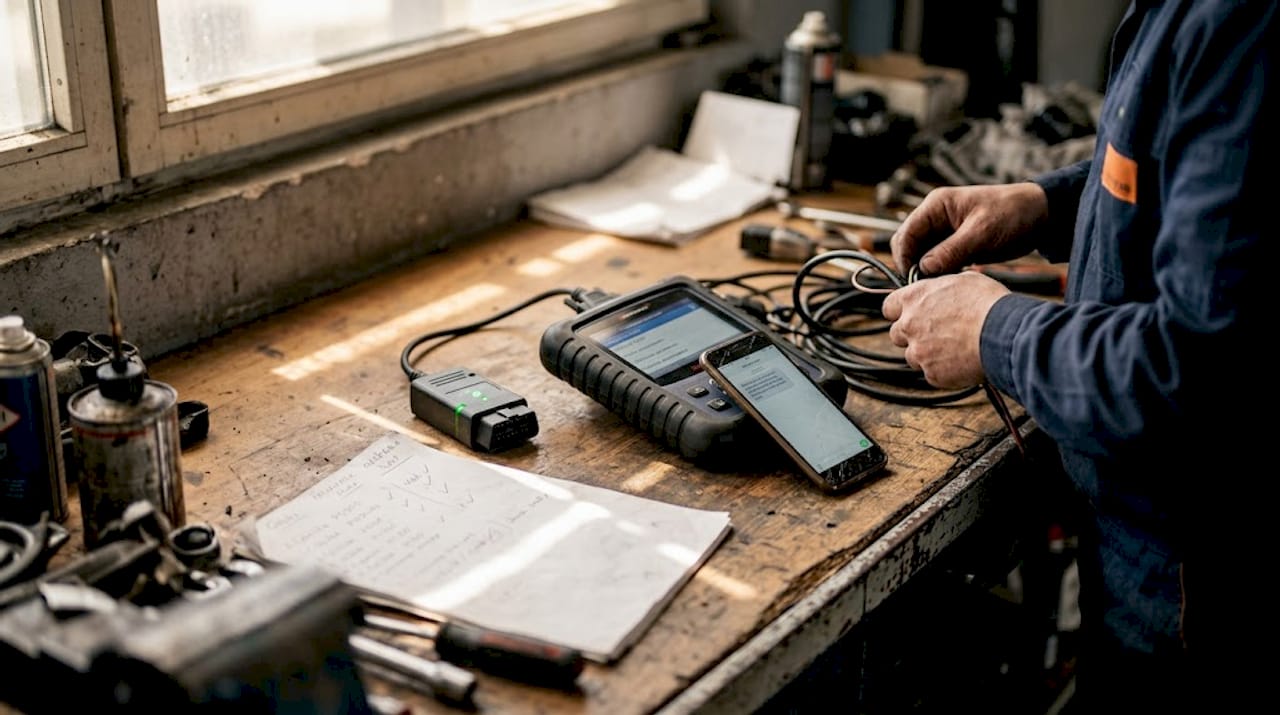
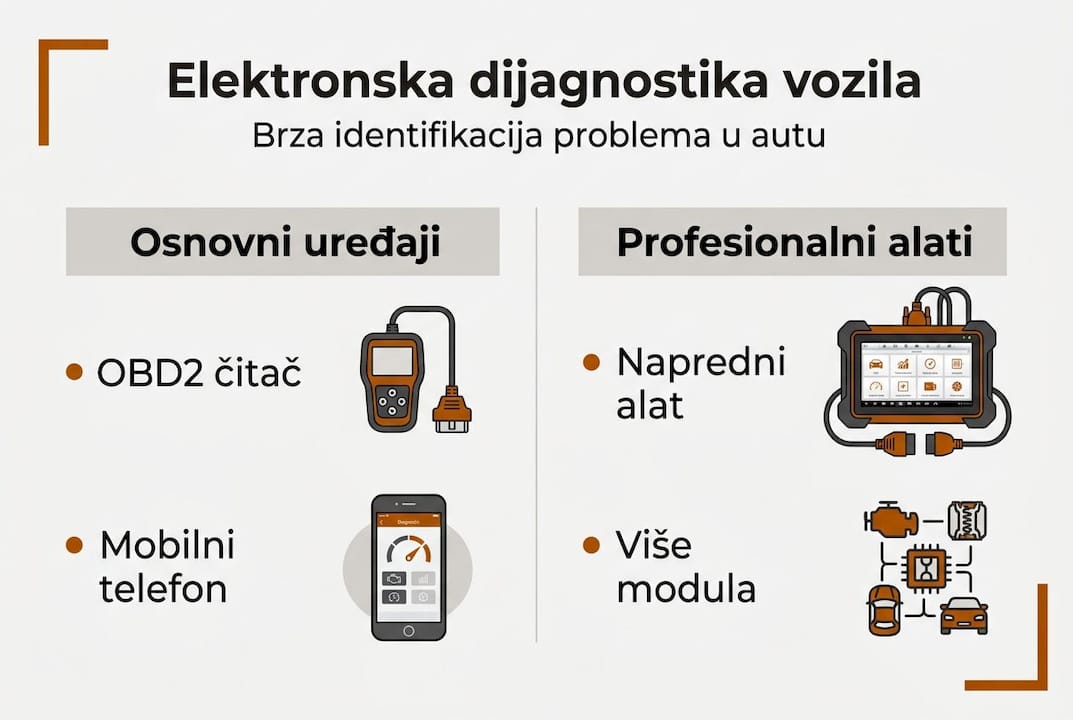
Basic OBD2 adapters, like the popular ELM327 that connects to your phone via Bluetooth, are available for just a few dozen euros. They can read generic trouble codes and some live data. For owners who want a quick check of a single warning light, that can be useful. However, their limitations are serious.
| Feature | Basic OBD2 reader | Professional tool |
|---|---|---|
| Module access | Engine and transmission only | All modules (ABS, airbag, climate...) |
| Code type | Generic only (P0xxx) | Generic and manufacturer codes |
| Live data | Limited number of parameters | Full parameter set |
| Freeze frame | Basic | Detailed, multiple frames |
| Programming | No | Yes (in some cases) |
| Price | 10 to 50 EUR | 500 to 5000+ EUR |
As hands-on OBD2 experience shows, basic adapters are cheap and accessible for owners, but they're limited to generic codes and don't reach every module in the vehicle. Professional workshops use advanced tools that also read manufacturer-specific codes.
Additionally, the basics of vehicle diagnostics clearly distinguish generic codes (P0xxx) - which every device can read - from manufacturer codes (e.g. P1xxx or B, C, U codes), which only specialised tools can read. This matters especially for newer vehicles with complex electronic systems.
For example, an ABS or airbag module fault won't show up on a cheap OBD2 adapter. An automatic transmission control fault may only be visible with the manufacturer's tool for that specific carmaker. This means an owner using a home reader can get a false sense of security, believing there are no errors while in fact there are errors in modules the device simply can't read.
Professional tip: A home OBD2 reader can be useful as a first indication, but never make a final repair decision based on it. Always confirm the findings at a workshop with a professional tool that covers every module in your vehicle.
For a complete assessment of the vehicle's condition, professional workshop services remain the only reliable option.
Common Errors, False Alarms, and Diagnostic Limitations
Electronic diagnostics is a powerful tool, but it has limitations that are important to understand so you don't draw the wrong conclusions.
The most common errors that diagnostic devices detect on vehicles in our region include:
| Error code | Description | Possible cause |
|---|---|---|
| P0300 | Misfire | Spark plugs, coils, fuel |
| P0420 | Catalyst efficiency | Catalyst, lambda sensor |
| P0171 | Lean mixture | Air leak, flow sensor |
| P0401 | Insufficient EGR flow | EGR valve, pipe |
| U0100 | Loss of communication with ECU | Cables, connectors, ECU |
False alarms are a particular challenge, especially on older vehicles. According to the basics of diagnostics, false errors are common on vehicles with more than 150,000 kilometres, where worn wiring, corroded connectors, and older sensors generate codes that don't match the actual fault.
For example, a coolant temperature sensor that's borderline can intermittently send wrong values, triggering a system error even though the engine runs normally. Without an experienced mechanic who understands the context, an owner might needlessly replace an expensive component.
There are also situations where the same error can have dozens of different causes. A P0171 code (lean mixture) can be caused by a leaking intake hose, a faulty mass air flow sensor, clogged injectors, a fuel pressure regulator problem, or even bad fuel. With faults like typical Audi A4 issues or Opel Astra faults, experience with the specific model is invaluable.
-
Always check the fault history, not just active codes
-
Don't clear codes until you know the cause
-
Seek confirmation of the fault through live data and a road test
-
Consult a specialist when the code isn't unambiguous
It's especially important to know what to do when the check engine light comes on. Information on whether you can drive with the light on can help you make the right call and avoid major engine damage.
Electronic diagnostics tells you where to look for the problem, but not always exactly what to fix. Interpreting the data takes knowledge and experience that no device on its own can replace.
Why Experience and Expertise Matter More Than the Device
Over the years in our workshop we've seen plenty of cases where an owner brought the car in with a "diagnosis" made using a home reader and a part already bought - a part that wasn't actually needed. The device showed a code, the owner drew conclusions about the fault and bought a replacement part, while the real cause was somewhere else entirely.
That taught us one important thing: a diagnostic device is a tool, not an expert. Even the most expensive professional tool can't replace a mechanic who knows how a particular engine behaves under particular conditions, who has seen the same problem twenty times, and who knows that a P0420 code on a given model almost always means a failed lambda sensor rather than the catalyst itself.
An experienced mechanic is the difference between an accurate diagnosis and expensive guesswork. Data is only raw material; knowledge is what turns it into the right solution. That's why you should always choose a workshop where the mechanic explains what they found and why, rather than just showing you a trouble code.
Connect Your Vehicle's Diagnostics to the Right Solution
If you have a warning light on, hear an unusual noise, or suspect something isn't right with your vehicle, don't wait for the problem to get worse. Timely diagnostics saves money and prevents bigger failures.
At the Auto Gas Gaga workshop in Banja Luka, active since 1996, we use professional diagnostic tools that cover every module in the vehicle. Our mechanics don't just read codes; they interpret them, confirm them, and fix the cause, not the symptom. Book a professional diagnostic session or reach out to our Banja Luka auto mechanic team for advice. No guesswork, no unnecessary costs.
Frequently Asked Questions About Electronic Diagnostics
Can basic OBD readers detect every fault?
Basic OBD readers only detect generic codes and don't access every module in the vehicle. Based on ELM327 experience, professional tools are essential for complete diagnostics of all systems.
Why shouldn't you clear codes right after diagnostics?
Clearing codes before repair loses the trail of the fault's cause and makes reliable problem identification harder. According to OBD2 specialists, codes should be preserved until the cause is confirmed and resolved.
What does a 'freeze frame' error entry mean?
A "freeze frame" shows the exact conditions under which the fault first appeared, such as engine RPM, temperature, and driving speed, which helps the mechanic accurately reconstruct the situation and reach a correct diagnosis.
How reliable is electronic diagnostics on older cars?
On older vehicles with more than 150,000 kilometres, false readings are more likely due to worn wiring. According to the basics of diagnostics, such vehicles require extra verification and the mechanic's experience for correct interpretation of the results.