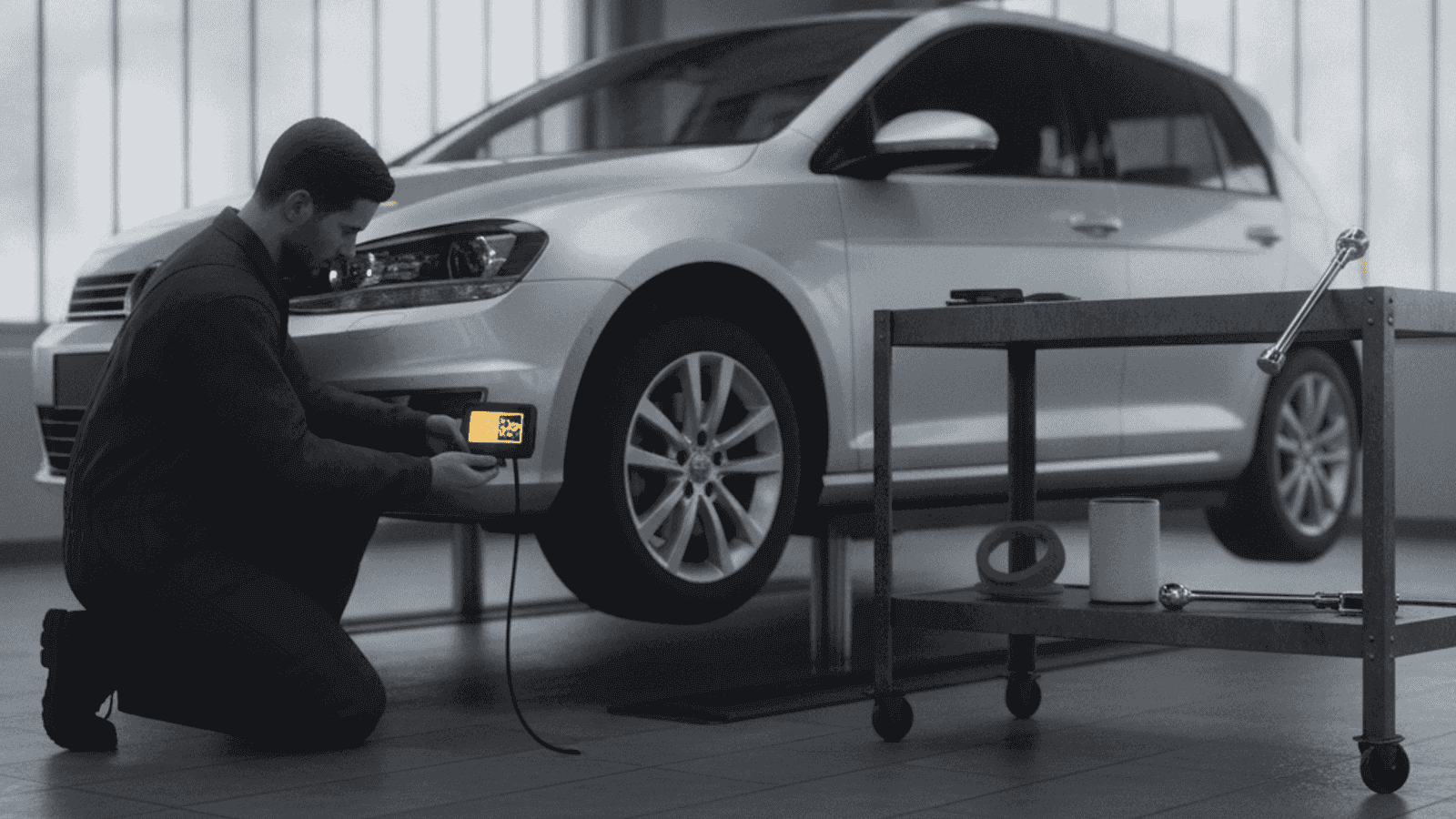
The average car in BiH covers around 15,000 kilometres a year and burns somewhere between 7 and 9 litres per 100 km. With fuel prices as of 15 June 2026 (diesel 3.03 KM/L, B95 petrol 2.91 KM/L), that works out to an annual fuel bill of 3,000 to 4,000 KM. Neglected maintenance that increases fuel consumption can push that figure up by 15-25%, meaning you throw away 500 to 1,000 KM every year on fuel you did not need to burn. This guide walks through the specific service items that directly affect consumption, with the percentage impact of each one and realistic KM savings tailored to BiH conditions.
This guide was compiled by the Auto Gas Gaga workshop in Banja Luka, based on years of service experience and fuel-consumption measurements on customer vehicles before and after maintenance work.
Table of Contents
- How Much Neglected Maintenance Really Costs in Fuel
- Tyre Pressure as the Simplest Saving
- Wheel Alignment and Uneven Tyre Wear
- Engine Oil, Viscosity and Change Interval
- Air Filter, Fuel Filter and Spark Plugs
- Lambda Sensor and the Check Engine Light
- Brakes That Do Not Fully Release
- Fuel-Saving Service Plan by Mileage
- How Much You Can Realistically Save per Year
- Frequently Asked Questions
- Related Articles
How Much Neglected Maintenance Really Costs in Fuel
Most drivers in BiH think of maintenance as an expense. Oil, filters, tyres, spark plugs, alignment. It all costs money, and the natural instinct is to postpone spending as long as possible. The problem is that neglected maintenance does not wait. It starts charging you immediately, not through a workshop invoice but through a bigger bill at the fuel pump.
The US Department of Energy (DOE) has published data that spells out exactly how individual service items affect consumption. An engine that is out of tune improves efficiency by an average of 4% once corrected. Using the wrong oil viscosity cuts fuel economy by 1-2%. A faulty oxygen sensor can raise consumption by up to 40% in the worst case. When you add up all the small things that accumulate on a typical car with 150,000 to 200,000 km and postponed services, an overall loss of 10-20% in fuel economy is not an exaggeration at all.
For a car that burns 8 litres per 100 km and covers 15,000 km a year, a 10% increase in consumption means 120 extra litres of fuel. At June 2026 petrol prices (2.91 KM/L), that is roughly 350 KM per year. At 20% extra, the figure exceeds 700 KM. Ironically, the amount you save by postponing a service is often less than what it costs you in fuel. And that is before accounting for accelerated part wear that makes the next repair even more expensive.
Tyre Pressure as the Simplest Saving
This is an item that requires zero money and five minutes of your time, yet delivers a measurable result. According to data from fueleconomy.gov (the joint DOE/EPA platform in the US), every 1 PSI drop across all tyres reduces fuel economy by approximately 0.2%. Properly inflated tyres improve consumption by an average of 0.6%, and in some cases by up to 3%.

When pressure is 0.5 bar below the recommended level, the tyre deforms, its contact patch grows and rolling resistance increases. Consumption in that scenario can rise by up to 4%. Over 15,000 km a year at an average consumption of 8 L/100 km, that is 48 litres of fuel. On diesel at 3.03 KM/L, that comes to roughly 145 KM.
The recommended pressure is always stated on a sticker inside the driver's door frame or in the owner's manual. Check it at least once a month and always on cold tyres, before driving. Compressors at larger filling stations are free, and a handheld digital gauge costs less than a single tank of fuel. For comprehensive advice on pressures, seasonal tyres and signs of wear, see our tyre and pressure guide.
Wheel Alignment and Uneven Tyre Wear
Faulty alignment works similarly to low pressure, except the effect is even greater and harder to spot without specialist equipment. When the wheels are shifted out of their optimal position, the tyre does not roll cleanly on the road surface but is partially dragged sideways across the tarmac. The engine has to overcome that extra resistance, and that costs fuel.
According to data from fuelconsumptioncalculator.com, slight misalignment of one degree increases consumption by 3-4%. Moderate misalignment of two degrees pushes it up by 7-8%, while severe misalignment of three degrees or more costs over 10% extra fuel. At the same time, tyres wear unevenly: the inner or outer edge disappears quickly while the rest of the tread still has depth. Instead of a set of tyres lasting 50,000 to 60,000 km, with poor alignment you replace them after 20,000 to 30,000 km.
Alignment should be checked every time you fit new tyres, after hitting a pothole or a kerb, or whenever you notice the car pulling to one side on a straight road. A detailed guide covering symptoms and the adjustment procedure (toe, camber, caster) is available in the article on wheel alignment.
Engine Oil, Viscosity and Change Interval
Engine oil serves for lubrication but also for reducing friction inside the engine. Friction is the direct enemy of fuel economy because every joule of energy lost to friction is a joule that does not push the car forward. As oil ages it loses its properties and friction increases. If the viscosity is wrong, the engine works harder than it should.
The DOE figure is specific: using engine oil of the wrong viscosity can cut fuel economy by 1-2%. That may not sound like much, but it is a loss that persists continuously, on every kilometre, from the moment the wrong oil enters the engine until the next change. Over a year with 15,000 km and consumption of 8 L/100 km, 1.5% extra is 18 litres of fuel, roughly 52 KM on petrol.
The manufacturer has prescribed the exact oil specification for every engine. Knowing just 5W30 or 5W40 is not enough; the standard matters too (e.g. VW 504.00/507.00, BMW LL-04, MB 229.51). If you are unsure what your engine requires, see our engine oil selection guide. As for change intervals, under BiH conditions the optimum is 10,000-15,000 km or once a year, regardless of what the longlife programme says. More detail on all fluid and filter intervals is in the oil, filter and fluid change interval overview.
Air Filter, Fuel Filter and Spark Plugs
This is the trio most commonly neglected because the parts are cheap, so drivers leave them "for next time". The problem is that each one affects engine operation in its own way.
Air Filter and the Truth About Consumption
There is a widespread belief that a clogged air filter increases fuel consumption. That is partly true, but only for older carburettor engines. A 2009 study by Oak Ridge National Laboratory (ORNL/TM-2009/021), funded by the US DOE, tested the impact of a clogged air filter on modern vehicles with electronic fuel injection. The result: replacing a clogged filter on a modern engine does not improve fuel consumption. The reason is straightforward. The electronic engine management system automatically adjusts the mixture according to the amount of air the sensor detects. If the filter is clogged, the engine injects less fuel in proportion to the reduced airflow.
What a clogged air filter did worsen in that study was acceleration, by 6-11%. An engine with a clogged filter simply cannot inhale enough air to produce full power. In practice that means a sluggish car, longer overtaking manoeuvres and more throttle on inclines, which can indirectly raise consumption because the driver compensates for the power loss by pressing the pedal harder. On BiH roads, especially in hilly terrain, that is not a negligible factor. Older carburettor cars (of which some still remain on BiH roads, though fewer every year) face a different situation because the carburettor does not correct the mixture automatically, so a clogged filter genuinely raises consumption directly. More on symptoms and replacement intervals in the air filter guide.
Diesel Fuel Filter
The diesel fuel filter should be replaced every 40,000 to 60,000 km. A clogged fuel filter directly affects engine operation because the high-pressure pump must work under greater load to force enough fuel through the blocked element. That means higher electrical energy consumption (generated by the alternator, which loads the engine), as well as altered combustion conditions because pressure and fuel atomisation are compromised. For diesel drivers, this is one of the most important items in a regular service schedule. More detail on the diesel fuel filter, clogging symptoms and system bleeding is available here.
Spark Plugs on Petrol Engines
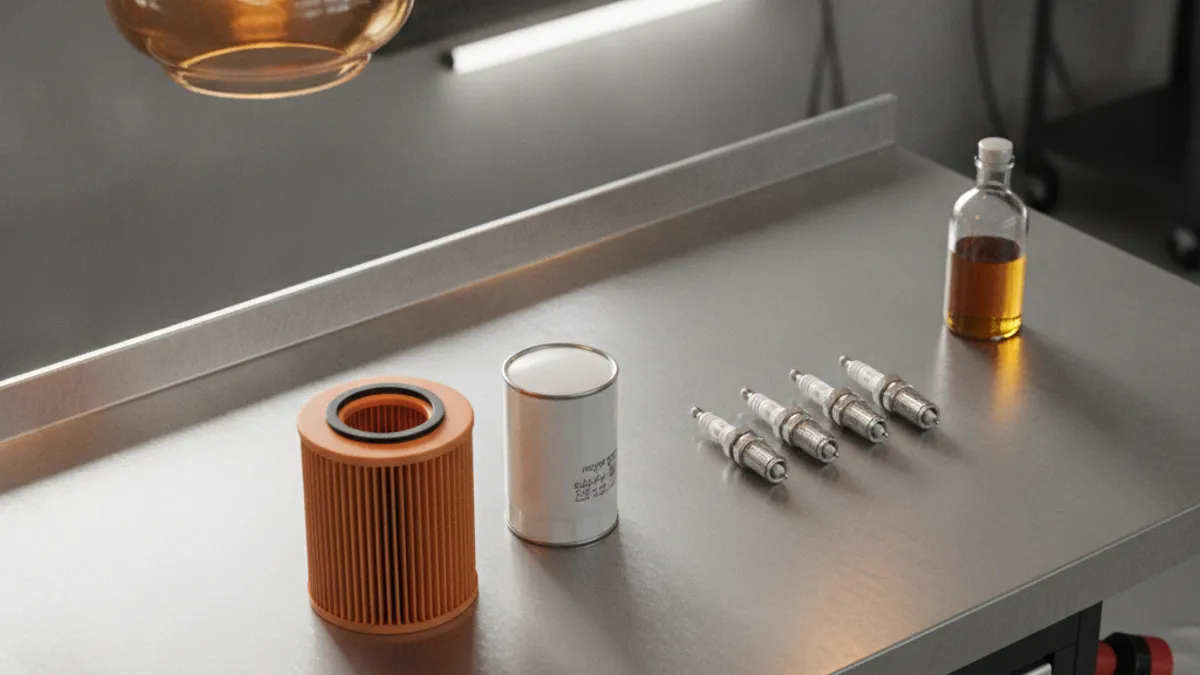
Spark plugs are a component many people forget about until the engine starts shaking or becomes hard to start. A worn spark plug does not ignite the mixture fully and correctly on every stroke, which means incomplete combustion, power loss and higher fuel consumption. Together with clogged filters, a faulty ignition system can raise consumption by up to 10%. Standard copper-nickel plugs last 20,000-40,000 km; iridium and platinum plugs last 60,000-100,000 km. A full explanation of symptoms, types and selection is in our spark plug guide.
Lambda Sensor and the Check Engine Light
The lambda sensor (oxygen sensor) sits in the exhaust and measures how much oxygen is present in the exhaust gases. Based on its reading, the ECU regulates the amount of injected fuel. When the lambda sensor is working correctly, the air-fuel mixture is constantly fine-tuned in real time, stroke by stroke.
According to US DOE data, a faulty oxygen sensor can worsen fuel consumption by up to 40%. That is a worst-case scenario, not typical, but it does happen. In practice, drivers with a faulty lambda sensor usually notice 10-20% higher consumption, and the engine runs in so-called "open loop" mode where it uses pre-programmed values instead of actual measurements. Almost invariably the check engine light comes on as well. If your check engine light is on and consumption has jumped, do not delay diagnostics. Details on what that light means and whether you can keep driving are in the check engine light guide.
A faulty lambda sensor does not just waste fuel; it can destroy the catalytic converter because the rich mixture (excess fuel) breaks down on the catalyst and heats it far above its operating temperature. Replacing a catalytic converter is a far more expensive job than replacing the sensor. A full explanation of the lambda sensor's role, fault symptoms and diagnostics is in the lambda sensor article.
Brakes That Do Not Fully Release
This is a problem that most fuel-consumption guides never even mention, yet we see it regularly in the workshop. A seized brake caliper or a piston that does not retract fully means the pad is constantly pressing lightly against the disc. The engine has to overcome that resistance on every wheel rotation, which is like driving with the brake gently applied at all times.
The symptoms are subtle: the car feels slightly more sluggish than usual, one wheel nut area on the rim is noticeably hotter than the others after a drive, and sometimes you can detect a faint smell of heated brakes. Fuel consumption rises by 3-5% when one caliper is partially seized, and it can be more if two wheels are affected. Over a year, the amount adds up noticeably.
Regular brake servicing, which includes cleaning and lubricating the caliper slide pins, prevents this problem. A detailed guide on seized-caliper symptoms and prevention is in the seized brake caliper article.

Fuel-Saving Service Plan by Mileage
Rather than remembering each item individually, here is an overview that links maintenance items affecting fuel consumption to specific mileage thresholds.
| Mileage | What to check or replace | Impact on consumption |
|---|---|---|
| Every month | Tyre pressure | Up to 3-4% saving |
| 10,000-15,000 km | Engine oil and oil filter | 1-2% saving, engine protection |
| 20,000-30,000 km | Air filter, spark plugs (standard) | Acceleration, indirect consumption |
| 20,000-30,000 km | Wheel alignment (check) | 3-10% saving |
| 30,000-40,000 km | Brake system (caliper cleaning) | 3-5% saving |
| 40,000-60,000 km | Fuel filter (diesel) | Prevents pressure drop and higher consumption |
| 60,000-100,000 km | Spark plugs (iridium/platinum) | Up to 10% saving (combined with filters) |
| 80,000-150,000 km | Lambda sensor (check, possibly replace) | Up to 40% saving in extreme cases |
This schedule is not expensive. Most of the items are part of a standard minor or major service. The point is not to skip or postpone them, because every delayed item means the engine runs less efficiently in the meantime and burns fuel you did not need to spend.
How Much You Can Realistically Save per Year
Let us put numbers into context. Take an average BiH car: a petrol engine burning 8 L/100 km and covering 15,000 km a year. The price of B95 petrol as of 15 June 2026 is 2.91 KM/L. The annual fuel cost is approximately 3,492 KM.
| Maintenance item | Estimated saving | Annual saving (KM) |
|---|---|---|
| Correct tyre pressure | 2-3% | 70-105 KM |
| Correct wheel alignment | 3-5% (conservative) | 105-175 KM |
| Right oil, correct viscosity | 1-2% | 35-70 KM |
| Regularly replaced filters and spark plugs | 2-5% | 70-175 KM |
| Working lambda sensor | 0% (if working) to 20%+ (if not) | 0-700+ KM |
| Brakes that release properly | 0-5% | 0-175 KM |
The individual items should not simply be added up because the effects overlap, but the realistic overall difference between a well-maintained and a neglected car is 10-20% in fuel consumption. That is 350 to 700 KM a year on petrol. On diesel with consumption of 7 L/100 km and a diesel price of 3.03 KM/L, the annual fuel cost is around 3,182 KM, and a 10-20% saving amounts to 318-636 KM.
For a car running on LPG, fuel is cheaper (1.41 KM/L as of 15 June 2026), but the percentages are the same. Someone burning 10 L/100 km on LPG and covering 15,000 km has an annual fuel cost of roughly 2,115 KM. A 10-20% saving means 212-423 KM. Less in absolute terms, but enough for two complete minor services. For a detailed breakdown of how much air conditioning adds to consumption in summer and what every hour of compressor operation costs, see our article on A/C fuel consumption. And if you want tips on driving techniques that save fuel (anticipation, engine braking, pacing), we covered that in detail in the eco driving guide.
Maintenance that cuts fuel consumption is not a revolution. These are ordinary, well-known service items that most drivers need to do anyway; they just need to be done on time and properly. The difference between a car that is "sort of fine" and a car that is genuinely fine can be 50-70 litres of fuel a year on a single item, and hundreds of litres when everything is added up.
If you are not sure what condition your vehicle is in and how much neglected maintenance is costing you at the pump, book an inspection and we will go through every item together.
Frequently Asked Questions
How much can neglected maintenance increase fuel consumption?
According to US DOE data, neglected maintenance can increase fuel consumption by 10-20% across all items combined. Individually, the strongest impact comes from a faulty oxygen sensor (lambda sensor), which in the worst case raises consumption by up to 40%, followed by wheel alignment (3-10%) and low tyre pressure (up to 4%).
Does a clogged air filter increase fuel consumption?
On modern engines with electronic fuel injection, a clogged air filter does not increase fuel consumption directly. A study by Oak Ridge National Laboratory (ORNL, 2009) showed that the ECU automatically adjusts the mixture. However, a clogged filter reduces acceleration by 6-11%, which on hilly BiH roads can indirectly raise consumption because the driver has to press the throttle harder.
How often should tyre pressure be checked?
Once a month on cold tyres, before you start driving. A tyre naturally loses 0.5-1 PSI per month even when it is perfectly sound. Combined with temperature swings (which are pronounced in BiH, from -15 in winter to +40 in summer), pressure fluctuates further. Five minutes a month at a compressor can save over 100 KM in fuel per year.
Does the wrong oil really affect consumption?
Yes. Using oil of the wrong viscosity reduces fuel economy by 1-2% according to DOE data. That sounds small, but over a year with 15,000 km it is 35-70 KM. On top of that, the wrong oil accelerates engine wear, which in the long run worsens both consumption and mechanical integrity.
How do you tell if your brakes are wasting fuel?
The most common sign is that one area on the rim is noticeably hotter than the others after driving, or you detect a faint smell of heated brakes. The car may feel more sluggish than usual. Visually, the disc on the affected wheel may show heat marks (a bluish tint) or uneven pad wear. A seized caliper can cost 3-5% extra fuel.
How much can you realistically save per year on fuel through proper maintenance?
For an average petrol car in BiH (8 L/100 km, 15,000 km per year), the difference between a well-maintained and a neglected car is 350-700 KM per year in fuel. For a diesel at 7 L/100 km, the saving is 318-636 KM. These are realistic amounts that require no change in driving habits, just regular maintenance done on time.