
With the Federal Hydrometeorological Institute issuing an orange warning for the whole of BiH and temperatures between 33 and 40 degrees, your car is probably sitting in a car park with no shade whatsoever. ADAC tested seven identical Dacia Dusters, each fitted with a different sun protection method, and measured differences of up to 10 degrees. The results clearly show which methods work and which are a waste of money.
This guide was prepared by the Auto Gas Gaga workshop in Banja Luka, based on ADAC tests, years of hands-on service experience, and the real-world damage we see on cars that spend their summers baking in the sun.
Table of Contents
- How Fast Does a Car Heat Up in the Sun: Concrete Numbers
- What Sun and Heat Do to Your Car: Damage That Costs Dear
- ADAC Test: Seven Identical Cars and Five Protection Methods
- Protection Methods Ranked from Most to Least Effective
- How to Cool Down an Overheated Car Quickly
- Smart Parking: Free Protection Most Drivers Ignore
- Protecting the Interior from Long-Term Damage
- Car Sun Protection: What to Apply Right Now
- Frequently Asked Questions
- Related Articles
How Fast Does a Car Heat Up in the Sun: Concrete Numbers
At an outside temperature of just 28 degrees, a car's interior exceeds 50 degrees within half an hour. After one hour, it reaches 57 degrees inside. A completely unprotected car left in direct sunlight for four hours hits 53 degrees at the driver's seat. These are not laboratory conditions but a typical summer day when you leave your car in a shopping centre car park or at work.
What surprises most drivers, though, is not the cabin air temperature but the surface temperatures. The dashboard can reach 97 degrees. The steering wheel exceeds 70 degrees, enough to cause burns. A seatbelt buckle in direct sunlight becomes hot enough to leave a mark on a child's skin. The gear lever, handbrake handle, buttons on the centre console, everything becomes painful to touch after four hours in the sun.
How Hot Does a Dashboard Get in the Sun
A dark dashboard in direct sunlight absorbs nearly all solar energy and reaches temperatures above 70 degrees. A windscreen sunshade alone can reduce that temperature by up to 26 degrees. The difference is dramatic and explains why dashboard plastics crack and fade after a few summers without protection. Lighter-coloured dashboards heat up somewhat less, but still enough to accelerate material ageing.
Black vs White Car in the Sun: The Difference
ADAC measurements confirm what many suspect, but rarely with hard numbers: a black car has a surface temperature of 65 degrees versus 44 degrees for a white one. That is a 21-degree difference on the bodywork. Inside the cabin, the gap is smaller, around 5 degrees (53 versus 48 degrees), because the interior heats up regardless of body colour. If you are choosing a colour when buying a used car, this is a concrete argument for lighter shades, especially if the car often sits outdoors. Silver and white not only heat up less but also hide dust and minor paint blemishes better, which is an added bonus for practical drivers.
What Sun and Heat Do to Your Car: Damage That Costs Dear
Sunlight does more than cause discomfort; it actively destroys your car. UV radiation breaks down the chemical bonds in plastics, leather, and fabric throughout the interior. Dashboard polymers crack, fade, and deform. Leather seats dry out and split. Fabric loses its structural integrity. This does not happen in a single summer, but every summer without protection accelerates interior deterioration. Tinted windows block up to 99% of UV rays, which is precisely why they are far more than a cosmetic addition. If window tinting interests you, details on legal limits and prices in BiH can be found in our dedicated article on car window tinting.
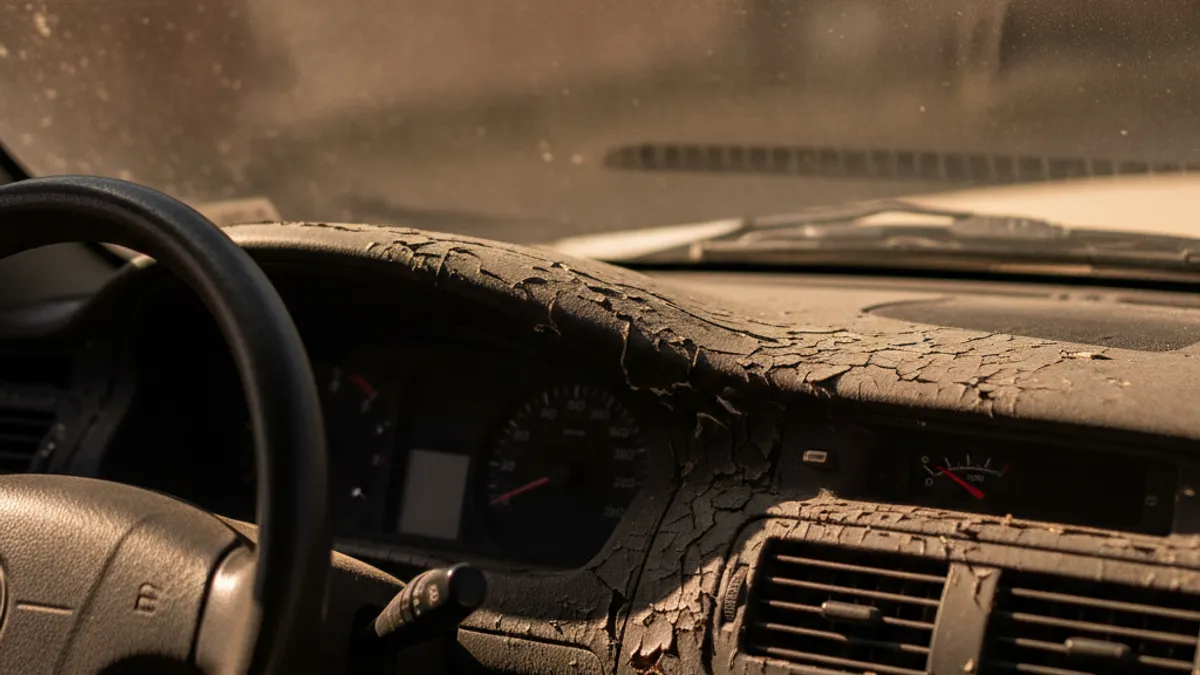
Heat also affects mechanical components that are not immediately visible. At high temperatures, the battery loses capacity faster because heat accelerates the chemical processes that degrade the internal plates. A battery that would last five years in a moderate climate can weaken in three if the car is constantly parked in the sun. Engine oil at extreme temperatures loses its optimal viscosity and provides weaker protection for the engine, which is especially critical for older vehicles with already worn engines. High road surface temperatures increase tyre pressure, and old or over-inflated tyres risk a blowout. We covered how heat affects your car while driving in detail in our guide to driving in extreme heat.
Rubber seals on windows, doors, and the bonnet gradually lose their elasticity from constant exposure to high temperatures. Once the rubber hardens, it starts letting in water when it rains and creates extra wind noise on the motorway. Replacing a full set of seals is a job most drivers never plan for, yet it could have been delayed by simply parking in the shade. Corrosion also accelerates when heat and humidity combine, and we wrote about stopping rust before it reaches the body shop in our dedicated guide to car rust.
The current heatwave sweeping across Europe, with temperatures up to 45 degrees in Spain and serious health warnings across the continent, makes the urgency of this topic abundantly clear. In France, during this very same heatwave, three children died in overheated cars. A car in the sun becomes a dangerous place for a child or pet within 30 minutes, no exceptions. Never, not even for one minute, leave a child or animal in a closed car in the sun.
ADAC Test: Seven Identical Cars and Five Protection Methods
ADAC carried out a rigorous test with seven identical Dacia Dusters, each fitted with a different protection method, parked in the same spot, and measured simultaneously. This is precisely what makes the test reliable: identical cars eliminate variables such as colour, cabin size, or glass quality. Here are the results, ranked from most effective to least.
A full car cover delivered the best results: 43 degrees at the driver's seat, a full 10 degrees less than the unprotected car. The drawback is practicality, since fitting and removing a cover takes time and space, and it can be tricky in the wind. For a car sitting in the same parking spot for several days, a cover makes sense. For daily commuter parking, it is less practical.
An external reflective film on the windscreen proved to be the second-best solution: 45 degrees, or 8 degrees less. The film is placed on the outside of the windscreen and reflects solar heat before it even enters the cabin. The key difference from an interior sunshade: the external film prevents the glass itself from heating up, whereas an interior sunshade allows the glass to heat up and then radiate warmth into the cabin.
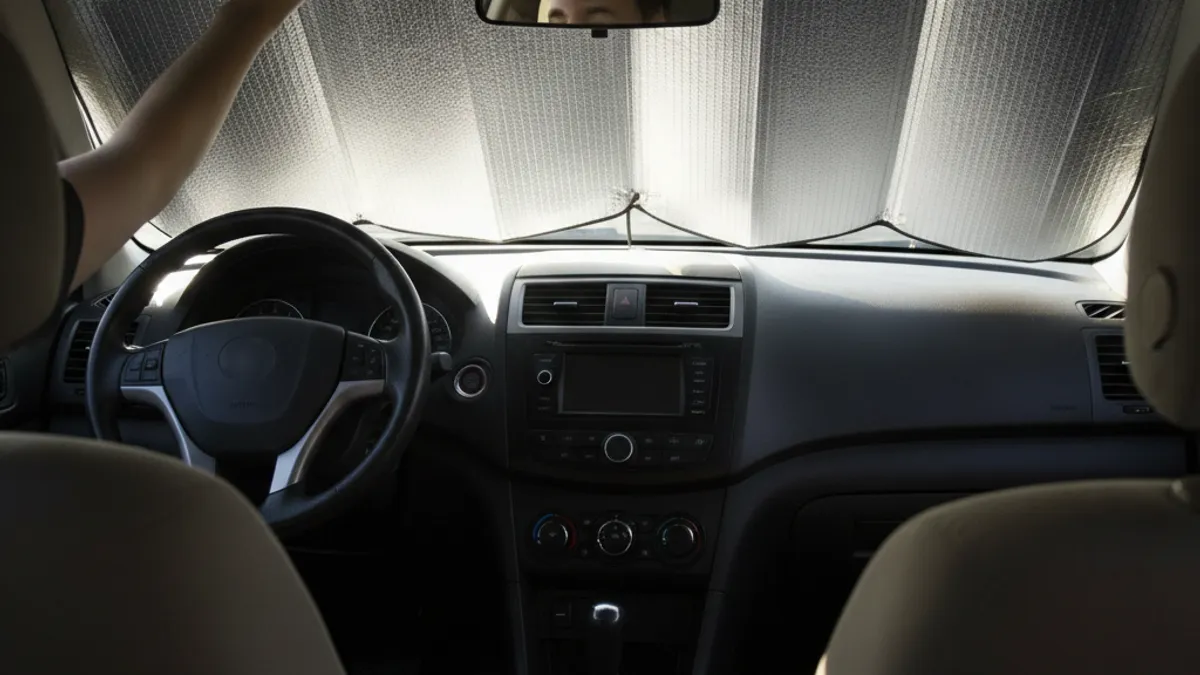
An interior windscreen sunshade, the most common solution on the BiH market, recorded 49 degrees. That is 4 degrees less than without protection. Not revolutionary, but it is the simplest method that still makes a measurable difference, especially on steering wheel and dashboard temperatures where the shade directly blocks the sun.
A white cloth draped over the dashboard brought a modest 3-degree improvement (50 degrees). Cheap and easy to do, but the effect is limited because it only protects the dashboard, not the rest of the cabin.
Tinted windows yielded only a 2-degree difference at the front seats (51 degrees). However, on the rear seats the difference was far more significant: 48 versus 57 degrees without tinting. For family cars with children in the back, tinted windows have clear value. Details on window tinting in BiH, including legal requirements and prices, are covered in our dedicated article.
Does an Open Window Help Against Heat in a Car
Short answer: barely. ADAC tested this method too, opening windows by 5 centimetres. All three test cars reached practically the same dangerous temperatures as fully closed ones. The reason is simple: solar radiation heats surfaces inside the cabin directly, and the minimal airflow through a cracked window cannot carry away enough heat to make a difference. An open window also poses a security risk by making break-ins easier, so it is better to keep windows closed and use a sunshade.
Protection Methods Ranked from Most to Least Effective
Based on the ADAC test, here is the definitive ranking of car sun protection methods by effectiveness, with all the numbers in one place.
| Method | Temperature | Difference vs unprotected | Practicality |
|---|---|---|---|
| Full car cover | 43 C | -10 degrees | Low |
| External reflective film | 45 C | -8 degrees | Medium |
| Interior sunshade | 49 C | -4 degrees | High |
| White cloth on dashboard | 50 C | -3 degrees | High |
| Tinted windows | 51 C (front) / 48 C (rear) | -2 / -9 degrees | Permanent |
| Cracked window | 53 C | 0 degrees | No effect |
| No protection | 53 C | reference | None |
Combining methods delivers the best results. A windscreen sunshade plus tinted windows plus parking in the shade can reduce the cabin temperature by 15 degrees or more compared with a completely unprotected car in the sun.
How to Cool Down an Overheated Car Quickly
The Japanese Trick for Cooling a Car
There is a simple physics-based trick that circulates widely online and actually works because it relies on elementary physics. Lower the front passenger window all the way down. Then open and close the driver's door forcefully five to six times. Each cycle pushes hot air out of the cabin through the open window, replacing it with cooler air from outside. This trick can reduce the temperature by roughly ten degrees in under a minute, without starting the engine and without waiting for the air conditioning to cool the cabin. It works because the door acts as a pump and the open window on the opposite side serves as the exhaust for the hot air.
After this initial cool-down, start the engine and set the air conditioning to maximum, but keep the windows open for the first minute or two. The AC is then working against 45 degrees instead of 55, which means faster cooling and less strain on the compressor. Once the air from the vents feels cold, close the windows and let the AC reach the target temperature. If your AC is not cooling properly, that is a matter for a service visit, and details on what an AC service involves can be found in our guide to car AC servicing.
Another useful tip: before you leave the car, turn the steering wheel 180 degrees. The part of the wheel you normally grip stays in the shade, shielded from direct sunlight by the upper section of the wheel and the dashboard cowl. When you return, the wheel will not be scorching where you hold it.
Smart Parking: Free Protection Most Drivers Ignore
The most effective car sun protection costs nothing, but it requires thinking ahead. The north side of a building stays untouched by the sun from late morning until late afternoon. A tree with a dense canopy can reduce the temperature of a parked car by 15 degrees or more compared with an open car park.
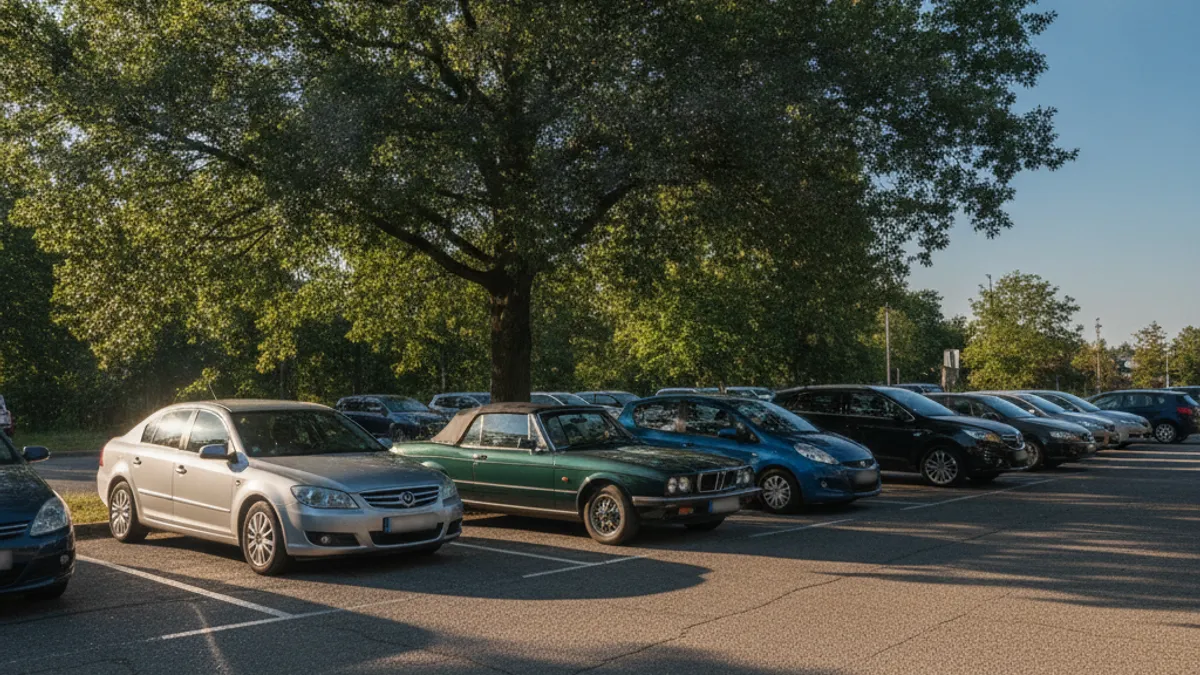
The problem is that most drivers park based on proximity to the entrance, not shade. An extra 50 metres' walk to a shaded spot can mean the difference between a car you can sit in straight away and one that is unsafe for children for the next ten minutes.
Track the sun's movement throughout the day. A spot that is shaded at 8 a.m. can be in full sun by midday. If you park at work for eight hours, choose the west side of the building because the car will be in shade during the hottest afternoon hours when you return. The same applies when shopping: if you know you will be in the store for an hour or two, check where the sun is coming from and park on the side that will be shaded when you leave.
Car parks, even above-ground ones with open sides, keep the temperature significantly lower than an open lot. If you have access to a car park and the choice is between a covered structure and the nearest sunny spot, the covered option is always the better choice in summer. Underground car parks are ideal because the temperature inside rarely exceeds 25 degrees even when it is 40 outside.
Protecting the Interior from Long-Term Damage
Beyond daily heat protection, the interior needs long-term defence against UV radiation. UV rays break down polymers in plastic dashboard components, cause fabric to fade, and dry out leather on seats and the steering wheel. This process is cumulative: every summer adds another dose of damage, and the result shows after the third or fourth season in the form of cracked dashboards and faded seats.
Interior care products with UV protection slow this process. A quality plastic spray restores shine and creates a thin protective layer that absorbs some UV radiation. For leather surfaces, conditioning products maintain elasticity and prevent cracking. This is not a one-off job; the treatment should be repeated every couple of months during the season to maintain continuous protection.
For the car's exterior, protective coatings such as ceramic coating or wax shield the paint from UV damage and oxidation. The differences in durability, cost, and application method are significant, and we covered them in detail in our guide to paint protection.
Car Sun Protection: What to Apply Right Now
The key takeaway from the ADAC test is that combining several cheap methods delivers better results than any single expensive one. A windscreen sunshade plus smart parking plus basic interior care costs less than a single cracked-dashboard repair or seat re-upholstering, and it protects your car for years.
For the current heatwave, start with what you already have: park in the shade, place any kind of barrier on the windscreen, and never get straight into an overheated car. Use the Japanese trick for a rapid cool-down, then let the AC finish the job. Before next season, consider window tinting as a permanent solution, especially if you have a family car.
If you need an AC service, a cooling system check, or help preparing your car for summer, Auto Gas Gaga is here. Book an appointment or get in touch via the contact page.
Frequently Asked Questions
How fast does a car heat up in the sun?
At an outside temperature of 28 degrees, a car's interior exceeds 50 degrees within 30 minutes and 57 degrees within an hour. The dashboard can reach 97 degrees. The rate of heating depends on the car's colour, cabin size, and whether the windows have any protection, but dangerous temperatures are reached quickly regardless of vehicle type.
Does a windscreen sunshade actually help?
Yes, measurably. The ADAC test on identical cars showed that an interior sunshade reduces the temperature by 4 degrees, while an external reflective film reduces it by 8 degrees. A sunshade is by far the simplest method with the best effort-to-result ratio, especially because it dramatically lowers steering wheel and dashboard temperatures.
Does an open window cool a car while it sits in the sun?
It barely helps at all. ADAC tested this method with windows open by 5 centimetres. All three test cars reached practically the same temperatures as fully closed ones. The reason is that the sun heats surfaces directly, and the minimal airflow cannot compensate for that heating. Additionally, an open window poses a security risk.
How much difference is there between a black and a white car in the sun?
The surface temperature of a black car reaches 65 degrees versus 44 degrees for a white one, a 21-degree difference on the bodywork. Inside the cabin the gap is smaller, around 5 degrees. Body colour affects the exterior temperature more than the interior because the cabin heats up mainly through the windows.
What is the fastest way to cool down an overheated car?
Lower the front passenger window all the way, then open and close the driver's door forcefully five to six times. This trick pushes hot air out through the open window and can reduce the temperature by roughly ten degrees in under a minute. After that, turn on the AC at full blast with the windows open for the first minute or two, then close the windows once the AC starts blowing cold.
Do tinted windows protect against heat?
Partially. The ADAC test showed only a 2-degree difference at the front seats, but a significant 9-degree difference at the rear seats. Tinted windows are especially useful for family cars because they protect rear-seat passengers. They also block up to 99% of UV rays, significantly slowing interior deterioration from sun exposure.