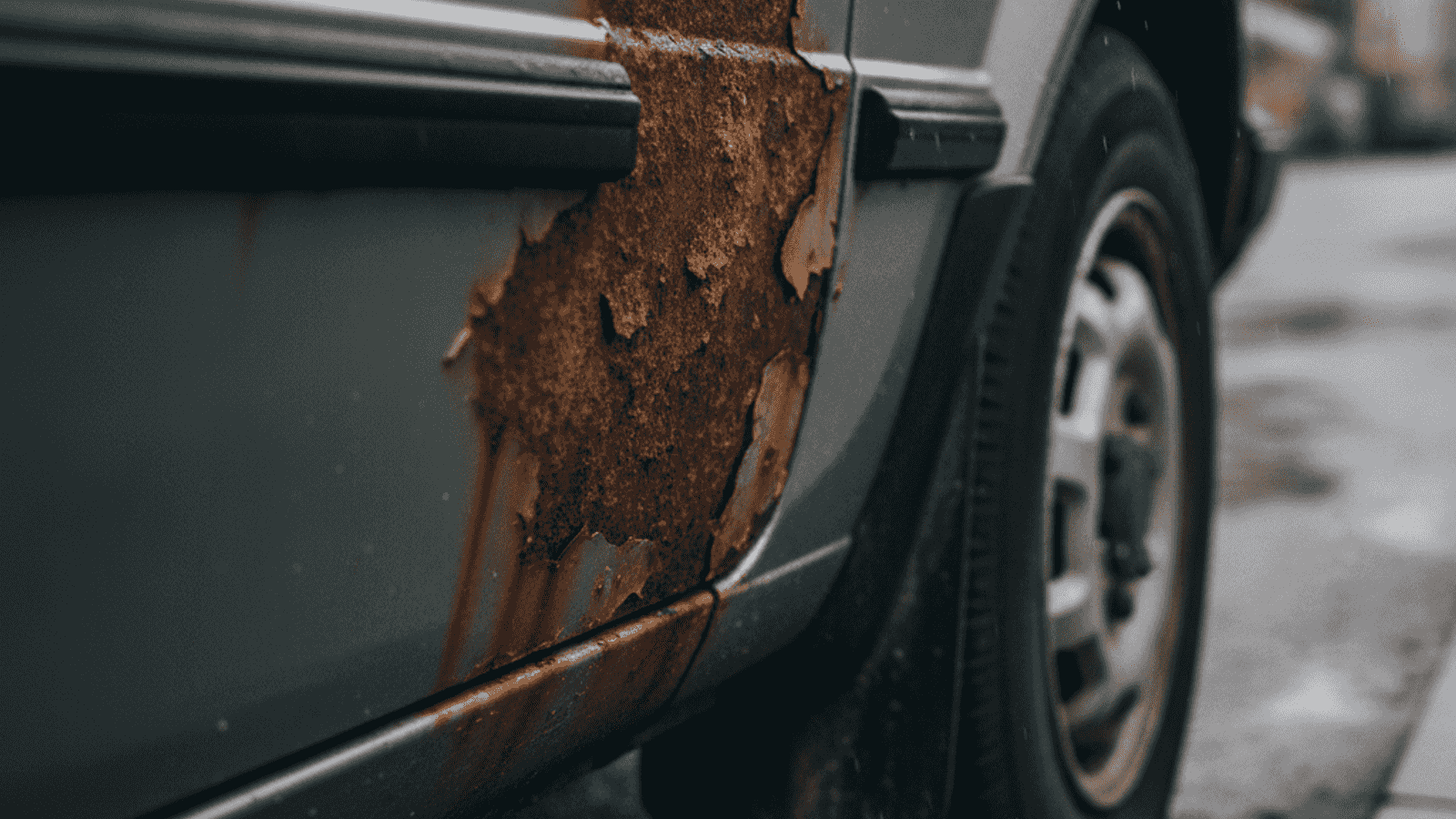
The average age of registered vehicles in BiH is 17 years. That means most cars on our roads have already been fighting moisture, road salt and paint damage for a long time. Rust on a car is a matter of when, not if, and the difference between a minor repair and a full sill replacement often comes down to how early you react. According to industry estimates, as many as 60% of cars experience some form of corrosion during their lifetime, and repair costs can far exceed the price of prevention.
This guide was compiled by the Auto Gas Gaga workshop in Banja Luka, based on years of experience with corrosion repairs and vehicle preparation for MOT inspections.
Table of Contents
- Why Corrosion Is Such a Problem in BiH
- How Rust Forms and What Accelerates It
- Most Vulnerable Parts of a Car
- How to Spot Corrosion at an Early Stage
- What You Can Do Yourself When Rust Appears
- When You Need a Body Shop and How Much Repairs Cost
- Professional Underbody Protection with Bitumen
- Corrosion and the MOT Inspection in BiH
- Frequently Asked Questions
- Related Articles
Why Corrosion Is Such a Problem in BiH
Bosnia and Herzegovina has one of the oldest vehicle fleets in Europe. According to 2025 data from BIHAMK, the average age of registered motor vehicles is 17 years, with a total of 1,295,224 vehicles on the books. This is a fleet whose factory galvanised coating wore off long ago, and many examples have passed through two or three owners who treated prevention as optional rather than essential.
The climate makes things worse. Winter temperatures with frequent freeze-thaw cycles, road salt and grit, plus damp springs and autumns create perfect conditions for accelerated metal decay. A car that was corrosion-free in Germany or Austria at the time of export can start showing first signs after three or four winters in BiH. Vehicles that drive daily on salted routes, such as main roads through mountain passes, are particularly exposed.
The third factor is economic. When budgets barely cover servicing and registration, anti-corrosion treatment easily falls to the bottom of the priority list. Yet it is precisely that delay that turns a 50-euro repair into a bill of several hundred. Drivers who are used to seeing rust as a cosmetic issue often realise its true severity only when the car fails its MOT or when the body-shop technician cuts half a sill away and shows how little sound metal is left.
How Rust Forms and What Accelerates It
Corrosion is a chemical process in which iron, in the presence of water and oxygen, turns into iron oxide. The orange-brown material we call rust is actually a porous, brittle substance that does not protect the metal beneath it but instead accelerates further decay by trapping moisture.
The process begins when the protective layer (paint, primer, galvanised coating) is breached. This can be a stone chip that punched through the paint, a scratch in a car park, or simply ageing of the coating as it peels over time. As soon as bare metal contacts water, the reaction starts. Initially it is slow and barely visible, but once the first layer of rust forms it acts like a sponge, holding moisture against the metal and causing decay to accelerate exponentially.
Several factors dramatically speed up corrosion:
- Road salt destroys protective layers and acts as an electrolyte that accelerates the electrochemical reaction. Winter gritting is the number-one enemy of bodywork in BiH.
- Mud and organic debris hold moisture against the metal for hours and days after driving. Wheel arches, sills and panel joints are critical spots.
- Minor paint chips left unrepaired. A stone chip on the bonnet looks harmless, but six months later there can be a coin-sized blister of corrosion underneath.
- Condensation inside hollow sections. Sills, subframes and doors contain hollow profiles where moisture condenses. If drainage holes are blocked with mud, water sits for days and corrosion advances invisibly from the inside out.
- Galvanic corrosion occurs where two dissimilar metals are in contact (steel and aluminium, steel and copper), often at bolt joints and brackets. This type of corrosion is insidious because it progresses faster than ordinary rust and is difficult to notice in time.
Most Vulnerable Parts of a Car
Corrosion does not attack evenly. Certain parts deteriorate first, and if you know which ones, you can act before the damage becomes structural. According to industry estimates, more than 60% of all corrosion-critical components are located on the body shell itself.
Sills (rocker panels). The single most critical zone on any car. Sills are hollow sections that take stone impacts, road salt and mud, while also serving as structural members of the body. A corroded sill is not just a cosmetic problem but a safety risk, because the sill transfers forces in a side impact. On models such as the Golf 5 and 6, Astra H and J, Peugeot 307 and 308, and Renault Megane 2 and 3, sills are a notoriously weak spot. You can find details on model-specific faults on our common faults pages.
Wheel arches and arch liners. The edges of wheel arches are constantly exposed to spray and stone chips. Corrosion usually starts on the inside, invisible from the outside, until it breaks through the paint. Rear arches are especially vulnerable because they catch more spray from the tyres and access for treatment is limited.
Lower door edges. Water runs down the glass and door skin, collects at the bottom edge and the process begins. Blocked drainage holes in the doors drastically accelerate the problem. A simple check: open the door and inspect the lower edge from the inside; if you see rust or moisture that is not draining, the drainage holes are blocked.
Underbody and rear longitudinals. The entire underside of the car is exposed, and the rear longitudinals that support the axle bear both mechanical loads and corrosion. When a longitudinal member rusts through, the repair is expensive and complex because it is a load-bearing element for the entire rear axle.
Brake lines. Steel brake lines corrode both internally and externally. Brake-line corrosion is a dangerous fault because a corroded line can burst under pressure, causing total loss of braking on that wheel.
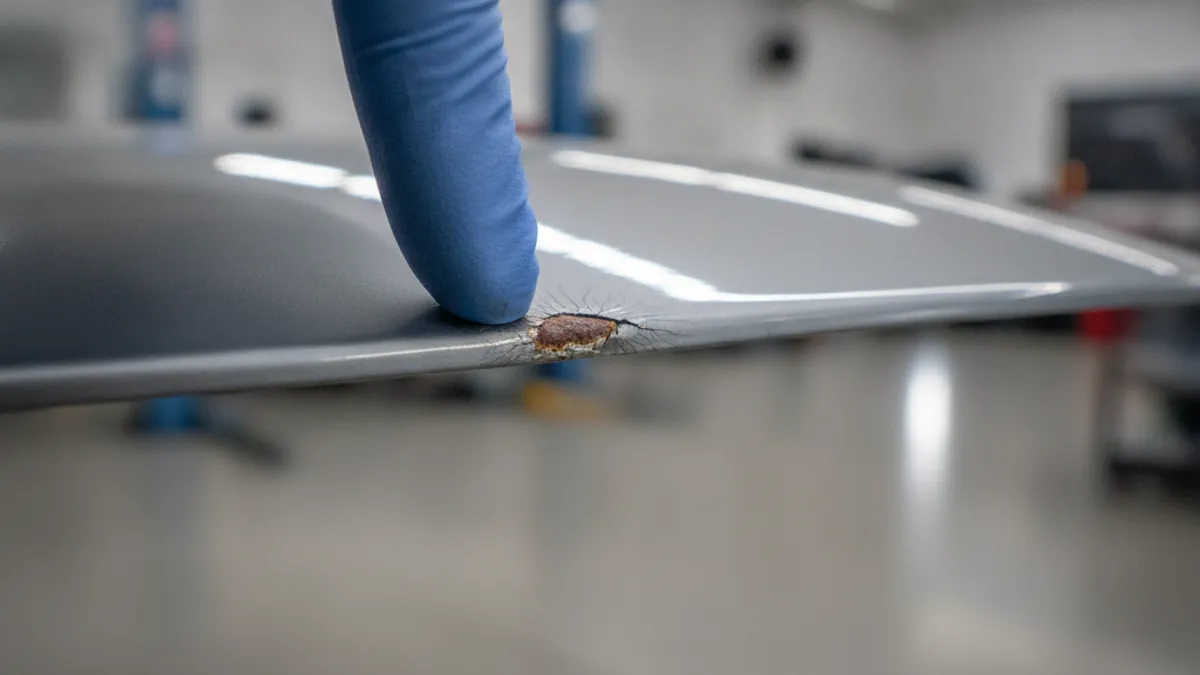
Corroded brake line symptoms
Symptoms of corroded brake lines include a spongy or low brake pedal, traces of brake fluid under the car (most commonly near the inner side of a wheel), the brake-fluid warning light on the dashboard and reduced braking efficiency on one or more wheels. If you notice any of these symptoms, do not delay an inspection because the braking system is directly tied to safety. Read more about the braking system in our guide on brake fluid and when to change it.
Boot lid and bonnet edges. Areas where water collects in panel folds, especially if the original protective wax in the seams has dried out.
Fasteners and bolt joints. Corroded bolts on the subframe, exhaust and brakes are not only a problem during disassembly but can structurally weaken the joint. Mechanics in the workshop regularly see an exhaust that has "fused" with its bracket due to corrosion, which makes replacement considerably more expensive because cutting and welding are needed instead of a simple unbolting.
How to Spot Corrosion at an Early Stage
Early detection is the key difference between a cheap fix and an expensive repair. Here is what to look for during regular vehicle inspections:
Blisters under the paint. If you notice that the paint on a sill, wheel arch or lower door edge has small blisters, it is almost certain that corrosion has already formed beneath. The metal under the blister is probably already orange. This stage is ideal for intervention because the corrosion is still superficial and confined to a small area.
Paint discolouration. Before visible rust appears, the paint often takes on a different shade or texture at the spot where corrosion is starting. A slightly darker or uneven surface on the lower part of a panel deserves a careful look.
Pitting and craters. If you see small pits on the metal surface, corrosion has already progressed significantly. At this stage a surface treatment will probably not be enough and a body-shop repair should be considered.
Soft spots in the sheet metal. Press your finger against the lower edge of a sill and feel the metal give way; this is a sign that corrosion has eaten the metal from the inside. Structural integrity is compromised and repair is unavoidable.
Seepage at joints. Rusty stains around seams, bolts or panel joints indicate corrosion in hard-to-reach areas. This is a common symptom on rear longitudinals where water and salt accumulate in body joints.
A practical tip: twice a year, once in spring (after the winter season) and once in autumn (before winter), walk around the car and carefully inspect the sills, wheel arches, lower door edges and underbody. If you have access to a ramp or inspection pit, check the underside as well. Twenty minutes of inspection can save hundreds of marks. Use a torch and an inspection mirror on a handle for harder-to-reach spots.
What You Can Do Yourself When Rust Appears
Minor surface corrosion on non-structural parts can be treated at home without visiting a body shop. This applies to rust patches roughly up to the size of a one-mark coin, on areas that are not structurally critical.
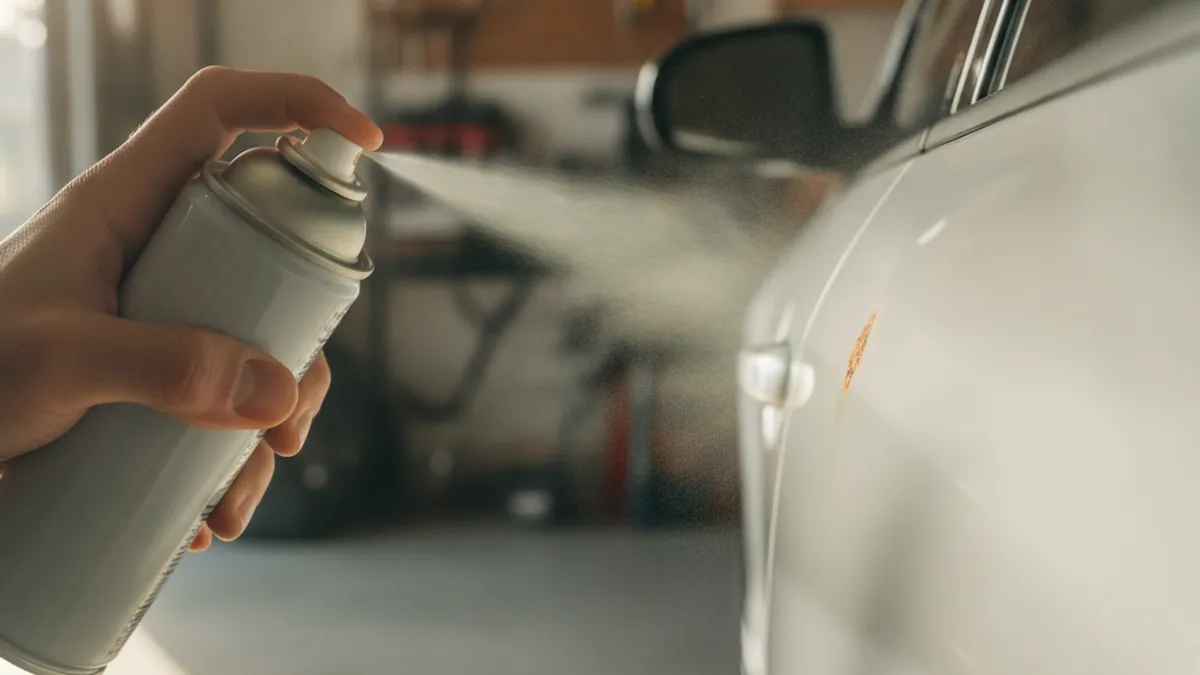
Can rust be stopped without a body shop
The answer is yes, but only at an early stage. The procedure for surface corrosion:
- Cleaning. Wash the affected area and the surrounding paint. Remove mud, grease and dust.
- Sanding. Use sandpaper (120 grit, then 240, then 400) to remove all rust down to clean, shiny metal. No rust must remain under the new coating, or it will continue working beneath the surface.
- Degreasing. Wipe the cleaned metal with a degreaser (acetone or isopropanol) and let it dry.
- Primer coat. Apply an anti-corrosion primer in two thin layers. Let each layer dry according to the instructions on the can.
- Colour coat. Aerosol paint matched to the car's colour (find the colour code on the plate in the engine bay or on the B-pillar) in two to three thin coats, with drying pauses between them.
- Clear coat. A final clear lacquer protects the colour from UV rays and minor scratches.
The entire process takes two to three hours for a single small area and requires no specialist tools. Sandpaper, degreaser, primer spray and colour-matched paint are available at any well-stocked car-parts shop.
For hollow sections such as sills and doors, there are cavity-preservation products (cavity wax) that are injected through existing holes or specially drilled openings. This is a preventive measure that can significantly extend the life of a sill, and the procedure is simple enough for an owner to do with an injection probe and a can of wax.
Rust converters are chemical products that react with iron oxide and convert it into a stable, protective surface (usually black). They are useful as a temporary measure or for hard-to-reach areas, but they are not a substitute for thorough sanding and repainting. A converter on a visible area will not look factory-fresh, but on the underbody or inside a wheel arch it does the job.
When You Need a Body Shop and How Much Repairs Cost
You need a body shop when corrosion has gone beyond the surface stage. Specifically, in the following situations:
- Rust has eaten through the metal; you can see a hole or push your finger through the panel.
- Corrosion is on a structural part (sill, longitudinal member, subframe bracket).
- The affected area is larger than the palm of your hand.
- Corrosion is on a visible area and you want a cosmetically correct result.
- Brake lines are corroded, which is exclusively a workshop job because it involves the braking system.
Car sill rust repair cost
Sill repair is one of the most common body-shop jobs on older cars in BiH. The procedure involves cutting out the corroded section, welding in a new piece of sheet metal, sanding, filling, priming and painting. The scope of work varies dramatically: sometimes a 20-centimetre patch weld is enough, and sometimes the entire sill from A-pillar to B-pillar needs replacing. The cost depends on the specific condition - get in touch for a quote.
According to regional reference data, professional underbody and body protection ranged from 200 to 400 euros, including sandblasting, corrosion removal and application of protective coatings. Repairing an already corroded sill with new welded sheet metal costs more because it involves both bodywork and paintwork.
According to industry estimates, corrosion can account for more than 30% of a vehicle's total maintenance costs, and corrosion damage on an individual car can reach up to 1,500 euros over its lifetime. Put in the context of a car whose market value is 3,000 to 5,000 marks, the maths becomes clear: a single serious corrosion repair can consume a third of the car's value.
Professional Underbody Protection with Bitumen
Professional anti-corrosion underbody protection is the most thorough preventive measure you can carry out on an older car. It is recommended for every vehicle over ten years old, especially if it has never been treated before and regularly drives on salted roads.
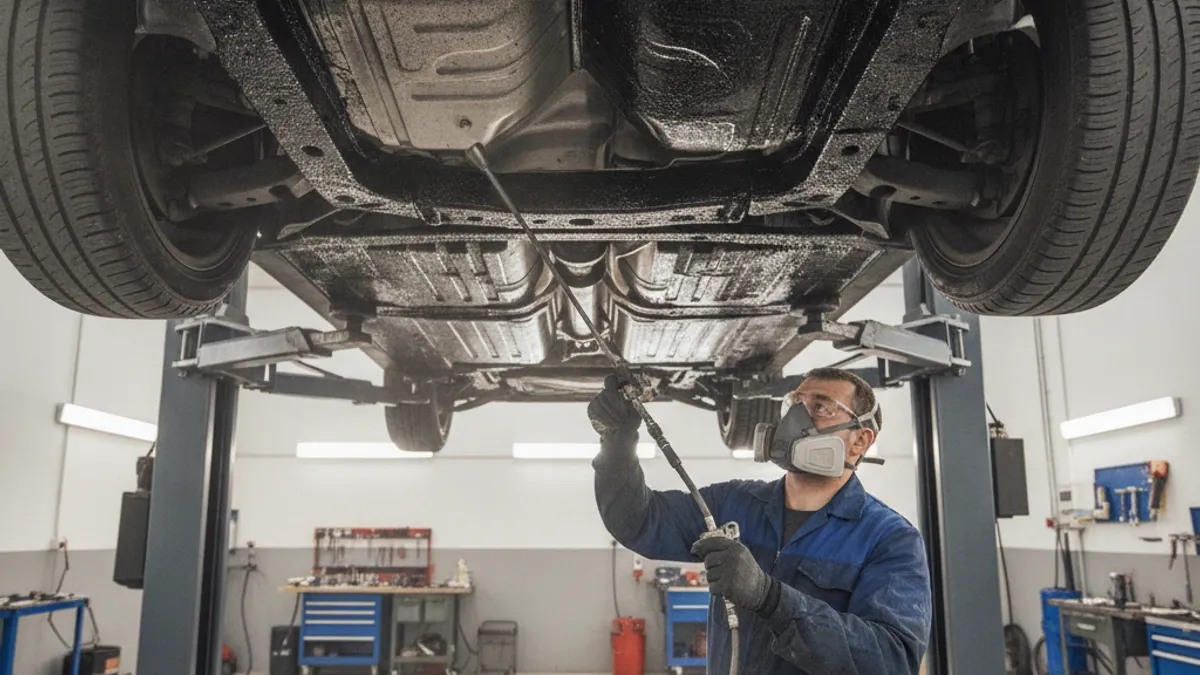
How much does bitumen underbody protection cost
The cost of professional treatment depends on the underbody condition, the size of the car and the extent of preparation work. The price depends on the specific condition - get in touch for a quote. As a regional benchmark, a treatment including full preparation and underbody protection ranges from 200 to 400 euros, although the exact amount depends on how much corrosion needs to be removed first.
The professional procedure involves eight steps:
- Removing protective elements (plastic covers, liners)
- Thorough high-pressure washing of the underbody
- Removing existing rust by sanding or sandblasting down to bare metal
- Applying an anti-corrosion primer
- Protective intermediate layer
- Bitumen layer as the main barrier
- Controlled drying
- Refitting the removed protection
The entire procedure usually takes one working day. It is important that it is carried out on a clean, dry underbody, ideally on a ramp where all surfaces can be reached. If the underbody is heavily soiled or has thick deposits of old bitumen that is peeling, preparation can take longer.
According to industry estimates, protective coatings and anti-corrosion treatments can reduce the chances of corrosion appearing by up to 70%. On a 17-year-old car, this is an investment that can extend the vehicle's useful life by several years and preserve the structural integrity of the body.
The ideal time for underbody protection is late spring or early summer, after road salt has been washed off by natural rainfall and before the new damp season begins. Avoid the winter months because the cold slows coating drying and reduces bitumen adhesion to metal.
Corrosion and the MOT Inspection in BiH
Corrosion is one of the reasons vehicles fail the MOT inspection, and many owners are unaware of this until they arrive at the testing station. According to the TUV report for 2026, 21.5% of vehicles have significant or dangerous defects at the main inspection, and after 15 years of age the failure rate rises to 32.9%. Around 90% of vehicles taken off the road are at least 10 years old, which shows how much age (and the corrosion that comes with it) determines a car's lifespan.
The MOT inspection in BiH checks elements that are directly affected by corrosion:
| Inspected element | How corrosion affects it | MOT outcome |
|---|---|---|
| Sills and longitudinals | Structurally weakened, visible holes | Fail, registration refused |
| Brake lines | Corrosion causes leaks | Fail, dangerous defect |
| Exhaust system | Leaks, noise | Fail if leaking |
| Subframe brackets | Corrosion weakens suspension mounting | Fail, safety risk |
| Body shell (sharp edges) | Rusty edges dangerous to pedestrians | Can cause a fail |
MOT failure due to rust on a subframe bracket
A corroded subframe bracket or longitudinal member is an automatic MOT failure because it is a safety-critical element. The inspector tests critical points by applying pressure and visual inspection, sometimes using a specialist hammer. If the metal gives way, the car cannot be registered until it is repaired.
A practical tip: before the MOT, inspect the underbody yourself. If you notice serious corrosion on the sills, brackets or brake lines, invest in a repair before heading to the testing station. Failing the MOT means paying again and making another trip, which is both a time and financial loss. For a detailed look at all the reasons for MOT failure, read the guide on why a car fails the MOT inspection.
Vehicles older than 10 years show an above-average number of safety-relevant defects, particularly on brakes, axles and lighting. Corrosion is the common denominator in most of these problems because it attacks metal brake-system components, electrical contacts and light housings alike. Corroded earth contacts, for example, can cause flickering lights and false error messages on the dashboard, which we discuss in more detail in the guide on poor earth connections and corroded contacts.
A recommendation for owners of older cars: once a year, take the car for a detailed underbody inspection at a workshop with a ramp. This is not the same as the MOT; it is an opportunity to spot problems while they are still small and treat them preventively rather than urgently. Book an underbody inspection before the MOT season begins and avoid unpleasant surprises at the testing station.
Frequently Asked Questions
Can rust be completely stopped?
It can be slowed and controlled, but in a chemical sense it cannot be completely stopped if the metal remains exposed to the environment. A properly treated surface (sanding down to bare metal, primer coat, top coat) can keep corrosion under control for years. The key is regular inspection of treated areas and a quick response to new damage.
How often should a car be inspected for corrosion?
Twice a year is the minimum: once in spring after the winter salting season and once in autumn before winter. For cars older than 15 years, we recommend an inspection every three to four months, especially if you drive on roads that are regularly salted.
Is underbody protection worth it on a 15-to-20-year-old car?
If the car is structurally sound and has no corroded sills or longitudinal members, underbody protection is worthwhile because it can extend the useful life by three to five years. If the brackets are already perforated, bodywork repair comes first and protection only after. Before deciding, have the car inspected on a ramp to see the real condition.
Can corrosion on brake lines be repaired?
No. A corroded brake line is replaced with a new one. The braking system does not tolerate compromises because it is a matter of safety. Symptoms of corroded brake lines include a soft pedal feel, brake-fluid leaks and a warning light on the dashboard. If you notice any of these symptoms, go to a workshop immediately.
Why do imported cars from Germany rust quickly in BiH?
Germany uses less road salt than BiH and has a milder continental climate. A car that was corrosion-free in Germany at the time of export faces more aggressive conditions in BiH: more salt, sharper temperature swings and worse roads. Additionally, many imported examples arrive with their factory-warranted underbody protection already expired (typically 10-12 years).
Does washing the car in winter help prevent rust?
Yes, and significantly so. Washing removes salt and chemical residues from the body and underbody. We recommend a wash including underbody rinse every two to three weeks during the winter season. Avoid washing in sub-zero temperatures because water can freeze in cavities and cause mechanical paint damage.