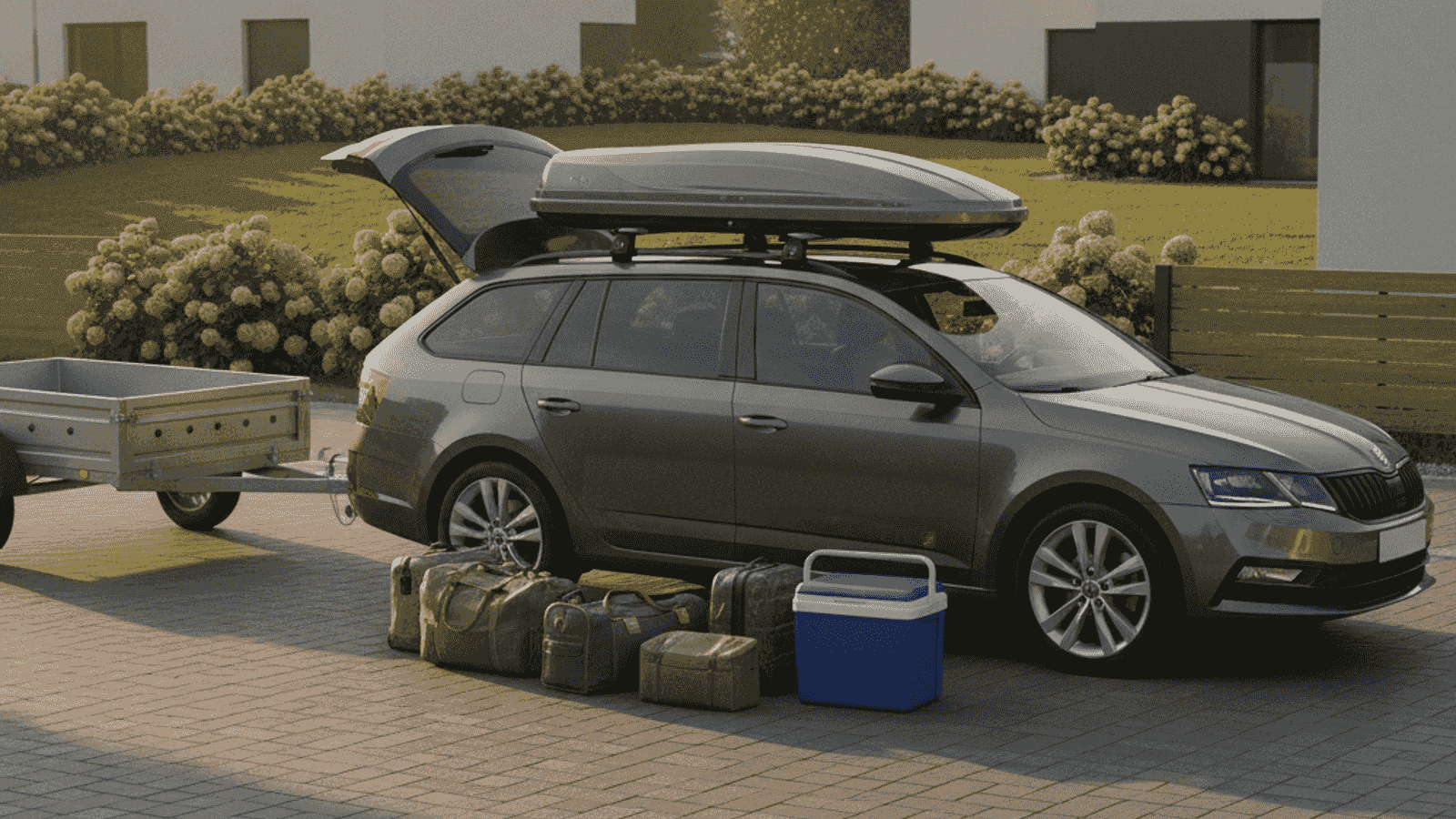
Every year, the same question and the same problem. A family of four, five days at the seaside, and the boot needs to swallow suitcases, sun loungers, a cool box, a pushchair and all those extras that "might come in handy". A car's payload has a limit. Aerodynamics has its price. And regulations differ from one border crossing to the next. This guide brings together three ways to transport cargo by car from BiH in 2026, with concrete figures for fuel consumption, capacity in litres and kilograms, and the rules that apply to a BiH driver travelling through the region. The goal is simple: after reading, you know exactly which method suits your holiday.
This guide was compiled by the Auto Gas Gaga workshop in Banja Luka, drawing on years of experience preparing vehicles for long trips and pre-season inspections.
TL;DR
| Topic | Summary |
|---|---|
| Roof box | Adds 300-450 litres of space but costs 11-19 % more fuel at motorway speed. Remove it when you don't need it. |
| Trailer | Largest capacity (up to 750 kg on a category B licence), but an 80 km/h speed limit and higher overall trip cost. |
| Interior cargo | Zero additional air resistance, but limited space and a risk of overloading the rear axle. |
| Fuel consumption | An empty roof rack adds up to 15 % extra consumption. A box on the motorway adds 11-19 %. A trailer depends on mass. |
| BiH regulations | Category B always covers a trailer up to 750 kg GVW, or a heavier one provided the combination stays under 3,500 kg. The B96 category does not exist in BiH. |
| Pre-trip check | Tyre pressure, cargo distribution, payload on the door sticker, luggage securing and light check. |
Table of Contents
- Three Ways to Transport Cargo by Car
- Roof Box and Rack: Capacity, Consumption and Rules
- Trailer: Regulations, Licence Category and Capacity
- Interior Cargo: Payload, Distribution and Limits
- Roof Box vs Trailer vs Interior: Comparison Table
- How Much Fuel Does Transporting Cargo by Car Cost
- Complete Guide by Transport Method
- Regulations by Country for BiH Drivers Carrying Cargo
- Five Checks Before Transporting Cargo by Car
- Frequently Asked Questions
- Related Articles
Three Ways to Transport Cargo by Car
Transporting cargo by car from BiH for a holiday boils down to three options, each with its own logic. A roof box provides extra space without losing passenger seats. A trailer solves the problem when the sheer volume of belongings exceeds everything the car can carry on its own. And interior luggage, properly arranged in the boot and on the rear seat, remains the cheapest and aerodynamically cleanest option.
What most drivers overlook is how much each of these three methods costs in fuel over the journey. The difference between an empty car and the same car with a roof box over 1,000 kilometres is far from trivial. Equally, the difference in regulations between BiH, Croatia and Montenegro can mean a fine at the border if you don't know the rules for a trailer or for cargo protruding from the boot.
A typical trip from Banja Luka to the Croatian coast is around 500-600 km one way. To Montenegro it is 600-700 km. To Greece via Serbia and North Macedonia, 1,000-1,200 km. The longer the journey, the more important the choice of transport method becomes, because every extra percentage of fuel consumption and every speed restriction compounds in both time and money.
The choice depends on several factors: how many passengers are travelling, how much luggage you are carrying, what your fuel budget is, and whether you already own the equipment (rack, box, towbar, trailer). In the sections that follow we break down each of the three methods by capacity, consumption, regulations and practicality, and at the end we put everything into a single comparison table from which you can make your final decision.
Roof Box and Rack: Capacity, Consumption and Rules
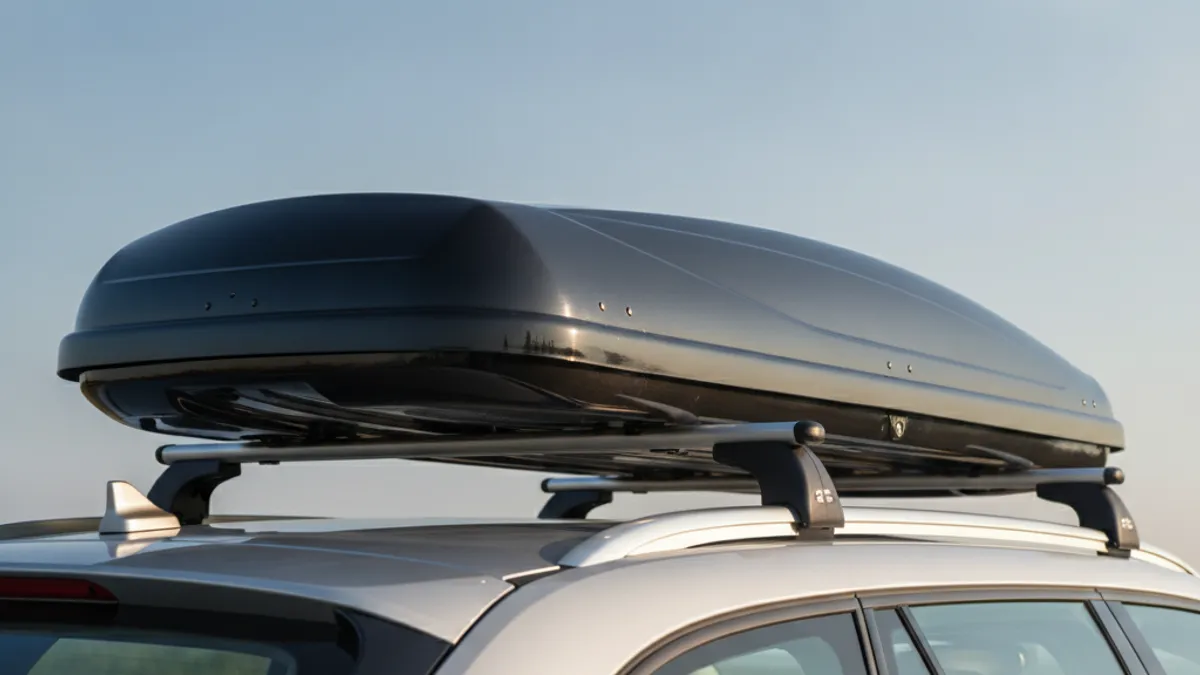
A roof box is the most common solution for families whose boot simply isn't big enough. A standard box holds 300-450 litres, and some models go up to 600 litres. That is enough for three to four medium suitcases, or a combination of sleeping bags, a tent and sun loungers.
But a roof box is not free transport. Consumer Reports measurements at a motorway speed of 105 km/h show that a sedan with a roof box loses 19 % fuel efficiency, while an SUV loses around 13 %. More specifically, a Nissan Altima with a box drops from 48 to 39 mpg, and a Toyota RAV4 from 41 to 35 mpg. That means on a return trip from Banja Luka to the coast (roughly 1,200 km) you pay noticeably more for fuel than without the box.
What many people forget is that even an empty roof rack carries its own cost. According to HAK measurements, even an empty roof rack or box can add up to 15 % to the fuel bill purely from increased air resistance. The practical advice is simple: as soon as you get back from the coast, take the rack and box off the roof. Every day you drive with an empty rack is money wasted.
Rules for a Roof Box in BiH and the Region
A roof box must not exceed the width of the vehicle. Roof cargo must not exceed the maximum roof load stated in the vehicle registration document or owner's manual. In practice, most cars have a roof limit of 50-75 kg, meaning a box weighing 15-20 kg leaves 30-55 kg for contents. Pay attention to the overall height of the vehicle with the box, especially when entering car parks, ferry ramps and low underpasses. The height of an estate car with a roof box easily exceeds 2 metres, and many car parks have a limit of 1.9-2.1 m.
For a detailed overview of all the rules, consumption figures and practical tips for roof boxes, see our roof box and rack guide.
How Many Extra Litres Does a Car with a Roof Box Use on the Motorway
At motorway speed the difference is most pronounced. Consumer Reports measurements show a loss of 11 % with the rack alone (no box), and 13-19 % with a mounted box, depending on vehicle type. Lower, more aerodynamic cars (sedans) lose more in percentage terms because their baseline consumption is lower, so every additional drag costs proportionally more. Taller SUVs lose less in percentage terms but more in absolute litres because their baseline consumption is already higher.
In practical terms, for an average car consuming 7 litres per 100 km, a roof box on the motorway means consumption of 8-8.5 litres per 100 km. On a 600 km one-way trip, that is 6-9 litres more fuel than without the box. At regional and urban speeds (60-80 km/h) the difference is smaller, because air resistance grows with the square of speed, so the box has less impact at lower speeds.
Trailer: Regulations, Licence Category and Capacity
A trailer is the solution when a roof box and the boot simply aren't enough. A city move, transporting furniture to a weekend cottage, or a family holiday with bicycles, a kayak and a full camping kit. With a trailer you get capacity that no other method can match.
Do I Need a BE Licence for a Trailer in BiH
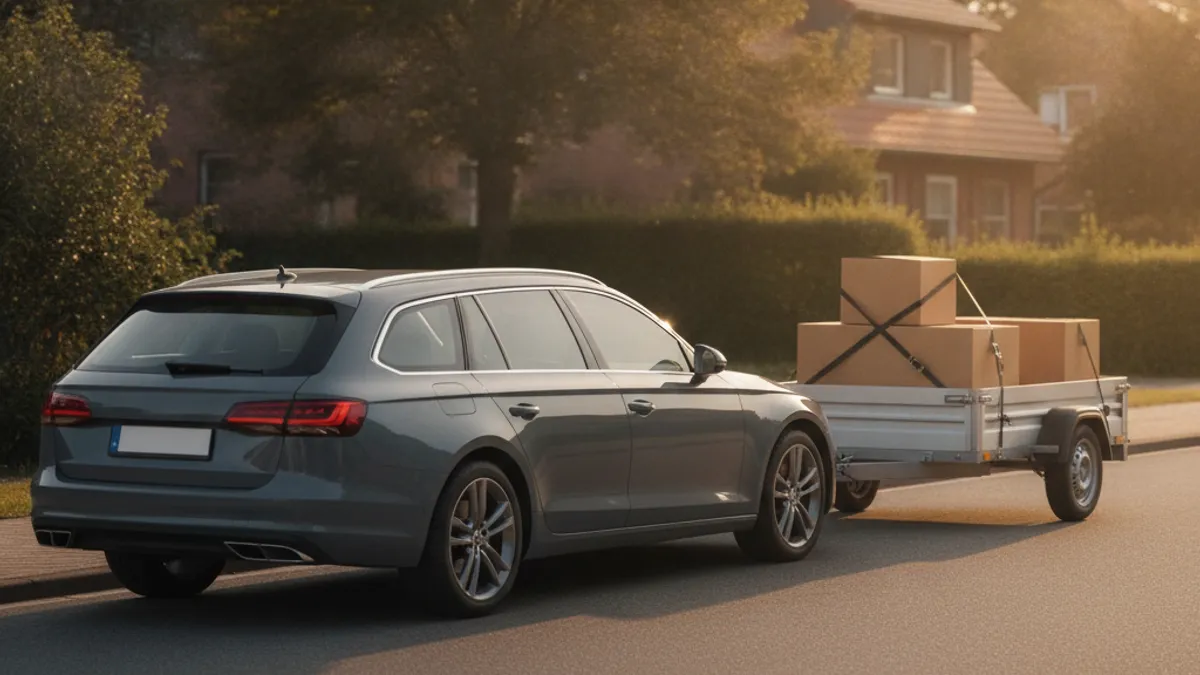
Under the BiH Road Traffic Safety Act, a category B licence always permits towing a trailer up to 750 kg gross vehicle weight (GVW), with no additional conditions. If the trailer is heavier than 750 kg, you can still drive on a category B licence, but only if the total combination (car + trailer) does not exceed 3,500 kg. An important point for BiH drivers: the B96 category that exists in some EU countries does NOT exist in BiH legislation. If you need a trailer above the category B limit, the next step is a BE licence, which requires a separate test.
Speed Limit with a Trailer
Article 46 of the BiH Road Traffic Safety Act clearly prescribes a speed limit for motor vehicles towing a trailer: 80 km/h. This applies on motorways as well. This is a fact many BiH drivers are unaware of or ignore, and fines for speeding with a trailer can be significant, especially in Croatia where motorway enforcement is frequent. Besides speed, with a trailer you also need to factor in a longer stopping distance. A car-and-trailer combination requires a greater distance for safe braking, especially on wet roads and on descents.
For a complete overview of regulations, weights and tips for towing a trailer on a category B licence, see our detailed trailer guide for BiH 2026.
Trailer Capacity vs Roof Box
The difference in capacity is dramatic. While a roof box offers 300-450 litres (and rarely more than 50 kg of cargo), a small trailer up to 750 kg GVW can carry 300-500 kg of useful payload, depending on its own kerb weight. In volume terms, that is typically 1,000-2,000 litres. A trailer is the only option for items too large for the boot or a box: bicycles for the whole family, a kayak, larger camping tents, or simply a volume of suitcases that exceeds everything the car can hold.
Interior Cargo: Payload, Distribution and Limits
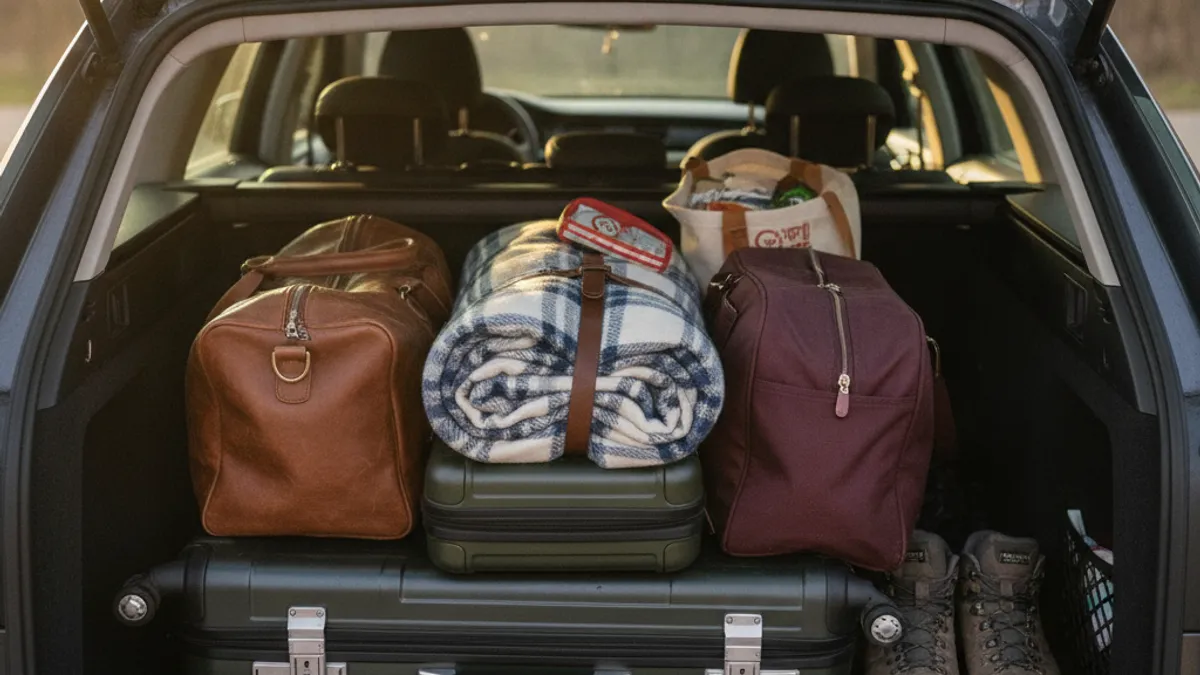
Interior cargo is what most drivers rely on as their primary method. The boot, the rear seat, the space under the seats, the boot floor. The advantage is obvious: zero additional air resistance, zero impact on aerodynamics, zero extra regulations.
But there is one limit that most people completely ignore, and that is the vehicle's payload. Every car has a defined GVW (gross vehicle weight) that includes the kerb weight, passengers and all cargo. Exceeding that weight is not only an offence, it also changes the car's behaviour on the road: longer stopping distance, worse stability in corners, greater risk of brake failure on long descents.
How Many Kilograms of Luggage Fit in a Golf for a Seaside Trip
A practical example illustrates the problem. A typical Golf 7 has a payload of around 501 kg. Subtract the driver (75 kg), front passenger (70 kg) and two children (60 kg total), and you are left with 296 kg for luggage. That sounds like a lot, but it adds up fast: four suitcases (20 kg each) are already 80 kg, a cool box with food 15 kg, sun loungers and parasols 10 kg, a pushchair 12 kg, a bag of toys 5 kg. You are already at 122 kg and haven't even started packing shoes, sun cream, towels and all the other small items that accumulate.
An Octavia has around 550 kg payload, and a Passat B6 around 630 kg, giving more room for manoeuvre. But even there, with four adult passengers and a full kit for a seven-day holiday, you can easily reach the limit. The Goslar Institute scenario confirms this: a car with 439 kg payload minus 165 kg for passengers (one adult and two children) leaves only 274 kg for luggage. Add a roof rack with bicycles and you quickly exceed the limit.
For a detailed overview of payloads for the most popular models and the rules on maximum weight, see our guide to how much you can load a car for a trip.
How to Distribute Cargo so the Car Doesn't Sway
ADAC measurements of axle load distribution provide clear insight. Luggage in the boot loads the rear axle by 110 % and unloads the front by 10 %. That means the front end is lighter, which directly affects handling, especially in corners on a wet road. A vehicle with an overloaded rear axle tends to "swing" its tail in a corner, while the front end responds less to steering input.
The rule is simple: heavier items go on the floor of the boot, as close to the rear axle as possible but not too far behind it. Lighter items go on top. Nothing should sit loose on the rear seat without being secured, because under heavy braking a 10 kg object behaves like a 50-80 kg projectile. Use a cargo net or elastic straps. If you fold the rear seats down, place hard objects (suitcases) on the bottom and soft bags on top as a makeshift barrier.
For vehicles with roof cargo, the distribution is different: the roof loads the rear axle by 85 % and the front by 15 %, which is a better split than the boot, but with the added problem of a raised centre of gravity that worsens cornering behaviour. That is why the recommendation is to put lighter but bulkier items (sleeping bags, sun loungers, pushchairs) in the roof box and keep heavier items low in the boot.
Roof Box vs Trailer vs Interior: Comparison Table
This is the central table of this guide. Every figure is drawn from concrete measurements and regulations. Use it as a quick overview before making your final decision.
| Criterion | Roof box | Trailer (up to 750 kg GVW) | Interior cargo |
|---|---|---|---|
| Capacity (litres) | 300-450 | 1,000-2,000 | 350-600 (boot) |
| Payload (kg) | 30-55 kg (contents) | 300-500 kg (useful payload) | Depends on car payload minus passengers |
| Impact on consumption | +11-19 % on motorway | +15-30 % depending on mass | Minimal if not overloaded |
| Speed limit | None specific | 80 km/h (BiH Road Traffic Safety Act) | None specific |
| Licence category | B (standard) | B up to 750 kg GVW or up to 3,500 kg combination | B (standard) |
| Aerodynamic drag | High | Low (cargo behind the car) | Zero |
| Setup time | 15-30 minutes | Towbar + 5 minutes | No preparation |
| Equipment cost | Rack + box | Towbar + trailer | Zero |
| Ideal for | Suitcases, soft bags, sun loungers | Bicycles, furniture, large equipment | Standard holiday for 2-3 people |
The table shows there is no universally best solution. For two passengers with a standard amount of luggage, interior cargo is perfectly sufficient and by far the most economical. For a family of four on a seven-day holiday, a roof box is the most common balance between capacity and practicality. And for campers, cyclists and those who drive to the coast with an entire household, a trailer is the only option that covers everything.
Combining methods is a common and smart strategy. A roof box for suitcases and soft bags, and the boot for heavy items and food. Or a trailer for bicycles and large equipment, and the boot and rear seat for personal belongings. The key is that cargo distribution between two locations is thought through: heavier always lower, and the height and width of the vehicle with all additions must remain within the regulations.
How Much Fuel Does Transporting Cargo by Car Cost
This is the section of most interest to every driver calculating trip costs. Concrete figures from independent measurements tell a clear story.
Roof Rack and Box
Consumer Reports at 105 km/h:
- Rack only (no box): 11 % efficiency loss (Nissan Altima from 48 to 43 mpg)
- Rack with box on a sedan: 19 % loss (Altima from 48 to 39 mpg)
- Rack with box on an SUV: 13 % loss (RAV4 from 41 to 35 mpg)
According to the same measurements, at motorway speed a roof box on a sedan costs around 1,700 KM in extra fuel over five years with the box permanently mounted. That is a strong argument for removing the box after every trip.
Bicycles on the Roof
Bicycles on a roof rack represent the worst aerodynamic scenario. According to HAK measurements, bicycles on the roof increase fuel consumption by around 25 %. A better alternative is a towbar-mounted bicycle carrier, which has less impact on aerodynamics but places more load on the rear axle (145 % rear, -45 % front, per ADAC). The difference between a roof carrier and a towbar carrier over a 1,000 km trip can amount to 10-15 litres of fuel, which is not insignificant when added to tolls and other costs.
Trailer
A trailer adds mass and rolling resistance but does not add significant aerodynamic drag if it sits lower than the roofline of the towing vehicle. The exact percentages depend on the trailer mass relative to the car mass: a light trailer (300-400 kg total) on a paved road typically adds 15-25 % consumption, while a heavier trailer closer to the limit (700-750 kg GVW) can add more.
Interior Cargo
Interior cargo has the least impact on consumption because it does not alter aerodynamics. Additional mass in the boot increases consumption proportionally: roughly 0.3-0.5 litres per 100 km for every 100 kg of extra cargo, depending on engine and driving style. On a 600 km trip, that is 2-3 litres of fuel for 100 kg of cargo.
Speed as a Factor in Fuel Consumption with Cargo
Another factor drivers rarely account for is speed. Air resistance grows with the square of speed. That means a roof box at 130 km/h costs significantly more fuel than the same box at 100 km/h. Drivers with a roof box who keep to 100-110 km/h instead of the maximum 130 km/h can reduce the extra consumption by 30-40 % compared to driving at the maximum permitted speed. On a 600 km trip, the time difference is 20-30 minutes, while the fuel difference is noticeable. For drivers with a trailer this is already settled by the 80 km/h limit, but the principle applies to interior cargo as well: gentler driving with a loaded car saves both fuel and brakes.
Complete Guide by Transport Method
This guide is part of a series of three detailed publications on transporting cargo by car. Each covers one method in depth, with all regulations, figures and practical tips. Here is a brief overview with links to each.
Roof Box and Rack
For families heading to the coast with 2-4 extra suitcases beyond what the boot can hold. Covers rack types, installation, roof load rules, and specific consumption percentages. Full guide: Roof Box and Rack on a Car: Consumption, Rules and Tips for BiH 2026.
Trailer with a Category B Licence
For drivers who need more capacity than the car alone can carry. Covers the Road Traffic Safety Act regulations for trailers, the difference between B and BE categories, speed restrictions, and everything to check before hitching a trailer. Full guide: Trailer with a Category B Licence in BiH 2026: Regulations, Weight and Tips.
How Much to Load a Car
For every driver wondering how many kilograms they can take on a trip. Covers payload by model, cargo distribution, the difference between kerb weight and GVW, and what happens at a roadworthiness check with an overloaded vehicle. Full guide: How Much to Load a Car for a Trip: Maximum Weight and Cargo Distribution.
Regulations by Country for BiH Drivers Carrying Cargo
A BiH driver heading for the coast passes through at least one, and often two, countries. The rules differ, and not knowing the regulations of a neighbouring country is no excuse for a fine.
BiH
The BiH Road Traffic Safety Act prescribes a speed limit of 80 km/h for vehicles towing a trailer. A category B licence permits towing a trailer up to 750 kg GVW with no additional conditions, or a heavier trailer provided the combination does not exceed 3,500 kg. Cargo must not exceed the width of the vehicle and must not compromise stability. If cargo protrudes from the vehicle, it must be visibly marked.
Croatia
Under Croatian Ministry of Interior rules, cargo on a motor vehicle must not protrude more than 1 metre beyond the furthest point at the front of the vehicle. Cargo protruding more than 1 m at the rear must be marked with a red cloth by day and reflective markings at night. The speed limit with a trailer on a motorway is 80 km/h, the same as in BiH. Tolls on Croatian motorways for a vehicle with a trailer are charged in a higher category, meaning an extra cost to factor into the travel budget. Bear in mind that driving with a trailer is more demanding on sections with tunnels, especially on the A1 motorway towards Split, where tunnels have height restrictions and you need to maintain a constant speed on ascents.
Montenegro
Rules are similar to Croatia, with an 80 km/h speed limit for vehicles towing a trailer. Pay attention to narrow and winding roads along the coast, especially on the Adriatic Highway, where a trailer significantly complicates driving and overtaking is practically impossible on many sections. Experience from our workshop shows that drivers towing a trailer on a long trip for the first time often underestimate how much it affects braking downhill and fuel consumption on hilly sections.
Serbia
For BiH drivers heading to Greece or Bulgaria via Serbia, the trailer rules are identical: 80 km/h limit, category B covers a trailer up to 750 kg GVW. Motorway enforcement is regular, especially in summer.
Five Checks Before Transporting Cargo by Car
Before you start cramming in suitcases, do these five things. Most take five minutes and can save you both a fine and a breakdown on the road.
1. Check Tyre Pressure
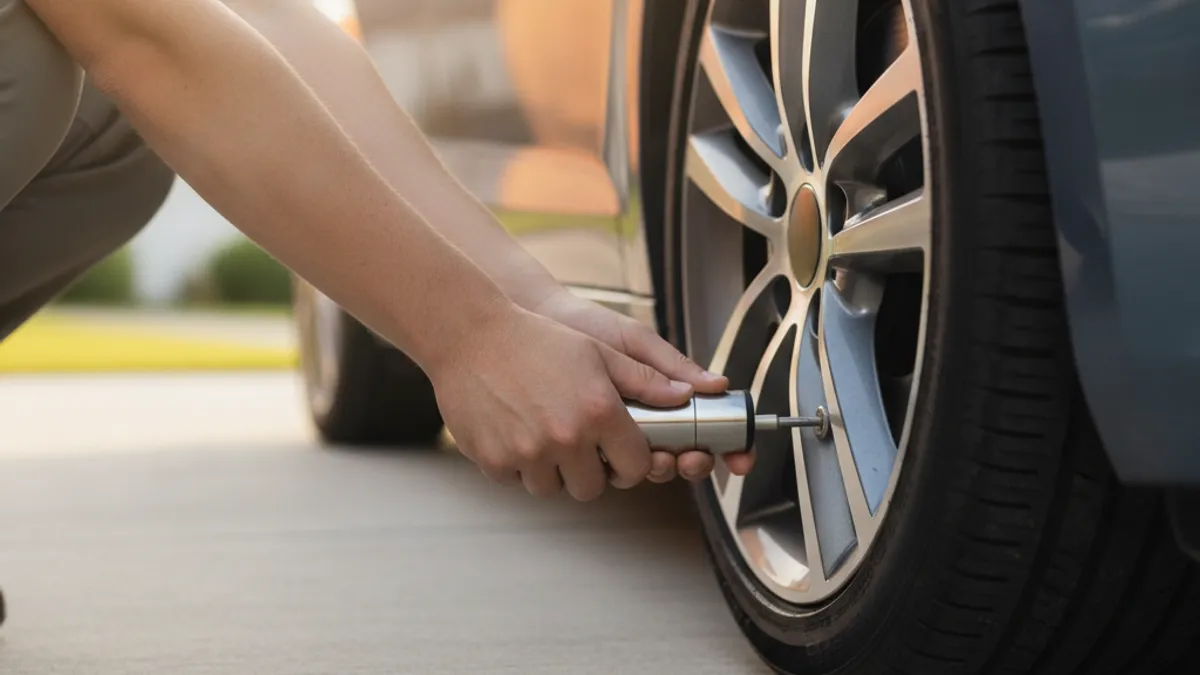
ADAC recommends increasing tyre pressure by 0.2 bar in summer, and by 0.3-0.4 bar above the manufacturer's recommendation for a fully loaded vehicle. The pressure figures for a fully loaded car are on the sticker on the B-pillar or inside the fuel filler cap. Check pressure on cold tyres, in the morning before departure. More details on pressures and tyres can be found in our tyre pressure guide.
2. Check the Payload on the Door Sticker
On the B-pillar (the pillar between the front and rear doors) there is a sticker showing the kerb weight and the GVW. The difference between those two numbers is your payload, including all passengers. Add up the weight of all passengers and estimate the weight of the luggage. If you are close to the limit, consider a roof box or trailer instead of stuffing everything into the boot.
3. Heavier on the Bottom, Lighter on Top
Arrange cargo so the heaviest items are on the floor of the boot, as close to the axle as possible. Do not place anything heavier than 5-10 kg on the rear seat without securing it. Use a net or straps if you are driving with the rear seats folded down and a full boot.
4. Check the Roof Rack
If you are using a roof rack or box, check all clamps and locks before departure. At the first rest stop (after 50-100 km) check again, as vibrations during driving can loosen the mounting. Pay particular attention to making sure the box is locked and that you keep the key with you in the cabin.
5. Check the Lights and Trailer
If you are towing a trailer, check all trailer lights (brake, indicators, position, number plate), check the safety chain, and check the towbar coupling. A single faulty bulb on the trailer is enough for a fine at the first checkpoint.
If you need help preparing your vehicle for a longer trip or checking the towbar and trailer, book an appointment at the workshop or contact us before departure.
Frequently Asked Questions
What is the cheapest way to transport luggage by car to the coast?
Interior cargo is the cheapest because it requires no extra equipment and does not significantly increase fuel consumption. If your boot is not big enough, folding the rear seats (if only two people are travelling) gives an additional 200-400 litres of space at no cost.
How much does a roof box increase fuel consumption?
According to Consumer Reports measurements at a motorway speed of 105 km/h, a roof box increases consumption by 13-19 %, depending on vehicle type. Lower sedans lose more (19 %), while taller SUVs lose less (13 %). Even an empty rack without a box adds up to 15 % consumption.
Do I need a special driving licence for a small trailer in BiH?
No, a standard category B licence is sufficient for a trailer up to 750 kg gross vehicle weight. If the trailer is heavier, category B still applies provided the vehicle-and-trailer combination does not exceed 3,500 kg. For heavier combinations a BE licence is required. The B96 category does not exist in BiH.
How many kilograms of luggage can I take in a Golf 7?
The Golf 7 has a payload of around 501 kg. Subtract the weight of the passengers (four adults are roughly 280-300 kg) and you are left with 200-220 kg for luggage. If you are travelling as a couple, considerably more remains, around 350-360 kg.
What happens if I am stopped with an overloaded car?
Fines for an overloaded vehicle in BiH and the wider region range from a warning to a monetary penalty, depending on the degree of excess. In some cases the police can prohibit further driving until you reduce the load. At border crossings, weight checks are rare for passenger cars but routine for vans and delivery vehicles.
Is it better to put bicycles on the roof or on a towbar carrier?
Bicycles on the roof increase consumption by around 25 % due to aerodynamic drag, according to HAK measurements. A towbar-mounted bicycle carrier has less impact on consumption because it sits in the vehicle's aerodynamic shadow, but it places more load on the rear axle (145 % rear, -45 % front, per ADAC). For longer trips, a towbar carrier is the more economical choice.