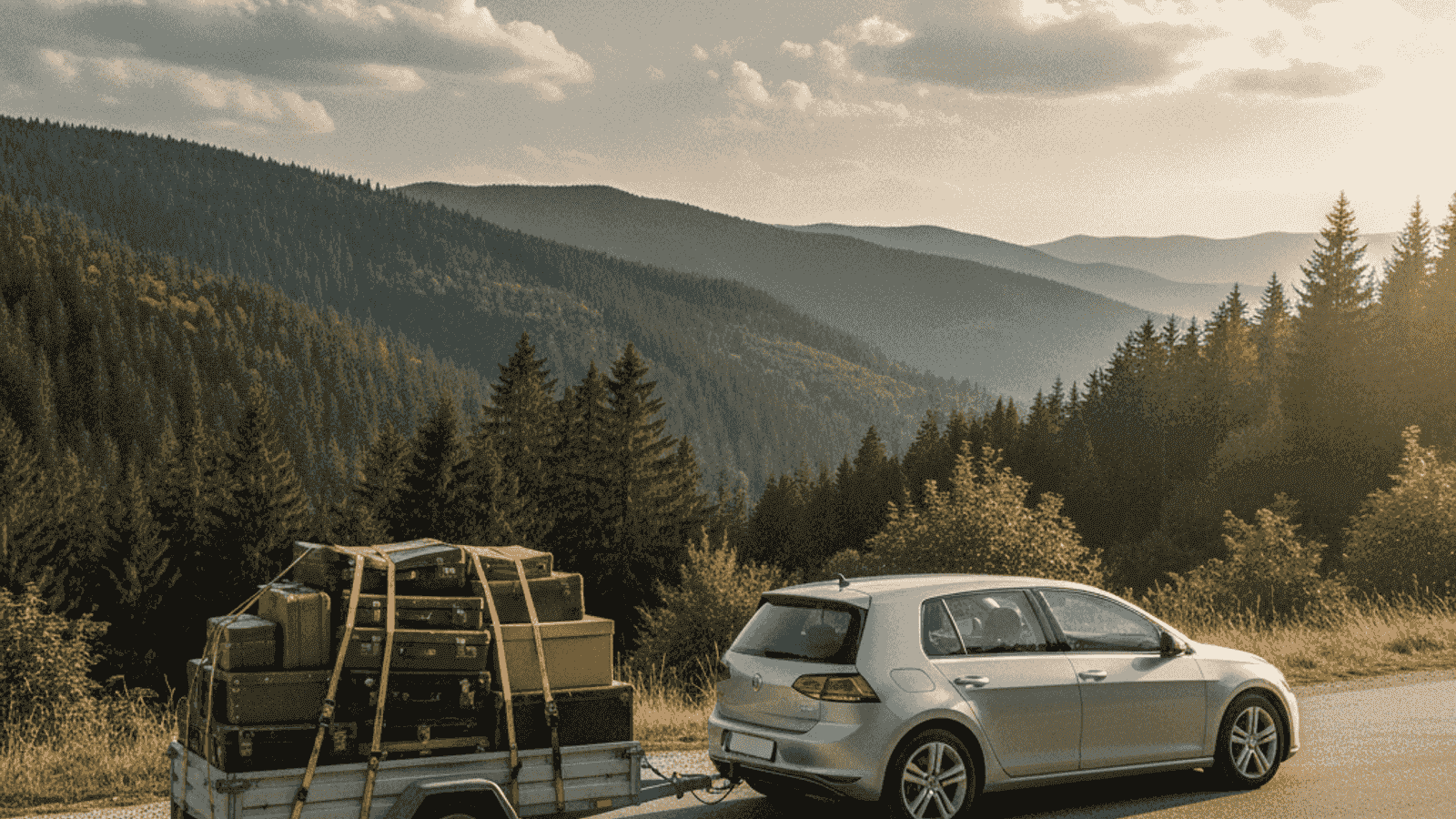
Towing a car trailer with a B licence in BiH is a topic that confuses drivers more than it should. The reason is simple: laws differ from country to country, the internet is full of information about EU categories that do not apply in BiH, and the fines for exceeding the permitted mass are far from symbolic. This guide explains exactly what you are allowed to tow, how to calculate whether you are within the limits, and what to check before your first trip with a trailer.
This guide was compiled by the Auto Gas Gaga workshop in Banja Luka, based on years of experience preparing vehicles for towing and roadworthiness inspections.
Table of Contents
- What You Can Tow With a B Licence in BiH
- How to Calculate the Permitted Combined Mass
- When You Need a BE Licence
- Preparing the Car and Tow Bar
- Trailer Registration and Insurance in BiH
- Speed Limits With a Trailer by Country
- Towing Capacity of Popular Models in BiH
- Braked vs Unbraked Trailer and Why It Matters
- Most Common Trailer Towing Mistakes
- Frequently Asked Questions
- Related Articles
What You Can Tow With a B Licence in BiH
The Law on Road Traffic Safety Fundamentals in BiH (ZOBS, Art. 9, Point 18) defines a light trailer as a towed vehicle whose gross vehicle mass (GVM) does not exceed 750 kg. With a standard B licence in BiH, the situation is as follows:
- You may always tow a trailer up to 750 kg GVM, with no additional conditions whatsoever.
- You may tow a trailer heavier than 750 kg GVM only if the total combined mass (car + trailer) does not exceed 3500 kg GVM.
The key point many people fail to understand: the police and the law always look at the maximum permissible mass (GVM) recorded in the vehicle registration document, not the actual (current) mass of the vehicle. So even if your trailer is empty, its paperwork is checked against the GVM, not against what the scales show.
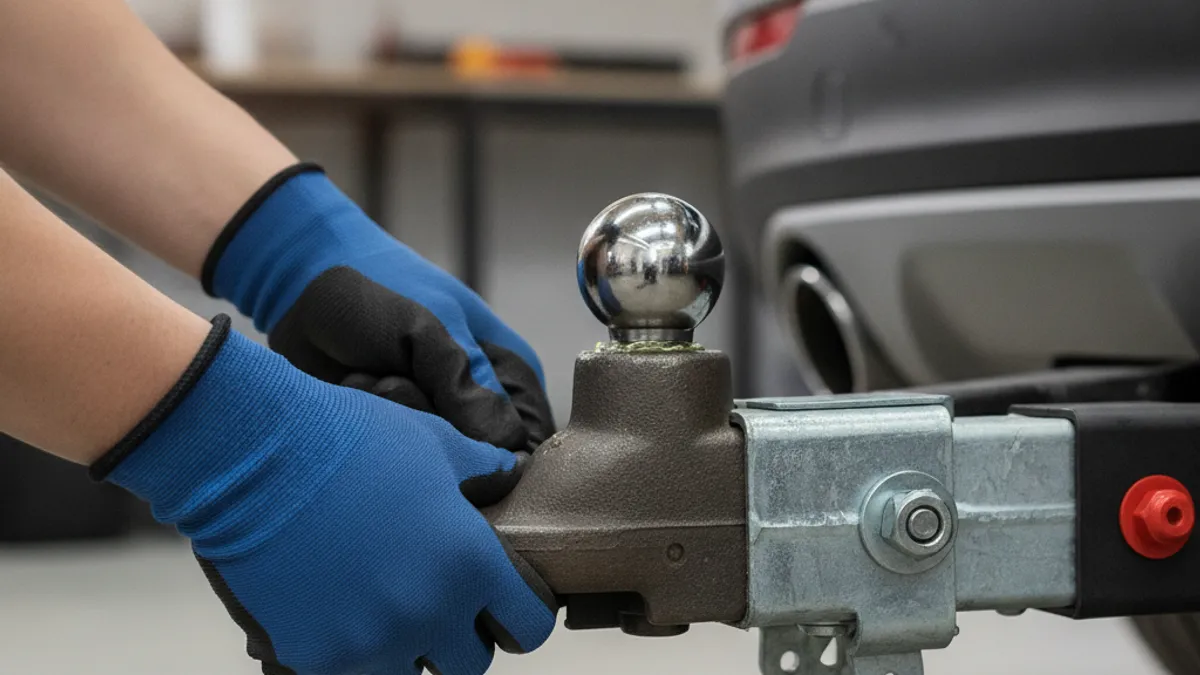
Practical example: you drive a car with a GVM of 1800 kg. The trailer has a GVM of 900 kg. The total is 2700 kg, which is below 3500 kg. You may drive with a B licence. But if your car had a GVM of 2500 kg and the trailer a GVM of 1200 kg, the total would be 3700 kg, exceeding the limit, and you would need a BE licence.
How to Calculate the Permitted Combined Mass
The calculation is straightforward but requires knowing exactly where to look. Open the registration document for your car and find field F.1 (GVM of the vehicle) or F.2 (GVM of the combination, if recorded). Then open the registration document for the trailer and check field F.1 (GVM of the trailer).
The formula:
Car GVM (F.1) + Trailer GVM (F.1) = combined mass
If the result is up to 3500 kg, you drive with a B licence. If it exceeds 3500 kg, you need BE.
There is a second restriction many people overlook: field O.1 in the car's registration document defines the maximum trailer mass your specific car is allowed to tow with brakes, and field O.2 without brakes. These values depend on the engine, gearbox, drivetrain and type approval, and they differ even within the same model.
So even when the total combination is below 3500 kg, you must verify that the trailer's GVM does not exceed the value in your car's O.1 field. Example: the car has a GVM of 1600 kg and O.1 states 1200 kg. A trailer with a GVM of 1000 kg is legal on both counts (the total of 2600 is less than 3500, and 1000 is less than 1200). But a trailer with a GVM of 1400 kg is illegal even though the total of 3000 is less than 3500, because it exceeds O.1.
When You Need a BE Licence
A BE licence in BiH is required when the combined mass exceeds 3500 kg GVM. To obtain a BE licence in BiH you need a practical towing test with a trailer and additional theory on regulations relating to towed vehicles.
This is where a major source of online confusion arises. If you search for this topic, you will come across the term B96 (or B96 code). This is a category that exists in the EU and specifically covers combinations from 3500 to 4250 kg with a short 7-hour training course and no theory exam. However, in Bosnia and Herzegovina the B96 code does not exist. The ZOBS BiH recognises only B and BE. There is no intermediate step.
This means: if your combination exceeds 3500 kg, you must hold a full BE licence in BiH. There is no abbreviated course, no one-day training. Any information about B96 you read on Croatian, German or Austrian websites does not apply to a BiH driving licence.
In practice, most drivers in BiH who use smaller trailers (for building materials, house moves, trips to the coast) will not exceed 3500 kg. A typical situation requiring BE: an SUV or van towing a large twin-axle trailer, a boat or a larger caravan.
Preparing the Car and Tow Bar
The tow bar is the first thing you need to think about. There are two basic types: a fixed tow bar (permanently mounted, cheaper, more robust) and a detachable tow bar (aesthetically cleaner when you are not towing, but a more expensive mechanism that requires checking it is properly locked before every trip). Both types must be recorded in the car's registration document. Fitting a tow bar without type approval and registration is an offence, and the police do check for it.
The electrical connector for the trailer comes in two standards: 7-pin (basic, covering brake lights, indicators, side markers and rear fog light) and 13-pin (adds permanent power for the trailer interior, reversing light and caravan battery charging). If you plan to use a caravan or a trailer with interior lighting, the 13-pin connector is essentially mandatory.
Towing under load on long uphill gradients significantly heats the engine, coolant and gearbox. On automatic transmissions and DSG units, the gearbox oil temperature rises faster than the driver expects. Never tow in the highest gear on an incline; instead use a lower gear (or manual mode) to reduce gearbox strain and keep engine revs in the range where torque delivery is better. Monitor the coolant temperature gauge on the dashboard, and if you notice it climbing towards the red zone, pull over in a safe spot and let the engine idle for 5-10 minutes to cool down before continuing.
Trailer Registration and Insurance in BiH
A trailer has its own registration plate and its own registration document, completely separate from the car. Even a light trailer up to 750 kg must be registered and must pass an annual roadworthiness inspection. The inspection covers: condition of the chassis and undercarriage, coupling device (hitch and safety catch), all lighting, brakes (if the trailer has a braking system), tyre condition and tread depth, and the condition of mudguards and reflective markings.
Regarding insurance, your car's third-party liability policy generally covers damage caused by the combination (car + trailer) to third parties. However, for heavier trailers, twin-axle units and caravans, it is advisable to check with your insurer whether the cover is sufficient or whether a policy extension is needed. Trailer registration is renewed in the same way as for a car, with a valid roadworthiness certificate and an active insurance policy. The renewal deadline is identical, and late renewal carries the same consequences as for an unregistered motor vehicle.
Speed Limits With a Trailer by Country
The ZOBS BiH (Art. 46, Para. 1, Point 2) clearly states: motor vehicles towing a caravan or light trailer (up to 750 kg GVM) may travel at a maximum of 80 km/h on open roads and motorways. For heavier trailers (goods vehicles with a towed unit) the limit may be even lower, down to 70 km/h.
If you travel outside BiH, the limits vary by country:
| Country | Outside built-up areas | Motorway | Note |
|---|---|---|---|
| BiH | 80 km/h | 80 km/h | Light trailer and caravan; heavier possibly 70 km/h |
| Croatia | 80 km/h | 90 km/h (with brakes) | Unbraked up to 80 km/h |
| Austria | 70-80 km/h | 100 km/h | Depends on combined mass |
| Germany | 80 km/h | 80 km/h | 100 km/h possible with Tempo-100 certificate |
| Slovenia | 80 km/h | 80 km/h | No exceptions |
| Italy | 70 km/h | 80 km/h | Stricter than most |
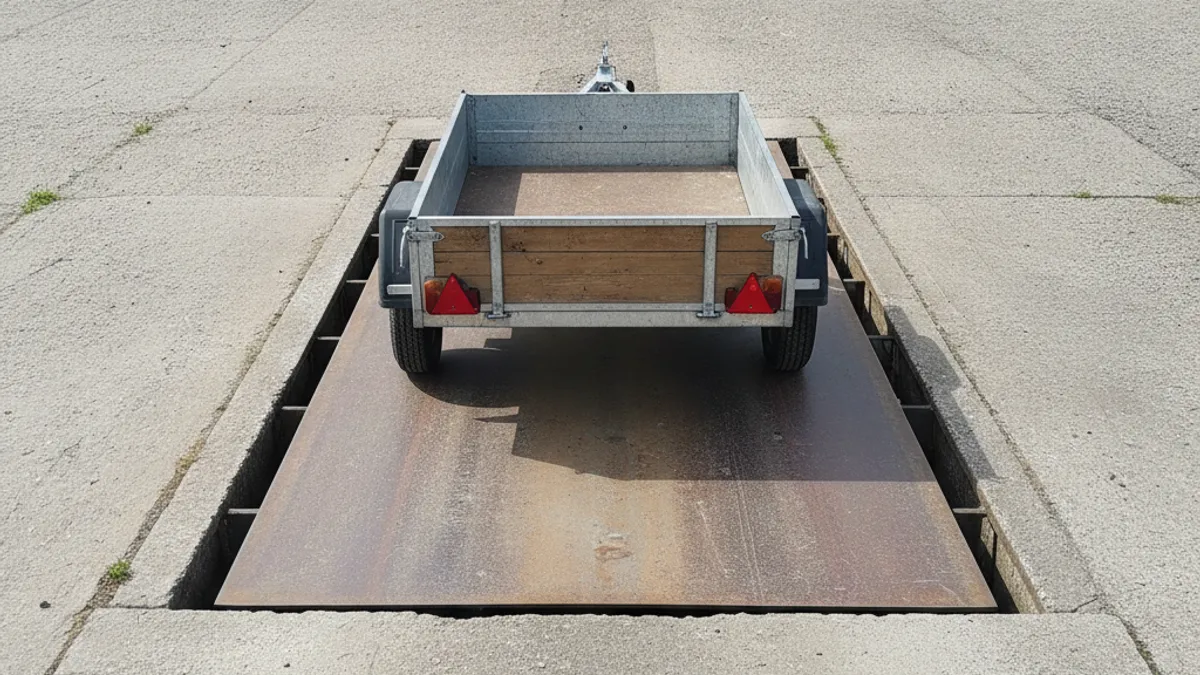
Important: these are general limits for each country. Local road signs always take precedence over the general rule. And remember, in BiH the 80 km/h limit for a light trailer is the legal maximum, even on motorway sections where 130 km/h is permitted for other traffic.
Towing Capacity of Popular Models in BiH
The values below are illustrative and vary depending on engine, gearbox type and drivetrain. The only authoritative figure for your specific car is what is written in your registration document (fields O.1 and O.2). Do not treat online tables as a legal argument, because even within the same generation of a model there are variants with different permissible towing masses.
| Model | Braked trailer (kg) | Unbraked trailer (kg) |
|---|---|---|
| VW Golf 7 (1.6 TDI) | 1400-1500 | 630-690 |
| VW Golf 7 (2.0 TDI) | 1600-1800 | 700-750 |
| VW Golf 5 (1.9 TDI) | 1200-1500 | 580-640 |
| Škoda Octavia Mk3 (1.6 TDI) | 1400-1600 | 650-720 |
| Škoda Octavia Mk3 (2.0 TDI) | 1600-1800 | 700-750 |
| Opel Astra J (1.6 CDTI) | 1200-1400 | 580-650 |
| VW Passat B7 (2.0 TDI) | 1800-2000 | 750 |
| Hyundai Tucson (2.0 CRDi) | 1800-2200 | 750 |
You will notice that the same model with a more powerful engine has a higher permissible towing mass. The Golf 7 with a 1.6 TDI tows up to 1500 kg, but with a 2.0 TDI up to 1800 kg. A difference of 300 kg can be decisive when choosing a trailer.
Never take a figure from the internet as final. Open your registration document, check O.1 and O.2, and that is your only legal framework.
Braked vs Unbraked Trailer and Why It Matters
Trailers come in two variants by braking system: unbraked (no brakes of their own) and braked (with overrun brakes that engage through inertia when decelerating).
An unbraked trailer is cheaper and simpler to maintain but has a strictly limited mass. Most cars permit an unbraked trailer up to 580-750 kg GVM (check field O.2 in your registration document). This is sufficient for lighter loads: bicycles, garden waste, a single pallet of materials.
A braked trailer can carry significantly more, because its own brakes assist with stopping. Overrun brakes work automatically: when the car begins to brake, the trailer runs into the hitch and that pressure activates the trailer's braking mechanism. Specifically, an overrun (inertia) brake operates via a sliding mechanism in the trailer drawbar. When the car decelerates, the trailer pushes forward under its own inertia, the sliding element compresses a spring and transmits force via cables or hydraulic lines to the brake drums or discs on the axle. The system is entirely mechanical, requires no electrical connection to the car and operates proportionally, meaning harder deceleration activates stronger braking force on the trailer.
For a braked trailer, field O.1 in the registration document applies, and those values are typically 1200-2200 kg depending on the car.
Trailer sway (lateral oscillation at higher speeds) is the most dangerous situation when towing. ESP systems on modern cars detect the onset of sway and automatically brake individual wheels to stabilise the combination. Correct nose weight on the hitch (50-100 kg) and proper load distribution (55-60% of the mass ahead of the axle) are the first line of defence. If the trailer begins to sway, never brake hard. Release the throttle, hold the steering wheel straight and let the combination stabilise on its own as speed decreases.
Maintaining a braked trailer includes regular inspection of brake cables or hydraulics, replacing linings and checking the overrun coupling. Brake fluid in the trailer's hydraulic system should be changed every two years, the same as on the car. Trailer tyres should be replaced every 5-7 years even if the tread is not worn, because rubber older than 5 years loses elasticity and grip.
Most Common Trailer Towing Mistakes
Most drivers hitching a trailer for the first time make the same mistakes. Here are the most common ones and how to avoid them:
1. Incorrect load distribution. The ideal distribution is 55-60% of load mass ahead of the trailer's axle. Too much weight at the rear lifts the front of the trailer, reduces nose weight on the hitch and makes the car unstable at higher speeds.
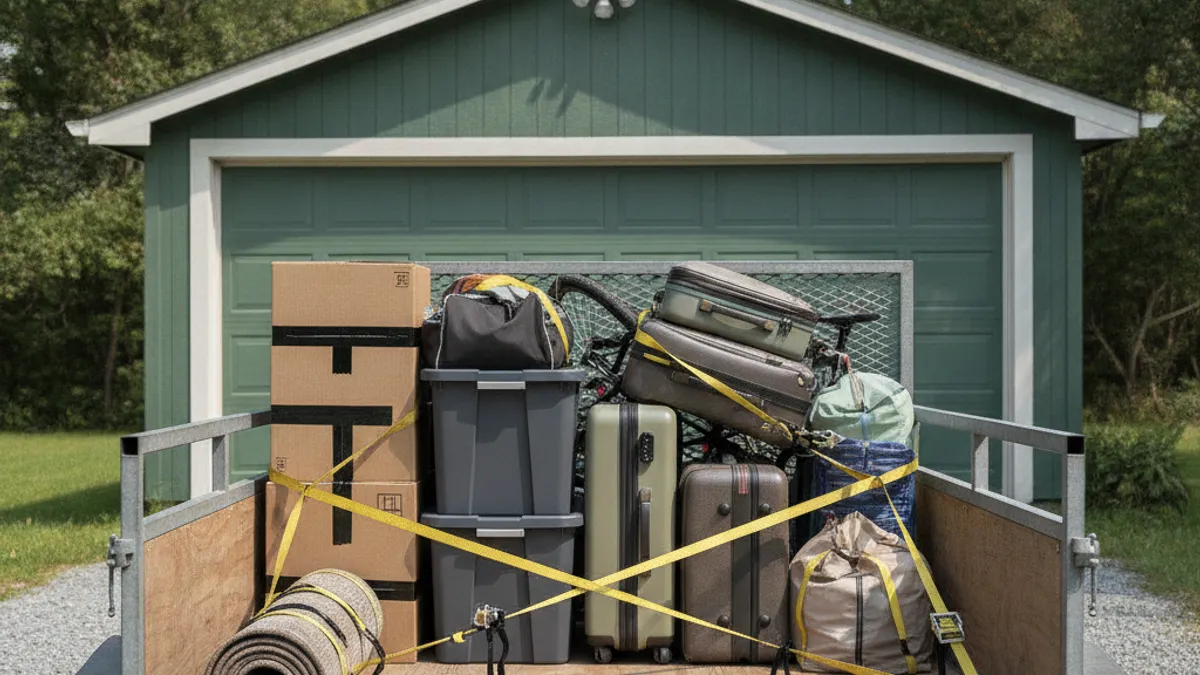
2. Ignoring nose weight. The downward force the trailer exerts on the hitch (vertical load) should be around 50 kg for road use, up to 100 kg for off-road trailers. Too little nose weight means the trailer floats and sway begins on the motorway. Too much means an overloaded rear axle on the car.
3. Unchecked tyre pressure. A trailer that has been sitting in the yard for months almost certainly has lower pressure than required. Check tyre pressure before every trip, adjusting for the load (typically 2.5-3.5 bar for a trailer; refer to the sticker on the trailer itself).
4. Braking as if there is no trailer. With a trailer the stopping distance is longer, especially if the trailer is unbraked. Maintain a greater following distance and brake earlier and more gently. On an unbraked trailer without ABS, harsh braking can cause the trailer to jack-knife.
5. Excessive speed in bends. A trailer has a higher centre of gravity than the car and reacts more slowly to changes in direction. Reduce speed in bends more than you normally would, especially under load.
6. Forgetting the extended turning radius. The trailer cuts the inside of a bend. The longer the trailer, the more it cuts in. When turning right at a junction, you need to swing wider to prevent the trailer from clipping the kerb or a post.
7. Faulty trailer lights. Before every trip check that all trailer lights are working: brake lights, indicators, side markers, rear fog light. A faulty connector or corroded contacts are the most common cause.
8. Driving without a safety chain. The safety chain (or cable) between the car and the trailer is mandatory. It serves as a backup in case the coupling separates. The chain should be short enough to prevent the trailer from dropping onto the road, but long enough to allow turns.
9. Stopping on a gradient without securing the trailer. When you stop a car with a trailer on a slope, place wheel chocks under the trailer's wheels. The car's handbrake holds the car, but the trailer (especially an unbraked one) can start rolling backwards.
10. Ignoring crosswinds. An empty trailer with high sides catches the wind like a sail. On exposed stretches of road (bridges, cuttings, tunnel exits) be prepared for lateral gusts.
All these mistakes share a common thread: a failure to adapt your driving to the fact that you are pulling an additional 500-1500 kg behind you. A trailer is not invisible; it changes the physics of your vehicle.
Found a trailer and want to check whether your car can tow that load? Get in touch for advice or an inspection before you sign the purchase contract.
Frequently Asked Questions
Can every car tow a trailer with a B licence?
No, it depends on the specific car. Every car has a maximum towing mass recorded in its registration document (fields O.1 and O.2). Some smaller cars are only approved to tow 400-500 kg as an unbraked trailer. A B licence grants the right to tow up to a 3500 kg combination, but your car may not physically be rated for that much.
How much does it cost to obtain a BE licence in BiH?
The cost depends on the specific driving school and region. It includes theoretical and practical training with a towed vehicle. Get in touch for a driving school recommendation in Banja Luka if you are looking for a proven choice.
Do I need B96 for a trailer in BiH?
No. B96 is an EU category that does not exist in BiH. The ZOBS BiH recognises only B (combination up to 3500 kg) and BE (above 3500 kg). Information about B96 that you find online applies to EU countries, not to BiH.
Can I tow a trailer on a motorway in BiH?
Yes, but with a speed limit of 80 km/h for a light trailer and caravan. For heavier trailers the limit may be 70 km/h. This applies regardless of the speed limit for other traffic on that section.
What if my car is registered in BiH but the trailer is from Croatia?
What matters is that the trailer has a valid registration and that the total combination satisfies the conditions of your BiH driving licence (B or BE) and your registration document (O.1/O.2 fields). A foreign trailer registration in itself is not a problem if the paperwork is in order.
Does a trailer need a roadworthiness inspection in BiH?
Yes. Every trailer registered in BiH must undergo a regular roadworthiness inspection. A light trailer (up to 750 kg) is inspected once a year, the same cycle as a car. The inspection covers brakes (if fitted), lights, chassis and coupling device.