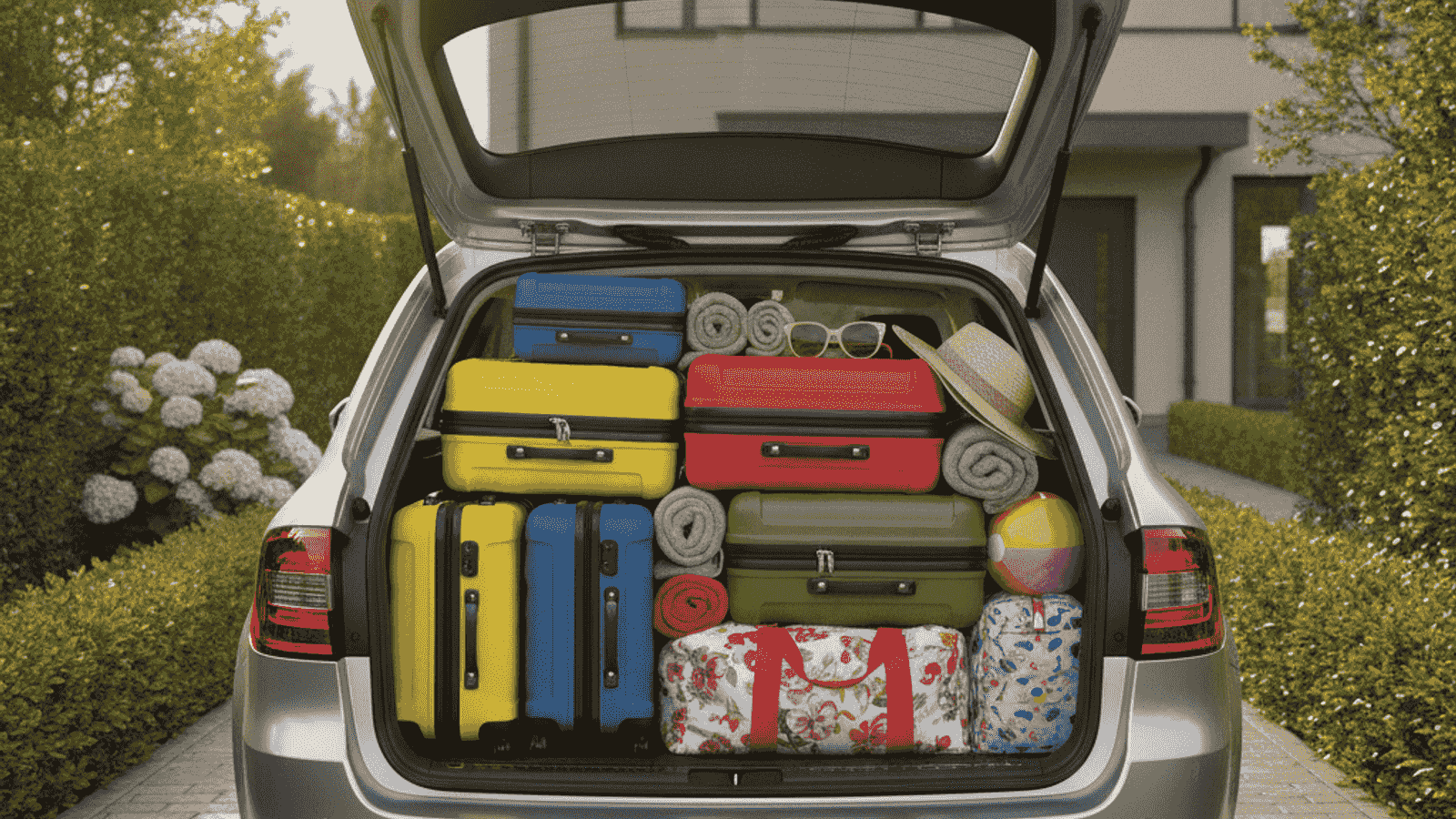
Every summer the same scenario repeats: a family packs suitcases, bags, boxes of food, two pairs of sandals per person and a tent "just in case". The boot barely closes, the springs bottom out, and the headlights shine at the sky instead of the road. Maximum permissible car load is not a question you only face at the MOT inspection. It is a question of braking, handling and safety on every kilometre of the journey to the coast.
This guide was compiled by the Auto Gas Gaga workshop in Banja Luka, based on years of experience with pre-purchase inspections and seasonal trip preparations.
Table of Contents
- How to Calculate Your Car's Payload
- Where to Find Payload in the Vehicle Registration
- How Many Kg Actually Remain for Luggage
- Payload of Popular Car Models in BiH
- How to Properly Distribute Weight in Your Car
- What Happens When You Overload Your Car
- Tyre Pressure for a Loaded Vehicle
- Regulations and Fines for Overloaded Vehicles in BiH
- Frequently Asked Questions
- Related Articles
How to Calculate Your Car's Payload
The formula is simple: subtract the kerb weight from the gross vehicle weight (GVW). The result is the payload — the total number of kilograms the car may carry, including passengers and luggage.
GVW is the maximum mass the vehicle is allowed to have in traffic. This figure is set by the manufacturer and does not change. Kerb weight includes the body, engine, all factory equipment, coolant, engine oil and a minimum fuel fill (usually 90% of a full tank per DIN standard, though this varies by manufacturer).
Example: if your vehicle registration states a GVW of 1,800 kg and a kerb weight of 1,305 kg, the payload is 495 kg. Those 495 kg cover everything: the driver, front passenger, children in the back seat, suitcases, bags, a cool box and a spare tyre if it differs from the factory weight.
This calculation looks straightforward, but drivers routinely get it wrong because they forget to account for people. Averages: an adult male 80 kg, a woman 65 kg, two school-age children at 35 kg each. The occupants alone account for 215 kg of the available payload. In a car with 500 kg payload, less than 300 kg remains for luggage. And once you add a full fuel tank above the factory minimum (the difference can be 15-25 kg depending on tank size), the margin shrinks further.
Where to Find Payload in the Vehicle Registration
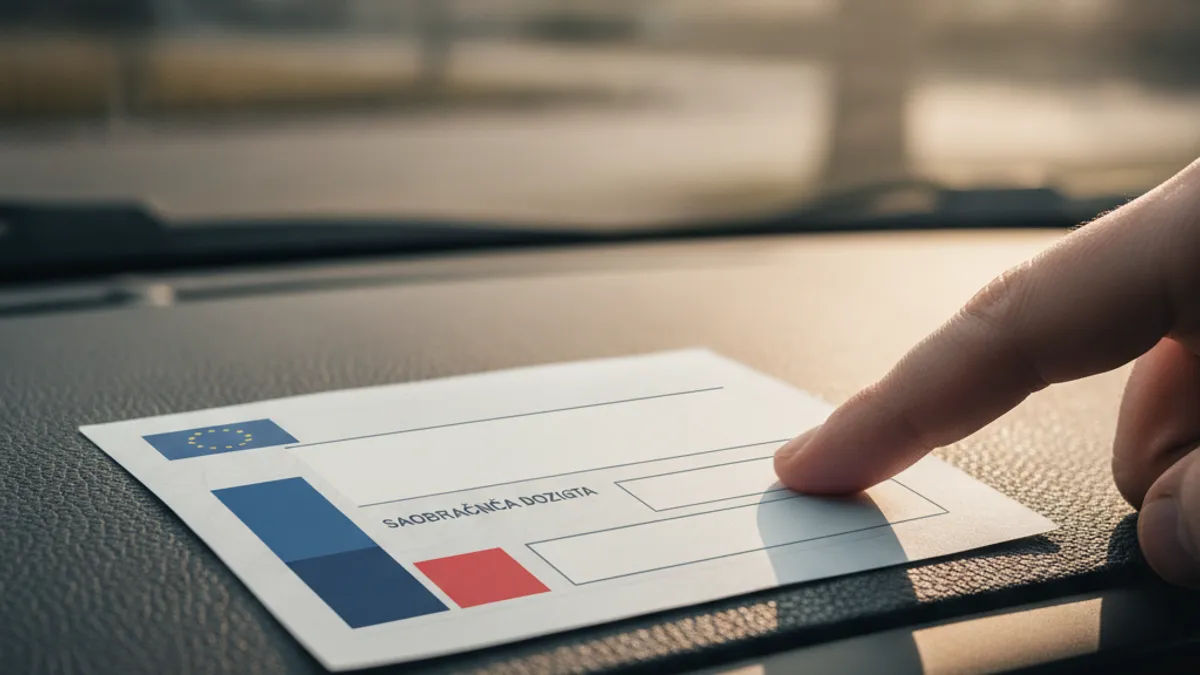
In the BiH vehicle registration look for fields F.1 and F.2. Field F.1 is the gross vehicle weight (GVW), and F.2 is the GVW of the vehicle in combination (with a trailer, if applicable). Field G is the kerb weight.
Payload is obtained by subtraction: F.1 minus G. If you have an older registration document without these labels, look for the fields "Najveća dozvoljena masa" (maximum permissible mass) and "Masa praznog vozila" (kerb weight). Those two figures are all you need.
An important detail: the kerb weight in the registration is the factory figure. If you have subsequently fitted a tow bar, roof rails, engine guard or an LPG tank with installation, those kilograms are deducted from your available payload. An LPG installation with a cylindrical tank typically adds 35-55 kg to the kerb weight. Those are kilograms you no longer have for luggage. The same applies to a steel bumper, boot cover or any other aftermarket equipment that was not on the vehicle when it left the factory.
How Many Kg Actually Remain for Luggage
Here is a concrete example based on a Goslar-Institut study. The car has a payload of 439 kg. Driver 85 kg, front passenger 70 kg, two children totalling 70 kg. Passengers alone account for 225 kg. That leaves 214 kg for luggage.
It sounds enough until you start adding up: large suitcase 23 kg, medium suitcase 15 kg, two sports bags at 8 kg each, cool box 12 kg, pushchair 10 kg, beach bag 5 kg, miscellaneous small items 10 kg. That is already 91 kg for just the essentials. Add a tent, two bicycles on a rear carrier (12-15 kg each) and you have exceeded the permissible mass by a good 30-40 kg.
Almost every family heading to the coast with four occupants and a standard amount of luggage exceeds or is right at the payload limit. This is especially true for smaller cars with a payload below 500 kg. The problem becomes more serious if you drive an older car whose shock absorbers are already partially worn, because weakened shock absorbers cannot compensate for excess mass the way new ones can.
The trouble is that overloading is not immediately noticeable. The car will pull out of the parking space, accelerate normally and even hold 130 km/h on the motorway. Overloading reveals itself only when you brake hard, enter a bend faster than usual, or get hit by a crosswind on a bridge. That is when the extra kilograms stop being a statistic and become a problem.
If you are planning to carry bicycles or a roof box, see the guide to roof carriers and boxes for details on extra fuel consumption and BiH regulations. When the load exceeds the car's own capacity, a trailer with a category B licence may be the only legal solution.
Payload of Popular Car Models in BiH
Payload differs even within the same model, depending on the engine and body variant. A heavier engine means a higher kerb weight and lower payload. This is why you must check your own registration document rather than relying on "my neighbour says a Golf carries 500 kg".
Golf 7 Payload: How Many Kg of Luggage
The Golf 7 with a 1.6 TDI engine (110 HP) has a kerb weight of 1,299 kg and a GVW of 1,800 kg, giving a payload of 501 kg in the hatchback version. The Variant of the same engine is heavier (1,395 kg kerb) but also has a higher GVW (1,930 kg), so the payload rises to 535 kg. For a family of four weighing a combined 215 kg, the Golf 7 hatchback leaves 286 kg for luggage, the Variant 320 kg. These are useful figures, but they apply exclusively to the 1.6 TDI powertrain. Other engine variants have different weights and different payloads.
| Model | Engine | Kerb weight (kg) | GVW (kg) | Payload (kg) |
|---|---|---|---|---|
| VW Golf 7 hatchback | 1.6 TDI 110 HP | 1,299 | 1,800 | 501 |
| VW Golf 7 Variant | 1.6 TDI 110 HP | 1,395 | 1,930 | 535 |
| Škoda Octavia III | 1.6 TDI 105 HP | 1,305 | 1,855 | 550 |
| Škoda Octavia III | 1.0 TSI | 1,230 | 1,855 | 625 |
| VW Passat B6 Variant | 2.0 TDI 140 HP | 1,510 | 2,140 | 630 |
| Opel Astra H | 1.7 CDTI | ~ 1,275 | 1,850 | 575 |
| Opel Astra H | 1.9 CDTI | ~ 1,358 | 1,850 | 492 |
Note the Opel Astra H: the same model, 83 kg difference in payload purely because of a different engine. The Astra with 1.7 CDTI carries 575 kg, while the heavier 1.9 CDTI version carries only 492 kg. That is the difference of one adult passenger. The Škoda Octavia with the lighter 1.0 TSI engine has 625 kg payload, while the 1.6 TDI version carries 550 kg. A 75 kg difference is not negligible when you are at capacity.
Estate versions as a rule have a higher GVW than hatchbacks (Golf 7 hatch 1,800 kg, Variant 1,930 kg), but they are also heavier themselves, so the payload gain is not as dramatic as the GVW difference suggests. The Passat B6 Variant with the 2.0 TDI engine carries 630 kg, making it one of the better choices for families that regularly transport larger amounts of luggage. On the other hand, it is also the heaviest car in the table (1,510 kg kerb), which means higher fuel consumption and higher registration costs.
How to Properly Distribute Weight in Your Car
Weight distribution in a car directly affects the vehicle's behaviour in bends, under braking and in crosswinds. This is not theory. ADAC measured axle load distribution for different packing methods, and the results are clear.
Cargo in the boot places roughly 110% of its weight on the rear axle and relieves the front axle by about 10%. This means 100 kg in the boot puts 110 kg of force on the rear wheels and removes 10 kg from the front wheels. The front end becomes lighter, steering less precise, and in a sharper bend the front tyres lose grip more easily.
Roof cargo is different: it distributes approximately 85% to the rear and 15% to the front axle. In addition, it raises the vehicle's centre of gravity, which increases body roll in bends and makes the car less stable in crosswinds. On an open motorway, particularly on bridges and in cuttings, this is a noticeable difference in how the car handles. More on limits and rules for roof cargo in the roof carrier guide.
A rear bicycle carrier is the least favourable: it shifts as much as 145% of the load onto the rear axle and relieves the front by 45%. Two bicycles at 13 kg each on a rear carrier (26 kg total for carrier and bicycles) place almost 38 kg of extra load on the rear axle. The front end rises, the headlights shine too high, and braking force on the front wheels drops because there is less mass on them.
Practical packing rules:
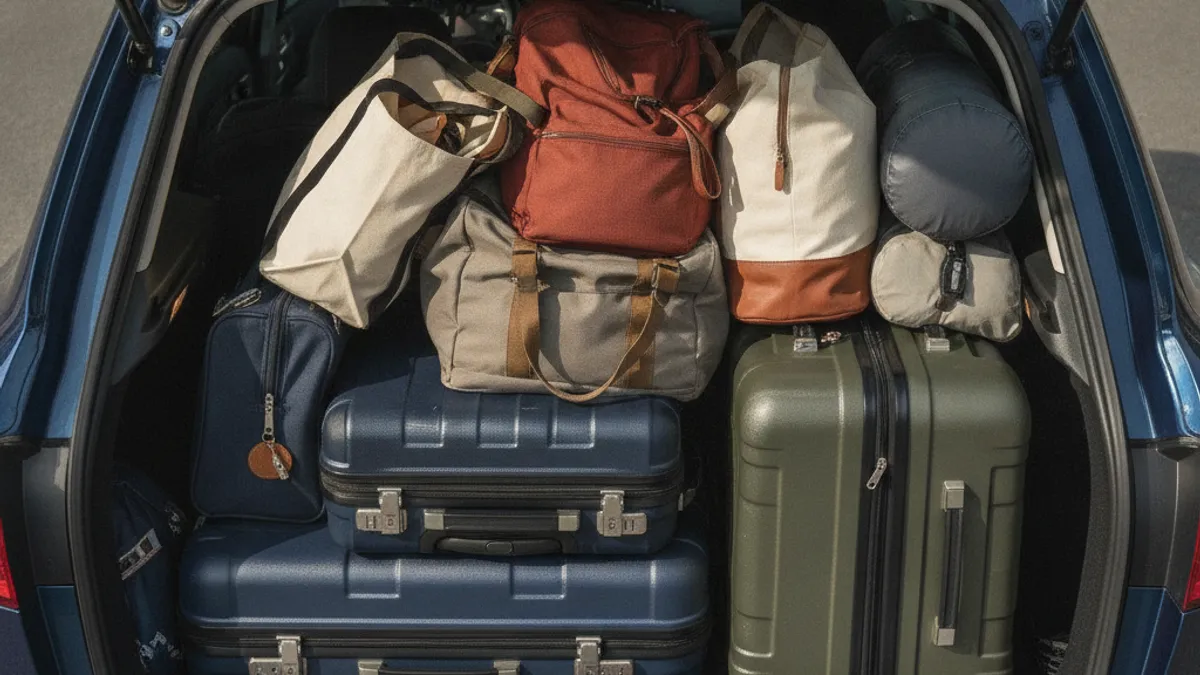
- Place the heaviest items on the boot floor, as close to the rear seat backrest as possible. There they are closest to the vehicle's centre and the rear axle.
- Never place heavy items on top of other things. A 23 kg suitcase sitting on top of a pile becomes a projectile under hard braking.
- Use the space under the boot floor (where the spare wheel sits) for heavier small items.
- Place lighter and softer items on top and towards the tailgate.
- If you are carrying long items through a folded-down backrest, secure them with a strap or net. A 2-metre rod sliding along a flat backrest under braking from 100 km/h hits with the force of thrown bricks.
- Inside the cabin, nothing heavy should sit on the rear shelf or loose on the back seat. In a collision at 50 km/h, a 5 kg object strikes with a force of around 150 kg.
If you have a grille or net separating the boot from the cabin, it is one of the best investments in safety. A net will not completely stop 50 kg of cargo, but it will slow and redirect objects enough that the difference is between a bruise and a serious injury.
What Happens When You Overload Your Car
Overloaded Cars Have Longer Stopping Distances
An overloaded vehicle behaves differently in every driving mode. ADAC warns of several specific consequences that most drivers do not consider until it is too late.
Stopping distance increases significantly. More mass means more kinetic energy that the brakes must convert into heat. Discs and pads designed for the factory mass range work outside their optimal zone. On a long descent (mountain road towards the coast), an overloaded vehicle overheats its brakes faster, and overheated brakes stop working. This is called brake fade and it happens without warning.
Evasive response becomes more sluggish. A heavier car changes direction more slowly. The ESP system, which calculates based on factory mass and distribution, can misjudge the situation and react too late or too aggressively. ADAC confirms that an overloaded vehicle can skid even with ESP engaged.
Shock absorbers work at the end of their travel. When the springs bottom out, the shock absorber has no room to cushion bumps. Every pothole transmits directly to the body. Tyres on an overloaded axle heat up faster, and an overheated tyre loses grip and is more likely to burst, especially in summer on hot tarmac.
Fuel consumption rises. Every excess 100 kg increases consumption by approximately 0.3-0.5 litres per 100 km, depending on the driving profile. On a 1,000 km round trip to the coast, that is 6-10 litres of extra fuel. On a car with an LPG installation the monetary difference is smaller, but the extra mass still loads the engine, gearbox and brakes just as much as on a petrol or diesel vehicle.
Tyre Pressure for a Loaded Vehicle
The 0.2 Bar Rule for Loaded Car Tyre Pressure
This is one of the most commonly neglected preparations for a trip. When you load the car with passengers and luggage, tyre pressure must be higher than for an unladen car. ADAC recommends a well-known rule: in summer, increase pressure by at least 0.2 bar on cold tyres. For a fully loaded vehicle (trip with a full boot and all passengers), the recommendation is 0.3-0.4 bar above normal pressure, while respecting the maximum marked on the tyre sidewall.
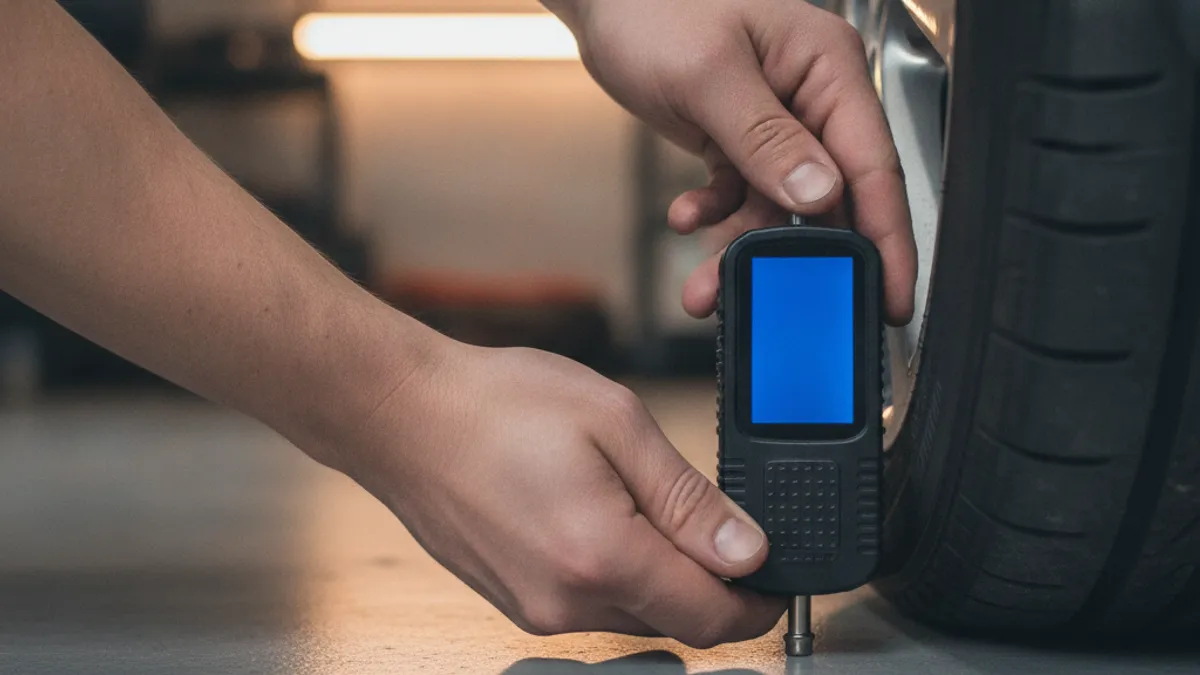
Pressure must ALWAYS be measured on cold tyres, before driving or after at least two hours at rest. A tyre that has covered even 5 km reads higher than its true pressure because the air has warmed up. If you measure at a petrol station after driving 20 km to get there, you are measuring incorrectly. The result is that you put in less pressure than needed.
Why does this matter? A tyre with too little pressure on a loaded car flexes too much during driving. The sidewalls overheat, the tyre wears faster at the edges, and in extreme cases the tread can separate or the tyre can burst. On a motorway at 130 km/h, with tarmac temperatures above 50 degrees in summer, an under-inflated tyre on an overloaded car is a ticking time bomb.
On the sticker in the driver's door frame or in your car's manual you will find the exact pressure for partially and fully loaded conditions. If the sticker is missing or illegible, the manufacturer's recommendations are available online by model and year. More on proper tyre maintenance and pressure in a dedicated guide.
Vehicles with TPMS sensors (tyre pressure monitoring system) usually warn when pressure drops below the factory minimum, but that minimum is set for an unladen vehicle. TPMS will not warn you that your pressure is too low for a loaded car, because it does not know you have put 400 kg in the boot. Adjusting pressure is a manual job and no sensor replaces it.
Regulations and Fines for Overloaded Vehicles in BiH
In BiH, the Law on Road Traffic Safety Fundamentals (ZOBS) stipulates that a vehicle must not be loaded beyond the maximum permissible mass. The police have the right to stop a vehicle they assess as overloaded and prohibit further travel until the excess cargo is removed.
Unlike Germany, where fines for overloaded passenger vehicles are precisely graduated (up to 235 EUR and a penalty point for overloading by more than 30%), BiH regulations do not define an equally clear tariff for this offence in the case of passenger vehicles. However, the police can issue a fine for a technically defective vehicle, because an overloaded vehicle is technically defective at that moment.
More practically relevant than the fine itself is the problem that arises if an accident occurs. If you were above the GVW at the time of the accident, the insurance company has grounds to dispute or reduce the payout. The insurer's logic: you were driving the vehicle in a condition that does not comply with technical regulations. This possibility of coverage denial is a far more serious financial consequence than any traffic fine.
Another practical consequence: if you are weighed at a border crossing and found to be overloaded, you are obliged to remove the excess cargo before continuing. At a border, that means leaving belongings behind or transferring them to another vehicle. Neither is a pleasant situation at the start of an annual holiday.
Before setting off on a longer trip, especially in summer when the car is loaded more than usual, checking pressure, tyres and loading is a five-minute investment that can prevent a five-hour problem. If you are unsure whether everything fits in the car or a trailer is needed, the trailer with B category licence guide explains the regulations, masses and limitations.
Before you hit the road, book a quick check at our workshop. We will check tyre pressure, shock absorber and brake condition in five minutes so you can head onto the motorway with peace of mind.
Frequently Asked Questions
How many kilograms of luggage fit in a Golf 7?
The Golf 7 with a 1.6 TDI engine has a payload of 501 kg (hatchback) or 535 kg (Variant). Subtract the mass of all passengers from that. For a family of four (around 215 kg combined), the hatchback leaves about 286 kg for luggage, the Variant about 320 kg. Check your vehicle registration because payload varies by powertrain.
Where can I see my car's payload?
In the vehicle registration, field F.1 is the gross vehicle weight and field G is the kerb weight. Payload is the difference between those two figures. The same information is on the sticker in the driver's door frame or in the vehicle's technical manual.
Does the driver's weight count towards the payload?
Yes. Payload covers everything: the driver, all passengers, luggage, aftermarket equipment and fuel above the minimum. A driver weighing 85 kg already takes a significant portion of the available payload, especially in smaller cars with 400-500 kg total payload.
How many kg are allowed on the car roof?
The dynamic roof load (while driving) is usually 50-100 kg, depending on the model. This figure is in the vehicle manual and always includes the mass of the roof carrier or box itself. If the carrier weighs 5 kg and the roof box 15 kg, that leaves 30-80 kg for cargo inside the box. Static load (when the car is parked) is higher, but during driving only the dynamic rating applies.
If I have a trailer, does the car's payload change?
The car's own payload remains the same regardless of whether a trailer is attached. However, the GVW of the vehicle in combination (F.2 in the registration) limits the total mass of car and trailer together. A trailer does not increase the car's payload; it allows you to legally transport cargo that does not fit in the car separately.
How can I tell the car is overloaded without a scale?
Visual signs: the car "sits" low at the rear, headlights shine upwards instead of at the road, the front end is raised, springs are compressed to the end of their travel. While driving: the car reacts far more harshly to bumps, is more sluggish in bends and takes noticeably longer to stop. If you notice any of these signs, you are certainly near or above the limit.