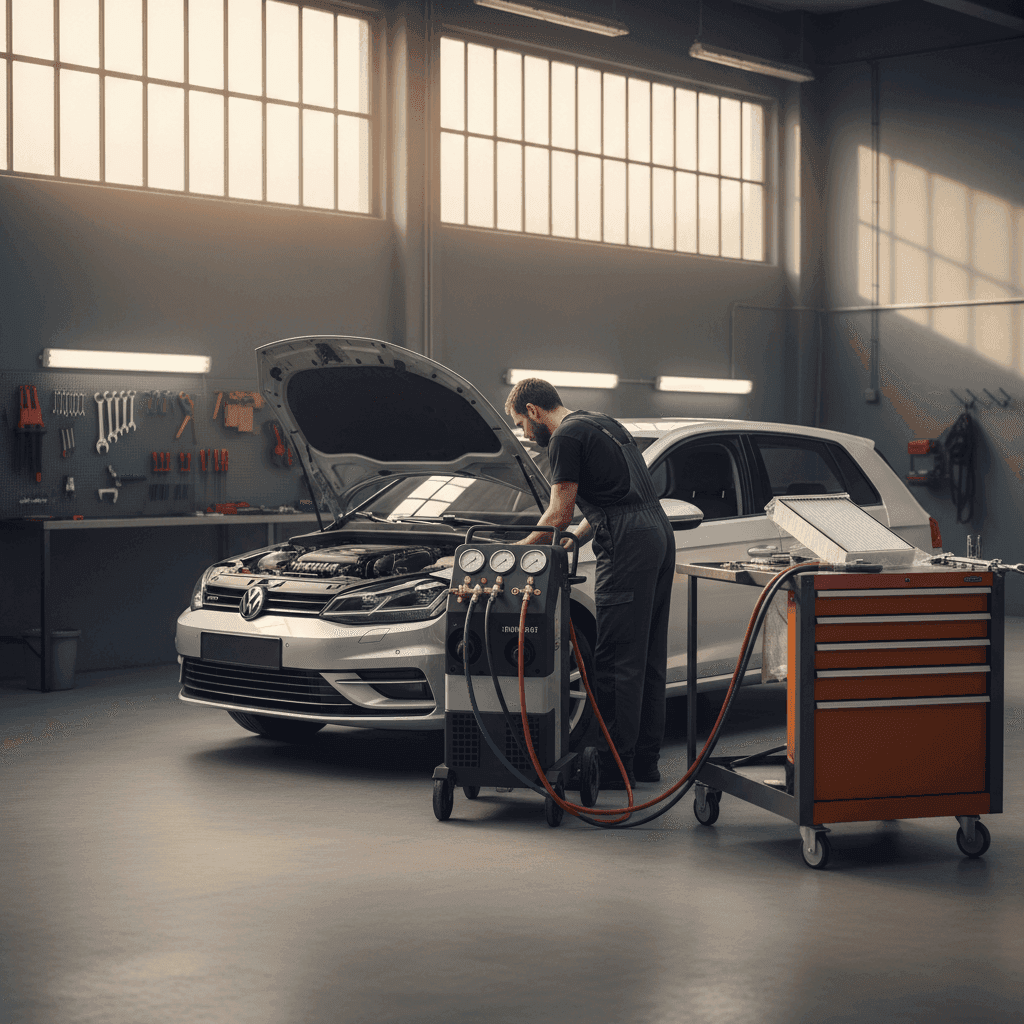
Last summer it cooled weaker, but you said "let it last one more season". It is now May 2026, and the first heatwaves hit in two weeks. A proper car AC service in BiH 2026 costs between 60 and 200 KM, depending on the type of refrigerant, but a cheap top-up of around thirty marks at a workshop that does not vacuum the system can lead to a compressor replacement of over a thousand marks. This article separates the two.
This guide was put together by the Auto Gas Gaga workshop in Banja Luka, based on years of experience servicing AC systems in European models.
Table of Contents
- Why AC Needs Service Right Before Summer
- How to Recognise When AC Is Not Working Properly
- Gas Top-Up or Complete AC Service
- R134a and R1234yf, Two Gases and Two Prices
- Ozone Disinfection and Cabin Filter
- AC Service Price List in BiH 2026
- Most Common Faults and When to Go Further
- Five-Minute Check Before Heading to the Coast
- Frequently Asked Questions
- Related Articles
Why AC Needs Service Right Before Summer
AC is not a system that stays trouble-free when unused. A healthy AC system naturally loses 10 to 15 grams of refrigerant per year, enough that after two or three seasons you notice noticeably weaker cooling. If this is topped up before the season and done correctly, the system stays intact. If it is topped up wrong or skipped, the compressor runs with too little gas and starts heating itself.
The second reason is logistics. From mid-May to mid-July, workshops in Banja Luka have a week-long wait for an AC service slot. A pre-season inspection in March or April is practically wait-free. We have a seasonal inspection list in the article preparing your car for summer in BiH.
The third reason is bacteria and mould. During winter, condensation on the evaporator under the dashboard feeds a biofilm that produces a damp smell when you turn on the AC for the first time in May. Ozone kills it in around twenty minutes, but the best moment is pre-season, together with replacing the cabin filter.
How to Recognise When AC Is Not Working Properly
Most drivers notice the problem only on the first humid day, when it is already 32 degrees in the shade. The signs are visible earlier if you know what to look for.
Weak cooling or long cool-down time is the most common symptom, and in nine out of ten cases the cause is a lack of refrigerant, meaning a leak. The test is simple. Turn the AC on at maximum, recirculation, close the windows and time it. If the cabin needs more than 8 to 10 minutes when it is 25 to 30 degrees outside, something is wrong.
Unpleasant smell on start-up is described as a damp basement or an old towel, which means bacteria and mould on the evaporator. The cabin filter is usually an accomplice, but the filter alone will not solve a smell that has already taken hold of the evaporator. That requires ozone.
Weak airflow when the blower is on maximum is almost always a clogged cabin filter. If even with the AC off the blower barely moves the papers on the dashboard, the problem is in the filter. Our article car AC, service and refrigerant recharge explains in detail how the filter affects the entire system.
Unusual noises like humming, grinding or whistling from the compressor area are a sign of a more serious fault, most often the compressor bearing or a loose belt. A compressor that squeaks today usually disintegrates within a few weeks.
Water puddle under the car at the front is normal condensation. A puddle inside under the passenger footwell, or fluid that smells of antifreeze, means the drain pipe is clogged or burst, and that needs immediate attention.
Gas Top-Up or Complete AC Service
This is the point at which drivers in BiH most often get caught out, because a cheap offer of 30 to 50 KM sounds tempting and is done in fifteen minutes.
A cheap can top-up means someone hooks up a small machine and injects refrigerant without first vacuuming the system. At that point the system has likely already drawn in moisture through micro-leaks, because if the AC is losing gas, it is losing it somewhere. That moisture stays inside, mixes with the new gas and the oil, and creates sulphuric acid that eats the metal parts of the compressor from the inside. A month or two of cooling, then a drop. It is no longer a question of recharging, but of replacing the compressor.
A proper AC service includes:
- Diagnostics and a leak test with nitrogen or UV dye
- Vacuuming the system for 30 minutes or more, which simultaneously checks for leaks and pulls out all moisture and air
- Machine recharge with the prescribed amount of refrigerant per the manufacturer's specification
- Pressure measurement on the high and low sides, to confirm normal compressor operation
- Outlet temperature check, a healthy AC blows air cooler than 8 to 10 degrees Celsius at the central vents
Vacuuming is the key difference. It is the reason a proper service takes 60 to 90 minutes while a quick top-up takes fifteen, and it is the reason a proper service does not later end up with the compressor in the bin.
If the system has not been emptied in a workshop within the last year, just topping up is not an option. A top-up is justified only if it has already been confirmed there is no leak, and you are simply replacing those 10 to 15 grams of natural annual loss.
R134a and R1234yf, Two Gases and Two Prices
Two completely different refrigerants are in use, and the price difference is threefold.
R134a is fitted in vehicles produced mainly up to 2015. The gas costs reasonably and the recharge is the cheaper option. Most used vehicles in BiH (Golf 5 and 6, Octavia 1 and 2, Astra G and H, older Passat) run on R134a.
R1234yf is mandatory in all new vehicles in the EU from 2017, for environmental reasons. The gas is significantly more expensive to source, the machine is special and workshops have it less often, so the final price is around three times higher. If your car is from 2017 or newer, your system is very likely R1234yf.
How to check: under the bonnet, most often on the AC high-pressure fitting, there is a small label with the refrigerant designation and the prescribed amount in grams. It clearly says R-134a or R-1234yf. If there is no label, the year is a good indicator: up to 2015 almost certainly R134a, from 2017 onwards almost certainly R1234yf, with 2015 to 2017 being mixed.
When you call a workshop, the first question should be the year of the car, or even better which gas your AC uses. The difference is large enough that it is worth knowing before you arrive. AGG in Banja Luka does both.
Ozone Disinfection and Cabin Filter
Two steps that drivers in BiH most often skip, both cheap and both dramatically changing the driving experience during summer.
Ozone disinfection is a treatment in which a generator is placed in the cabin, the AC is set to recirculation, and ozone is pushed through the entire ventilation system over 20 to 30 minutes. In that short time, ozone kills bacteria, mould, fungi and viruses on the evaporator, in the ducts and on the filter. The best time is at the start of the summer season, and always after replacing the cabin filter, so the ozone passes unobstructed through the entire system.
Especially important if you drive children, allergy sufferers, or anyone with asthma, because biofilm on the evaporator triggers allergies and respiratory infections.
Cabin filter is the cheapest item in the whole story, yet has the biggest impact on AC performance. It should be replaced at least once a year or every 15 to 20 thousand kilometres. In most cars, fitting it is a ten-minute job.
Order matters: first replace the cabin filter, then do ozone. Through a clean filter, ozone passes efficiently and reaches the entire system. Through a dirty filter, it stays mostly in the front section, leaving the rear of the evaporator untreated.
AC Service Price List in BiH 2026
Prices are indicative, taken from published BiH service price lists for the 2026 season. The actual price varies by workshop and model.
- AC recharge with R134a gas: range 60 to 80 KM for a standard machine recharge with vacuuming.
- AC recharge with R1234yf gas: range 150 to 200 KM.
- Ozone disinfection: an add-on of 15 to 30 KM on top of the basic recharge service.
- Cabin filter (part only): range 10 to 40 KM depending on model and quality.
- Leak detection: ranges from a token add-on alongside the basic service to a separate line item. The point most often skipped in cheap offers.
Larger interventions such as compressor, condenser or evaporator replacement fall outside the scope of this article. The price depends on the actual condition, get in touch for an estimate if your diagnosis pointed to one of these parts. Promotional prices in March and April are routinely lower than in June when everyone piles in.
Most Common Faults and When to Go Further
Leaks at fittings and hoses are by far the most common serious fault. Used cars with over 200 thousand kilometres almost always need a seal replaced. Detection with UV dye or nitrogen finds the exact location in fifteen minutes.
The condenser behind the front grille is exposed to stones flying from the road. A punctured condenser is not repaired but replaced.
The compressor is the most expensive item in the system. Early intervention at the first signs of squeaking, humming or overheating is the most important economic decision you make as a driver. A compressor that ran for two days without gas or with moisture often cannot be saved, and the result is a bill of over a thousand marks for what was a one-hundred-mark intervention two months earlier.
Expansion valve and evaporator faults are rarer. The evaporator is under the dashboard and replacing it requires removing half the car interior.
AC electronics produce symptoms that look like a gas fault but are not, for example AC that switches itself off after a minute of operation. Electronic car diagnostics helps here, the computer often resolves a symptom that nobody can figure out by ear.
If the AC cools weakly on a properly recharged system, or the fault returns after a month or two, it means the leak was not found or the compressor is already worn out.
Five-Minute Check Before Heading to the Coast
A quick check you can do yourself in the driveway before heading off to the border.
- Start the engine and set AC to maximum, with the blower on the highest speed and the temperature on coldest. Recirculation, doors and windows closed.
- Wait two to three minutes and feel the air from the central vents. It should be at least 10 degrees colder than the outside temperature on a warm day.
- Check the airflow. If it is feeble, the cabin filter is definitely the culprit.
- Smell it. If in the first thirty seconds you sense a damp, basement smell, the system needs ozone before you sit in it for an 8-hour drive.
- Look under the car after 10 minutes of operation. A puddle of clear water under the front is normal condensation. A puddle inside under the passenger footwell means trouble.
If the AC fails at any step, do not count on it surviving the trip. Wider pre-trip vehicle preparation is covered in the articles driving from BiH to the coast 2026 and what to check before a longer drive.
If you need an inspection or full AC service before your trip, book a workshop appointment or message us on WhatsApp. Pre-season slots are usually available the same day.
Frequently Asked Questions
How much does an AC recharge cost in BiH 2026?
For vehicles with R134a gas (most used cars produced up to 2015), it ranges from 60 to 80 KM for a machine recharge with vacuuming. For vehicles with R1234yf gas (EU production from 2017), the price is 150 to 200 KM. The difference is the more expensive gas and a special machine.
Is a 30 KM gas top-up enough?
No, unless the system was fully serviced with vacuuming the previous year and you are now only replacing the natural annual loss. Otherwise a top-up without vacuuming leaves moisture in the system and can destroy the compressor, whose replacement costs over a thousand marks.
Which gas does my AC use, R134a or R1234yf?
Look at the label under the bonnet, the designation is clearly written there. If there is no label, the year is a good indicator: up to 2015 almost certainly R134a, from 2017 onwards almost certainly R1234yf.
Why does the AC blow but not cool?
Three causes: lack of refrigerant due to a leak, compressor failure, or failure of the electromagnetic clutch that engages the compressor. All three are quickly identified on diagnostics.
When should the cabin filter be replaced?
At least once a year or every 15 to 20 thousand kilometres. The easiest is to tie the replacement to the pre-season AC service, because the workshop then runs ozone disinfection through a clean filter.
How long does a complete car AC service take?
With diagnostics, 30 minutes of vacuuming, machine recharge, cabin filter replacement and ozone disinfection, it takes 60 to 90 minutes. A quick can top-up takes fifteen, but a quick top-up is not a service.