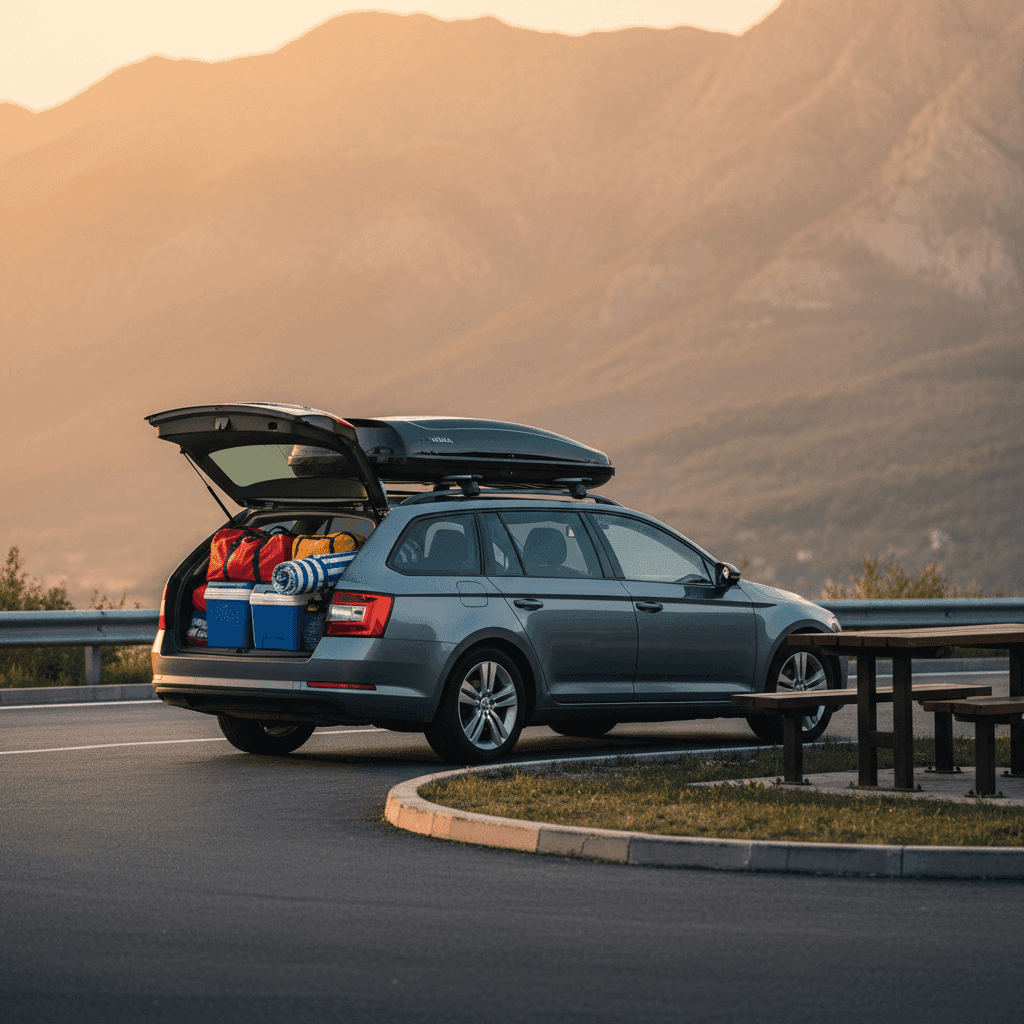
In late April and through May, tens of thousands of families from BiH set off by car for the Adriatic, and most of those who get caught at the border are not stopped because of the car but because of paperwork or gear they are missing. This guide to driving from BiH to the coast in 2026 boils everything down to one list: which papers to keep in the glovebox, where you need a green card, how much a vignette for Slovenia and Austria costs, what must be in the car, and how to get through without a fine if you are pulled over.
The checklist was prepared by the Auto Gas Gaga workshop in Banja Luka, in the order it follows in practice with its customers before the summer season.
Table of Contents
- What You Really Need in Terms of Documents When Leaving BiH by Car
- Green Card: For Which Countries Is It Still Mandatory
- Vignettes in 2026: Prices for Slovenia, Austria and Switzerland
- Tolls Without a Vignette: Croatia, Italy, Hungary
- Mandatory Equipment in the Car by Country
- Travelling with Children: Car Seats, Consent and the Border
- What to Bring in Case of a Breakdown and How to React on the Road
- Frequently Asked Questions
- Related Articles
What You Really Need in Terms of Documents When Leaving BiH by Car
Most families from BiH reach the coast through the Croatian border, so before you leave take a look at the live situation through our cameras - Gradiška, Brod and Šamac, plus an overview of all border crossings with cameras.
Pack the papers before the luggage, because if a single document is missing, the rest is irrelevant. The driver and all adult passengers carry a valid passport or ID card, and the driver also carries a driving licence. For the car itself you need the vehicle registration document, a compulsory third-party motor liability insurance policy (green card or in BiH format depending on the destination, more on this below) and, if the car is not yours, a notarised consent from the owner to leave BiH.
If you are driving a company vehicle or a leased car, ask the company for a travel order or a separate authorisation. In practice, the border police do not make an issue of family vehicles where the owner is in the seat, but when the driver is not the owner, the document must be with the vehicle.
A practical tip: scan all the papers and email them to yourself or upload them to the cloud before you set off. If your wallet drops in a crowd somewhere or you forget it at a petrol station, a copy on your phone can save your day with the police or when checking in at an apartment.
Green Card: For Which Countries Is It Still Mandatory
Since BiH joined the Multilateral Agreement on 20 October 2020, our number plate serves as proof of compulsory insurance in all EEA countries, plus Serbia, Montenegro, Andorra and Switzerland. If you are going to Croatia, Slovenia, Italy, Austria, Hungary, Germany or other EU countries, the green card is not mandatory at the border, the plate is enough.
The green card (IMIC, international) is still mandatory for nine countries: Albania, Azerbaijan, North Macedonia, Morocco, Moldova, Tunisia, Turkey, Ukraine and the United Kingdom. If you are going to any of them even for a single day, get the green card from your insurance company before the trip.
Even though the green card is not mandatory for Croatia and other EU countries, many drivers still carry it. The reason is practical: if you cause damage abroad, the green card with your details on it speeds up the claim and contact with the foreign insurer. Ask for it at your insurance company, it is most often free or comes with a token fee.
Vignettes in 2026: Prices for Slovenia, Austria and Switzerland
A vignette is a sticker or electronic marker that allows you to use the motorways in a given country. The three countries a BiH driver most often touches have a vignette system: Slovenia, Austria and Switzerland. The prices that follow are valid as of the research date 26 April 2026, according to HAK data, and may be slightly adjusted during the season.
| Country | Week | Month | Year |
|---|---|---|---|
| Slovenia (category 2A) | 16 EUR | 32 EUR | 117.50 EUR |
| Austria | 12.40 EUR (10 days) | 31.10 EUR (2 months) | 103.80 EUR |
| Switzerland | none | none | around 40 CHF (annual) |
Slovenia uses an e-vignette, which you buy online or at petrol stations. The weekly costs 16 EUR, monthly 32 EUR, annual 117.50 EUR. Prices have not changed for 2026.
Austria raised vignette prices by 7.7 percent on 1 December 2025. The one-day now costs 9.30 EUR, ten-day 12.40 EUR, two-month 31.10 EUR, annual 103.80 EUR. The Austrian vignette is also available as a sticker and as a digital one through the official ASFINAG app.
Switzerland has only an annual vignette, around 40 CHF, and for most BiH drivers it makes no sense unless they are planning a longer stay. For a single transit through it, factor this cost in upfront.
Buy the vignette before entering the country or at the first petrol station. Driving on the motorway without a vignette means a fine that in all of these countries is several times the annual vignette, so there is no point in taking the risk.
Tolls Without a Vignette: Croatia, Italy, Hungary
Croatia, Italy and France charge tolls per kilometre travelled, at toll booths. In Croatia you pay by card or cash at exit booths, and you can also use an ENC device that speeds up your passage. Hungary works on a different model: an e-vignette by days or month, which you buy online before entering the motorway, you do not need a sticker because cameras read the plates.
For a trip from Banja Luka to Split or Dubrovnik, you pay most of the toll in Croatia. If you do not take the motorway but use the old roads, the toll falls away, but the drive is extended by about an hour. In high season the motorway is more often worth it because the alternative routes can be congested.
If you cross through Hungary, for example if you are heading for Slovenia or further north, buy the Hungarian e-vignette in advance. The smallest options are seven-day, enough for a one-way crossing.
Mandatory Equipment in the Car by Country
Each country has its own list of mandatory equipment, and fines for missing items are concrete. The table below covers what you need to show at a roadside check.
| Equipment | BiH | Croatia | Slovenia | Austria |
|---|---|---|---|---|
| Warning triangle | mandatory | mandatory | mandatory | mandatory |
| First-aid kit | mandatory | mandatory | mandatory | mandatory |
| Reflective vest | mandatory (all passengers recommended) | mandatory (driver + passengers outside the car) | mandatory | mandatory |
| Spare bulbs | recommended | recommended | recommended | not mandatory |
| Fire extinguisher | mandatory | not mandatory | not mandatory | not mandatory |
| Spare wheel or repair kit | mandatory | mandatory | mandatory | mandatory |
In Croatia, the fine for a missing first-aid kit, warning triangle or reflective vest is 30 EUR per item. Three missing items and you have a fine of nearly 100 EUR for one stop. Failing to clear snow or ice from the windscreen in Croatia in winter costs 130 EUR, but that is not an issue for a summer trip.
Also check that the vest is not stuck in the boot under a suitcase. The rule in Slovenia and Austria is that you put the vest on before getting out of the car on the motorway, which means it must be reachable from the driver's seat. The simplest is to keep one vest each for the driver and the front passenger in the door pocket.
Vehicles running on autogas have specific rules when entering some Alpine tunnels - if you drive on LPG, check the restrictions on your specific route before you set off.
Travelling with Children: Car Seats, Consent and the Border
The BiH border police have a clear rule: a child under 14 years of age travelling abroad in the company of another person (not a parent) must have a notarised consent from both parents or guardians. If the child is travelling with one or both parents, no consent is needed. The notarisation is done at a notary or municipal office.
In BiH, a child under 12 years of age is not allowed to sit in the front seat, unless they are under two years old and are in a rear-facing car seat with the airbag switched off. The fine for incorrect transport of a child in BiH is 40 KM, and for a child in the front seat in breach of the rules 400-1000 KM.
The rules on car seats and child transport vary between BiH, Croatia, Slovenia and Austria. The table below gives the minimum required across all four countries, so if you stick to the stricter thresholds you are not in trouble anywhere:
| Rule | Practical decision |
|---|---|
| Rear-facing car seat | mandatory until at least 15 months, many children are fine in one until age 4 |
| Car seat | until the child reaches 150 cm in height or 12 years (depending on the country, take the stricter threshold) |
| Booster seat | after the classic car seat, up to 150 cm |
| Front seat | avoid for children under 12 years |
| Airbag and car seat | airbag MUST be OFF if a rear-facing seat is in front |
Bring a copy of the birth certificate for the children, especially if surnames in the family are not identical. The border officer rarely asks for it, but when they do, a paper that is at home rather than in the car will not help you.
What to Bring in Case of a Breakdown and How to React on the Road
A breakdown on the motorway in season is rare but not impossible. A car going on a longer trip should be inspected in advance, which is a topic of its own and covers a pre-trip check, the condition of the tyres, radiator, air conditioning and battery.
In addition to the mandatory equipment, add to the car:
- a 5-litre bottle of water (in case the radiator boils or the engine overheats)
- jump leads (booster cables, do not wait for the battery to die)
- a torch with spare batteries
- hand sanitiser, bags and paper tissues
- a phone charger that works from the cigarette lighter (12V), not just USB from the infotainment
- a hard copy of the insurance policy and the assistance number
If your car stops on the motorway, first move the vehicle to the hard shoulder if you can. Switch on all four indicators, get out on the side away from traffic, put on the reflective vest, place the warning triangle at the prescribed distance (50 m outside built-up areas, 100 m on the motorway) and call assistance or 112. Passengers, especially children, get out behind the safety barrier, never standing next to the car.
If your car runs on autogas, be sure to tell roadside assistance, because some tow trucks and workshops have rules for vehicles with an LPG installation.
For a trip to the coast it is worth doing an inspection before you set off. Auto Gas Gaga in Banja Luka does pre-trip technical inspections: tyres, brakes, oil, battery, air conditioning and the LPG system if the vehicle runs on gas. Write to us through the contact form if you would like to book a slot during May.
Frequently Asked Questions
Do I need a green card for Croatia in 2026?
No, the BiH number plate serves as proof of compulsory insurance in Croatia and the rest of the EEA, Serbia, Montenegro, Andorra and Switzerland. The green card is mandatory only for Albania, Azerbaijan, North Macedonia, Morocco, Moldova, Tunisia, Turkey, Ukraine and the United Kingdom.
How much does the annual vignette for Slovenia cost in 2026?
The Slovenian annual e-vignette for category 2A passenger vehicles costs 117.50 EUR. The monthly is 32 EUR and the seven-day 16 EUR. Prices have not changed for 2026.
What equipment exactly must be in the car when I set off for the coast?
Warning triangle, first-aid kit, reflective vest, spare wheel or repair kit. In BiH a fire extinguisher is also required. Keep the reflective vest within reach, not in the boot, because you must put it on before getting out onto the motorway.
Can an 8-year-old child sit in the front?
It is not recommended. In BiH a child under 12 years of age may not sit in the front seat unless they are under two years old and in a rear-facing seat with the airbag off. Croatia and Slovenia have similar rules, so if you carry the child in the front, you risk a fine and, more importantly, their safety.
Does a child need special consent for a trip to the coast with both parents?
No. Consent is only required when a child under 14 years of age travels abroad with another person who is not a parent or guardian, for example with a grandmother, grandfather or aunt. With one or both parents no consent is needed.
How much fuel do I need for a trip from Banja Luka to Split?
It depends on your car's consumption, but for a rough idea: in the Federation of BiH in mid-April 2026 the average price of 95 petrol was around 2.92-2.93 KM per litre, and diesel around 3.68 KM per litre. Reckon on about 480 km one way, multiply by your car's consumption and you have the fuel budget for the trip.