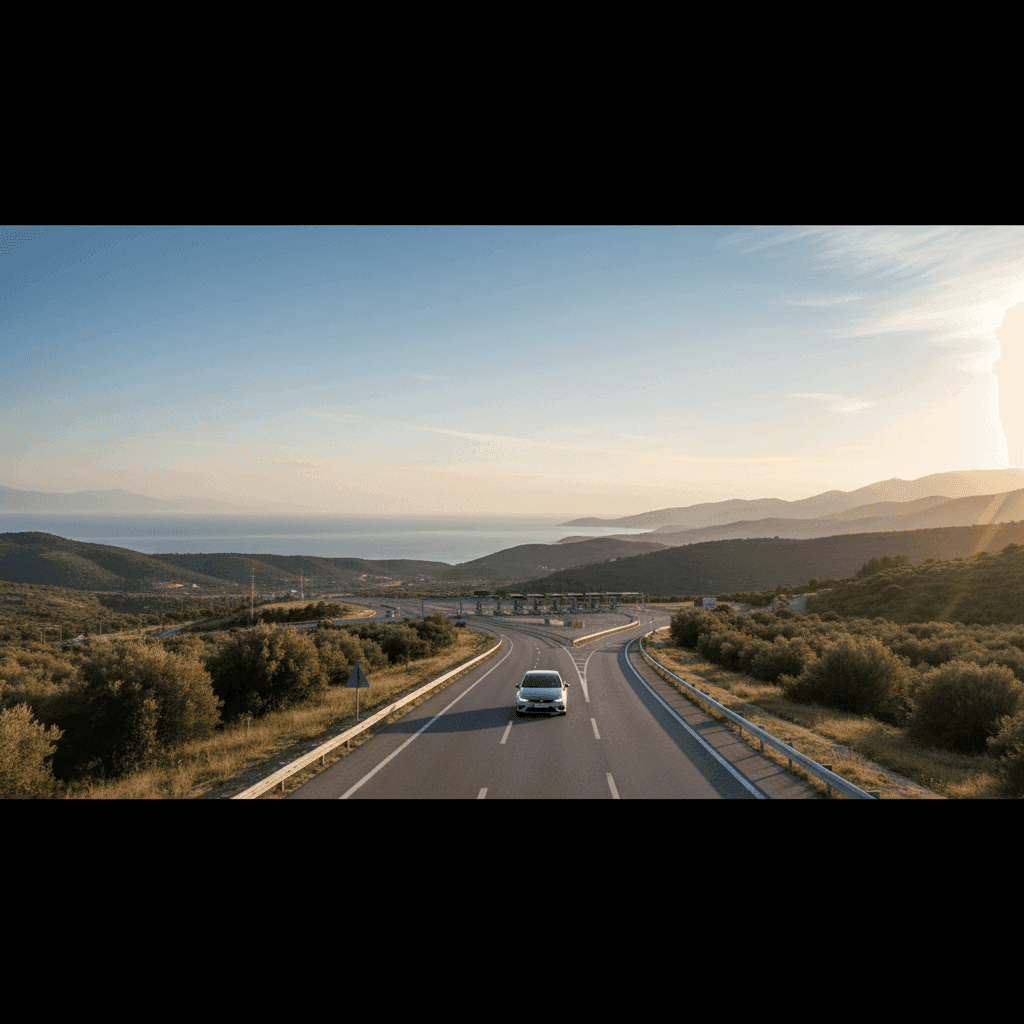
Driving from BiH to Greece in 2026 will cost you roughly 60 to 90 EUR on tolls and vignettes alone, depending on the route and destination, and you can clear the border in half an hour if your paperwork is in order. The Egnatia Odos toll went up on 1 January, Bulgaria requires an e-vignette, North Macedonia asks for a Green Card, and Greek police take mandatory in-cabin equipment seriously. In this guide we walk through both corridors, every document and the actual numbers you need in your glovebox before you set off.
This guide was prepared by the Auto Gas Gaga workshop in Banja Luka, based on publicly available sources as of late April 2026 and many years of experience preparing vehicles for summer trips to Greece.
Table of Contents
- Two Routes from BiH to Greece in 2026
- Documents and Papers You Must Prepare
- Tolls on the Route via North Macedonia
- Tolls and Vignette on the Route via Bulgaria
- Tolls in Greece 2026 and What Awaits You from Evzoni
- Mandatory Car Equipment Under Greek Law
- Practical Tips for Driving in Greece
- Preparing the Vehicle Before Leaving Banja Luka
- Frequently Asked Questions
- Related Articles
Two Routes from BiH to Greece in 2026
Both routes first pass through Serbia, so before the trip check our border cameras live - entry into Serbia via Rača, then Preševo / Tabanovce on the Macedonian route or Gradina / Kalotina on the Bulgarian one. All crossings with cameras are on this page.
There are two ways to drive from Bosnia and Herzegovina to Greece. The first corridor runs through Serbia and North Macedonia to Evzoni, the main Greek-Macedonian border crossing. The second goes through Serbia and Bulgaria to the Promachonas crossing. Which is better in 2026 depends on your final destination.
If you are heading to the western or central Greek coast - meaning Halkidiki, Sithonia, the Olympic Riviera, Lefkada or Corfu via the Igoumenitsa ferry - the route through North Macedonia is on average 30 to 60 kilometres shorter and logistically more natural. If, however, you are aiming for the eastern destinations, primarily the island of Thassos, Kavala or Alexandroupolis, the route via Bulgaria is shorter and avoids one extra border crossing.
You also need to keep in mind the difference in driving style. Through North Macedonia there are more two-lane sections off the motorway, five smaller toll plazas and border crossings that can get cramped in summer. The Bulgarian corridor is motorway almost the entire way, but you pay an e-vignette and cross one additional border.
The Fastest Route to Thessaloniki from Banja Luka
The fastest route from Banja Luka to Thessaloniki and Halkidiki goes via Belgrade, Niš, Vranje, the Tabanovce border, through North Macedonia to Evzoni. Plan on 950 to 1000 kilometres - doable in a single day with two drivers swapping. If you are driving alone, plan on an overnight stop in Serbia or Macedonia so you do not arrive exhausted into the peak summer traffic around Thessaloniki.
Documents and Papers You Must Prepare
Bosnia and Herzegovina is not in the European Union or the Schengen area, so there are several papers you cannot afford to forget. The principle is the same at every border crossing on the route: an officer can ask for proof, and you should be able to produce it within a minute.
| Document | Required for | Note |
|---|---|---|
| Passport (driver and all passengers) | All borders | Must be valid at least until the end of the trip |
| BiH driving licence | All countries on route | International licence not required if you are driving your own car |
| Vehicle registration document | All countries on route | Original, not a copy |
| Compulsory insurance policy | All countries on route | Check validity, must not expire during the trip |
| Green Card | North Macedonia (mandatory), Bulgaria, Greece | See next section |
| Owner's authorisation | If the car is not in your name | Notarised, translated into English |
Is a Green Card Mandatory for Greece
Greece and Bulgaria, as EU members, accept your BiH compulsory insurance policy as valid, so Greece itself does not formally require a Green Card. But North Macedonia does, and since the most common way to reach Greece from BiH is precisely through Macedonia, the Green Card becomes a mandatory item. If you buy insurance at home, your insurance company issues the Green Card free of charge or for a nominal fee. A temporary policy issued at the Macedonian border itself costs around 20 EUR and eats up half an hour in the queue.
If you are driving someone else's vehicle, prepare a notarised and translated owner's authorisation. That applies to any country on the route, not just Greece.
Tolls on the Route via North Macedonia
Through Serbia (from Belgrade to Preševo) tolls amount to roughly 20-22 EUR in dinar equivalent. Through North Macedonia in one direction you pass five toll plazas at 60 to 100 denars each (1 to 2 EUR). For the round trip, count on roughly 14 EUR.
The Tabanovce (Serbia/Macedonia) and Bogorodica/Evzoni (Macedonia/Greece) border crossings can have long queues in summer, especially on Friday and Saturday afternoons. Setting off mid-week or early in the morning saves an hour or two of waiting.
Tolls and Vignette on the Route via Bulgaria
Bulgaria uses an electronic system - the e-vignette is bought through the BGTOLL app, online or at petrol stations near the border. Plates are tracked by cameras, so there is no physical check, but if you have not paid, the penalty arrives by post or when you exit. When buying, enter the exact registration number, because the policy is tied to the plate.
How Much Does a Vignette Cost in Bulgaria 2026
A weekly e-vignette for a passenger vehicle costs around 5 EUR, a monthly one around 28 EUR. There are also daily options at around 1.50 EUR for transit. Activation is instant; buy the vignette before entering Bulgaria, not after, to avoid the risk of the first camera catching you before activation. For a summer trip there and back, a weekly or two-week version is usually enough.
Tolls in Greece 2026 and What Awaits You from Evzoni
Greece collects tolls through a system of classic toll plazas, and this is genuinely the biggest expense on the entire trip. From 1 January 2026 the rates on the Egnatia Odos motorway have been raised to 0.04 EUR per kilometre plus VAT. The full route from Igoumenitsa on the western coast to Evros on the eastern border now costs 30.45 EUR, while last year it was 24.45 EUR.
Other key numbers for 2026:
- Aegean Odos (Thessaloniki to Lamia, 230 km): around 21.70 EUR.
- A.T.H.E. Odos / PATHE (Lamia to Athens, 168 km): around 15.10 EUR.
- Full Thessaloniki to Athens route through 11 toll plazas: around 33.25 EUR.
- Evzoni to Lefkada through 8 plazas: around 16.90 EUR.
The average Greek tariff sits at around 8.5 EUR per 100 kilometres of motorway, which is significantly above the average in North Macedonia or Bulgaria.
Toll Cost from Evzoni to Halkidiki
From Evzoni to the Halkidiki exit (via the Thessaloniki ring road) you pass through two to three toll plazas. Count on about 7 to 10 EUR in tolls for that section, depending on the exact exit and whether you take the Thessaloniki bypass or go through the city. For Sithonia and Kassandra it makes sense to take the bypass and pay the toll, because going through central Thessaloniki in summer costs you an hour in traffic.
Payment is in cash in euros or by card; keep 5-10 EUR in coins on the passenger seat so you do not rummage through your wallet while the queue waits.
Mandatory Car Equipment Under Greek Law
Greek police regularly check mandatory equipment in season, especially at the frequent checkpoints along PATHE and Egnatia. Fines are concrete and collected on the spot. List of mandatory equipment:
- Reflective vest: must be in the cabin, not in the boot, because you need the vest before you step out of the car on a motorway. Fine 50 to 100 EUR.
- Warning triangle: one piece, accessible and in working order. Fine 50 to 100 EUR.
- Fire extinguisher S2: at least class S2, with a valid service. Fine 80 EUR.
- First aid kit: a standard BiH first aid kit meets Greek requirements.
- Spare wheel or tyre repair kit: in working order, with the wrench and jack.
Is a Fire Extinguisher Mandatory in Greece
Yes, a fire extinguisher is mandatory in every passenger vehicle in Greece, class S2 or higher, with a valid service. Keep the extinguisher accessible, not buried under luggage, because in a check the officer will ask to see it in front of you. Servicing the extinguisher in BiH takes one day if it expires just before the trip.
In addition to the mandatory list, in summer it is worth carrying a reflective windscreen sunshade; in a beachfront car park the cabin temperature climbs above 60 degrees.
Practical Tips for Driving in Greece
Greek traffic rules are similar to ours, but there are a few things drivers from BiH routinely underestimate.
Permitted blood alcohol level is 0.5 per mille, but for drivers with less than two years of experience only 0.2 per mille. Checks are frequent, especially at night at motorway exits. The rule is simple: if you drive, you do not drink.
Speed limits: 130 km/h on motorways, 110 km/h on expressways, 90 km/h outside built-up areas, 50 km/h in built-up areas. Speed cameras are installed densely, particularly around Thessaloniki and Athens, and fines arrive by post.
Fuel: petrol and diesel prices in Greece are on average around 0.30 to 0.50 EUR per litre higher than in BiH. Fill up the tank before entering Greece, because in North Macedonia fuel is cheaper than even in BiH. Stations are frequent along the motorway, but motorway service stations often charge 5 to 10 cents per litre more than stations off the motorway.
Mobile internet: EU roaming for BiH numbers is not free. Check the package with your operator before leaving, or buy a local prepaid SIM at any Greek petrol station for a couple of euros.
Preparing the Vehicle Before Leaving Banja Luka
The worst thing that can happen to you 1000 kilometres from home is for a radiator hose to burst at 38 degrees because you skipped the coolant change last year. Air conditioning that does not work in central Greece is not an inconvenience - it is a reason to cut the holiday short and head home.
What must be checked before a longer summer trip:
- Air conditioning: gas refill, fan operation, pollen filter cleaning. If it does not cool the way it did last year, the gas is probably leaking.
- Cooling system: coolant level and condition, hose condition, thermostat operation. Old coolant loses its protective ability at high temperatures.
- Tyres: pressure adjusted for full load (not an empty car), tread depth, sidewall condition. Hot asphalt and a worn tyre at 130 km/h do not mix.
- Battery: in summer heat kills a battery as much as winter does. If it is older than four years, test it before the trip.
- Brakes: pad and disc condition. Coming down from Greek mountain stretches towards the coast demands a healthy braking system.
- Engine oil and filters: if your service is due, do it before the trip, not after.
If you run on autogas, add an inspection of the reducer, injectors and the LPG installation to the list. Summer heat on the motorway is a challenge for the gas line, especially if there is even the smallest leak that does not cause a problem at normal temperatures but starts to manifest itself at 40 degrees of engine coolant.
At our workshop we routinely run pre-trip inspections ahead of summer season, and most of the issues we catch would not be noticed in everyday driving but would surface only at the 800th motorway kilometre. We have a dedicated pre-long-trip checklist. Book a pre-trip inspection or get in touch if you want a second opinion before you set off.
Frequently Asked Questions
Do I need an international driving licence for Greece?
No, not if you are driving your own vehicle. A BiH driving licence is valid in Greece, Bulgaria and North Macedonia. An international driving licence is required only in some cases when you are driving someone else's vehicle, and then it goes with a notarised owner's authorisation. The international licence is issued by BIHAMK and costs around 30 KM.
What is the total toll cost for Greece from BiH 2026 in one direction?
Rough numbers: Serbia around 20-22 EUR, North Macedonia around 7 EUR one way, Greek tolls from Evzoni to your destination 7-25 EUR depending on location. In total, for one direction you arrive at around 35 to 55 EUR on toll plazas alone. Add fuel and, if you go via Bulgaria, the vignette of around 5 EUR.
What if my vehicle insurance expires during the trip?
The compulsory insurance policy must be valid for the entire duration of the trip. If yours expires a few days after your return, extend it before you set off. Without a valid policy you may not cross the border, and in case of an accident with an expired policy the situation gets seriously complicated.
Can I pay tolls by card at Greek toll plazas?
Yes, most plazas accept both cash in euros and cards. Smaller plazas on secondary routes sometimes only take cash, so keep 30-40 EUR in change to be safe.
What about autogas in Greece?
Autogas is sold in Greece, but stations are rarer than at home. The main corridors (PATHE, Egnatia, the approaches to Thessaloniki and Athens) are sufficiently covered; for more remote destinations check the LPG station map before setting off. The price in Greece is around 0.90 to 1.00 EUR per litre.
When is the best time to leave Banja Luka for Greece?
The quietest windows are Tuesday or Wednesday early in the morning, around 4 to 5 a.m. Friday afternoon and Saturday morning are the worst, because that is when the entire region sets off at the same time and queues at Tabanovce and Evzoni can last two to three hours.