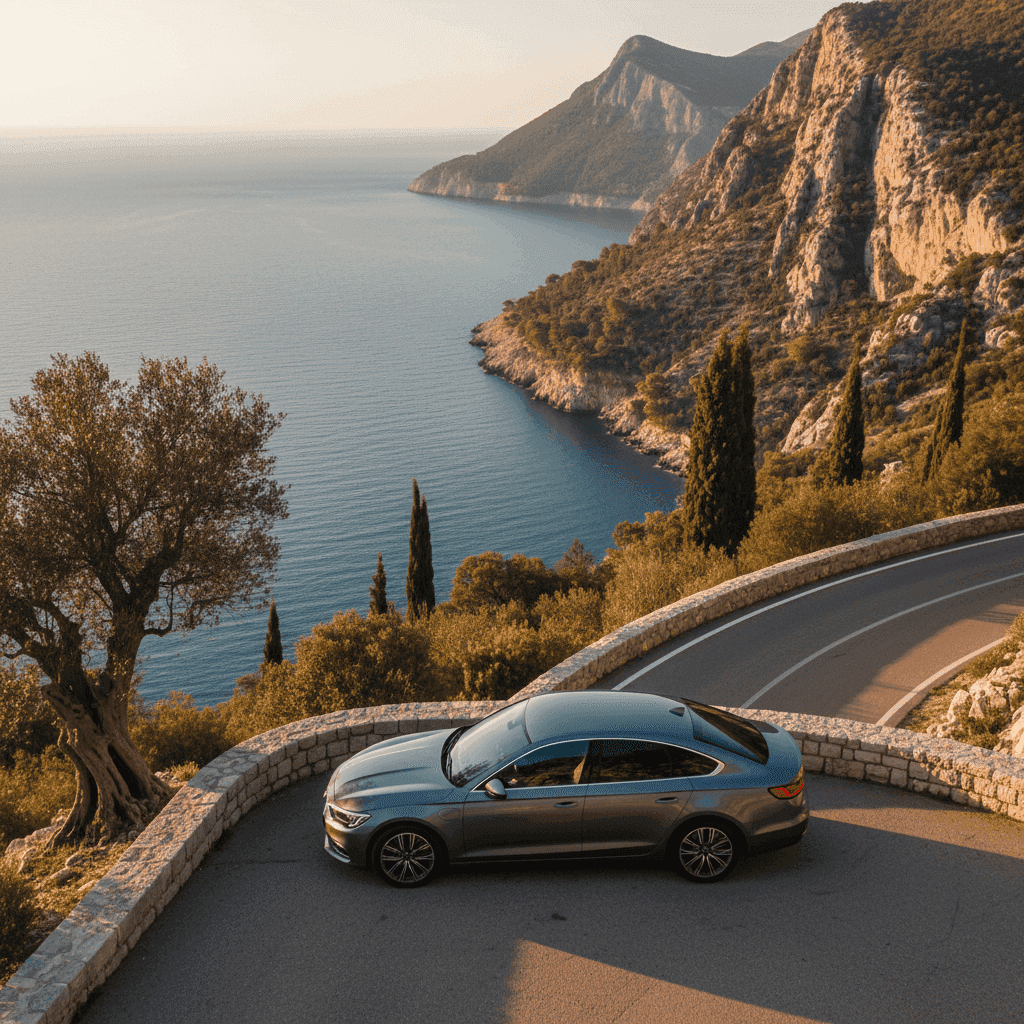
Driving from BiH to Montenegro in 2026 is simpler than it was a few seasons ago. You no longer need a green card, the main border crossings work well during summer, and the toll through the Sozina tunnel still costs EUR 2.50 per passenger car. The price has not moved in ten years. What has changed is the motorway: the Smokovac-Mateševo section has been operating since 2022, tolls are charged on exit, and it is now part of the route many drivers from BiH use when heading inland and to the southern Adriatic.
This guide was prepared by the Auto Gas Gaga workshop from Banja Luka, based on current data from Montenegrin operators (AMSCG, Monteput, Montenegro Travel) and years of experience with drivers passing through the workshop before the summer season.
Table of Contents
- What Documents You Need to Drive to Montenegro
- Border Crossings Between BiH and Montenegro - Which to Choose
- Tolls in Montenegro - Sozina and the Bar-Boljare Motorway
- Mandatory In-Car Equipment Under Montenegrin Law
- Driving Rules, Speed Limits and Alcohol
- Vehicle Preparation Before Departure - What to Check at the Workshop
- What to Do If You Break Down on the Road
- Frequently Asked Questions
- Related Articles
What Documents You Need to Drive to Montenegro
For the driver and passengers, a valid travel document is enough, either a passport or an ID card. BiH citizens may stay in Montenegro for up to 90 days without a visa, which covers any realistic summer holiday scenario.
For the vehicle, carry the registration certificate, your driving licence (a BiH licence is sufficient, an international one is not required), and your compulsory insurance policy from BiH. If you are driving someone else's car, a friend's, your brother's or a company car, also bring a notarised authorisation from the owner permitting border crossing. Border officers do check this, especially during summer rush.
Do I Need a Green Card for Montenegro From BiH
No. Montenegro has abolished the green card requirement for vehicles from BiH, based on a bilateral agreement on the recognition of motor insurance. Your valid compulsory insurance from BiH is recognised on Montenegrin territory.
So you do not need to spend time and money obtaining a green card from your insurer before the trip. If you plan to continue from Montenegro further on, say to Albania or Turkey, a green card may still be required there, so check before departure. It is also useful to carry photocopies of all documents, separated from the originals. If you lose an original, a photocopy speeds up reporting at the embassy.
Border Crossings Between BiH and Montenegro - Which to Choose
Check the current situation at these crossings live through our cameras before departure - Klobuk and Hum / Šćepan Polje, and all crossings toward Montenegro with cameras are on the live border cameras page.
According to Montenegrin AMSCG and Montenegro Travel, the road crossings are: Sitnica, Ilino brdo, Vraćenovići, Krstac, Nudo, Šćepan Polje, Metaljka and Šula. Not every crossing is suitable for your departure point or destination. The difference in time to reach the coast can be an hour and a half, or even two hours, depending on where you start.
Which Border Crossing for the Sea From Banja Luka
For drivers from Banja Luka and the western part of Republika Srpska, the most logical choices are via Trebinje or via Foča. Sitnica via Trebinje takes you toward Herceg Novi and the Bay of Kotor; this is the fastest route if your destination is Igalo, Herceg Novi, Tivat or further along the coast toward Budva. Vraćenovići via Bileća leads you toward Nikšić and through the central part of Montenegro, useful if your goal is Podgorica, Bar or the inland. From Sarajevo and central BiH, drivers most often go via Foča and Šćepan Polje, which descends toward Nikšić through the Piva valley. The drive is slower, but in terms of scenery it is one of the more beautiful roads in the region.
Smaller crossings, namely Ilino brdo, Krstac, Nudo, Metaljka and Šula, are useful locally, but only worth it if you are heading to less touristy spots and know the terrain. The main crossings (Sitnica, Vraćenovići, Šćepan Polje) have longer queues on weekends and during peak hours from 10 a.m. to 3 p.m. If you can choose, set off early in the morning or late in the afternoon when temperatures drop and queues thin out.
The main crossings operate 24/7 during the summer season, but smaller crossings are not always open all night. Check before departure, so you do not end up in front of a closed barrier at three in the morning.
Tolls in Montenegro - Sozina and the Bar-Boljare Motorway
Montenegro is not a vignette country. You only pay for two specific things: the Sozina tunnel and, if you use it, the Smokovac-Mateševo section of the motorway. All other main roads are free.
Sozina Tunnel Toll Price 2026
The Sozina tunnel connects inland Montenegro (Podgorica) with the coast (Bar) and significantly shortens the route to the southern Adriatic. The toll for a passenger vehicle is EUR 2.50 and, according to the operator Monteput, has remained unchanged for ten years. It is paid at the entrance, the toll booth is fast, and the alternative is the drive over Sutorman, more scenic but considerably longer and slower.
If your destination is Bar, Ulcinj, Sutomore or Petrovac, Sozina is a regular part of the route and that EUR 2.50 is worth it. If you are heading to the Bay of Kotor, namely Tivat, Kotor, Herceg Novi, you do not need Sozina.
Bar-Boljare Motorway Price List
The open Smokovac-Mateševo section, 41 km long, is for now the only motorway in Montenegro. It was opened to traffic on 13 July 2022 and tolls are charged on exit according to the Monteput price list. Passenger vehicles up to 1.9 m in height and a total mass of 3,500 kg (category 2) pay, depending on the exit, between EUR 1.50 and EUR 3.50 (Pelev Brijeg, Veruša, Mateševo). Motorcycles pay EUR 0.50 to EUR 1.50.
The motorway is particularly useful if you are heading from Podgorica toward the north: Žabljak, Kolašin, further toward Serbia. For a trip to the sea from BiH, the motorway is not a mandatory part of the route. The longest tunnel on this section is Vjeternik (about 3,000 m). The Mateševo-Andrijevica section is announced to start construction in May 2026, which means the motorway network is still developing.
Mandatory In-Car Equipment Under Montenegrin Law
This is the part where drivers from BiH most often slip up, because mandatory equipment in Montenegro is not the same as in BiH. The differences are small, but the fines are real.
| Equipment | Required | Fine |
|---|---|---|
| Reflective safety vest | Yes, when leaving the vehicle on the roadside | EUR 0-80 |
| Warning triangle | Yes | prescribed fine if missing |
| First-aid kit | Yes | prescribed fine if missing |
| Spare bulb | Yes, for vehicles that provide for it | prescribed fine |
| Fire extinguisher | Not required for passenger vehicles | no fine |
| Winter equipment (chains or winter tyres min. 4 mm tread) | 15 Nov - 1 Apr | EUR 50-120 |
The reflective vest is mandatory when you exit the vehicle on the roadside, not just to have it in the boot. If you blow a tyre on the motorway, the vest must be on you before you stand next to the car. It is best to keep it under the driver's seat, not in the boot.
Daytime running lights are mandatory throughout the year, day and night. The fine for driving without low beams turned on is EUR 30-80. Most newer cars have automatic lights, but if you drive an older model, get used to switching them on as soon as you sit in the car.
Driving Rules, Speed Limits and Alcohol
Speed limits in Montenegro:
- 50 km/h in built-up areas
- 80 km/h outside built-up areas
- 100 km/h on the motorway (the only one for now is the A-1 Smokovac-Mateševo)
Speed checks are regular, especially on coastal roads toward Budva and Bar, where built-up areas often have unclear boundaries and the limit drops from 80 to 50 and back up to 80 within a few hundred metres. Follow the signs, do not rely on intuition about whether this is a village.
The permitted blood alcohol level is 0.2 g/kg for new drivers. The fine for driving under the influence ranges from EUR 200 to 2,000, depending on the alcohol level and circumstances. The rule is clear: if you drink, do not drive. Montenegrin police enforce this strictly, especially at night in coastal towns.
Mobile phone use while driving is prohibited unless via a hands-free device. Seat belts are mandatory for all passengers. Children under 12 must not sit in the front without an appropriate child seat.
Vehicle Preparation Before Departure - What to Check at the Workshop
Drivers who ask us what to check before Montenegro usually do not have time for repairs in Bar if something breaks, so a preventive inspection in Banja Luka costs much less than improvising on the road. A list that in practice covers most problems on a summer trip:
- Tyres: pressure (on cold tyres, before departure), tread depth (a minimum of 3 mm is recommended for a longer trip, not the legal 1.6 mm), age (tyres older than six years, even if the tread is good, are a risk on hot asphalt). Do not forget the spare.
- Air conditioning: if the AC is not cooling properly, do not wait for it to fail at 38 degrees above Podgorica. Heat plus a non-working AC are a recipe for an overheated engine and irritated passengers.
- Radiator and coolant: check the level, the condition of the hoses, whether the fan is working. Montenegrin serpentines toward Lovćen, Boka or Cetinje push the engine to its limit, especially if you are towing a trailer or driving a fully loaded car with the AC on.
- Battery: heat kills batteries faster than frost. A battery older than four years should be tested before the season.
- Brakes: pads, discs, fluid. Coming down from Lovćen toward Kotor or from Sutorman toward Bar are tests your brakes must not fail.
- Oil and filters: if you are close to the service interval, do it before the trip.
For a detailed list, see our advice on what to check before a longer trip and the article on how to prepare your car for summer. Before the season we offer an inspection package that covers all of this, with an assessment of what can wait and what must be fixed immediately. Book an appointment at the workshop a week or two before departure, not the day before, because slots fill up quickly during the summer rush.
What to Do If You Break Down on the Road
First rule: do not panic, do not improvise on the road. If something happens, get the car off the carriageway, turn on all four hazard lights, get out wearing your vest, place the warning triangle at the prescribed distance, and call for help.
Emergency service numbers in Montenegro (AMSCG roadside assistance, ambulance, police, fire service, the unified European emergency number) are best saved in your phone in advance. The list is publicly available on the AMSCG website and on the Montenegro Travel page. Save them before departure, not after you have already stopped on the motorway with your family in the car and papers in one hand.
AMSCG is the Montenegrin equivalent of BIHAMK and has cooperation agreements with foreign auto clubs. If you are a BIHAMK member, chances are your assistance is covered or available at a reduced rate. Check the conditions of your membership before departure.
For more serious breakdowns (gearbox, engine, electronics), towing to the nearest workshop is usually the only option. Service prices in Montenegro are comparable to BiH, but spare parts for some models can be delayed. If the breakdown is not acute and the car is drivable, it is worth bringing it back to BiH and resolving it with a mechanic who already knows your car.
If you drive on LPG and have an issue with the LPG system in Montenegro, for example the car runs poorly on gas, will not switch over or is leaking, switch to petrol and do not push the gas system on the road. LPG service is available, but LPG stations along the route are rarer than in BiH, so plan your refuelling.
Are you driving to Montenegro this summer and not sure whether your car is ready? Book a pre-season inspection or write to us via the contact form with the car model and date of departure.
Frequently Asked Questions
Do I Need a Green Card for Montenegro From BiH in 2026?
No. Montenegro has abolished the green card requirement for vehicles from BiH. A valid compulsory insurance policy from BiH is sufficient and is recognised on Montenegrin territory.
How Much Is the Toll Through the Sozina Tunnel?
The toll for a passenger vehicle through the Sozina tunnel is EUR 2.50. The price has remained unchanged for ten years according to the operator Monteput.
Is a Fire Extinguisher Mandatory in a Car in Montenegro?
For passenger vehicles, a fire extinguisher is not mandatory under Montenegrin law. A warning triangle, first-aid kit, reflective vest and spare bulb are required.
Which Border Crossing From BiH Is Fastest for the Bay of Kotor?
For destinations in the Bay of Kotor (Herceg Novi, Tivat, Kotor) from Banja Luka and western RS, the fastest crossing is Sitnica via Trebinje. From central BiH, Šćepan Polje via Foča is used.
How Much Does the Smokovac-Mateševo Motorway Cost for a Passenger Vehicle?
Passenger vehicles up to 1.9 m in height and 3,500 kg total mass pay, depending on the exit, EUR 1.50 to EUR 3.50 (Pelev Brijeg, Veruša, Mateševo). Tolls are charged on exit from the motorway.
Are Daytime Running Lights Mandatory in Montenegro in Summer?
Yes. Driving with low beams turned on is mandatory throughout the year, not only in winter. The fine for driving without lights on is EUR 30-80.