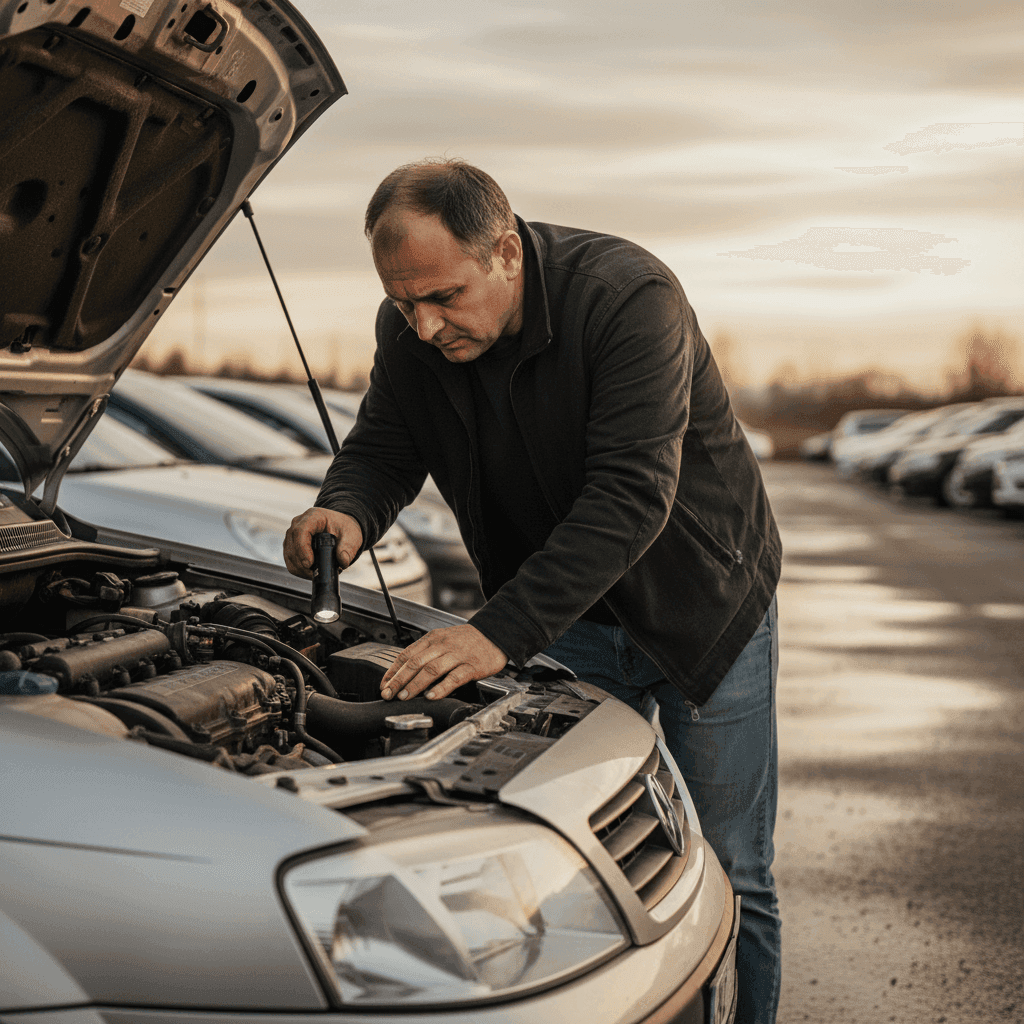
A pre-purchase inspection of a used car does not take ten minutes and is not done on the gravel next to a petrol station. It is one to two hours of systematic checks that can later save you hundreds, and depending on the fault, thousands of marks. The average buyer in BiH today pays between 8,000 and 25,000 KM for a used car, and a hidden accident can easily turn that amount into additional repairs over the next few months. This checklist walks you through seven steps with the same logic a workshop applies during a pre-purchase inspection.
The checklist was prepared by the Auto Gas Gaga workshop in Banja Luka, in the order it actually follows with its clients during pre-purchase inspections.
Table of Contents
- Why a Pre-Purchase Inspection Is Worth Your Time
- Step 1 - Check the History and VIN Before the Physical Inspection
- Step 2 - Visual Inspection of Body, Paint and Chassis
- Step 3 - Under the Hood - Oils, Fluids and Repair Traces
- Step 4 - Interior and Wear Items
- Step 5 - Test Drive, the First 15 Minutes
- Step 6 - OBD Diagnostics and When to Call a Mechanic
- Step 7 - Documentation, Type Approval and the Contract
- Most Common Scams on the BiH Used Car Market in 2026
- Frequently Asked Questions
- Related Articles
Why a Pre-Purchase Inspection Is Worth Your Time
The used car market in BiH in 2026 is not small; supply is wide and varied in quality. The broader market situation and selection by budget are covered in our used car guide for BiH 2026; this article picks up from the moment you have chosen a specific car.
The biggest cost after the purchase does not come from regular maintenance, but from hidden problems: a gearbox close to replacement, a turbo with a worn bearing, a cylinder head with a hairline crack, a body with prior accident damage covered up by a respray. A hidden fault discovered before payment is a negotiating card or a reason to walk away. The same fault discovered the day after the deposit is your cost, because in BiH there is no strong legal protection for the buyer of a used car from a private seller.
Step 1 - Check the History and VIN Before the Physical Inspection
You do not go to view a car without checking the chassis number first. The VIN is a 17-digit identifier in the vehicle registration document, on the driver-side door pillar, and on the chassis under the hood or on the floor on the passenger side.
The BiH government, through the e-Citizen service, offers a free vehicle check by chassis number that shows whether the vehicle is reported as stolen, has unpaid traffic fines or a registered accident in the insurance system. That is the first step before you even arrange a meeting. If the VIN is not clean, the conversation is over.
The second layer is a paid vehicle history report from international registers. Specialised VIN services typically cover over 1,000 data sources from EU registers, technical inspection records and insurance companies.
An experienced seller can hide a lot. Mileage rolled back by tens of thousands of km, a repaired total loss sold as an "import from Germany", welds covered up with fresh paint, even theft with an altered chassis number. A pre-purchase inspection at a workshop catches the current state of the car, but not its past. The easiest way to pull the full documented history is through carVertical. By chassis number, from international registers, you get actual odometer readings at points in time, recorded accidents, the number of previous owners, and indicators of theft or total loss. We consider this essential before buying any used car. When paying for the report you can use code GAGA for a 20% discount.
In the report, look for actual mileage at points in time (if the history shows 280,000 km in 2022 and the car shows 180,000 today, you have a problem; more in the article on rolled-back used car mileage), accident or total-loss status, the number of previous owners, and service records. If the seller refuses to share the VIN in advance, walk away.
Step 2 - Visual Inspection of Body, Paint and Chassis
Do the visual inspection in daylight on a dry body. A car right after washing hides small irregularities, so ask for a washed car that has been sitting for at least half an hour.
How to Spot a Resprayed Car
The fastest way is a paint thickness gauge, a small device pressed against a metal surface that shows the layer thickness in micrometres. Factory paint thickness is typically 80-120 μm, while repaired zones (resprayed after an accident or sanding off rust) typically read 150-190 μm and above. Without a gauge, a respray can be spotted by colour shade differences between the sides of the vehicle in daylight, paint residue on the seals around windows and headlights, an "orange peel" surface, or visibly different paint colour on the inside of doors, trunk or hood.
Magnet test for rust. A magnet (even an ordinary fridge magnet) sticks to steel body parts. If the magnet does not stick on the sill, fender or bottom of the door, there is filler underneath covering a rust hole.
The chassis inspection is done from below, ideally on a lift. Look for active rust (brown, open, not painted), traces of fresh welding that do not match the factory layout, oil leaks, and bumper damage that does not match the seller's description. If the car is not in a state to pass a regular technical inspection, it is not worth buying (covered in detail in the article on the technical inspection in BiH 2026).
Step 3 - Under the Hood - Oils, Fluids and Repair Traces
With the hood up and a cold engine, the inspection takes 10-15 minutes and reveals more than half of what a test drive would.
Oil dipstick. Oil should be between minimum and maximum, ranging from clear to dark brown. Black-milky oil means water in the engine (a blown head gasket). Oil that smells like fuel means the injectors are leaking into the sump. Suspiciously fresh oil on a car with "300,000 km" is a red flag.
Coolant. Colour green, red, purple or blue (depending on the manufacturer), with no sediment. Brown-cloudy fluid or oil traces on the surface point to a blown head gasket (more symptoms in the tip on a blown head gasket).
Brake, power steering and transmission fluid. In the normal range and clear. Dark, cloudy fluids mean the car has not been serviced as it should have been.
Battery. Sulphate residue on the terminals (green or white crust) shows the terminals have not been cleaned for years. A manufacture date older than 5 years means a quick replacement.
Repair traces. New bolts on the cam cover while the rest are old and dusty, a new gasket or silicone in a non-factory spot, new cooling system hoses on a car with 200,000+ km. These are all signs the engine has been opened. A reason to ask what was done and request paperwork.
Step 4 - Interior and Wear Items
How to Read Wear on Pedals and Steering Wheel
The steering wheel, pedals and gear lever wear in proportion to mileage. At 100,000 km, the rubber on the pedals is mildly worn. At 200,000 km, the rubber is polished smooth, and the brake pedal starts showing metal at the edges. At 300,000+ km, the rubber has typically been replaced. If the seller tells you "it has 130,000 km" but the brake pedal is glass-smooth, the mileage has been rolled back. The same applies to the rim of the steering wheel and the gear lever knob.
Air conditioning. Switch on maximum cooling with the doors open for a few minutes. If it does not cool, it needs a refrigerant top-up (tip on car AC service) or there is a fault in the compressor.
Electronics. Check every button, the windows, wipers, indicators and all dashboard warning lights (turn the ignition on; the lights should illuminate and go out after the engine starts). A light that does not come on when it should means it has been disconnected, usually because the seller does not want you to see a check-engine or airbag fault.
Step 5 - Test Drive, the First 15 Minutes
A test drive of 2-3 minutes around the lot reveals nothing. The minimum check worth trusting is 15 minutes combining city driving with stops, open road at 80-100 km/h, one stronger acceleration and one harder braking. Only then does the engine reach operating temperature and the system show what it actually does.
Engine sound on cold start. Ask the seller to start the engine while the car is fully cold. A seller who has already "warmed the car up for you" is usually hiding the cold-start sound. Listen for an even idle in the first seconds. Knocking, banging or rattling that lasts longer than 5-10 seconds is a sign of worn hydraulic lifters, a timing chain or a loose injector (more in the tip car shakes at idle).
Causes of White Smoke from the Exhaust
On a cold start, a small cloud of white vapour is normal condensation. But if the white smoke does not disappear after 2-3 minutes, or appears under throttle when the engine is warm, it points to water in combustion, a blown gasket or a cracked head. Bluish smoke indicates burning oil (worn piston rings or turbo). Black smoke on a diesel under throttle is usually an EGR or DPF issue.
While driving, watch for: pulling to the side when you let go of the steering wheel on a flat road (geometry or a worn wheel bearing, see tip steering wheel pulls to the side); steering wheel vibrations at 80-100 km/h (imbalance or a bent rim); knocking under braking (warped discs); clutch slipping; a gearbox that jerks or hesitates, especially on automatics and DSG.
Step 6 - OBD Diagnostics and When to Call a Mechanic
OBD2 diagnostics is an electronic conversation with the car's computer. Every car after 2001 (petrol) or 2004 (diesel) has an OBD2 connector under the steering column. A Bluetooth adapter and a free Android app (Torque Lite, Car Scanner) costs 15-25 KM at giga.ba and similar retailers in BiH.
With an adapter you read current and "pending" faults in the ECU, monitor live parameters (temperature, fuel trim, throttle, intake air), and check "readiness monitors", a status that shows whether the ECU was reset just before the inspection (a common scam, where the seller clears codes 10 minutes before the buyer arrives).
A basic adapter cannot read brand-specific systems: DSG mechatronics, BMW iDrive, VAG-specific channels. For that you need a brand-specific scanner (VCDS, OBDeleven, ISTA) or a professional Launch (basic around 70 KM, brand-specific 200 KM and up per the giga.ba price list).
When to call a mechanic: a professional pre-purchase inspection at a workshop is always worth it for any car over 10,000 KM, as well as for automatics, DSG, diesels with DPF and EGR, petrol engines with direct injection (TSI, TFSI), and vehicles imported from the EU. The price at our workshop depends on the type of engine and the scope of the check - get in touch for a quote or book a pre-purchase inspection before paying.
Step 7 - Documentation, Type Approval and the Contract
Vehicle registration document. The owner's name in the document must match the name of the seller in front of you. A sale "for a relative" without a notarised power of attorney means you walk away.
Type approval (homologation). Important for LPG and structural modifications. A car with installed LPG that is not type-approved is not legal on the road (see tip on LPG documentation in BiH).
Service book and receipts. The difference in estimated value between a car with a book at an authorised service centre and one without it is typically 10-20%. Ask for receipts for timing chain, clutch or gearbox replacement. "We did everything at the neighbour's place" without paperwork gives you nothing legally usable.
Contract. A used car is sold via a contract certified at a court or municipality, with name, ID number, registration plate, chassis number, mileage and a clause on condition. Do not sign a contract with empty fields.
Most Common Scams on the BiH Used Car Market in 2026
Rolled-back mileage. The most widespread. A car with an actual 280,000 km comes out at 180,000, and the traces show on the pedals, steering wheel and seat (more in the article on rolled-back used car mileage).
Hidden accident damage (imports from the EU with total-loss status). The car was declared a total loss in Germany or the Netherlands, repaired, imported and sold as "tidy from Germany". A VIN check, paint thickness gauge and chassis inspection reveal the truth. The price of such a car is unusually low, which is the first warning sign.
Resprayed rust and patching with filler. The magnet test reveals it in five minutes, most often on the sill, the lower part of the door, the edge of the fender or under the fuel tank.
"Fixing" the technical inspection. A car with worn pads, tired shocks or poor lights gets a fresh inspection certificate "through a connection". You think you are buying a car in good condition, when in fact you are paying for your first service in the first 1,000 km.
Car in someone else's name. A sale "for a relative" with an uncertified or expired power of attorney. Rule: name on the registration = name on the contract = the person in front of you.
Non-type-approved LPG installation or structural modifications. "Backyard" LPG, modified exhaust, a different gearbox swapped in. Everything must be on the type approval.
Before paying a deposit, book a pre-purchase inspection online or message us on WhatsApp.
Frequently Asked Questions
How much does a pre-purchase inspection at a workshop in Banja Luka cost?
A pre-purchase inspection takes one to two hours and covers computer diagnostics, a visual inspection of the body and chassis from the lift, fluids and a test drive. The price depends on the type of engine - get in touch for a quote or book an appointment online.
Can I do a pre-purchase inspection myself without a mechanic?
You can do a visual inspection, fluid check, OBD readout and test drive. That covers a good part of the risk for a car in the lower price range. For a car over 10,000 KM, automatics, DSG, diesels with DPF or imported vehicles, a professional inspection is worth it.
What exactly does a paint thickness gauge do?
A paint thickness gauge is pressed against the body and shows how many micrometres of paint sit on the metal. Factory thickness is usually 80-120 μm; repaired zones typically read 150-190 μm and above. If the gauge reads 250-300 μm, there is most likely filler underneath.
What if the seller refuses a test drive longer than 5 minutes?
An honest seller allows 15-20 minutes of test driving. If they refuse, the excuse is usually "insurance" or "short notice". These are signs the car has a problem that only shows on a longer drive.
I am buying a car with installed LPG. What should I pay particular attention to?
Three things: type approval entered in the vehicle registration, a system registered with an authorised servicer, and a current tank certification (tanks are recertified every 10 years). If anything is missing, the car is not legal on the road (see also the tip on a car running poorly on LPG).