Vehicle inspection in BiH follows a clear list of items the inspector must work through: vehicle identification, brakes, suspension, lights and the emissions test. Almost every failure could have been avoided with a fifteen-minute check in the driveway the day before. This guide shows what the inspector actually looks at on the station, the classic mistakes, and how to get your car into shape to pass first time.
The checklist was prepared by the Auto Gas Gaga workshop in Banja Luka, in the order in which we, in practice, inspect vehicles before clients take them to the inspection station.
Table of Contents
- What Is Vehicle Inspection and How Often Is It Done
- Types of Vehicle Inspection in BiH
- What the Inspector Checks - Nine Steps
- Most Common Reasons for Failing Inspection
- What to Check the Day Before Inspection
- How Much It Costs and How Long It Takes
- What If You Fail - 15-Day Window
- When to Schedule a Pre-Inspection at the Workshop
- Frequently Asked Questions
- Related Articles
What Is Vehicle Inspection and How Often Is It Done
Vehicle inspection is the mandatory annual roadworthiness check that precedes registration. Without a valid inspection report, a vehicle cannot be registered. The legal framework is the Regulation on Vehicle Technical Inspections published in the Official Gazette of BiH No. 33/19 (10 May 2019), with amendments in OG BiH 29/20.
The regular inspection for a passenger car is done once a year. You can have it done at the earliest 30 days before the current registration expires, which gives you time to fix any issues before the car formally becomes unregistered.
For certain categories, a preventive inspection is required every six months. This applies to taxis, buses, rent-a-car fleets and all vehicles with a maximum permitted mass above 7,500 kilograms.
Types of Vehicle Inspection in BiH
There are three basic types:
- Regular annual inspection: tied to registration, mandatory for all motor and trailer vehicles.
- Preventive inspection: a shorter but more frequent inspection for taxis, buses and trucks.
- Extraordinary inspection: at the request of the competent authority, most often after a traffic accident.
For most drivers it is the first category, and the rules below relate to it.
What the Inspector Checks - Nine Steps
The standard procedure at the inspection station is organised into nine sequential steps. HAK (the Croatian Auto Club) publishes that list publicly, and stations in BiH follow the same logic.
- Document check: vehicle registration document, owner's ID card, mandatory insurance policy. For a first registration, the sales contract as well.
- Vehicle identification: the inspector compares the VIN on the chassis, the engine number and the licence plates against the registration document. Any discrepancy stops you right there.
- Visual inspection of bodywork, glass and tyres: rust through the metal, broken glass in the driver's view zone, tyres with tread depth below the minimum or with sidewall cracks. Instant fail.
- Brake test on the roller bench: braking force at each wheel is measured, the left-right difference on the same axle, and the overall braking coefficient. The handbrake is checked separately.
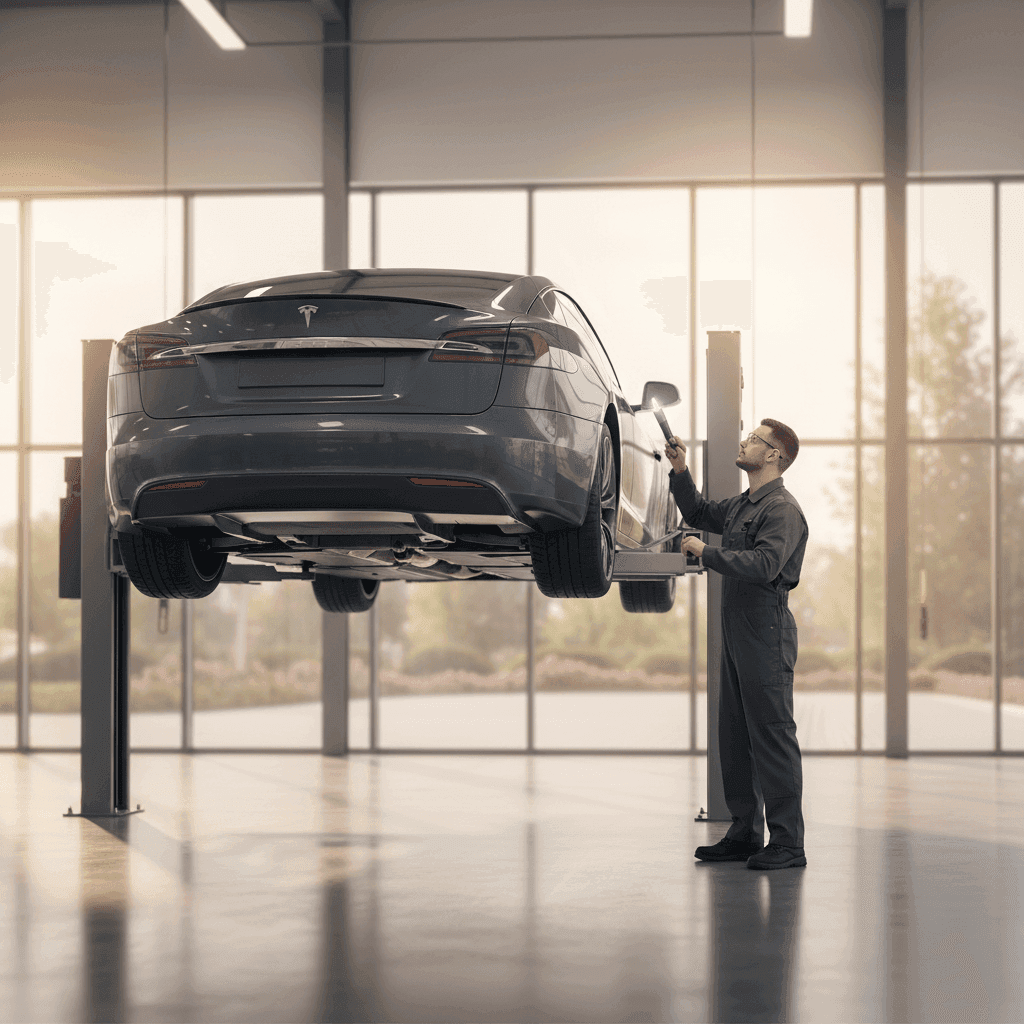
- Undercarriage inspection over the pit or on the lift: the inspector goes around with a flashlight checking the shock absorbers, ball joints, tie rods, bushings, the exhaust system, and looks for oil or brake fluid leaks.
- Steering check: play in the steering wheel, condition of the rack and auxiliary components. Significant play means a fail.
- Brake fluid check: the boiling point is measured. If the fluid has absorbed moisture, the boiling point drops below 155 degrees Celsius and the inspection fails, regardless of whether the brakes "work".
- Headlight check with the headlamp aligner: beam alignment, intensity, and that all bulbs are working.
- Emissions test: mandatory for all vehicles since 2017. The composition of exhaust gases is measured; petrol engines on lambda value and CO, diesels on opacity (opacimeter).
At the end the inspector enters the findings into the report. If everything is in order, you receive a certified report which you take to registration. If not, the report states exactly what needs to be fixed and within what time frame.
Most Common Reasons for Failing Inspection
The Croatian Vehicle Centre states that nearly one in four vehicles fails on its first attempt. That is Croatian data, but structurally the situation in the regional used-car market is very similar.
The most common causes, in the order in which they show up in the workshop:
- Faulty lights: a single burnt-out bulb, a misaligned beam or a non-working indicator. Check ALL lights, not just the front ones: the licence plate light and the brake light are most often overlooked.
- Worn brakes: thin discs, worn pads, uneven braking force. A braking coefficient below the prescribed threshold (around 50-58 % for the service brake) automatically fails the inspection. If you hear squealing when braking or the car pulls to one side, check your brakes before going.
- Failing the emissions test: on petrol engines a typical cause is a faulty lambda sensor, a worn-out catalytic converter or an issue inside the engine. On diesels it is most often a clogged DPF, a faulty EGR or old injectors.
- Suspension and steering: worn ball joints, tie rods, bushings and shock absorbers. The car "wobbles" on the roller bench and the inspector hears clunking under the body the moment the lift comes down.
- Brake fluid older than two years: it absorbs moisture, the boiling point drops, the inspection fails even when the pedal "feels solid".
- Windscreen, wipers, horn: little things that get overlooked. A crack in the driver's field of view is a fail; same for a non-working horn.
If your car has already done 150,000 or 200,000 kilometres, at least one of these items will probably need attention. Our dedicated piece on the most common reasons for failing goes deeper into each category.
Braking Coefficient at Inspection Below 58 Per Cent
Many drivers hear the term "braking coefficient" for the first time when the inspector stops them and tells them their service brake is not generating enough force. The figure is the ratio of braking force to vehicle mass, expressed as a percentage. For the service brake on a passenger vehicle the prescribed minimum is in the range of 50-58 %, depending on the vehicle category and the regulation under which it is measured. In practice, if the pads are worn down to the metal indicator or the disc is below the prescribed thickness, braking force drops and the inspection fails, even if the pedal subjectively "feels solid" to the driver.
Emissions Test Failed Because of the Lambda Sensor
The most common message that surprises petrol drivers is "emissions test failed, mixture out of range". In practice, when an older-generation lambda sensor (more than 100,000 kilometres) gives up, the ECU no longer gets accurate information about the exhaust gas composition and runs the mixture blind. The typical signal that precedes the failure is a Check Engine light or increased fuel consumption.
What to Check the Day Before Inspection
A workshop checklist we go through with the client before they head out. It takes no more than 20 minutes and catches 80 % of the reasons cars fail.
- All lights, one by one: low beam, high beam, fog lights, position lights, brake lights, indicators, licence plate light, reverse light. For the brake lights, park the car against a wall and look for the reflection.
- Wipers and washers: both must wipe the entire surface without streaks; washer fluid reservoir full, jets working.
- Horn: a single short press confirms it works.
- Tyres: tread depth above the legal minimum on all wheels, no visible cracks or bulges on the sidewall.
- Fluids: engine oil, coolant and brake fluid levels. If the brake fluid has not been changed in the last two years, replace it before the inspection.
- Documents: vehicle registration, ID card, mandatory insurance policy - all with you.
- Check Engine light: an illuminated light automatically fails the emissions test. Resolve the cause with diagnostics before the inspection.
- Clunking under the car: if the car clunks over the smallest bump or squeaks when the steering wheel turns, the suspension needs attention.
If anything is in doubt, the best move is to book a pre-inspection at the workshop one or two days before going to the station.
How Much It Costs and How Long It Takes
The inspection itself is a smaller part of the total registration cost. The total registration of a passenger vehicle in BiH, according to data from the Driver.ba portal, ranges between 550-800 KM in the Federation of BiH, 500-600 KM in Republika Srpska, and 270-350 KM in the Brčko District. Those ranges include the vehicle inspection, mandatory insurance, taxes and fees. The inspection itself is one of the smaller items in that bill.
The exact figure differs from station to station. For a precise number, check the price list of the specific station you are going to; the price list must be clearly displayed in the reception area.
How Long the Inspection Takes at the Station
The inspection itself at the station, when everything is in order, usually takes between 15 and 30 minutes. Actual time spent including waiting can be longer, especially in the last seven days of the month, when everyone who has been putting off registration shows up at once. If you can choose, go early in the morning or in the middle of the month.
What If You Fail - 15-Day Window
A failure is not a disaster, but it requires a quick response. The inspector states in the report what did not pass and within what time it must be fixed. The regional rule of practice is that the vehicle can be brought back for a re-inspection within 15 days, without paying the full price again. Only the item that failed is charged for.
If you miss the 15-day window, the re-inspection is treated as a new one and you pay the full price from scratch. In practice: if you failed on lights, do not wait. Fix it the same day or the next, and come back within the window.
When to Schedule a Pre-Inspection at the Workshop
A pre-inspection at the workshop is not the same thing as the inspection at the station. It is an internal check by which we catch the items that are likely to be flagged at the official inspection. In practice these are always the same things: lights, brakes, suspension, brake fluid, possibly an emissions-test simulation if we suspect the mixture.
A pre-inspection makes sense in the following situations:
- The car is more than ten years old and you have not had it seriously serviced in the last 12 months.
- You have a Check Engine light on and you are not sure what it is.
- You hear any clunking, squealing when braking, or feel vibrations in the steering wheel.
- The car has just gone through winter and you suspect suspension corrosion from the road salt (a spring vehicle check catches that earlier).
- You bought a used car and your first registration in your name is coming up.
What to Bring to the Inspection
Pack this in an envelope the day before: vehicle registration document (original), the owner's ID card, mandatory insurance policy, plus the sales contract and proof of paid transfer tax if it is the first registration in your name. If the vehicle has been modified (towbar, LPG system, modified suspension), bring the certification documents. Without certification for an installed LPG system, the emissions test will not be performed and the inspection fails automatically.
If you want a safe pair of hands before going to the station, book a pre-inspection slot or message us on WhatsApp with the car's registration and we will come back with an assessment the same day.
Frequently Asked Questions
How many days before registration expires can the inspection be done?
A regular vehicle inspection in BiH can be done at the earliest 30 days before the current registration expires. The optimal moment is to book the inspection ten to 15 days before expiry, enough time to fix something if it does not pass.
Is the inspection valid in the other entity?
Yes. An inspection done at one station in BiH is valid for registration in any entity, because the Regulation on Vehicle Technical Inspections applies at the level of the entire country. What differs is the registration itself (price, cantonal fees in FBiH), not the inspection report.
Will a car with the Check Engine light on pass the inspection?
Most often, no. The Check Engine light signals an engine management fault, which directly affects exhaust gas composition. Most stations automatically fail the emissions test if the light is on. Resolve the cause with diagnostics before the inspection.
What if my tyres are at the legal minimum?
The legal minimum tread depth for summer tyres is 1.6 mm, and for winter tyres 4 mm during the winter period. At the minimum the inspection formally passes, but the inspector usually notes that it is time for a replacement. Below the minimum, a fail is certain.
Can I drive the car between the failure and the re-inspection?
It depends on what failed. From the inspection report it is clear that the inspector considers there to be a defect. If a road inspection stops you in that period, you are exposing yourself to risks. It is safer to fix it immediately and come back within the 15-day window.
Is a workshop pre-inspection mandatory?
It is not mandatory, but it pays off if your car is older or you have any doubts. An hour in the workshop driveway costs less than a repeat trip to the station and a lost day.