
One in three cars on the used market has forged or incomplete documentation.
Checking the service history is critical to protect yourself from expensive future faults and to preserve the vehicle's value.
By combining a visual inspection, diagnostics and online reports you can significantly reduce the risk of fraud.
Every third car on the used vehicle market has some form of incomplete or forged documentation. It sounds alarming, but it is entirely realistic. Buy a car without checking it, and you can find yourself facing a bill of several thousand marks for faults that existed long before you got behind the wheel. This guide shows concrete ways to check the service history of your car, whether you are buying it or have been driving it for years. The goal is simple: to make safer decisions and avoid unnecessary costs. Because forged service booklets are not rare, they are an everyday occurrence.
Table of Contents
- What Service History Covers and Why It Matters
- How to Check Service History: Tools and Methods
- Weak Points in the Check: What May Be Missing
- How to Choose a Reliable Workshop: A Practical Guide
- Our Perspective: Why Knowledge Protects More Than a Workshop
- Trust Your Vehicle to Proven Experts
- Frequently Asked Questions About Service History Checks
- Related Articles
| Point | Details |
|---|---|
| Checks prevent fraud | Analysing service history protects you from hidden faults and costs. |
| Combine methods | The most reliable result comes from pairing online sources with mechanic expertise. |
| Choose workshops with digital records | Authorised workshops with electronic documentation guarantee transparency. |
| Watch for irregularities | Data mismatches or suspicious entries are reason for additional checks. |
What Service History Covers and Why It Matters
A vehicle's service history is the collection of all recorded interventions on the car throughout its life. This includes regular oil and filter changes, brake repairs, belt replacements, diagnostic checks, and even minor interventions such as swapping bulbs or wiper blades. Each of these records says something about how the vehicle was treated and what you can expect in the future.
When you buy a used car, a tidy service history directly affects its value. A vehicle with documented service visits is worth more, because the buyer knows what they are getting. On the other hand, a car without any records carries a risk that is hard to assess. A service booklet and digital reports from specialized vehicle history services give insight into repairs and ownership history, which is especially important for imported vehicles.
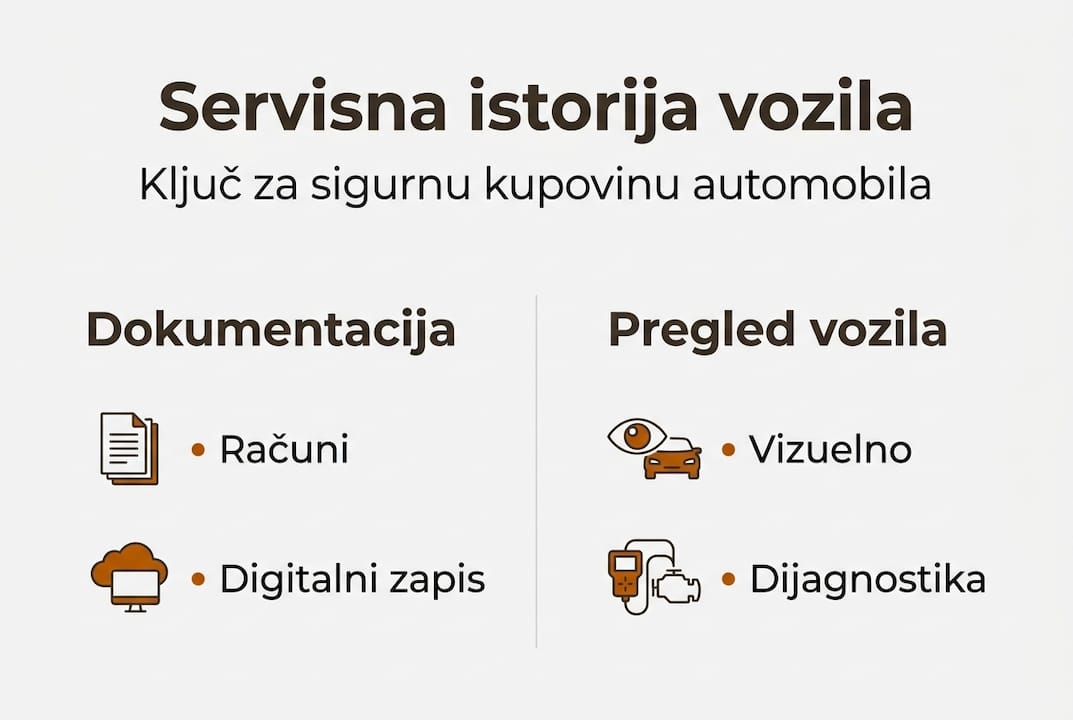
But value is not the only reason. Safety matters just as much, perhaps even more. A vehicle whose brake fluid was not changed in time, or whose timing belt was replaced late, represents a risk on the road. Such problems are not visible from the outside, but they make themselves felt at the worst possible moment.
Here is what a proper service history can cover:
-
Regular engine oil and filter changes
-
Replacement of brake pads, discs and fluid
-
Gearbox and clutch service
-
Timing belt or chain replacement
-
Diagnostic checks and fault code clearing
-
Tyre changes and wheel alignment
-
Work on the cooling system and air conditioning
A driver who knows the history of their car is not only better informed, they are also safer on the road. Every missed service is a potential fault waiting for the right moment to appear.
Tracking online service history is becoming ever more available and practical, because digital records cannot be lost or forged like a paper booklet. If you are wondering when to change oil and filters, that is exactly the kind of information that should be clearly documented in your service record.
How to Check Service History: Tools and Methods
Once you know what to check, it is time to get familiar with the concrete tools and procedures. There are several approaches, each with its own strengths and limitations. It is smart to use more than one method at a time, because no single one gives the full picture.
The most accessible method is a visual inspection of the vehicle. You look at the state of the body, the interior, under the bonnet and underneath the car. Signs of corrosion, non-original parts or traces of repairs can point to a hidden history. This does not require equipment, but it does require experience.
The next step is workshop diagnostics. By plugging a diagnostic device into the OBD port, a mechanic can read stored fault codes, fault history and certain engine operating data. This is especially useful for uncovering problems that are not visible from the outside.
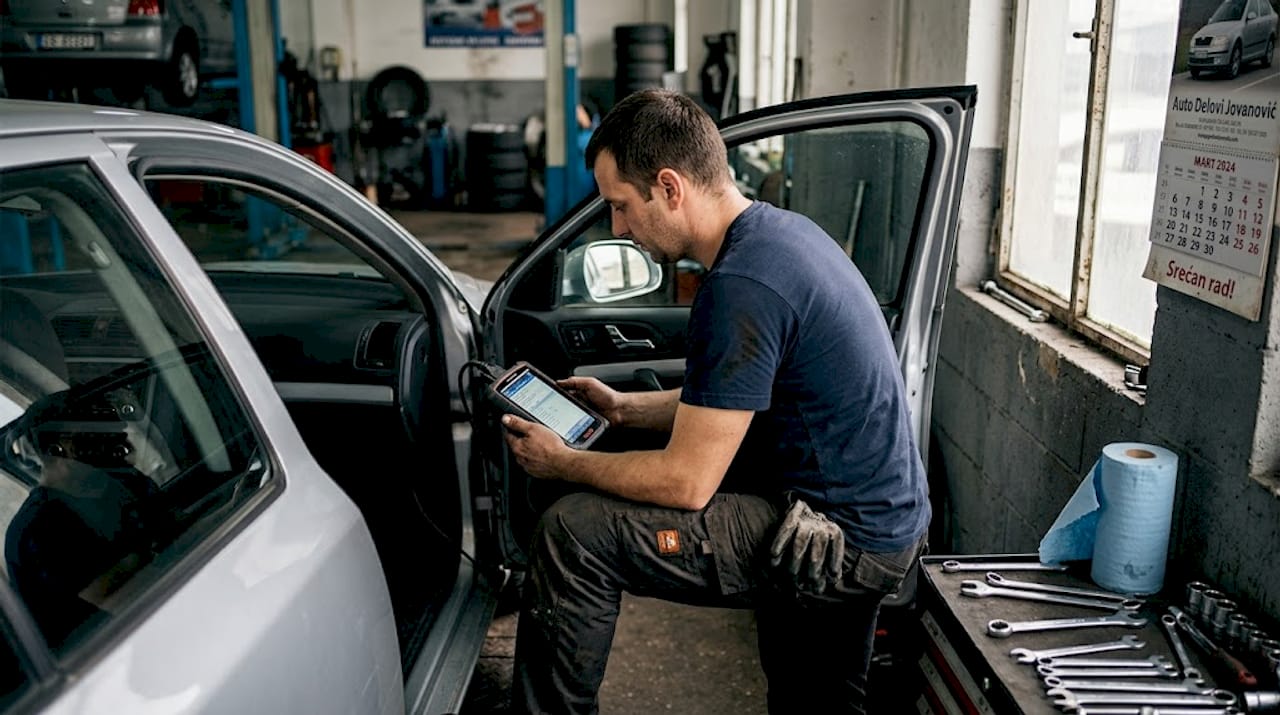
The third method is online platforms for checking vehicle history. Using the chassis number (VIN), specialized VIN services search databases from more than 1,000 sources and display data on ownership, mileage, damage and recorded service visits.
The methodologies include visual inspection, mechanical diagnostics and the use of online platforms, and each of them reveals a different layer of information.
| Method | Advantages | Limitations | Indicative cost |
|---|---|---|---|
| Visual inspection | Fast, free | Depends on experience | 0 KM |
| OBD diagnostics | Reveals hidden faults | Does not cover the whole history | 20 to 50 KM |
| Online VIN report | Global data, quick overview | Unregistered service visits missing | 15 to 40 EUR |
| Inspection by a mechanic | Most detailed insight | Requires time and money | 50 to 100 KM |
The steps we recommend for a thorough check:
-
Check the VIN number in several places on the vehicle and confirm they match
-
Order an online VIN report before any physical inspection
-
Carry out a visual inspection of the body and interior
-
Book OBD diagnostics at a trusted workshop
-
Ask to see the original service booklet and invoices
-
Consult an experienced mechanic before making the final decision
Professional tip: Always compare the VIN number on the registration document with the number stamped on the chassis and engine plate. A mismatch is an immediate red flag.
Weak Points in the Check: What May Be Missing
After the check method, it is important to know how far the reliability of your check actually reaches. No system is perfect, and awareness of the limitations is just as important as the check itself.
The biggest problem is that not every workshop is registered in digital databases. Small private workshops, home garages or repairs carried out abroad often leave no trace in online records. That means a vehicle can have a rich service history, but it is simply not visible in the reports.
Forged booklets and the lack of records from unregistered workshops are a serious problem on the used vehicle market. A paper service booklet can easily be bought, filled in with false data and stamped in a way that looks legitimate.
What to watch out for when reviewing documentation:
-
Differences in handwriting or ink between entries
-
Workshop stamps that do not exist or are from closed businesses
-
Illogical gaps between services (e.g. 80,000 km without a single entry)
-
Entries that do not match the vehicle's year or model
-
An overly tidy booklet for a vehicle with high mileage
-
Missing original invoices to accompany the booklet
Beyond outright forgery, there is also the problem of so-called rollback, that is, winding the odometer back. This is harder to spot visually, but OBD diagnostics and online reports can reveal inconsistencies in recorded values.
Professional tip: If a seller refuses to allow an inspection at an independent workshop before purchase, that is a strong signal that something is not right. Any serious seller has no problem with a transparent inspection.
The best way to reduce risk is to combine methods and rely on digital records that cannot be changed after the fact. Digital entries are time-stamped and tied to the vehicle's VIN, which makes them significantly more reliable than paper alternatives.
How to Choose a Reliable Workshop: A Practical Guide
Given the challenges of checking a vehicle's history, we finish with advice on choosing the right workshop. Because it is not enough to only check a vehicle's past; it is also important to make sure its future history stays tidy and reliable.
Online records kept by authorised workshops significantly reduce the risk of fraud, because every entry stays permanently recorded and accessible to the vehicle owner. This is one of the key criteria when choosing a workshop.
What makes a workshop good and reliable:
-
Communicates costs transparently before work begins
-
Offers a digital record of every service
-
Can show references and a business track record
-
Uses original or equivalent parts with a guarantee
-
Explains what was done and why, without jargon
-
Remains available for questions after the service
| Criterion | What to look for | Red flag |
|---|---|---|
| Documentation | Digital record and invoice | Only a verbal confirmation |
| Transparency | Explanation before work | Price known only at the end |
| Parts | Guarantee on fitted parts | Parts of unknown origin |
| Communication | Availability for questions | Avoiding answers |
| Experience | Specialisation in your model | A generalist approach to everything |
Before you entrust your vehicle to a workshop, ask a few concrete questions. Ask whether they keep a digital service record, whether you can receive a copy of every invoice, and whether they inform you before starting any work that was not originally planned.
It is especially important to ask about choosing a reliable workshop in your area, because a local workshop with a long-standing reputation often offers a better balance of trust than an unknown garage with low prices.
Our Perspective: Why Knowledge Protects More Than a Workshop
In more than 25 years of work, we have seen many drivers who made expensive decisions simply because they did not have the information. They bought a car with a rolled-back odometer. They paid for a service that was not necessary. Or they skipped a timing belt change and ended up with a destroyed engine.
Our experience clearly shows one thing: an informed owner always comes out better. Not because they are a mechanic, but because they know the right questions to ask. They know what to look for in the documentation. They know when something does not look right.
Checking the service history is not a luxury for those who buy expensive vehicles. It is a basic part of being a driver, regardless of the car's value. You are responsible for the vehicle you drive, and no one else can be as motivated to protect it as you are.
Transparency and availability of information are our strongest tools against fraud and hidden problems. That is why we have built digital service records into our service, because we believe the vehicle owner should always have full insight into everything that has been done to their car.
Trust Your Vehicle to Proven Experts
Now that you know how and why to check the history, it is time to find a workshop you can trust. Knowledge only has value if you apply it in the right place.
At the Auto Gas Gaga workshop in Banja Luka, we have been active since 1996 and we document every service digitally. Our clients have permanent online access to their records and can track the history of every job done on their vehicle. We offer complete workshop services, from routine maintenance to complex diagnostics, with full transparency on prices and procedures. Get in touch and we will arrange a time that suits you.
Frequently Asked Questions About Service History Checks
How can I check whether a service booklet has been forged?
Compare the data in the booklet with the online records of authorised workshops and look for irregularities in signatures or stamps. Forged paper documentation can fool even experienced buyers, so combining sources is essential.
What information is typically available in digital reports?
Digital reports usually contain information about maintenance, ownership, mileage and potential damage. these specialized VIN services use data from more than 1,000 databases around the world, which gives a relatively comprehensive view of a vehicle's history.
Does workshop diagnostics guarantee a complete history check?
Diagnostics helps, but it is not a guarantee because unregistered workshops and forged records can remain undetected. The data is not complete for repairs done without insurance or at unregistered workshops, so diagnostics is only one piece of the puzzle.
Why is it recommended to use several check methods?
A combination of digital sources and a physical inspection gives the most comprehensive view and reduces the risk of something being missed. Combining methods verifies both digital and physical data, which is the only way to minimise risk when buying or taking over a vehicle.