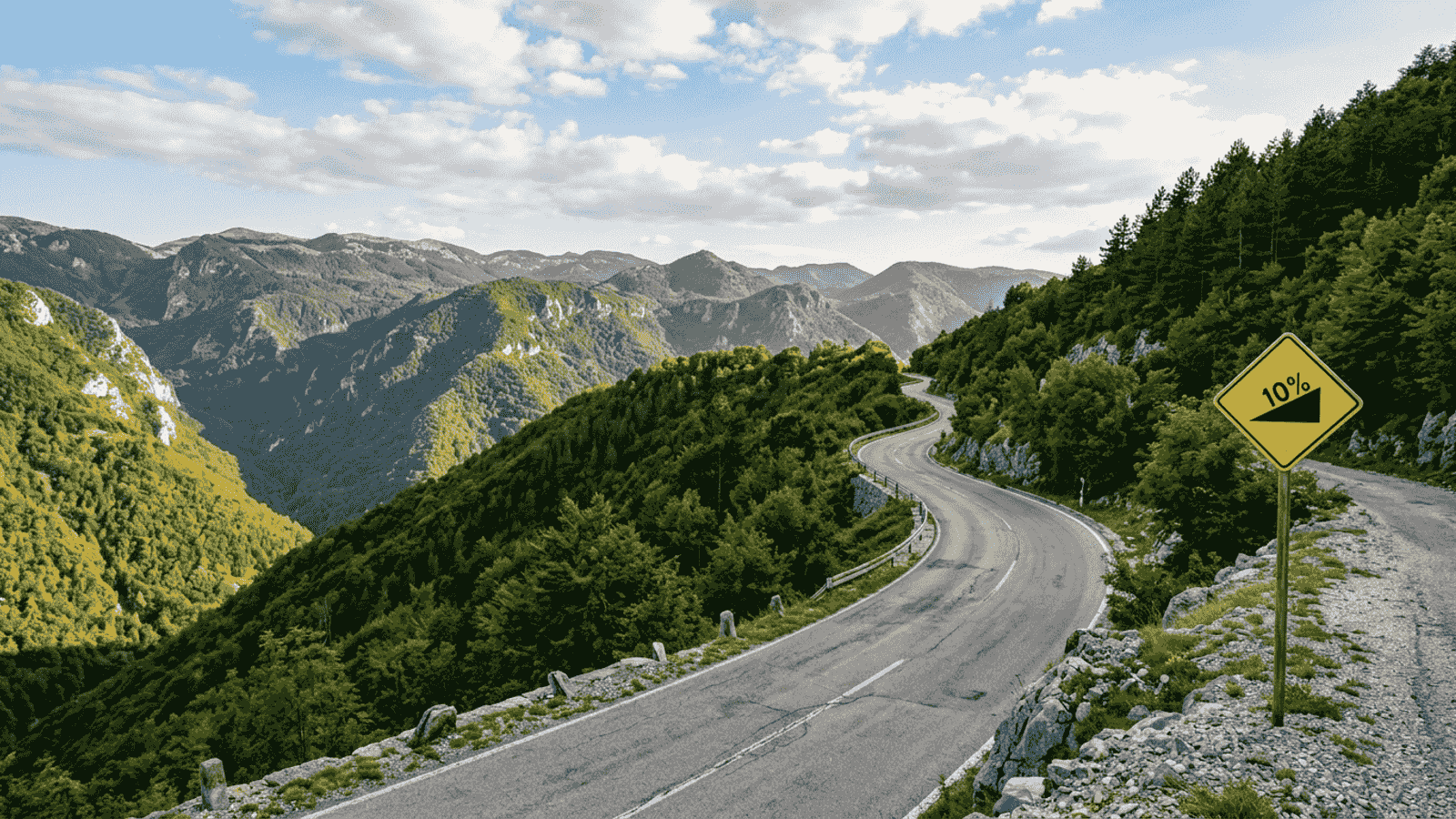
The average age of motor vehicles in BiH is 17 years, and 38 per cent of passenger cars are over 23 years old. With a fleet like that, every mountain pass becomes a serious test for brakes, the cooling system and driver technique. Driving mountain roads in BiH demands more than careful attention behind the wheel: it demands an understanding of engine braking principles, knowledge of the limits your brakes can withstand, and vehicle preparation before you even set off.
This guide covers all three: the specific temperatures and RPM figures you need to watch, the difference between manual and automatic gearbox behaviour on descents and climbs, and the preparation you can do the day before to reduce risk to a minimum.
This guide was compiled by the Auto Gas Gaga workshop in Banja Luka, drawing on years of experience servicing brakes and cooling systems on vehicles that regularly cross mountain sections throughout BiH.
Table of Contents
- Why Mountain Roads in BiH Are Particularly Demanding
- Engine Braking on Downhills, the Technique That Saves Brakes and Lives
- Brake Fade, When Brakes Stop Working
- Manual Gearbox on Mountain Roads
- Automatic Gearbox on Mountain Roads
- Engine Overheating on Long Climbs
- Vehicle Preparation Before a Mountain Trip
- Which BiH Trunk Roads Have Mountain Passes
- Frequently Asked Questions
- Related Articles
Why Mountain Roads in BiH Are Particularly Demanding
BiH is a country where flat terrain practically does not exist on most trunk roads. Ivan Sedlo at 967 metres above sea level, Makljen at 1,123 metres, Komar at 927 metres and Kupreska Vrata at 1,384 metres are all sections that thousands of drivers cross every day. Each of those sections demands downshifting to a lower gear, continuous monitoring of engine temperature and full concentration on bends without crash barriers.
A 2024 study identified 124 hazardous locations on FBiH trunk roads, of which 51 were classified as extremely dangerous black spots. Among the most dangerous sections are Jablanica-Mostar and Bugojno-Gornji Vakuf, both with significant mountain segments. According to MUP RS analysis, inappropriate speed accounts for 41.1 per cent of traffic fatalities.
What makes Bosnian mountain roads particularly demanding is the combination of steep gradients, tight bends and road surface condition. Many sections lack safety barriers, hard shoulders are narrow, and the tarmac is riddled with patches and potholes. Lorries use the same routes as passenger cars, so queues form on climbs that force impatient drivers into risky overtakes.
Then there is the question of vehicle age. A car with 200,000 or 300,000 kilometres on the clock does not brake the same as a new one. Brake pads, discs, fluid, hoses - everything wears and gradually loses effectiveness, and a mountain road is precisely the situation that reveals how weak the system really is.
For drivers arriving from flat parts of the country or from abroad, driving over Ivan Sedlo or Makljen may be their first encounter with a long, steep descent. And it is on a long descent that the worst mistake occurs: keeping your foot on the brake pedal continuously.
Engine Braking on Downhills, the Technique That Saves Brakes and Lives
Engine braking is a technique in which the engine acts as an additional braking device. Instead of transferring all stopping force to the brake disc and pads, you use the compression resistance in the engine's cylinders to slow the vehicle. In this mode the engine burns virtually no fuel because the ECU detects a closed throttle and cuts fuel injection.
The principle is straightforward: when you are in a lower gear and release the accelerator, the engine has to overcome air compression in the cylinders at higher RPM, and that resistance slows the front or all four wheels depending on the drivetrain. The result is controlled deceleration without touching the brake pedal.
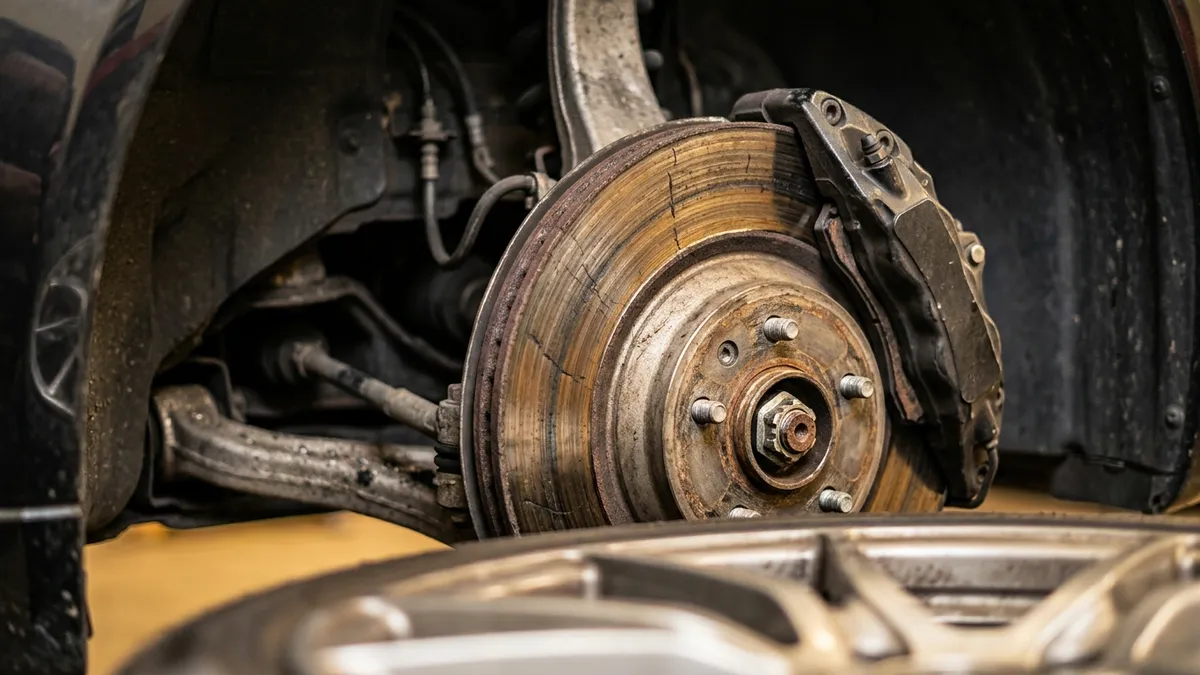
On a long descent such as the drop from Makljen towards Prozor or from Ivan Sedlo towards Konjic, engine braking is the difference between a safe descent and a situation where your brakes fail completely. Diesel engines have an advantage here because their higher compression ratio produces a stronger engine braking effect at the same RPM.
The rule for downshifting: on a petrol engine, downshift when revs drop to around 3,000 RPM. On a diesel, which has greater compression resistance, the threshold is around 2,000 RPM. If you shift too early, at too-low revs, the dual-mass flywheel and clutch absorb the impact instead of the engine taking over the braking, and that leads to an expensive repair.
On particularly steep sections use second gear for greater braking effect. On gentle slopes, third or even fourth gear may be sufficient. The key is to listen to the engine: if revs exceed 4,500 RPM on a petrol or 3,500 on a diesel, shift up because the engine is under unnecessary strain. If the car continues to accelerate despite being in a low gear, only then apply the brake with a short, firm press - never a prolonged hold.
The combination of engine braking and occasional short presses of the brake pedal is the only correct technique for long descents. Each press should be short and firm rather than long and gentle, because a short press dissipates energy more quickly and gives the disc time to cool between braking events.
Brake Fade, When Brakes Stop Working
At What Temperature Do Brakes Overheat
Brake fade is the technical term for loss of braking force due to overheating. The brake disc absorbs heat every time you press the pedal. On a short descent in town, the heat dissipates between braking events. On a mountain descent of five or ten kilometres with no break, the disc has no time to cool.
When disc temperature exceeds approximately 815 degrees Celsius, a chemical change occurs in the brake pad material. The organic binder in the pad begins to combust, creating a layer of gas between the pad and the disc. The pad literally floats on that gas layer and loses contact with the disc. The result: you press the pedal and the car does not stop.
The symptoms of overheated brakes arrive gradually in a recognisable sequence. First you notice a burning smell, similar to scorched plastic or rubber. Then you hear a squeal that differs from the usual noise of worn pads - the tone is deeper and continuous. At a more advanced stage, smoke appears from the front wheel area. The brake pedal becomes soft and sinks deeper than usual. In the worst case the disc can become visibly glowing, red or orange in colour.
If you notice any of these symptoms, the worst thing you can do is stop and wait for the brakes to cool in place. A brake disc that glows at one point while the car is stationary develops permanent deformation, known as disc warping, which causes steering wheel pulsation during every subsequent braking event. Instead of stopping, reduce speed as much as possible, shift to the lowest practical gear and drive gently for another two to three kilometres until the discs cool through rotation and airflow. Only when the smell has completely gone and the pedal has returned to its normal height should you stop and inspect.
It is important to understand that overheated brakes cannot be repaired on the spot. Pads that have been through overheating permanently lose some braking capacity because the bonding material has burned away. Discs that have been through extreme temperatures undergo metallurgical changes and become prone to cracking. After a brake fade episode, a workshop visit is mandatory to check disc thickness and flatness as well as pad condition.
If you want to know how to spot worn brake components before the situation becomes critical, a more detailed overview of symptoms by severity can be found in our guide to signs your brakes need servicing.
Manual Gearbox on Mountain Roads
A manual gearbox on a mountain gives you complete control over gear selection. That is its greatest advantage because the driver decides exactly how much compression resistance the engine provides.
On a climb, the basic rule is to keep the engine in the RPM range where it has sufficient power without excessive strain. For petrol engines that is typically 2,500 to 4,000 RPM; for diesels, 1,800 to 3,000 RPM. If revs drop below the lower limit because the gradient is steep, downshift immediately. Do not wait for the engine to start labouring because by then it is already too late and the clutch absorbs the impact of an abrupt shift.
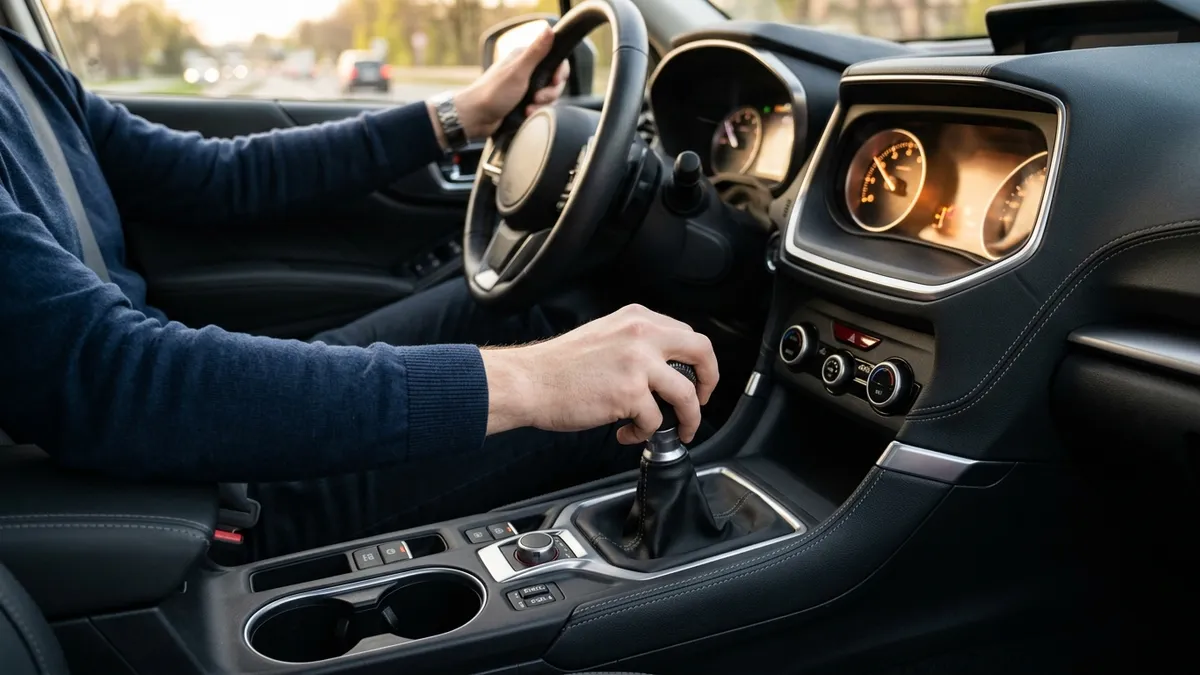
On a descent, the manual gearbox is used for engine braking as described above. The technique is: before entering the downhill section, shift down while you are still on flat ground or at the very start of the drop. Do not attempt to shift in the middle of a steep descent at high speed because the gearbox synchromesh suffers, and an abrupt clutch release can cause the rear wheels to lock on a wet road.
For drivers with five-speed gearboxes, the typical choice on Bosnian mountain descents is third gear for moderate gradients and second for steep ones. First gear on a descent is rare and is only used on extremely steep gravel or forest tracks where speed does not exceed 15 to 20 kilometres per hour.
One additional point that is often forgotten: the handbrake is not a substitute for engine braking. The handbrake acts only on the rear wheels and with far less force than the main hydraulic brake. On a steep descent the handbrake can overheat the rear drums or discs while the fronts remain cold. That is a recipe for loss of control.
Automatic Gearbox on Mountain Roads
An automatic gearbox on a mountain requires a different approach because the gearbox decides the gear for you, and in D mode that decision is optimised for flat driving, not for mountains.
Most modern automatic gearboxes have an L mode or the option to select gears manually via plus-and-minus movement of the lever. L mode restricts the gearbox to first or second gear depending on the manufacturer, thereby forcing engine braking as if you were driving a manual in second.
How to Use L Mode on an Automatic Gearbox Downhill
Move the lever from D to L, or to 2, or to M then minus, before entering the downhill section while the car is still on flat ground. Do not wait until the car is already accelerating before shifting, because an abrupt change to a low gear at high speed delivers a heavy shock to the drivetrain. The gearbox can handle this once or twice, but repeated incidents wear the clutch packs and torque converter.
If your gearbox has no L but does allow manual selection, shift to 2 or 3 before entering the descent. CVT gearboxes, which are common on Japanese cars, usually have simulated gears that you can select with steering wheel paddles or the lever. The principle is the same: force a lower gear so the engine takes over the braking.
What you must never do with an automatic gearbox on a mountain: shift from D to R or P while the car is moving. It sounds obvious, but in panic situations when brakes weaken, drivers sometimes instinctively reach for the lever and push it into the wrong position. The result is instant gearbox destruction and complete loss of vehicle control.
On a climb, an automatic gearbox generally behaves well because it shifts down on its own when it senses the need for power. The problem arises in cars with older four-speed automatics that lack enough ratios to find the optimum gear. The engine then oscillates between too-low and too-high revs, which wastes fuel and overheats the gearbox. In that case, manually lock the gearbox in third and leave it there until you clear the climb.
If you want to know how to handle difficult night driving conditions on these same sections, tips on visibility and fatigue can be found in our guide to night driving in BiH.
Engine Overheating on Long Climbs
An engine that overheats on a long climb is a serious problem requiring a swift response. On a climb the engine operates under full load: the throttle is open, revs are high and vehicle speed is low. That means airflow through the radiator is minimal because the car is moving slowly, while the engine is producing maximum heat.
On a new, properly functioning vehicle the cooling system compensates with stronger fan operation and an adequate supply of coolant. On a car that is 15 or 20 years old, the thermostat may be partially stuck, the water pump worn, the radiator partially blocked internally and the coolant level at minimum. Each of these factors on its own is not a problem on flat terrain, but during a fifteen-minute climb up Komar or Kupreska Vrata they all combine and the temperature needle starts creeping towards the red zone.
What to Do if the Engine Starts Overheating on a Climb
If the temperature needle moves towards the upper limit or the overheating warning light illuminates, react immediately. Switch off the air conditioning because the AC compressor places additional load on the engine. Turn the cabin heating to maximum and the blower fan to full speed because the heater core draws heat from the cooling system and thereby relieves it. Reduce throttle and, if possible, pull over at the first safe location with the engine still running and let it idle until the temperature drops. Only switch the engine off after the temperature has stabilised. Never open the radiator cap while the engine is hot because pressurised coolant can cause severe burns.
If overheating recurs, that is a sign that something in the cooling system is not working properly. A more detailed guide to overheating causes and emergency response steps can be found in our article on engine overheating in summer.
Vehicle Preparation Before a Mountain Trip
Most problems on mountain roads can be prevented with a single afternoon of preparation in your garage or workshop. Here is a concrete checklist in order of priority.
Brakes come first. Check pad and disc thickness. If the pads are close to their replacement limit, replace them before the trip. A disc with a visible ridge around its edge is also unsafe for mountain use because it has less material to absorb heat. Check the flexibility of brake hoses, particularly on older cars. A hard, cracked hose can fail under the increased pressure of mountain braking.
Why Old Brake Fluid Loses Effectiveness on Mountain Roads
Brake fluid deserves special attention because a mountain road is precisely the situation in which old, moisture-laden fluid can fail. DOT 4 fluid has a dry boiling point of 230 degrees Celsius, but a wet boiling point - with 3.7 per cent absorbed moisture - of only 155 degrees. DOT 3 is lower still: dry point 205, wet 140 degrees. On a mountain descent, brake system temperature easily exceeds 150 degrees, and old fluid with excess moisture boils, creates air bubbles in the brake line and turns the pedal spongy. That is the worst possible moment to lose braking effectiveness.
If you do not know how old the fluid in your car is, it is worth replacing it before a serious mountain trip. Detailed information on the differences between DOT standards, replacement intervals and moisture testing methods can be found in our guide to brake fluid.
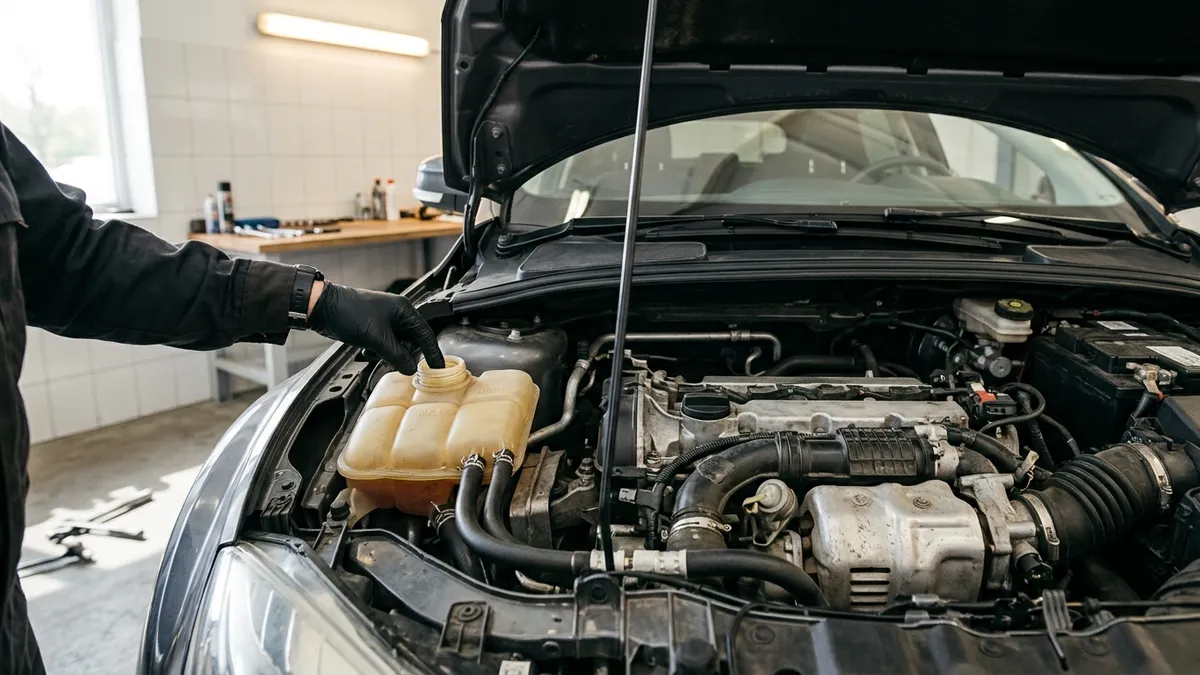
Check the cooling system visually: the coolant level in the expansion tank must be between the MIN and MAX marks with the engine cold. Inspect the upper and lower radiator hoses, looking for traces of white crystite deposits or greasy stains around clamp fittings. Verify that the radiator fan works by letting the engine warm up at idle and listening for the fan to engage.
Tyres matter because on a mountain road they have a dual role: holding the car on steep bends and assisting the brakes when stopping. Tread depth must be at least 3 millimetres for safe mountain driving; the legal minimum of 1.6 millimetres is insufficient for a wet bend on a gradient. Check pressure on cold tyres and adjust according to the manufacturer's specification because a tyre with low pressure under load on a climb overheats on its sidewall and wears unevenly.
Which BiH Trunk Roads Have Mountain Passes
BiH has several key mountain passes that every driver should know before getting behind the wheel.
Ivan Sedlo sits at 967 metres above sea level on the M-17 trunk road between Sarajevo and Konjic. The descent towards Konjic is approximately 15 kilometres long with several tight hairpins. This is probably the busiest mountain pass in the country and a section where overheated brakes occur regularly, particularly in summer when tourist traffic mixes with freight vehicles.
Makljen is at 1,123 metres, between Gornji Vakuf and Prozor. The descent towards Prozor is steep and long, with worse road surface condition than Ivan Sedlo. This is a section where engine braking is not an option but a necessity.
Komar is at 927 metres, on the road between Travnik and Jajce. Less busy than Ivan Sedlo but with an equally demanding descent. Winter conditions on Komar can be extremely harsh, making this section just as dangerous outside the summer season.
Kupreska Vrata at 1,384 metres is the highest pass on the regular trunk road network. In summer the crossing is comfortable, but the climb is long and the engine works under load for longer than on other passes. For older vehicles with weaker cooling systems, this is the most serious test.
Beyond these well-known passes, do not underestimate smaller sections either: Vlasic towards Travnik, the passage through the Vrbas canyon towards Jajce, or the climb from Jablanica towards Posusje. All are segments with significant elevation changes over relatively short distances.
If you are travelling in rain, a mountain road becomes even more demanding because wet bends on a gradient drastically shorten braking distances. For specific wet-road driving technique and aquaplaning prevention, see our guide to driving in rain in BiH.
Mountain passes in BiH are not something you can avoid - they are part of the daily journey for thousands of drivers. The difference between a safe and a dangerous crossing lies in preparation and technique. Check your brakes and cooling system before the trip, use engine braking on every descent, react to the first symptoms of overheating and know your gearbox. A mountain road is no place for improvisation, but with the right preparation it is no reason for fear either.
If you are unsure about the condition of your brakes or cooling system, book an inspection at the workshop before setting off on a longer trip over a mountain.
Frequently Asked Questions
Does engine braking damage the engine?
No. Engine braking is a designed operating mode of every internal combustion engine. The engine burns no fuel during engine braking, and cylinder compression is far below the level that would cause damage. The only danger is a premature downshift to too-low revs, which stresses the dual-mass flywheel and clutch.
How long can I brake on a descent before the brakes fail?
There is no universal answer because it depends on vehicle mass, speed, gradient, pad and disc condition, and brake fluid age. On a typical Bosnian mountain descent of 5 to 10 kilometres, a car with worn pads and old fluid can experience brake fade after as few as 3 to 4 kilometres of continuous braking. That is why engine braking is essential.
What if my car overheats on every climb?
If overheating recurs, the problem lies in the cooling system. The most common causes are a worn water pump, a partially stuck thermostat, a radiator blocked internally, or a faulty fan. Workshop diagnostics are needed because each of these causes requires a different intervention.
Can I use the handbrake to slow down on a descent?
The handbrake acts only on the rear wheels and with far less force than the main braking system. On a steep descent the handbrake can overheat the rear drums while the front discs remain cold, leading to uneven braking and loss of control. Use engine braking and the main brake pedal instead.
Can an automatic gearbox engine-brake like a manual?
It can, but you need to help it. In D mode the automatic gearbox shifts into a multi-ratio programme optimised for flat driving. For engine braking, shift to L, 2, or use M mode to manually lock a lower gear. The effect is the same as with a manual gearbox.
Which BiH mountain pass is the most dangerous for brakes?
Ivan Sedlo on the M-17 is the most demanding for brakes due to its long descent of approximately 15 kilometres towards Konjic combined with heavy traffic. Makljen has a steep descent towards Prozor with worse road surface. Kupreska Vrata at 1,384 metres has the longest climb, which is the hardest test for the engine cooling system.