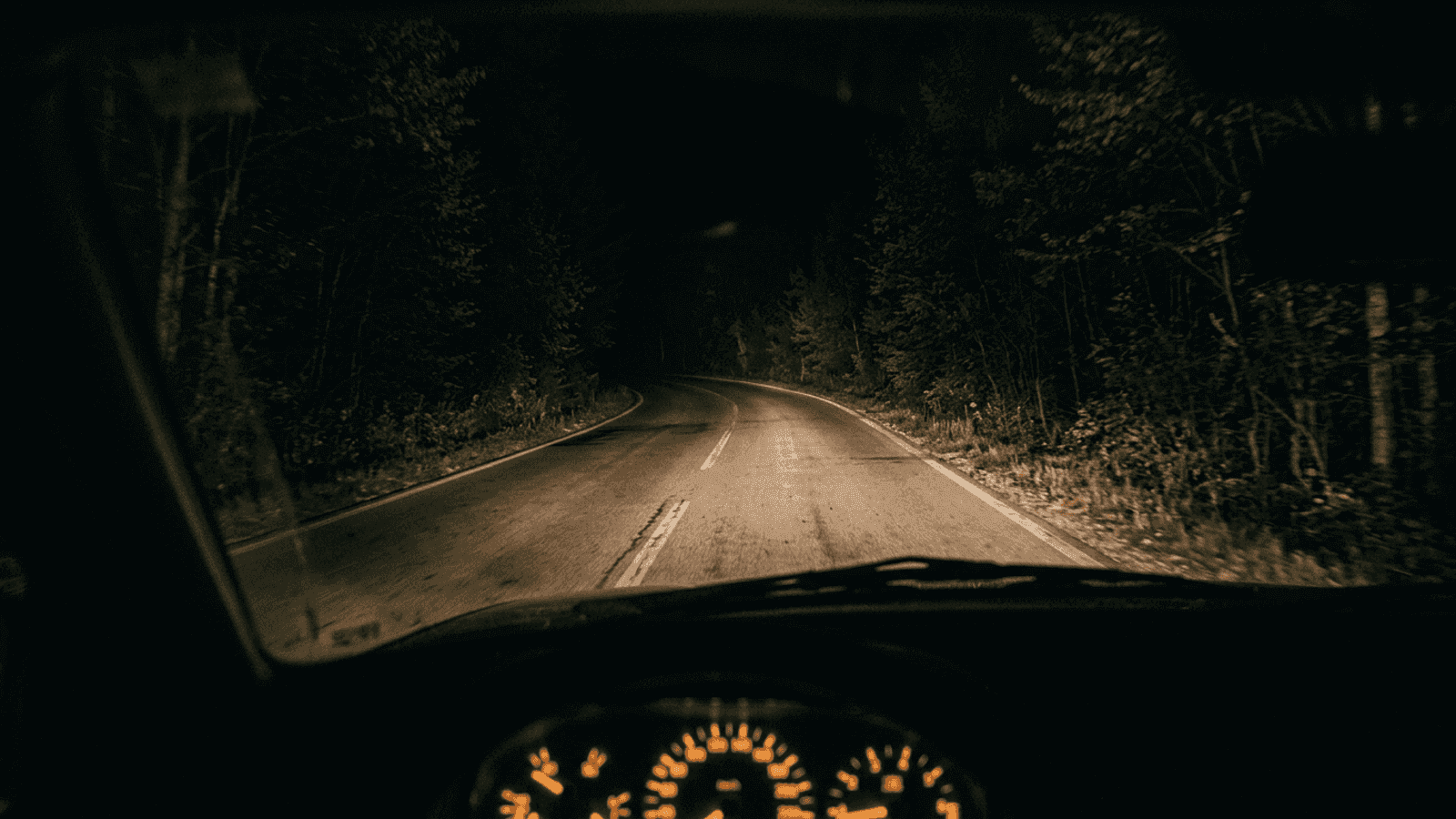
Every night the same thing happens on BiH roads: a driver switches on the low beams, pulls onto a trunk road and drives at the same speed they would during the day. The problem is that halogen headlights illuminate roughly 91 metres of road, while stopping distance at 88 km/h is around 152 metres. At that moment the driver is travelling faster than they can react to anything that appears ahead. In a country that recorded 42,762 traffic accidents and 288 fatalities in 2025, night-driving advice for BiH is not a matter of theory but of survival.
This guide was compiled by the Auto Gas Gaga workshop in Banja Luka, drawing on years of experience with roadworthiness inspections, post-accident repairs from night-time collisions and pre-purchase vehicle checks.
Table of Contents
- Why Night Is So Dangerous for Drivers in BiH
- How Far You Actually See on Low Beams
- Driver Fatigue and When It Becomes as Dangerous as Alcohol
- Microsleep and the Seconds That Can Be Fatal
- Wildlife on the Road as the Greatest Invisible Night Hazard
- Seven Rules for Safe Night Driving
- When Not to Get Behind the Wheel
- Frequently Asked Questions
- Related Articles
Why Night Is So Dangerous for Drivers in BiH
Roughly 90% of the information a driver receives comes through sight. At night that volume drops dramatically, with visibility falling up to three times compared with daytime conditions. The period between 23:00 and 05:00 is considered the most dangerous for driving, and European data confirm that crash risk between 02:00 and 05:00 is 5.5 times higher than during the day.
BiH roads add their own layer of risk. Trunk roads through forested stretches between Banja Luka and Jajce, between Doboj and Tuzla, between Mostar and Konjic have no divided carriageways, no lighting outside built-up areas and pass through regions rich in wildlife. The combination of a narrow road, unlit terrain, the possibility of encountering an animal and a driver who does not realise how little they can see creates conditions in which an accident need not be a matter of inattention but of physics.
The 2025 statistics are stark: 42,762 traffic accidents across BiH, 288 fatalities, representing a 30% increase over the previous year. The RS Ministry of Internal Affairs cites unadjusted speed as the cause in 41.1% of fatal outcomes. At night, that failure to adjust is not about pressing the accelerator harder but about not understanding how little road you can actually see.
How Far You Actually See on Low Beams
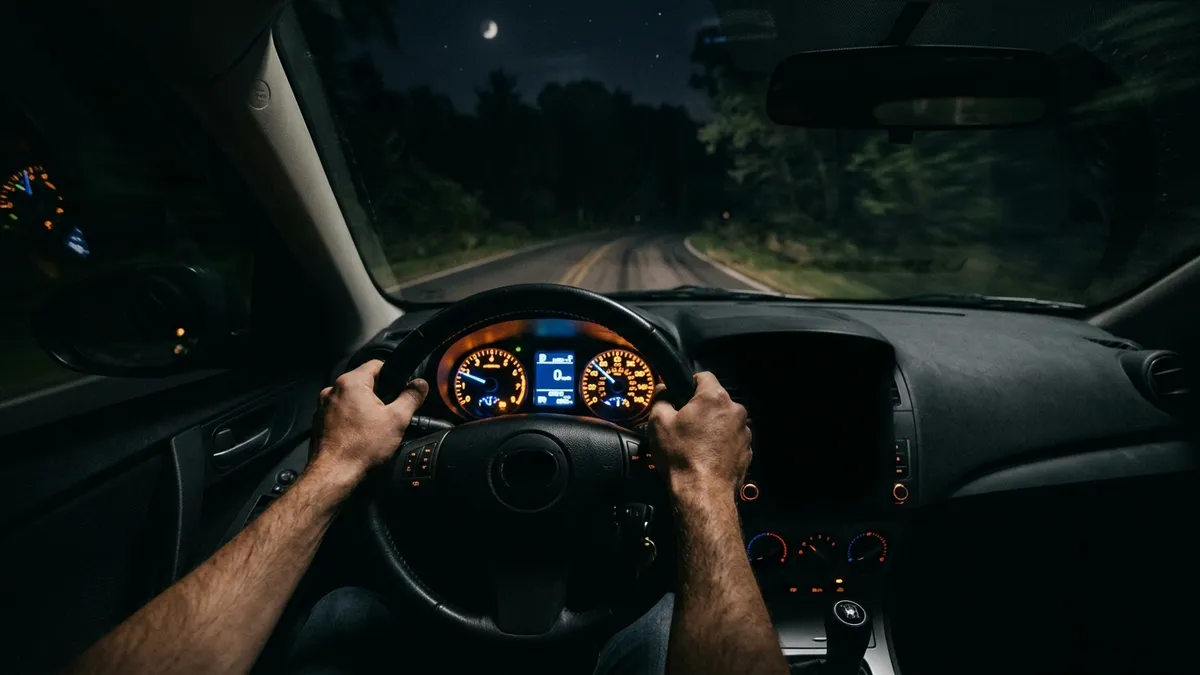
Here is a figure most drivers never hear: standard halogen headlights on low beam illuminate roughly 91 metres of road. At first glance that sounds adequate. But stopping distance at 88 km/h, factoring in reaction time and braking on dry tarmac, is around 152 metres.
This means that at a trunk-road speed of 80-90 km/h you are driving faster than you can bring the car to a halt within the lit zone ahead. In technical terms this is called driving beyond your headlights, and it is one of the most common causes of night-time crashes on open roads. A driver accustomed to daytime speeds on the same stretch is effectively driving blind at night, unable to react to an obstacle appearing at the edge of the illuminated area.
Pedestrian Visibility by Clothing Colour
The situation is especially critical with pedestrians. A pedestrian in dark clothing at night becomes visible to a driver at just 26 metres. In grey clothing that distance rises to 31 metres. With a reflective vest, visibility jumps to 136 metres.
Consider what this means in practice:
| Speed | Stopping distance (wet road) | Pedestrian in dark visible at | Outcome |
|---|---|---|---|
| 40 km/h | 23 metres | 26 metres | Driver manages to stop |
| 50 km/h | 32 metres | 26 metres | Collision unavoidable |
| 70 km/h | 56 metres | 26 metres | Collision at full speed |
On a wet road at 70 km/h the stopping distance is 56 metres, yet a pedestrian in dark clothing only becomes visible at 26 metres. A collision is virtually inevitable and there is no margin for error. The only speed that provides a buffer is 40 km/h, where the 23-metre stopping distance leaves three metres of reserve.
If you drive at night through a built-up area and see pedestrians on the road, there is no alternative: reduce your speed below 40 km/h. Anything above that is mathematics that does not work in your favour.
Driver Fatigue and When It Becomes as Dangerous as Alcohol
Most drivers understand that alcohol is dangerous behind the wheel. Very few realise that ordinary fatigue can produce the same effect. A study by Williamson and Feyer from 2000, also cited by the Sleep Foundation, found that after 18 hours of wakefulness the impairment of cognitive and motor abilities is equivalent to a blood-alcohol concentration of 0.05%.
That is the threshold at which the law in most European countries starts penalising drivers. And you are merely tired after a long day.
After 24 hours of wakefulness the impairment equals 0.10% blood alcohol, i.e. severe intoxication. Reactions are slower, distance judgement inaccurate, decision-making weakened. The difference is that a drunk driver at least knows they have been drinking, whereas a fatigued driver often believes they are "just a little tired" and can make it home.
European data on the effect of fatigue on crash risk confirm that driving between 02:00 and 05:00 is the most dangerous combination of tiredness and darkness. During this period the body is at its lowest level of alertness, and the circadian rhythm pushes strongly towards sleep regardless of how much coffee you have consumed.
Microsleep and the Seconds That Can Be Fatal
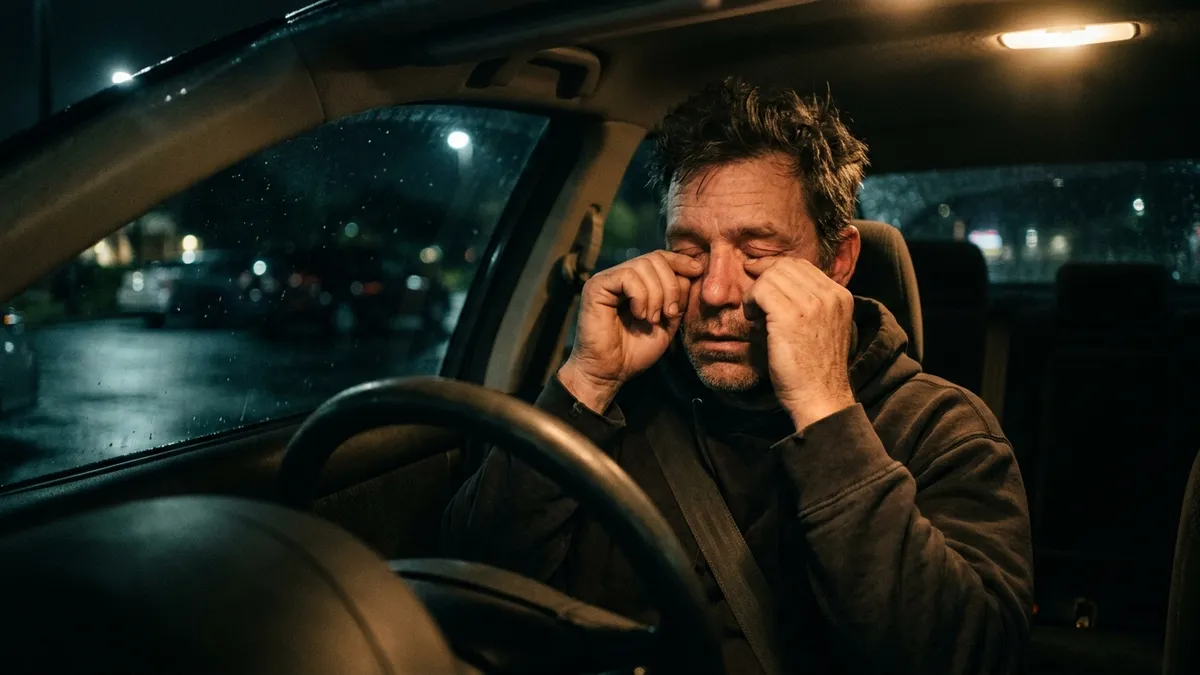
A microsleep is a brief episode in which the brain simply "switches off the screen" for 2 to 30 seconds. The driver does not feel they have fallen asleep, has no memory of the episode and usually wakes only when the car drifts off the road or crosses into oncoming traffic.
British data are alarming: one in three drivers (31%) admits to having experienced a microsleep at the wheel at least once. At 112 km/h a car covers roughly 200 metres in six seconds with absolutely no control. On a BiH trunk road, 200 metres can mean a bend, a bridge, the opposite lane or a tree at the roadside.
Warning Signs Before a Microsleep
A microsleep does not strike without warning. The body sends signals that drivers routinely ignore:
- Unintentional lane drifting
- Inability to recall the last few kilometres
- Heavy eyelids and frequent blinking
- Yawning every minute or two
- Restless shifting in the seat
- A feeling that your head is heavy and dropping forward
If you notice two or more of these signs, it is not "just tiredness that will pass." It is the final warning before your brain stops cooperating. According to research, drivers are up to 20 times more likely to fall asleep at 06:00 than at 22:00. In other words, if you are heading home at 05:00 and feel your eyes growing heavy, your body is telling you something you need to heed.
The only effective response to a microsleep is to pull over and sleep for 15-20 minutes. Opening a window, turning up the music or drinking coffee are all strategies that buy at most 15-20 minutes before fatigue takes over again. Coffee needs 20-30 minutes to take effect, so the most efficient strategy is to drink a coffee and nap for 20 minutes immediately afterwards, waking up just as the caffeine kicks in.
Wildlife on the Road as the Greatest Invisible Night Hazard
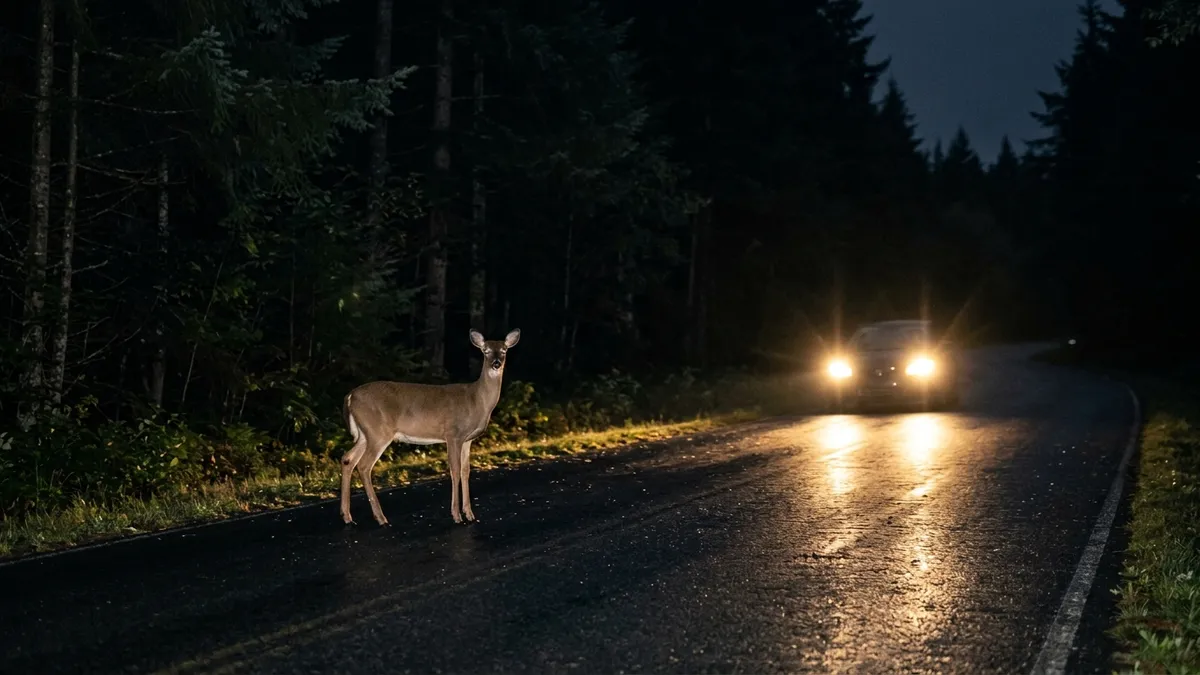
BiH trunk roads pass through some of the densest forested areas in the region. Roe deer, wild boar, foxes, badgers and even bears regularly cross roads, especially at dusk and dawn. An animal on the road at night is a hazard you cannot anticipate, and the consequences of hitting large game at 80 km/h are comparable to a head-on collision with another car.
Regional data from Karlovac County in Croatia for the first three months of 2026 show 154 vehicle-wildlife collisions, an increase of 27.3% over the same period the previous year. Roe deer account for 76% of all strikes. The peak is between 20:00 and 22:00 (56 strikes) and between 18:00 and 20:00 (50 strikes). Note that figure: the most dangerous period for encountering wildlife is not the dead of night but dusk, the period when drivers still feel safe and drive at full speed.
BiH does not have isolated wildlife-collision statistics, but trunk roads through Kozara, Vlasic, Igman, Borje and dozens of other forested areas sit within the same ecosystem and carry the same risk. Drivers who regularly travel the Banja Luka-Jajce or Doboj-Teslic routes know that deer on the road are not a rare sight.
What to Do When You Spot an Animal on the Road
First rule: do not swerve. A sudden steering input at 70-90 km/h on a narrow road almost certainly leads to leaving the carriageway or a head-on collision with an oncoming vehicle. Brake as hard as you can, keep the wheel straight and take the impact if it is unavoidable.
An animal up to 30-40 kg (fox, badger, hare) does not pose a hazard that justifies leaving the road. A roe deer weighing 25-30 kg can cause serious damage to the bonnet and windscreen but remains a lesser danger than a head-on crash. A wild boar of 80-150 kg or a bear can already cause severe consequences, yet controlled braking is still a safer option than swerving.
If you know you are driving through an area where wildlife is common, reduce speed to 60-70 km/h, use high beams when there is no oncoming traffic and watch for eye reflections along the roadside. Animal eyes reflect headlight beams and are visible as two small glows at 100-150 metres, giving you enough time to brake provided you adjust your speed.
Seven Rules for Safe Night Driving
These are not theoretical tips. These are rules that measurably reduce risk on BiH roads at night.
1. Match your speed to headlight range. On low beams with halogen bulbs, that means a maximum of 70-80 km/h on open roads. On high beams with no oncoming traffic, you can safely drive at 90-100 km/h. This is the fundamental rule: never drive faster than you can stop within the illuminated zone ahead.
2. Use high beams whenever possible. On BiH trunk roads outside built-up areas, traffic at night is sparse. High beams illuminate 200-250 metres of road, giving you a realistic braking margin. Switch to low beams as soon as you see oncoming headlights, and back to high beams once the vehicle has passed.
3. Check your headlights before the journey. A clouded or yellowed lens can reduce light range by 30-40%. A single blown bulb means you see half of what you otherwise would. If your headlights are ageing, consider polishing the lenses or replacing the bulbs. For more on what passes the roadworthiness test and which bulb fits your car, see our guide to headlight bulbs.
4. Keep the windscreen clean. A dirty windscreen at night creates a halo around every light source and dramatically reduces contrast. Ordinary finger grease on the inside of the glass can halve effective visibility. Before driving at night, wipe the windscreen inside with a clean microfibre cloth and top up the washer-fluid reservoir. Worn wipers make things worse by smearing instead of clearing, especially combined with worn or incorrect tyres that extend stopping distance on wet roads.
5. Avoid glare from oncoming headlights. When blinded by oncoming traffic, do not look directly at the headlights. Direct your gaze to the right edge of the road (the white line) and use it as a guide until the vehicle has passed. Recovery from glare takes 3-5 seconds, and during that time you are effectively blind. If you struggle with glare and find it harder to see at night, visit an ophthalmologist, especially if you are over 45, as the eye's ability to adapt to darkness diminishes with age.
6. Plan breaks every 2 hours. On longer night journeys a 15-20 minute break every two hours is not a luxury but a necessity. Use the break to stretch your legs, have a coffee and assess whether you are still alert enough to continue safely. If you still feel heavy and unrefreshed after a break, that is a clear signal to find overnight accommodation and continue in the morning.
7. Do not drive alone if you can avoid it. A passenger who talks to you keeps your alertness significantly higher than music or air conditioning. If a passenger notices you starting to stare at a single point or responding with a delay, that is a signal for a break. On longer trips, taking turns at the wheel every hour or two dramatically reduces the risk of fatigue.
When Not to Get Behind the Wheel
There are situations where the safest decision is simply not to drive. That is not weakness; it is mathematics.
Do not get behind the wheel if you have been awake for more than 16 hours. After 18 hours of wakefulness your abilities are equivalent to a blood-alcohol level of 0.05%. If you got up at 06:00 and plan to set off at midnight, that is 18 hours of wakefulness. Postpone departure until morning.
Do not get behind the wheel if you slept fewer than 5 hours the previous night. Chronic sleep deficit is cumulative and cannot be offset by coffee. Two nights of 4 hours' sleep produce an effect similar to one night of no sleep at all.
Do not get behind the wheel if you have taken any medication labelled as potentially causing drowsiness. Antihistamines, certain blood-pressure drugs, muscle relaxants and many others list drowsiness as a side effect, and in combination with night driving the effect multiplies.
If you are on a longer night journey and feel your eyes dropping while still an hour from your destination, pull over at the first safe spot. Sleep for 20 minutes in the car with the doors locked and parking lights on. Those 20 minutes can be the difference between arriving safely and an accident on the road. For more on driving in other challenging conditions, particularly aquaplaning on wet roads, see our guide to driving in rain in BiH.
If you have any doubts about the condition of your headlights, brakes or tyres, book an inspection before setting out on a longer night drive.
Frequently Asked Questions
How many metres do low beams illuminate at night?
Standard halogen headlights on low beam illuminate roughly 91 metres of road. High beams reach 200-250 metres. The problem arises because stopping distance at 88 km/h is around 152 metres, meaning that at trunk-road speed you are driving faster than you can react to an obstacle in the illuminated zone.
Is driver fatigue really as dangerous as alcohol?
Yes. Research shows that after 18 hours of wakefulness the impairment of cognitive and motor abilities is equivalent to a blood-alcohol concentration of 0.05%. After 24 hours without sleep the effect equals 0.10% blood alcohol, which constitutes severe intoxication. The difference is that a fatigued driver usually does not realise how impaired they actually are.
What is a microsleep and how long does it last?
A microsleep is a brief episode lasting 2 to 30 seconds during which the brain transitions into sleep without the driver's conscious decision. The driver has no memory of it. At 112 km/h a car covers roughly 200 metres in 6 seconds with absolutely no control. One in three drivers has experienced a microsleep at the wheel at least once.
How can I tell if I am too tired to drive?
The main signs are: inability to recall the last few kilometres, frequent yawning, heavy eyelids, unintentional lane changes and a feeling of a heavy head. If you notice two or more of these symptoms, stop at the first safe location and rest. Do not rely on an open window or loud music as they buy at most 15-20 minutes.
What should I do if a deer or wild boar runs onto the road at night?
Brake as hard as you can and keep the wheel straight. Never swerve, because at 70-90 km/h a sudden steering input on a narrow road leads to leaving the carriageway or a head-on collision with an oncoming vehicle. Controlled braking, even if a collision with the animal is unavoidable, is a safer option than swerving.
When should I use high beams on BiH roads?
Use high beams whenever there is no oncoming traffic and you are outside a built-up area. On BiH trunk roads at night traffic is sparse, so you can use high beams most of the time. Switch to low beams as soon as you see oncoming headlights and return to high beams once the vehicle has passed.