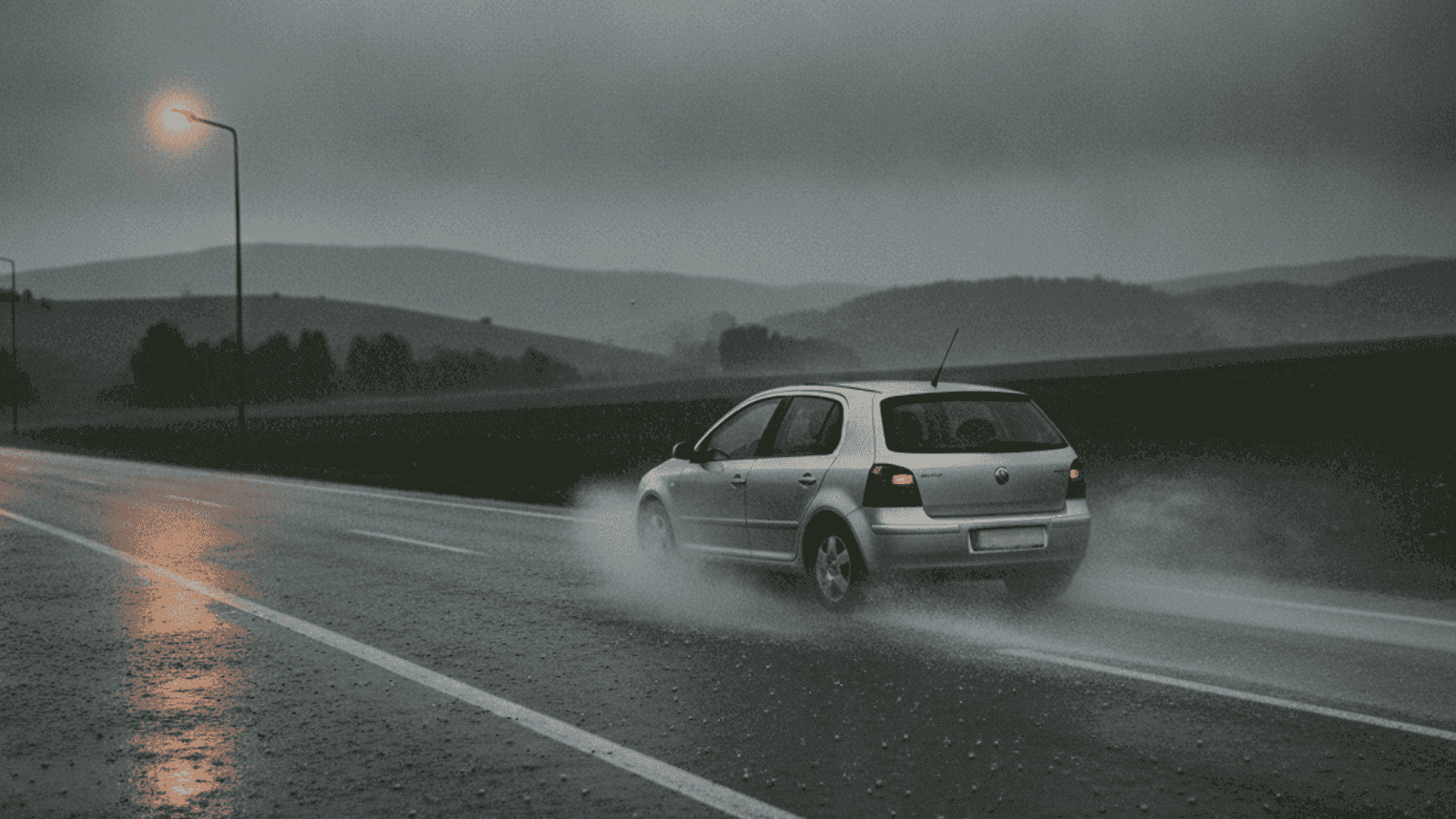
Thirty litres of water per second. That is how much a single new summer tyre at 80 km/h must displace from underneath itself to maintain contact with a wet road surface. When the tread wears down to 3.5 millimetres, the tyre loses that battle at just 75 km/h. Driving in rain in BiH on worn tyres means your car is no longer driving but floating, and the driver has lost all control. In a country where 288 people died in traffic in 2025, understanding how aquaplaning occurs and how to behave on wet roads is not an academic exercise but a matter of survival.
This guide was prepared by the Auto Gas Gaga workshop in Banja Luka, based on years of experience with pre-purchase and seasonal vehicle inspections.
Table of Contents
- Why Rain Is So Dangerous on BiH Roads
- What Is Aquaplaning and How Does It Happen
- At What Speed Does a Car Lose Contact with the Road
- Stopping Distance on Wet vs Dry Road Surface
- How to React When Your Car Starts Hydroplaning
- Tyre Tread and the Depth That Protects Against Aquaplaning
- Seven Rules for Safe Driving in Rain
- Frequently Asked Questions
- Related Articles
Why Rain Is So Dangerous on BiH Roads
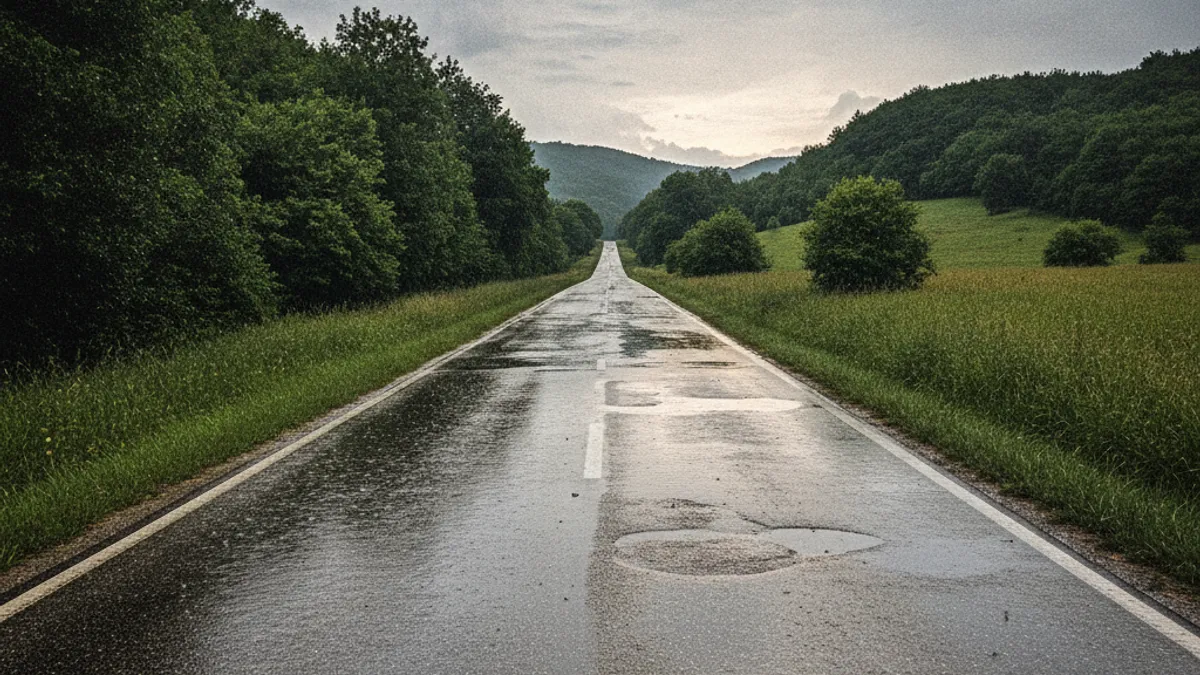
BiH has a specific combination of factors that make wet roads deadly. Roads often lack adequate drainage, asphalt on many sections is old and smooth, and drivers maintain the same speeds regardless of conditions. Regional roads, which far outnumber motorways in BiH, have no shoulders for drainage, so water collects on the very surface where traffic flows. Potholes and road deformations, which BiH has in abundance, become invisible traps hidden under water.
The Republika Srpska Ministry of Interior found in its 2024 analysis that excessive speed was the cause of 41.1 per cent of all fatal traffic accidents. June and August, months with frequent summer downpours, recorded the highest number of fatalities. Across all of BiH in 2025, there were 42,762 traffic accidents with 288 fatalities, roughly 30 per cent more than the previous year.
The problem is not just speed. The problem is that most drivers do not realise how much a wet road changes the rules. The following distance they are used to keeping on dry roads becomes fatally short. A steering input that saves you on dry tarmac causes loss of control on wet. A downpour that starts on a main road between two BiH towns creates dangerous conditions in a minute or two, and a driver who fails to adjust speed and following distance in that window is playing roulette with their life.
The first few minutes of rain are especially dangerous. Water mixes with oil, dust, and rubber particles that have accumulated on the dry asphalt, forming a thin slippery film that is more hazardous than a heavier downpour. That film only disappears once stronger rain washes it away, typically after 15 to 20 minutes. During that initial period, the coefficient of friction drops dramatically and the road is more slippery than during the actual heavy downpour.
What Is Aquaplaning and How Does It Happen
Aquaplaning occurs when a layer of water builds up between the tyre and the road surface faster than the tyre can displace it. Instead of touching the asphalt, the tyre floats on a film of water. At that moment there is no friction, no grip, no control. The car behaves like a boat, and the driver is a passenger without a paddle.
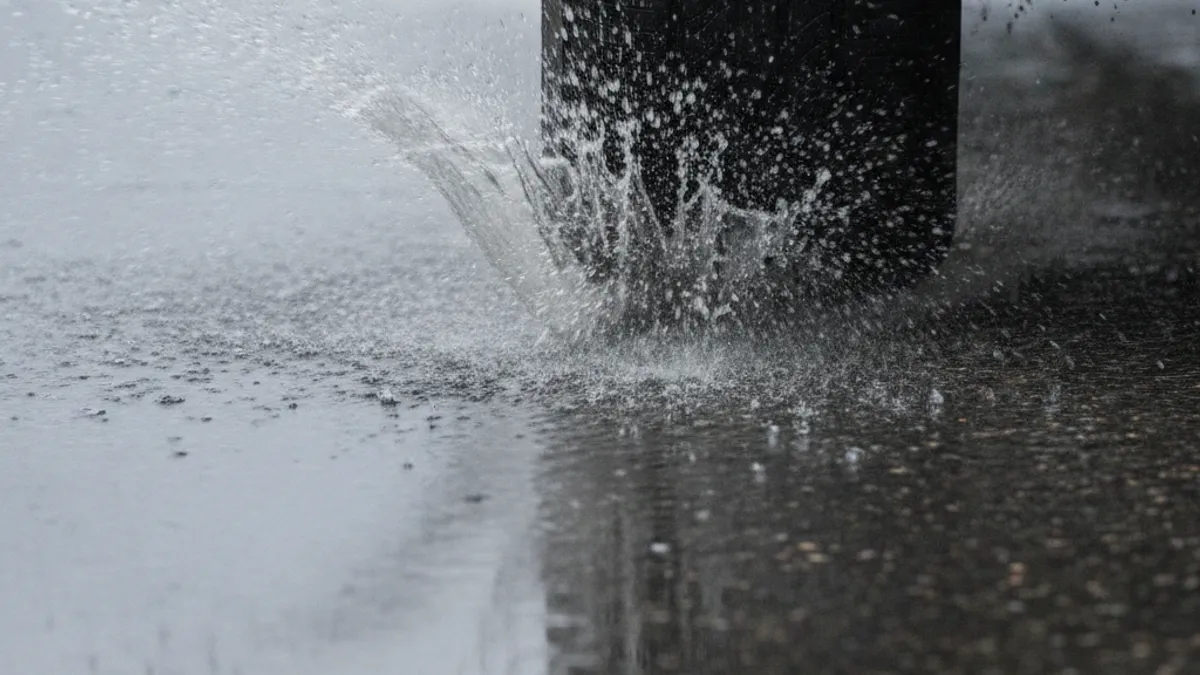
The physics are straightforward. A moving tyre must constantly push water out of its path. The higher the speed, the more water must pass through the tread grooves in a shorter unit of time. At a certain point, the volume of water exceeds the tyre's capacity to channel it away, and the entire contact patch becomes a water cushion. The tyre separates from the asphalt fully or partially, depending on how much water is standing on the road and how fast the car is travelling.
We distinguish between full and partial aquaplaning. In full aquaplaning, all four tyres lose contact with the surface. The car is completely out of control and slides in whichever direction inertia carries it. In partial aquaplaning, only the front or only the rear tyres lose contact. Partial aquaplaning is more insidious because the driver senses something is wrong but believes they still have control. Attempting a correction often makes things worse because the driver reacts the wrong way, assuming grip that simply is not there.
Factors that accelerate the onset of aquaplaning include water depth on the road surface, where as little as 2 to 3 millimetres is enough at higher speeds. Tyre width also plays a role, as a wider tyre is more susceptible because it has a larger contact patch for water to traverse. Tyre pressure is significant because low pressure deforms the tyre and reduces its ability to displace water. And the most important factor of all is tread depth, which we discuss in detail below.
At What Speed Does a Car Lose Contact with the Road
The 2025 ADAC summer tyre test produced a concrete number that every driver should commit to memory. The average speed at which aquaplaning occurs across the tested tyres is 78.19 km/h. That is a speed most drivers in BiH regularly exceed on regional roads, often even in built-up areas.
But that average conceals an enormous difference between new and worn tyres. Nokian Tyres tests showed that a new summer tyre with full tread depth maintains road contact up to 90.4 km/h. A tyre with 3.5 millimetres of tread loses contact at just 75 km/h. A 15 km/h gap that can mean the difference between control and a complete loss of steering.
There is also a mathematical relationship that clearly illustrates how critical speed is. A 20 per cent increase in speed raises the risk of aquaplaning by 44 per cent. The risk grows with the square of speed, meaning a small change in velocity produces a disproportionately large change in risk. A driver doing 100 instead of 80 km/h on a wet road does not increase their risk by 25 per cent, but nearly doubles it.
This explains why motorways are paradoxically safer than main roads in the rain. Motorways have better-quality asphalt with superior drainage, but also higher speeds. Main roads have worse asphalt, puddles, potholes that retain water, but lower speed limits. The problem arises when a driver on a main road drives at motorway speed, because the surface quality simply cannot cope.
On a typical BiH main road with worn asphalt, puddles where potholes have been patched, and no marked drainage, aquaplaning can occur at as little as 60 km/h if the tyres are worn. That is the reality BiH drivers face during the rainy season, from March to November.
Stopping Distance on Wet vs Dry Road Surface
These are numbers every driver needs in their head before getting behind the wheel in the rain. At 80 km/h, stopping distance on a dry road is around 64 metres. On a wet road, the same scenario requires approximately 128 metres, 1.5 to 2 times more depending on tyre condition and asphalt quality. That is the difference between five standard parking spaces and ten.
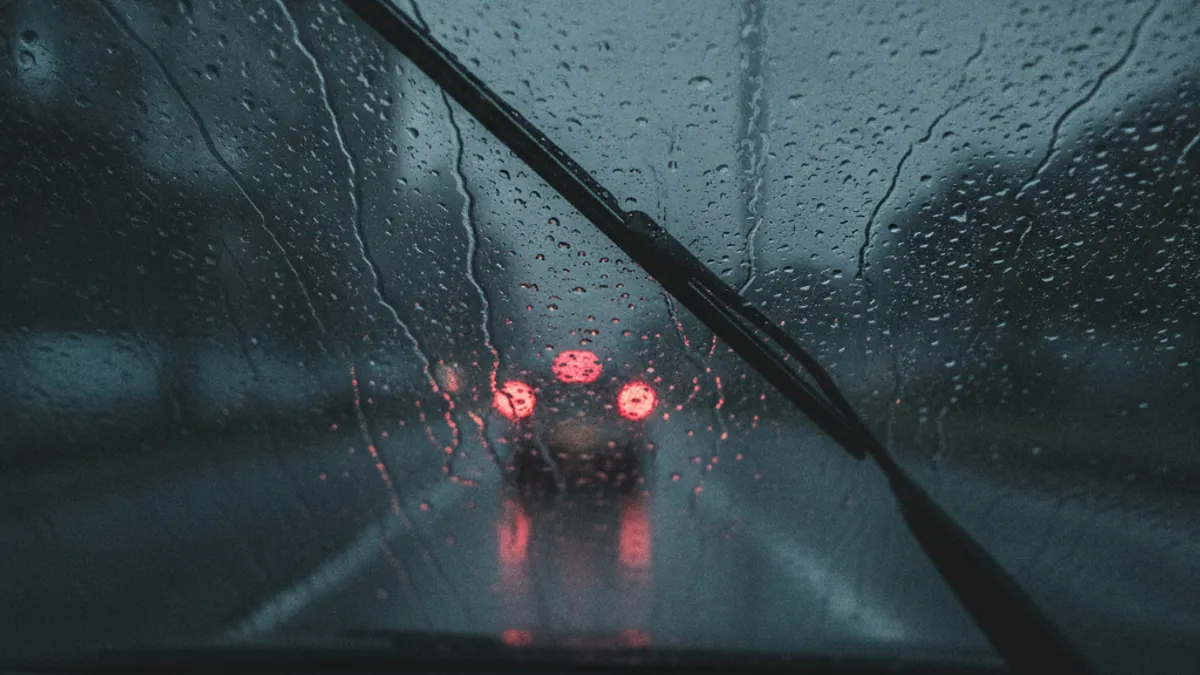
Stopping distance consists of two components: reaction distance and braking distance. Reaction distance is the distance the car covers while the driver spots the hazard, makes a decision, and moves their foot to the brake. On a dry road, that process takes about one second. On a wet road, when visibility is reduced, wipers are running, rain is hitting the glass, and reflections from wet asphalt are dazzling, reaction time increases because the brain is processing more information. It can rise to 1.5 to 2 seconds, which at 80 km/h means an extra 10 to 22 metres in reaction alone, before the brake even begins to work.
Continental measured the difference at their Contidrom test facility between a new tyre with 8 millimetres of tread and a tyre at the legal minimum of 1.6 millimetres. On a wet surface, the difference in stopping distance is 6.8 metres. That is the length of one car. At 80 km/h, those 6.8 metres can be the difference between stopping before an obstacle and a full-force impact.
Driving in rain at night makes things considerably worse. Visibility drops to 50 to 80 metres in heavy rain with standard halogen headlights. If your stopping distance is 128 metres but you can only see 60, the maths is merciless. You are braking for something you cannot see until it is too late. This is why adjusting your speed in the rain is mandatory, not optional.
What does this mean in practice? If you keep three car lengths of following distance on a dry road, on a wet road you need a minimum of six. Most drivers in BiH keep one to two car lengths on dry roads. On a wet surface, that is a recipe for a multi-vehicle pile-up. The rule for wet roads is clear: double the distance, no exceptions, no compromises.
How to React When Your Car Starts Hydroplaning
Aquaplaning is recognisable by a sudden feeling of lightness in the steering wheel. The wheel goes slack, offering no resistance. Engine revs climb because the driven wheels lose contact with the road and resistance drops sharply. If you have ESP, the warning light will start flashing and the system will attempt to intervene by braking individual wheels. On newer cars, even slight wheelspin activates the stability control.
The protocol for aquaplaning is simple, but goes against every instinct a driver has. Do not brake hard. Do not turn the steering wheel. Press the clutch to disconnect the engine from the wheels. Lift off the accelerator completely. Hold the steering wheel straight and wait for the tyres to regain contact with the road.
Hard braking during aquaplaning locks the wheels, and locked wheels on water have zero braking force. ABS will try to help, but when there is no contact between tyre and asphalt, even ABS cannot perform miracles. The system can only modulate pressure, but if the tyre is not touching the surface, modulation produces no result. A sharp steering input at the moment when the front tyres have no grip means the car will veer in whichever direction you turned the wheel the instant the tyres regain contact with the asphalt, usually into the oncoming lane or off the road entirely.
Aquaplaning typically lasts a short time, from half a second to two seconds. But during that period the car can travel 20 to 40 metres with absolutely no control. The key is to stay calm and do nothing except hold straight. As soon as you feel the steering wheel offering resistance again, the tyres have gripped the asphalt and you have control back. Then brake gently and gradually reduce speed to a level that is safe for the conditions.
An automatic gearbox requires a slightly different approach. You cannot press a clutch because there is none, but you can lift off the accelerator and let the car slow down on its own. With an automatic, never shift into neutral during aquaplaning because you will lose engine braking the instant the tyres regain grip.
Tyre Tread and the Depth That Protects Against Aquaplaning
The legal minimum in BiH is 1.6 millimetres of tread depth. That figure is inadequate for safe driving in the rain, and every serious recommendation considers it a lower limit that should not be left until. Tyre experts and independent test results unanimously recommend a minimum of 4 millimetres for adequate protection against aquaplaning.
At 1.6 millimetres, a tyre has virtually no drainage capability at speeds above 60 km/h. The grooves are too shallow to channel enough water, and a tyre at the legal minimum behaves on wet roads almost like a slick tyre. At 4 millimetres, a tyre still effectively displaces water at normal regional road speeds. The difference in behaviour between 4 and 1.6 millimetres on a wet surface is far greater than the numbers alone suggest.
Check your tread depth with a simple test. Take a one-mark coin and insert it into a tread groove. If the entire gold rim of the coin is visible, the tread is below 3 millimetres and the tyre is due for replacement. For a more precise measurement, a tread depth gauge costs a few marks and gives an exact reading in millimetres. Any workshop that carries out inspections or servicing can measure the depth for you in half a minute.
Do not forget to check all four tyres, as they do not wear evenly. Front tyres typically wear faster, especially on front-wheel-drive cars. The inner and outer edges can have different depths, particularly if the wheel alignment is off. Uneven wear is a signal that you need an alignment before fitting new tyres, otherwise you will wear through a new set just as quickly and unevenly.
Pay attention to tyre age as well. A tyre older than five to six years loses elasticity regardless of tread depth, and a hardened compound grips worse on wet surfaces even when the tread looks deep enough. The manufacturing date is stamped on the sidewall as a four-digit DOT number. For example, 2521 means the 25th week of 2021. For more detail on proper tyre maintenance, pressures, and signs it is time for a replacement, read our guide to tyres and correct pressures.
Seven Rules for Safe Driving in Rain
Rule one is speed. Reduce your speed by at least 20 per cent compared with dry conditions. On a motorway, that means driving 100 to 110 instead of 130. On a regional road, hold 60 to 65 km/h instead of 80. This is not excessive caution but physics, because the squared relationship between speed and aquaplaning risk is unforgiving.
Rule two is following distance. Double the gap to the vehicle ahead. On a wet road, everything happens more slowly except the collision. A collision is just as fast on wet as on dry. If you keep two to three intervals on dry, keep four to six on wet.
Rule three is tyres. Check your tread depth before the rainy season. If it is below 4 millimetres, seriously consider replacing them. Check your tyre pressures, because low pressure dramatically increases the risk of aquaplaning and extends stopping distance. The correct pressure is listed on the sticker inside the driver's door frame or in the vehicle handbook.
Rule four is wipers and visibility. A worn wiper blade that leaves streaks on the glass reduces visibility and extends reaction time. Replace your wipers at least once a year, ideally before autumn when the rainy season begins. Switch on dipped headlights as soon as rain starts, not for your own benefit but so others can see you. In heavier downpours, switch on the rear fog light as well.
Rule five is wheel tracks. Drive in the tracks left by the vehicle ahead on a wet road. The thin layer of water there has already been displaced and grip is better. This is especially useful on motorways and main roads where traffic flow is sufficient for the tracks to be visible.
Rule six is avoiding standing water. Puddles and water collecting along kerbs are the most dangerous spots for aquaplaning. If you must drive through a puddle, reduce your speed significantly and do not brake while in it. Braking in a puddle almost guarantees loss of control because both front wheels are simultaneously on water.
Rule seven is smooth steering. Avoid sudden steering inputs on a wet road. Any abrupt change of direction can trigger a loss of grip. Change lanes gradually, brake gently and progressively, accelerate smoothly. Wet roads reward patient drivers and punish nervous ones. For more on how brakes affect stopping distance and when they are due for servicing, read our guide to recognising worn brakes.
Need a tyre, wiper, or brake check before the rainy season? Book an inspection at our workshop or message us on WhatsApp.
Frequently Asked Questions
At what speed does aquaplaning occur?
According to the 2025 ADAC test, the average speed at which aquaplaning occurs is 78.19 km/h. With worn tyres at 3.5 millimetres of tread, aquaplaning can begin at just 75 km/h. On poorer road surfaces common in BiH, with standing water and potholes, that threshold can drop below 60 km/h.
How many millimetres of tread does a tyre need for driving in rain?
The legal minimum in BiH is 1.6 millimetres, but for safe driving on wet roads experts recommend a minimum of 4 millimetres. At 1.6 millimetres, a tyre has virtually no drainage capability at speeds above 60 km/h. The difference in stopping distance between a new tyre and one at the legal minimum is 6.8 metres on a wet surface.
What should you do when your car starts skidding in rain?
Do not brake hard and do not turn the steering wheel. Press the clutch, lift off the accelerator, and hold the steering wheel straight. Wait for the tyres to regain contact with the road. This usually takes one to two seconds. As soon as you feel the steering wheel offering resistance again, brake gently and reduce your speed.
How much longer is the stopping distance on a wet road?
On a wet road, stopping distance is 1.5 to 2 times longer than on a dry surface. At 80 km/h, that means approximately 128 metres instead of 64 metres on dry. Factor in the longer reaction time due to reduced visibility, which adds another 10 to 22 metres.
Why are the first few minutes of rain the most dangerous?
Rain mixes with oil, dust, and rubber particles that have accumulated on the dry asphalt, creating an extremely slippery film. This film is more dangerous than the downpour itself because it reduces friction more than clean water does. It only disappears after 15 to 20 minutes, once heavier rain washes it off the road surface.
Does ABS help during aquaplaning?
ABS modulates braking pressure to prevent wheel lock-up, but when a tyre has no contact with the asphalt, even ABS cannot generate braking force. ABS helps when the tyre has at least partial contact with the surface. During full aquaplaning, the only correct response is to lift off the accelerator, hold straight, and wait.