
In February 2026, 6,858 passenger vehicles were registered for the first time in BiH, and only 752 of those were new. Nine out of ten cars entering traffic here are used, and every one of those buyers faces the same decision at some point: buy from a car lot or from a private seller. The difference is not just in price — it is also in what the law offers you if something breaks a month later.
This guide was prepared by the Auto Gas Gaga workshop in Banja Luka, based on years of experience with pre-purchase vehicle inspections and the legal framework of the Republika Srpska Consumer Protection Act.
Table of Contents
- The BiH Used Car Market in 2026
- How Dealership Sales Work in BiH
- How Private Sales Work
- The Legal Difference: Conformity and the Consumer Protection Act
- What 'As Seen' Means and Why It Doesn't Hold Up at a Dealership
- Price: How Much More Do You Really Pay at a Dealership
- Paperwork: Who Handles What
- Test Drive and Pre-Purchase Inspection
- Post-Purchase Complaints: The 15-Day Deadline and Market Inspectorate
- When a Dealership Makes Sense and When a Private Seller Does: Six Scenarios
- Frequently Asked Questions
- Related Articles
The BiH Used Car Market in 2026
The figure from the introduction is not an outlier. A used car is the standard here; a new one is the exception — and that shapes everything else: how prices form, who has the stock, and who carries the risk. The best-selling used model on our market is the Skoda Octavia III, averaging around 11,000 KM, while the average imported used car goes for about 20,000 KM. Those numbers are not a guarantee for any specific car — they are a market snapshot showing you where the middle sits.
Another indicator worth keeping in mind: used car values in 2026 have risen roughly 6 per cent compared to the same period last year. That is the highest price level since summer 2023, and supply in March dropped to the lowest point of the year. In practice this means one thing: the buyer is in a weaker negotiating position than a year ago, and getting a worse car for the same money is easier if you are not careful.
In that environment, the choice between a dealership and a private seller matters more than when supply is plentiful and prices are falling. When the market tightens, the seller — whether a car lot or a private individual — has less incentive to lower the price and more incentive to stay quiet about details. Your defence consists of two things: the legal framework and an independent inspection.
How Dealership Sales Work in BiH
Car lot, dealership, consignment — in practice these are the same story with different names. It is a legal entity or sole trader registered for motor vehicle trade, with business premises, records, and the ability to issue an invoice. A car on the lot may belong to them (they bought it, prepared it, and sell it on their own account) or it may be on consignment (placed on the lot by a third party, with the lot selling it for a commission).
From the buyer's perspective, the most important thing is not who formally owns the car while it sits on the lot, but who signs the sales contract. If the seller named on the contract is a company (the lot), the full consumer protection legal framework applies. If, however, someone brings a consignment car onto the lot and the signature on the contract belongs to a private individual (the original owner), then legally it is a transaction between two private parties, and the lot is merely a broker. This distinction can be crucial when something breaks after a month, yet the buyer does not even realise they signed as if they were buying from a neighbour.
A typical scenario at a larger lot: the car has already been formally transferred to the company, put through a minor service, had small cosmetic issues sorted — sometimes even a larger repair — and the listing price includes the lot's margin. Smaller lots often operate on consignment, do not touch the mechanicals, and earn only the difference between the price the original owner asks and the listing price.

How Private Sales Work
A private seller is a natural person selling their own vehicle. Usually through olx.ba or similar classifieds, sometimes through word of mouth. Two natural persons sign a purchase contract, it is notarised, and that is where the story ends from a legal standpoint. What you see is what you get — literally.
A sale between two private individuals in BiH does not fall under the Consumer Protection Act. That legislation protects consumers only when the other party is a trader, meaning a legal entity or sole trader engaged in commercial activity. When your neighbour sells you their Passat, you have no right to a warranty, no two-year conformity period, and no inspectorate to turn to. You only have what is written in the contract, plus the Law of Obligations which applies to hidden defects — but there the burden of proof is considerably heavier.
Most private sellers are honest. Not because the law requires it, but because they have been in your shoes and understand how much an unpleasant surprise hurts. The problem is not the majority, but the ones who know they cannot be easily challenged legally and exploit that. Rolled-back mileage, a repainted total loss imported under the headline "imported from Germany", welds concealed by paint, a replaced gearbox with no record — all of this appears more often from the private side than from a lot, simply because the lot, if you report it to the market inspectorate, has something to lose.
The Legal Difference: Conformity and the Consumer Protection Act
This is where the biggest difference between a dealership and a private seller lies, and this is where the most money is lost when people do not understand it before they sign. Under the Consumer Protection Act of Republika Srpska, Article 26 paragraph 5, the trader's liability for conformity of goods lasts up to two years from the date of purchase. For used goods — which a car certainly is — a shorter period may be agreed, but not shorter than one year. This means: if you buy a used car from a dealership and the contract says nothing about it, the full two-year period applies. If the dealership explicitly shortens the conformity period in the contract, it cannot go below one year.
Conformity does not mean the dealership must fix every fault that arises over the years. Conformity means the car, at the moment of handover, matched the description in the listing, the contract, and the conversation. If, after two months, something appears that clearly existed before delivery (say, clocked mileage, an unrecorded total loss, or a serious gearbox defect that could not have developed in a few hundred kilometres), that is non-conformity.
Republika Srpska and the Federation of BiH have parallel but not identical legislation. In FBiH, the Federation Consumer Protection Act applies, which prescribes conformity and complaint deadlines on the same principles. The principle is similar in both entities, but certain articles and technical details differ, so if you are buying at a lot registered in Sarajevo or Tuzla, the federal law formally applies, whereas for a lot in Banja Luka, Doboj, or Bijeljina it is the RS law. In substance the difference is smaller than the name suggests, but in a dispute you invoke the law of the entity where the lot is registered.
With a private seller, none of this applies. A private seller does not owe you conformity. If they conceal that the car is a convertible that flipped over, and you prove it, you enter a lengthy civil lawsuit under the Law of Obligations seeking rescission of the contract due to a hidden defect. It is legally possible. Practically, it takes a year or two, a lawyer, and a lot of stress — and the car in the meantime sits idle or gets resold with the same flaw.
What 'As Seen' Means and Why It Doesn't Hold Up at a Dealership
The "as seen" clause is one of the most common misunderstandings in used car sales here. People see it in a dealership contract, sign, and think they have just waived any right to a complaint. Legally, in a sale from a trader to a consumer, that clause is invalid. A car lot, as a trader, remains liable for conformity even when the contract states "purchased as seen." The clause can only apply in a sale between two entrepreneurs or two legal entities — in other words, when both parties are professionals.
This means that if a lot slips that sentence into a contract and tries to use it as a defence when a clearly concealed defect surfaces, the buyer can calmly invoke the law, because the clause has no legal effect in that context.
With a private seller, it is a different story. "As seen" between two natural persons is a valid contractual provision. A private seller is in principle obliged not to conceal known hidden defects, but if the contract states you are buying the car as seen, everything visible and everything you could have checked becomes your risk. That is why a technical inspection before signing is not a luxury when buying privately — it is the absolute minimum.
An experienced seller can hide a lot. Mileage rolled back by tens of thousands of kilometres, a total loss after an accident repainted and listed as "imported from Germany", welds hidden under paint, and even a theft with an altered chassis number. Some of that you catch during a pre-purchase inspection at a workshop, but the car's history is most easily checked through carVertical. Using the chassis number, it pulls the vehicle's documented past from international registers: mileage by date, recorded accidents, number of previous owners, and theft or total-loss indicators. We consider it an essential step before buying any used car, equally when purchasing from a dealership and from a private seller. When paying for a report, you can use the code GAGA and receive a 20% discount.
Price: How Much More Do You Really Pay at a Dealership
A car lot has to make a living somehow. Its margin covers business premises, staff, records, minor vehicle preparation, paperwork, and the risk it carries under conformity obligations. Typically it ranges from about 5 to 15 per cent above the price of the same model, year, and mileage in a private listing — but this is not a fixed rule, rather a range you observe when comparing private and lot offers for the same model on olx.ba.
The difference makes sense in two cases. First: technical preparation. A serious lot will not put a car in the showroom without doing an oil service, checking the brakes, sorting the cosmetics, and addressing obvious faults. A private owner more often leaves that to the next owner. Second: legal coverage. When you walk into a dealership, you get a legal framework with the car that you do not get from a private seller, and that framework is worth money.
The difference makes no sense when a lot takes a car from olx.ba, parks it in front of the shop, adds a few hundred KM in margin on top of the listing price, and waits for a buyer who does not know the market. That happens, and it is the reason why even at a dealership you should check the price of the same model in private listings before signing anything. If the difference exceeds 15 per cent and the car comes with no meaningful workshop intervention, the lot is profiting only from your being less informed.
A practical tip: before you commit to a car at a lot, open olx.ba, search for the same model and year within a similar mileage range, and see where the private offers sit. The difference you see is the lot's margin on that specific car. Then decide if it is worth it.
Paperwork: Who Handles What
At a dealership, paperwork is usually sorted on the spot or within a very short time. The sales contract, notarisation, deregistration from the previous owner, an insurance policy through a partner company, transfer to the new owner — the lot can take all of this on and charge the service as part of the overall preparation. The buyer signs, pays, and walks out with keys and documents.
With a private seller, everything is done manually. You and the seller go to a notary, notarise the purchase contract, the seller deregisters the car, you register it in your name, visit the insurance office, and get the registration certificate in your name. If the seller is unavailable, if the car is registered to a company that no longer exists, or if the documents do not match the actual state, you are left with the problem on your own. At a lot, if the documents are not in order, the lot must not hand you the car without clean paperwork because it makes no commercial sense for them as a trader.
One thing buyers often overlook: the invoice. A car lot is required to issue you an invoice. This is not a formality — it is proof that the seller is a trader, that you paid a specific price on a specific date, and that you have grounds for a complaint. Without an invoice, even if everything else looks fine, your case with the market inspectorate later on is considerably weaker. Always ask for an invoice, even if they do not offer one unprompted.
Test Drive and Pre-Purchase Inspection
A test drive is mandatory, regardless of where you buy. At a dealership, agreeing to a drive is a standard part of the conversation; with a private seller it is too, but it happens more often that the owner offers to drive while you watch from the passenger seat. That is not enough. Insist on sitting behind the wheel, driving for at least 15 minutes, and making sure those 15 minutes include a flat road, an incline, and hard braking from higher speed. Listen to the gearbox, feel the steering, check whether the car pulls to one side under braking, whether the engine temperature goes where it should and stays stable.
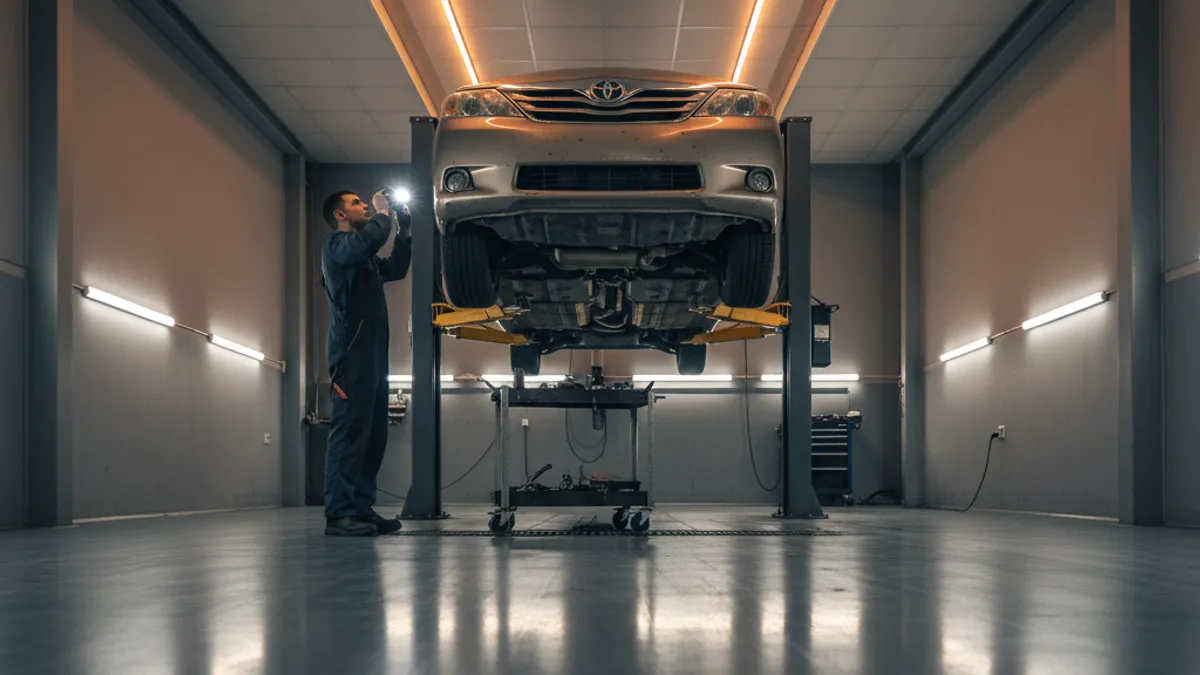
A pre-purchase inspection at an independent workshop is a cost of around a hundred KM that can save you thousands. A mechanic on a lift sees in one hour what the seller can conceal in a five-minute conversation: the condition of the body from below, oil leaks from the engine and gearbox, the state of brakes and suspension, signs of collision damage on the underside, and the service history indicated by inspection stickers. With a report in hand, you have a stronger negotiating position and, if something does come up later, evidence that supports your complaint.
At a dealership, a pre-purchase inspection is often met with mild resistance: "We've checked everything, you don't need it." You politely acknowledge this but insist anyway. A serious lot will not refuse to let you take the car off-site for an hour or two for an inspection at an independent workshop, possibly with a small deposit or by holding the registration certificate. If they explicitly refuse, that is a clear sign something is wrong — and the answer is to walk away.
With a private seller, a pre-purchase inspection is practically the only legal and technical defence you have, so there is no negotiation whatsoever. A private seller who refuses an inspection at a workshop of your choosing is telling you everything you need to know about that car.
Post-Purchase Complaints: The 15-Day Deadline and Market Inspectorate
Let us assume the worst realistic scenario: you bought a car from a dealership, drove it for a month, and the gearbox starts producing severe juddering that clearly could not have developed after just a few hundred kilometres. What now.
Step one: a written complaint. Not a text message, not verbally, not through connections — a written complaint stating what was purchased, when, what price was paid, what happened, and what you are requesting (repair, replacement, rescission of the contract, or a refund). The complaint is submitted to the lot with proof of receipt (a signed copy, an email with read confirmation, or registered post). This is when the statutory deadline begins.
Step two: waiting for a response. Under the Republika Srpska Consumer Protection Act, the seller is required to respond to a written complaint within 15 days. In that response they state whether they accept the complaint, what they offer as a resolution, or whether they reject it with reasons. If there is no response within 15 days, the buyer has the right to contact the market inspectorate.
Step three: the market inspectorate. In RS the responsible body is the Republic Market Inspectorate; in FBiH it is the cantonal and federal market inspectorates. The report is filed in writing, with copies of the contract, the invoice, and the correspondence with the lot. The inspectorate has the authority to order the lot to fulfil its obligation and to impose a fine. It is important to know: the market inspectorate does not compensate your loss — it acts administratively. For financial compensation you go to court, but in practice many lots agree to a settlement once they see the inspectorate has been activated, because their next inspection is not in their interest.
An important advantage many people are unaware of: any defect that appears within the first 12 months of purchase is presumed to have existed at the time of handover. The burden of proof is on the trader, not the buyer. This means that if a defect appears within the first year, the lot must prove it was caused by you or arose after delivery. You do not have to prove it was already there. This is one of the strongest consumer protection instruments and the reason why, even with seemingly minor faults within the first year, it is worth filing a written complaint.
With a private seller, we repeat, this avenue does not exist. You cannot submit a written complaint to a private individual under the Consumer Protection Act. What remains, as we mentioned, is a civil lawsuit under the Law of Obligations for hidden defects. It is a harder, slower, and more expensive path — and that is why a pre-purchase inspection when buying privately is worth so much more.
When a Dealership Makes Sense and When a Private Seller Does: Six Scenarios
Without getting into formulas and tables, here are six typical real-world situations and how they are usually resolved.
First car for a young driver, up to 8,000 KM. Dealership. The price difference in absolute terms is small, and conformity protection in the first year is worth far more to an inexperienced buyer than it costs. A young driver is more likely to miss warning signs during a private inspection, so the legal safety net protects them.
Family MPV or larger SUV around 15,000 KM, buyer who knows cars. Private seller, with a mandatory pre-purchase inspection at a workshop and a history check by chassis number. The lot's margin in this price range can be significant in absolute terms, and an experienced buyer with a report in hand gets the same technical quality at a lower price.
Expensive purchase of 25,000 KM or more, newer model year. Dealership, especially more established dealers in the broader sense (not necessarily brand dealerships, but reputable businesses with a track record). The high stake justifies the legal coverage, the paperwork is cleaner, and the chances of an unrecorded total loss are lower than with a privately imported consignment vehicle.
Older car for secondary needs (seasonal use, short city commutes) up to 4,000 KM. Private seller. In this range, the lot's margins become uncomfortable as a percentage, the lot's stock is thin, and the buyer generally relies on visual impression and inspection rather than legal coverage.
Car for business (trade, small business) with the need for a VAT deduction. Dealership, without question — a private seller cannot issue you an invoice with itemised VAT that an entrepreneur can claim as a business expense. This is a straightforward tax calculation, not a safety question.
A specific model that rarely appears, buyer knows exactly what they want. Private seller, if that model turns up before it hits a lot. In niche segments, private owners keep the car within a closed circle of enthusiasts with the same taste, and that is where you find examples that suit the knowledgeable buyer better than anything on a car lot.
These are not rules — they are patterns. The specific case always comes down to the technical condition of the car itself, your financial situation, and the time you have to search. With the legal framework in mind and an independent inspection in hand, both paths lead to a good purchase — the difference is only in where the risk is greater.
If you have found a car you are considering, whether at a lot or from a private seller, book a pre-purchase inspection at Auto Gas Gaga or write to us via the contact form with the listing link before you put down a deposit. An hour on the lift is the cheapest insurance policy you will take out for this purchase.
Frequently Asked Questions
How many years of warranty come with a used car from a dealership in BiH?
Under the Republika Srpska Consumer Protection Act, conformity on used goods lasts up to two years, and a shorter period may be agreed but not shorter than one year. If the contract says nothing about conformity, the full two-year period applies. In FBiH, a parallel law with the same principles is in force.
What if my used car from a dealership breaks down after a month?
You submit a written complaint to the lot stating what happened and what you are requesting. The lot is required to respond within 15 days. If there is no response or it is rejected without grounds, you report the matter to the market inspectorate. Any defect within the first 12 months is presumed to have existed at the time of handover unless the lot proves otherwise.
Is a car lot required to issue an invoice for a used car?
Yes. A car lot as a trader must issue an invoice. The invoice is proof that you paid a specific price on a specific date and forms the basis for a complaint. If the lot does not offer an invoice unprompted, ask for one. Without an invoice, your later case through the market inspectorate is considerably weaker.
Does the 'as seen' clause hold up when buying from a dealership?
It does not hold up legally. A car lot as a trader remains liable for conformity even when the contract states "as seen." That clause applies only in a sale between two entrepreneurs or legal entities. Between private individuals it is valid, which is yet another reason why you carry out your checks before signing, not after.
How much does an independent pre-purchase inspection of a used car cost?
An inspection at a workshop typically takes about an hour on the lift. A more detailed assessment — with a compression test, computer diagnostics, and a history check by chassis number — takes longer. Get in touch for a quote with the model, year, and reason for the inspection, and we will arrange a time and a specific price.
How do I report a car lot to the market inspectorate in BiH?
In Republika Srpska the responsible body is the Republic Market Inspectorate; in FBiH it is the cantonal and federal market inspectorates. The report is filed in writing, with copies of the contract, the invoice, the written complaint to the lot, and the response (or proof that no response was received within 15 days). The inspectorate acts administratively; for financial compensation you go to court separately.