Importing a used car from the EU to BiH in 2026 is no longer a cheap trick for savvy buyers, but it is not a lost cause either. On some models you still save a couple of thousand KM compared to the same car on the domestic market. On other models, the EUR.1 form, transport, homologation and registration eat your savings down to zero. The difference between "worth it" and "I wasted my time and nerves" comes down to a handful of things you need to know before you click on mobile.de.
This guide was put together by the Auto Gas Gaga workshop from Banja Luka, based on years of experience servicing imported cars - and on a synthesis of six detailed guides for individual source countries and procedures that we published over the past weeks.
This article is the complete guide of the "Importing a used car from the EU to BiH 2026" series - detailed guides by source country and procedure step are in the individual articles in the series, and here we synthesise them into a single plan from mobile.de to BiH plates.
TL;DR
| Topic | In short |
|---|---|
| Customs duty | For EU-origin cars the duty is 0% WITH a EUR.1 form or an invoice declaration (up to EUR 6,000); WITHOUT that paper you pay 15% duty on the customs value. |
| VAT | 17% VAT is always paid on the customs value (price + transport + insurance + duty if applied). No exceptions. |
| Minimum EURO standard | EURO 5 minimum. Importing vehicles with EURO 4 and below has been banned since June 2019. |
| Deadlines | 6 days for the transit customs declaration (border to destination customs office), 10 days for homologation from entry into BiH. Missing the deadline = fines and complications. |
| Real additional cost | On a EUR 10,000 car, count on 3,500 to 5,000 KM of additional costs (VAT, transport, homologation, registration, pre-purchase inspection). |
| Biggest pitfall | Clocked odometer. Imported vehicles have a 5x higher manipulation rate than domestic ones. Without a VIN history check you are driving blind. |
Table of Contents
- State of used car imports in BiH 2026 - when it pays off, when it does not
- Overview of all source countries
- Real costs from purchase to BiH plates
- EUR.1 form - the one paper that turns 15% duty into 0%
- How to pick a car in the EU - Pickerl, TÜV, Revisione, certificate of conformity
- Legal and technical steps from purchase to registration
- Most common pitfalls and how to avoid them
- What to check at the workshop as soon as the car arrives
- Frequently Asked Questions
- Related Articles
State of used car imports in BiH 2026 - when it pays off, when it does not
Five years ago, any reasonably experienced BiH driver knew that it almost always paid off to import a used car from Germany. The price difference was so large that customs, VAT, transport and registration were peanuts compared to the savings. In 2026 the story is no longer that simple.
The European used car market corrected prices downwards in 2025 and 2026 - the large supply drop that lasted from the pandemic through the semiconductor crisis is over, and with production back to pre-pandemic levels and the push of electric cars to Western markets, prices that were traditionally low in Italy, Slovenia and Germany have moved closer to prices on the BiH domestic market. We covered what this specifically means for a BiH buyer in more detail in our analysis of the drop in used car prices in Europe 2026.
Practically, today an import pays off in three types of scenarios:
- A specific model that is rarely or never offered on the domestic market, or is offered in significantly worse condition (early years, lower trim, smaller engines). A classic example is a well-maintained Passat B6/B7 with full service history from Germany, or an Octavia Mk2 with a factory automatic gearbox that rarely appears in domestic listings.
- A car with complete service documentation that BiH buyers value more than German owners do, so a "paperwork-rich car" carries standalone value. In other words, the same car is worth more on the BiH market if it comes with 8-10 service stamps from a factory-authorised service.
- A car with a higher trim package that usually carries a premium in BiH - Highline instead of Trendline, Elegance instead of Ambiente, Sport-Line instead of Active. Trim differences that are valued at a mild premium in Germany translate into a few thousand KM of difference on the BiH used market.
Importing does NOT pay off when:
- You are going after a standard small-engine city car (1.0 / 1.2 petrol) of an older generation. The domestic market is full of those, transport "eats" the entire calculated saving, and if some fault pops up in the first few months after arrival, you are back to zero.
- You do not seriously count transport, insurance, homologation, registration, and pre-purchase inspection. If you save 1,500 KM on price and spend 2,000 KM on "unplanned" stuff, that is not a saving. That is a hobby.
- You are not ready for the clocked odometer risk. The statistics for the German market are dramatic: this is where imported vehicles seriously deviate from domestic ones and where a 21% average overpayment for a "clocked" car can eat your savings three times over.
When importing from the EU does NOT pay off
Three scenarios where you will almost certainly lose time and money:
- A car whose price difference between EU and BiH is less than 2,500 KM. The math does not work - the additional costs are larger than the assumed saving.
- You are buying your first car. Without experience in pre-purchase inspection of an imported car, the risk of running into a hidden fault or a manipulated odometer is significantly higher.
- You are after a specific engine (e.g. 1.4 TSI, 1.2 PureTech, some specific diesel) that already has well-known problems in the domestic listings. The imported version of the same type will not be better just because it has a German stamp.
Overview of all source countries
The six most common source markets for BiH buyers - and what each one offers. We did a detailed breakdown by country in separate guides; here is the synthesis.
Germany is the largest market by volume and the largest base where it is easiest to find a desired combination of model, engine and trim. Prices were corrected downwards in 2026 but are still competitive. The TÜV Pickerl paper (Hauptuntersuchung) is an objective check that carries real weight. We covered prices, popular models, transport and typical pitfalls in the German market in detail in our guide to importing a used car from Germany to BiH 2026.
Italy is a market that often offers cars in a sunnier climate (less corrosion for the same year), but with significantly more messy service history and a language barrier in the documentation. The Revisione paper (the Italian technical inspection) is mandatory but milder than the TÜV, which means that a car with a "valid Revisione" in Italy is not the equivalent of a car with a "valid Pickerl" in Germany. We covered the specifics of the Italian market - from the libretto folder to the passaggio di proprietà - in our guide to importing from Italy to BiH 2026.
Austria is often a middle-ground solution for BiH buyers: close, geographic proximity means simpler transport (often we drive them back ourselves), the Pickerl is as rigorous a check as the German TÜV, language is not a barrier. Prices are slightly higher than in Germany for the same model, but the quality of paperwork and handover sometimes offsets the difference. We wrote about the specific steps and what to ask the Austrian seller in our guide to importing a used car from Austria 2026.
Slovenia is the geographically closest EU country, language is practically not a barrier (even written Slovenian is understandable), Tehnični pregled is a mandatory check, and the potrdilo o skladnosti is a document that directly simplifies homologation in BiH. If you are looking at speed and simplicity, Slovenia is a very reasonable choice. The complete plan for the Slovenian market is in our guide to importing a used car from Slovenia 2026.
Beyond these four countries, we covered all six parts of the process - from calculating customs duty and VAT to the actual registration in BiH - in two separate guides: customs duty, VAT and excise when importing a car into BiH 2026 with calculator for the financial part, and registration of an imported car in BiH 2026 step by step for the administrative part. These two guides apply regardless of which EU country you are importing from - the procedures are the same, only the starting points change.
We did not do the Dutch and Belgian markets as separate individual guides because BiH buyers use them more rarely (transport is longer and more expensive, the EUR.1 procedure through intermediaries is not always guaranteed), but everything that applies to Germany regarding EUR.1, VAT and homologation applies to them as well.
Real costs from purchase to BiH plates
The biggest mistake we see in first-time importers is that they count only the car price as the "cost". A real comparison with a domestic car includes six items, not one. Let us go through them in order:
1. Car price - shown on mobile.de or the local platform of the export country. This is the number where everything starts, but from a final-cost perspective it is the smallest part of the story.
2. Transport - from the car dealer to your address in BiH. From Germany and Slovenia people often drive themselves (fuel + toll + one or two overnight stays, count on 600 to 1,200 KM equivalent), from Italy and Austria sometimes self-drive, sometimes by transporter. Professional truck transport on a flatbed from Germany to BiH in 2026 typically ranges from 800-1,500 KM per vehicle when it goes as a trailer with multiple cars, more for individual transport. If you drive yourself and the car has a problem on the road (warning light, dead battery, tyre blowout on the German autobahn), count on risk being part of the calculation.
3. Customs duty and VAT - here the EUR.1 form plays the key role. With EUR.1 (or an invoice declaration for values up to EUR 6,000), customs duty is 0% and you only pay 17% VAT on the customs value (price + transport + insurance). Without the EUR.1 form, customs duty is 15% and VAT is calculated on the customs value INCREASED by the duty. According to UINO BiH (Indirect Taxation Authority, evergreen official guide), the rule on origin of goods from the EU abolished customs duty for vehicles from the EU as of 1 January 2013, but the paper is what proves it. Without the paper, you are not in the preferential system. On a EUR 10,000 car the difference is around 1,755 KM between the with-EUR.1 and without-EUR.1 scenario.
4. Single-vehicle homologation - per the official price list from Official Gazette of BiH 50/22, homologation for category M1 (passenger vehicles) or N1 (light commercial up to 3.5t) costs 150 KM. Plus any corrections if the homologator finds something inconsistent with the factory COC (Certificate of Conformity, "potrdilo o skladnosti" in Slovenian). Details of the procedure are in our guide to customs duty and VAT on imports 2026.
5. Registration in BiH - according to driver.ba's 2026 snapshot, the total cost of registering an imported vehicle varies by entity: in the Federation of BiH 550-800 KM, in Republika Srpska 500-600 KM, in Brčko District 270-350 KM (all without homologation and technical inspection, which go separately). This includes fees, third-party liability insurance for the first year, technical inspection, registration plates and other small fees. A detailed breakdown by item is in our guide to registering an imported car 2026.
6. Pre-purchase inspection at the workshop - when the car arrives, before you put it into daily use. Here our workshop is often the first stop. We check what was serviced in Germany/Austria/Italy, what was skipped, whether there are worn parts that could "fall off" within a year, and whether the car is in the condition the paperwork suggests.
Quick math for a EUR 10,000 car (about 19,500 KM):
- Car: EUR 10,000
- Transport (self-drive from Germany): ~800 KM
- VAT with EUR.1: about 3,330 KM (17% on the customs value)
- Homologation: 150 KM
- Registration RS: about 550 KM
- Pre-purchase inspection: by agreement
- Total on BiH plates: about 23,800-24,500 KM
In other words, on a car whose listing price in Germany is 19,500 KM, you will pay 24,000+ KM until you drive it away on plates. If the same car costs 23,500 KM in the BiH offer, the saving is no longer a saving - it is time, travel and risk. If it costs 26,500 KM, it pays off. We track the market situation for cars in various budget ranges in more detail in our complete guide to the state of the used car market in BiH 2026.
How much a EUR 10,000 car really costs on BiH plates
Rule of thumb: count on the import price of the car (on the German listing) being about 85% of the final cost on BiH plates, if everything goes normally and if you have EUR.1. Without EUR.1, that ratio drops to about 80% - the additional 5% goes to customs duty and additional VAT on the duty.
If you see a car in Germany for EUR 10,000, plan a budget of 23,500-24,500 KM on BiH plates. Then decide whether that is worth it compared to the same price on the domestic market.
EUR.1 form - the one paper that turns 15% duty into 0%
This is the zone where every year we see the most confusion, and where one sheet of paper makes a difference of nearly 2,000 KM. Let us go through it in order.
What EUR.1 is: proof that the car has EU origin. Not proof that the car is in the EU - proof that it was manufactured in the EU or has EU origin of goods under the rules of trade between BiH and the EU. That is the difference.
What it gets you: under the BiH-EU Stabilisation and Association Agreement, vehicles with EU origin pay 0% customs duty on import to BiH. The rule applies to both new and used vehicles from 1 January 2013 (end of the transition period). The 17% VAT is still paid, but it is calculated without the customs duty component, which further reduces the final cost.
Without EUR.1: customs duty is 15% on the customs value (price + transport + insurance), and VAT is then calculated on the value INCREASED by the duty. A double hit.
When you can go without EUR.1: if the vehicle value is up to EUR 6,000, the seller can state on the invoice (or on a separate paper declaration) text that the goods have EU preferential origin. This invoice declaration is legally equivalent to the EUR.1 form for customs purposes, but only up to EUR 6,000. Above that, EUR.1 is mandatory - no exceptions.
Practical advice for the BiH buyer: insist on EUR.1 before you pay for the car, not after. A professional car dealer in Germany knows what EUR.1 is and issues it within one working day. A private owner selling their car may not know, in which case the EUR.1 form is issued by local customs institutions - but that takes time. If the seller says "you don't need EUR.1, here's the invoice", and the car is worth more than EUR 6,000, that is a warning. Either back out of the deal, or be ready to pay 15% customs duty.
EUR.1 from a private seller - how to get it
A private seller in Germany, Austria or Italy who has no export experience usually hears about EUR.1 for the first time from a BiH buyer. The practical path:
- The seller goes to the local Customs Authority (Hauptzollamt in Germany, Agenzia delle Dogane in Italy, Customs Authority in Austria and Slovenia) with the sale invoice and the vehicle's technical data.
- The Customs Authority, based on the COC document (Certificate of Conformity, "Konformitätsbescheinigung", "potrdilo o skladnosti"), verifies the origin of the vehicle's manufacture.
- If the car was manufactured in the EU (which practically every VW, Audi, Skoda, Seat, Renault, Peugeot, Fiat, BMW, Mercedes is), the customs officer issues a certified EUR.1 form.
- The procedure for a private person takes 1-3 working days. At a dealer it usually takes one day.
The cost of issuing EUR.1 in EU countries is usually symbolic or free - it is part of the regular work of the Customs Authority. The bigger question is whether the seller has the time and willingness, so it is good to offer some "paperwork supplement" in the deal (EUR 50-100 or equivalent) if that saves you 1,500+ KM in customs duty on the BiH side.
How to pick a car in the EU - Pickerl, TÜV, Revisione, certificate of conformity
Every EU country has its own technical inspection, and the quality of the check varies. If you treat "valid technical" as a guarantee that the car is sound, you will easily get fooled because "valid technical in Italy" is not the same as "valid technical in Austria or Germany".
Germany - TÜV (Hauptuntersuchung, HU): the strictest European inspection. Check every 24 months for used vehicles, a paper (Bericht) with a detailed list of findings. If the car has a fresh TÜV (up to 6 months old), that is a real confirmation that at that moment it was technically sound. The Pickerl sticker on the windscreen (although Pickerl is more often used for the Austrian version) shows the date of the next check. A big plus is that the German TÜV also notes all "recommended" works - advice for the next check.
Austria - Pickerl (§57a Begutachtung): practically the same rigour as the German TÜV, with quarterly-yearly cadence for older vehicles. A Pickerl sticker on the windscreen with the month and year of expiry. For a BiH buyer, an Austrian car with a fresh Pickerl is a good indicator.
Italy - Revisione: a milder check than the TÜV, cadence every 2 years. A "valid Revisione" does not necessarily mean "car in excellent condition". An Italian seller who shows you a valid Revisione is not lying, but neither is he confirming that the car is problem-free. Treat it as a minimum requirement, not a quality guarantee.
Slovenia - Tehnični pregled: requirement annually for older vehicles, a registration sticker (nalepnica) on the windscreen showing the date of the next check. Quality close to the Austrian Pickerl, although it can vary locally between stations.
Potrdilo o skladnosti (COC - Certificate of Conformity): this is a paper issued by the manufacturer, not the country of registration. It contains factory technical data of the vehicle (mass, engine, emissions, dimensions, equipment) and is used for homologation in BiH. Insist that the seller hands over the original COC with the car - without it, the homologator in BiH must either contact the manufacturer or do an individual identification, which costs time.
An experienced seller can hide a lot. A clocked mileage by tens of thousands of km, an accident with damage repainted and sold as "import from Germany", welds hidden by paint, even theft with an altered VIN. Some of that you will catch on the pre-purchase inspection, but the actual history of the car is easiest to check via carVertical. Using the VIN from international registers, it pulls out the documented past of the car: recorded odometer readings by date, recorded accidents, the number of previous owners, and indicators of theft or total loss. We consider this mandatory before buying absolutely any imported used car. When paying for the report you can use the code GAGA and get a 20% discount.
Legal and technical steps from purchase to registration
Let us walk through the whole route, from signing the purchase contract in the EU to BiH plates.
Step 1: Purchase contract and original documents. At the moment of purchase, get from the seller: the purchase contract (notarised or with both parties' signatures), the original invoice with all line items (car, options, transport if included, VAT if charged on the seller's side - important for customs purposes in BiH), Fahrzeugschein/Zulassungsbescheinigung Teil I (the small registration document), Fahrzeugbrief/Zulassungsbescheinigung Teil II (the large registration document - vehicle "title"), a valid TÜV/Pickerl/Revisione report, the COC document, and if possible the EUR.1 form. Every paper that is missing at the time of purchase will be a problem later.
Step 2: Deregistration in the export country and export plates. The car is deregistered from local plates, or - more often for BiH buyers - it gets export plates (German: Ausfuhrkennzeichen, or red-and-white export plates in Slovenia/Italy/Austria) with a short validity period (usually 5-15 days depending on the country) and insurance for that period. You drive with those plates to the border. If you use a transporter, they use their own transport plates.
Step 3: BiH border crossing. On entry into BiH, you declare the vehicle to the customs service. The customs officer issues you a transit customs declaration with a deadline of up to 6 days to reach the destination customs office (usually the one closest to your place of residence). Those 6 days are a strict deadline - if you miss it, fines and complications. You carry the transit declaration together with the vehicle papers.
Step 4: Destination customs office and calculation. Within 6 days you arrive at the destination customs office with the car, all original documents (contract, invoice, COC, TÜV/Pickerl, EUR.1 or invoice declaration), and personal documents. The customs officer calculates: the customs value (price + transport + insurance), customs duty (0% with EUR.1, 15% without), VAT (17% on the customs value), and the possibility of additional excise on specific categories (mostly luxury or large vehicles - covered in our customs duty and VAT guide). You pay the assessed amount and receive the JCI (Single Administrative Document) - proof that the vehicle legally entered the customs territory of BiH.
Step 5: Single-vehicle homologation. After receiving the JCI you have 10 days for homologation at an authorised body (Institute for Standardisation or an authorised homologator per Official Gazette of BiH 50/22). The cost is 150 KM for category M1/N1 by the official price list. The homologator issues you a certificate that the vehicle meets the technical and ecological requirements for BiH (including EURO 5 minimum). If the car has EURO 4 or lower - it does not get homologation, and cannot be registered in BiH.
Step 6: Technical inspection and registration. With the homologation you go to technical inspection, then to third-party liability insurance, then to registration. We gave the prices by entity earlier (FBiH 550-800, RS 500-600, Brčko 270-350 KM without homologation and technical, driver.ba data for 2026). You get registration plates and the registration document with the new owner's name.
6 days vs 10 days - transit vs homologation
The most common confusion among first-time importers: they think they have 10 days from entry to BiH for everything. That is not the case.
- 6 days is the deadline from the border crossing to the destination customs office. That is the transit deadline - the time to drive the car across BiH to the place where it will be processed.
- 10 days is the deadline for homologation, COUNTED from the moment of entry into BiH (not from the customs office). Practically, when you account for the 6 days of transit, you have 4 days left for homologation after completing customs processing.
So: do the transit customs declaration as soon as possible after arrival, ideally the same or the next day. Do not wait 5 days and then rush with everything else.
Most common pitfalls and how to avoid them
All the pitfalls we list here we have seen in practice at the workshop in Banja Luka - a client brings in a freshly imported car and in the first few months reveals what was hidden at purchase.
Pitfall 1: Clocked odometer. The statistics are dramatic. Imported vehicles in Europe have on average a 5x higher rate of odometer manipulation than domestic ones (according to published research by European registers). In Germany it is estimated that 4.6% of imported vehicles have a manipulated odometer, against just 0.9% of domestic ones. And that is data from the German base - on smaller markets the number can be even higher. According to the same research, Europe loses about EUR 5.3 billion annually due to this type of manipulation, and buyers of "clocked" cars pay on average 21% more than the vehicle is really worth.
Practically, if you are buying a car with "100,000 km" and in the current German or Italian digital registers you can see that a year ago the car had "147,000 km", that is a clocked odometer. Without a check via VIN history of the car, this type of fraud is recognised only by an experienced eye, and not always then.
In detail on how to recognise clocked mileage by service stamps, wear on pedals, seats, steering wheel and other signals, we wrote in our guide to clocked mileage on a used car in BiH 2026.
How to recognise a clocked odometer before purchase
Three practical steps, in order of reliability:
- VIN history check by chassis number from international registers - gives recorded odometer readings by date, recorded accidents and the number of previous owners. The most reliable method, detects clocking almost every time.
- Service booklet and stamps. The service dates and mileages written in the booklet should grow monotonically. If 2022 says 130,000 km and 2024 says 110,000 km - clocked. Caution: the booklet can also be rewritten, so this is not certain without other checks.
- Physical wear signs. Pedals (gas, brake, clutch) worn down to metal on a "70,000 km car" - clocked. Steering wheel with worn leather, seat with a collapsed cushion, gear lever with a worn cover, buttons with worn markings - all of this does not match low mileage.
Pitfall 2: EURO 5 minimum (ban on EURO 4 and lower). Since June 2019, importing vehicles with EURO 4 or lower emissions standard is banned for BiH. Practically: if you see a cheap car from 2008-2009 (the year when EURO 5 started being made, but most were still EURO 4), check the COC or the engine label before you pay. A EURO 4 car cannot be homologated in BiH, cannot be registered, and becomes an expensive sculpture in your yard.
Safe starting point: diesel cars from 2011 onwards are almost certainly EURO 5+, and petrol cars from 2010 onwards. But do not rely on the rule of thumb - check the specific VIN.
Pitfall 3: Hidden costs after arrival. The car arrives, looks good, the pre-purchase inspection "finds nothing", but in the first 3-6 months these come up: a timing belt that has not been done in 130,000 km, a clutch plate near the end of its life, a battery that is already 5 years old, tyres at 3 mm without a usable DOT on the sidewall, an A/C that "cools" but really does not hold pressure, oils past their interval. All of these are real costs of 1,500-3,500 KM that materialise after arrival.
Solution: factor in a reserve for "technical refresh" of 1,000-2,000 KM in your budget calculation. If the reserve is not needed, great. If it is - you have the funds and will not be disappointed.
Pitfall 4: A car that "does not fit" the homologation category. Rarely but it happens: an SUV that in Germany is registered as M1 (passenger), but in BiH due to mass over 2,500 kg falls into category N1 (light commercial) or vice versa. That means a different set of checks and possibly additional homologation costs. Ask the homologator or an authorised workshop before you buy, not after.
Pitfall 5: "Serviced in Germany, paperwork in order" without actual verification. A service booklet from a German authorised service is a valuable paper, but if service intervals were 30,000 km (the max VW recommendation for TDI), that does not mean the car was honestly maintained at the shorter intervals BiH experts recommend. A car driven 30,000 km between oil changes, even with all service stamps, may be more worn internally than a car with oil changes every 15,000 km without a single stamp.
What to check at the workshop as soon as the car arrives
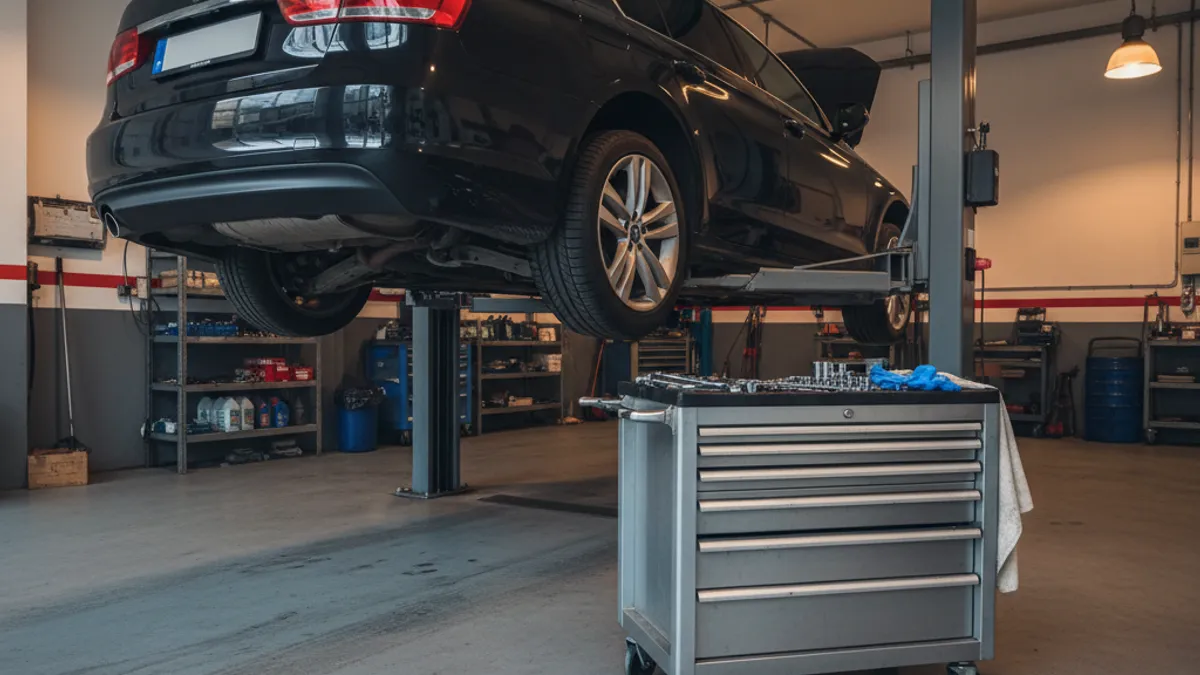
Let the first drive of the imported car be to the workshop, not to work. It is an investment of two-three hours and a few hundred KM that often saves several thousand KM later.
The minimum we look for on a freshly imported car:
- Fluids: level and condition of engine oil (colour, viscosity, date of last change on the sticker if legible), coolant (level, condition, that it is not plain water), brake fluid (DOT 4 age), power steering fluid or condition of the electric EPS, gearbox oil (manual - rarely changed, but check for leaks; automatic/DSG - in any case check the interval status). If the car has a DSG, glance at the details in our guide on DSG oil service.
- Filters: the oil filter has certainly been changed if a service was done, but the air filter, fuel filter and cabin filter are often skipped. We check the condition.
- Battery: age (DOT on the battery), state of charge, starting capacity. Batteries from Germany are often older than the car suggests, especially on serviced start-stop vehicles where the AGM/EFB battery is a specific case.
- Brakes: disc thickness (with a micrometer, not by eye), pad thickness, condition of brake hoses (not cracked, not leaking), brake fluid moisture content.
- Suspension and front end: shock absorbers (bounce test), springs (no creaks), CV joints (clicking when turning the steering wheel), tie rods and ends (play with manual movement), stabilisers, silent blocks. A detailed guide for self-check is in our advice on tie rods and ends.
- Tyres: tread depth (minimum 4 mm for safe driving), DOT number (age, ideally up to 4 years), uniformity of wear (asymmetric wear = geometry problems).
- Exhaust system: integrity, corrosion, EGR/DPF if it is a diesel, lambda sensors, mounting of the silencer. Especially important on diesels because DPF problems are often hidden by "valid TÜV". We covered DPF problems on used diesels in detail in our blog post on DPF filter on a used diesel 2026.
- Electronics: complete OBD diagnostics, reading active and stored faults, checking adaptations on engine and gearbox, A/C system status, parking sensors, cameras, everything else that is in the equipment.
With the results of this first round you know exactly where you stand with the car. If all items are in order, drive calmly. If 2-3 things need fixing, you plan in order: first safety-critical (brakes, suspension, tyres), then mechanically critical (timing belt, oils, clutch if problematic), then cosmetic/comfort. In parallel, think about what is coming up by mileage - the starting service plan depending on current mileage we covered in our complete guide to a service plan by mileage for a used car in BiH 2026.
Found a car in the EU you are considering, or already brought it over? Book a pre-purchase inspection or write to us on WhatsApp with the listing link (before purchase) or the VIN (after arrival) and we will combine the pre-purchase or post-purchase inspection in a single appointment at the Auto Gas Gaga workshop in Banja Luka.
Frequently Asked Questions
Does importing a used car from the EU to BiH still pay off in 2026?
In most cases, yes, but not everywhere and not for every model. It pays off when the price difference between EU and BiH is at least 2,500 KM, when you are after a specific engine or trim that is rarely offered on the domestic market, or when the car comes with complete service history that adds value on the BiH market. It does not pay off for standard small-engine city cars where domestic supply covers demand, nor if you are not ready to plan 3,500-5,000 KM of additional costs on top of the listing price.
How much does importing a car from Germany to BiH 2026 cost in total?
For a car whose listing price in Germany is EUR 10,000 (around 19,500 KM), the realistic final cost on BiH plates is 23,500-24,500 KM, provided you have the EUR.1 form and no big surprises on the pre-purchase inspection. That is about an 85% ratio between listing price and final cost. Without EUR.1, that ratio drops to about 80% because 15% customs duty is added and VAT is calculated on the duty. Specific cost calculations by item are in our guide to importing from Germany 2026.
What is the EUR.1 form and is it mandatory for me?
EUR.1 is proof of EU origin of goods (the car) that converts customs duty from 15% to 0% on import to BiH. It is mandatory for vehicles with a value above EUR 6,000. For vehicles up to EUR 6,000, an invoice declaration by the seller with the same legal effect is sufficient. Without EUR.1 (or an invoice declaration) for a EUR 10,000 car you pay about 1,755 KM more than with it. Insist on EUR.1 before you pay for the car.
How much time do I have for everything from the car's entry into BiH?
Upon entry, the customs office issues a transit customs declaration with a deadline of up to 6 days to reach the destination customs office (nearest to your residence). In addition, you have 10 days from entry into BiH for single-vehicle homologation. Practically, after the 6-day transit and customs processing, you have 4 days left for homologation. Do not wait - do the customs processing the same or the next day after arrival.
What is the minimum EURO standard for importing a car into BiH?
EURO 5 minimum. Importing vehicles with EURO 4 or lower standard has been banned since June 2019. Practically, diesel cars from 2011 onwards are almost certainly EURO 5+ (and diesel EURO 6 from about 2014-2015), petrol from 2010 onwards. Do not rely on the year - check the specific VIN or COC document before purchase. A EURO 4 car cannot be homologated and cannot be registered in BiH.
How much do homologation and registration of an imported car cost in BiH 2026?
Single-vehicle homologation for category M1 (passenger) or N1 (light commercial) costs 150 KM by the official price list from Official Gazette of BiH 50/22. Registration (without homologation and technical) varies by entity: Federation of BiH 550-800 KM, Republika Srpska 500-600 KM, Brčko District 270-350 KM, according to driver.ba's 2026 snapshot. Total: about 700-950 KM for homologation + registration, plus technical inspection. More details in our guide on registering an imported car 2026.
What to check at the workshop as soon as the imported car arrives?
Fluids (engine oil, coolant, brake fluid, gearbox oil), filters (oil, air, fuel, cabin), battery (age and condition), brakes (thickness of discs and pads), suspension (shock absorbers, springs, tie rod ends, tie rods, CV joints), tyres (tread depth and DOT number), exhaust system (on diesel especially DPF and EGR), complete OBD diagnostics of engine, gearbox and auxiliary systems. Count on a reserve of 1,000-2,000 KM for potential work that TÜV/Pickerl did not cover.