
Your car sits parked in the sun or in a garage while you are on holiday, travelling or simply not driving. Two weeks pass, a month, sometimes longer. You sit behind the wheel, turn the key and realise something is wrong. The engine struggles to start or will not start at all, the brakes squeal and vibrate, the tyres thump for the first few kilometres and the diesel chokes and throws warning lights. None of this is coincidence. Each of these problems has a clear timeline of onset and, more importantly, can be prevented if you know what to check before and after a long period of inactivity.
This guide covers six systems that suffer when a car sits idle, with concrete timelines for each, and finishes with two checklists: one for preparation before parking up and one for getting back on the road afterwards.
This guide was prepared by the Auto Gas Gaga workshop in Banja Luka, based on years of experience with vehicles that have sat idle for weeks and months.
Table of Contents
- How Long a Car Can Sit Without Driving
- Battery, the First Victim of Long-Term Parking
- Brakes and Disc Rust
- Tyres and Flat Spots From Long-Term Parking
- DPF Filter on a Diesel That Sits Idle
- Fuel in the Tank, the Shelf Life Most Drivers Forget
- Seals, Hoses and Rubber Components
- What to Do Before Leaving Your Car for an Extended Period
- What to Check When You Get Back Behind the Wheel
- Frequently Asked Questions
- Related Articles
How Long a Car Can Sit Without Driving
Two to three weeks without driving is the threshold after which most systems begin showing the first signs of trouble. That does not mean the car will be unusable after fifteen days, but it does mean every week of inactivity beyond that point increases the likelihood you will return to a dead battery, rusted discs or fuel that has started to age.
The timelines differ for each system. The battery reacts first, after just seven to fourteen days. Brake discs begin rusting within hours, though deeper corrosion takes weeks. Tyres develop temporary flat spots after a few days and permanent deformations after a month or more. The DPF filter on a diesel does not regenerate while the car is stationary, so soot accumulates from the last drive and waits to greet you with a problem on first start-up. Fuel ages more slowly, but it too has a shelf life: two to three months for petrol, three to six for diesel.
How long a car can sit without driving depends on the vehicle's age, battery condition, fuel type and storage conditions. A newer car with a healthy battery and a full tank of petrol can handle a month without serious consequences, provided you prepare it properly. An older car with a weak battery and a half-empty diesel tank can run into problems after just ten days.
The rule that applies to all vehicles: if you know the car will not be driven for more than two weeks, prepare it. If it has been sitting for more than a month, inspect it before demanding full performance.
Battery, the First Victim of Long-Term Parking
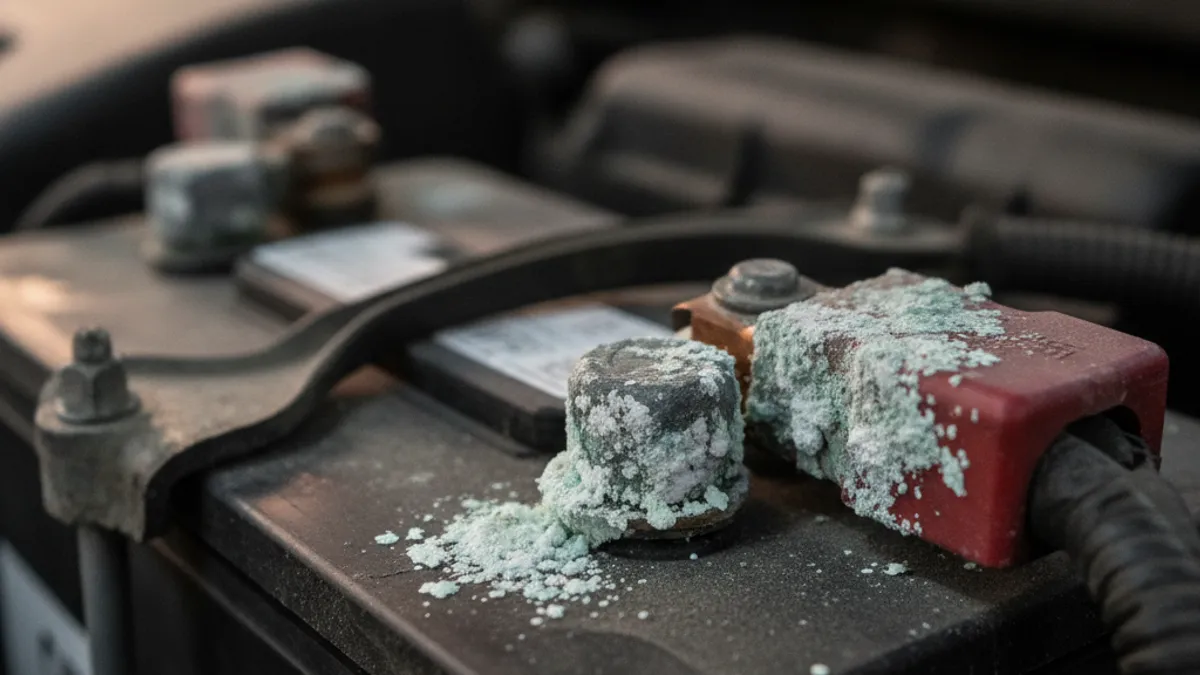
The battery is the first component to react to inactivity and the most common reason a car will not start after an extended period of parking. The reason is simple: even with the engine off, the electronics in a modern car draw power. The alarm, central locking, engine ECU, clock, radio station memory and GPS tracker if fitted all drain the battery twenty-four hours a day, seven days a week.
This consumption is called parasitic draw and in modern vehicles ranges from 20-85 mA depending on age and equipment. A standard 60 Ah battery with a parasitic draw of 50 mA can theoretically last up to fifty days before going completely flat. In practice, however, the engine stops cranking much sooner, after just two to three weeks, because the starter demands far more current than a half-charged battery can deliver.
The problem is compounded in summer. High temperatures accelerate the chemical degradation inside the battery. A battery at forty degrees ages twice as fast as one at twenty. If the car sits in an open car park under direct sunlight, the battery suffers a double hit: both from the electronic drain and from accelerated chemical ageing.
How Many Days a Car Can Sit Before the Battery Dies
It depends on three factors: the battery's age, the parasitic draw and the ambient temperature. A new 70 Ah battery in a garage at twenty degrees can last six weeks or more. The same battery at three years old, in a car park at thirty-five degrees, may not survive ten days.
If you disconnect the negative terminal before leaving the car, you eliminate parasitic draw entirely. In that case the battery loses only about five per cent of its charge per month through natural self-discharge. That is an enormous difference: instead of two to three weeks, the battery can hold its charge for months. The procedure is straightforward: switch off the engine, open the bonnet, loosen the nut on the negative terminal with a 10 or 13 mm spanner and move the cable to one side so it does not touch the post. The only trade-off is that you will need to reset the clock and stored radio stations when you reconnect.
For a more detailed guide on parasitic draw diagnostics, how to measure it with a multimeter and which consumers most commonly steal current, see our detailed guide on parasitic battery drain.
If you are unsure how strong the battery is before leaving the car, the safest course is to test it with a load tester. If it already shows signs of weakness, such as slow cranking in the morning or the clock resetting after the car has been sitting, the chances are it will not survive an extended period of inactivity without maintenance. More on that in our guide to recognising a battery at end of life.
Brakes and Disc Rust
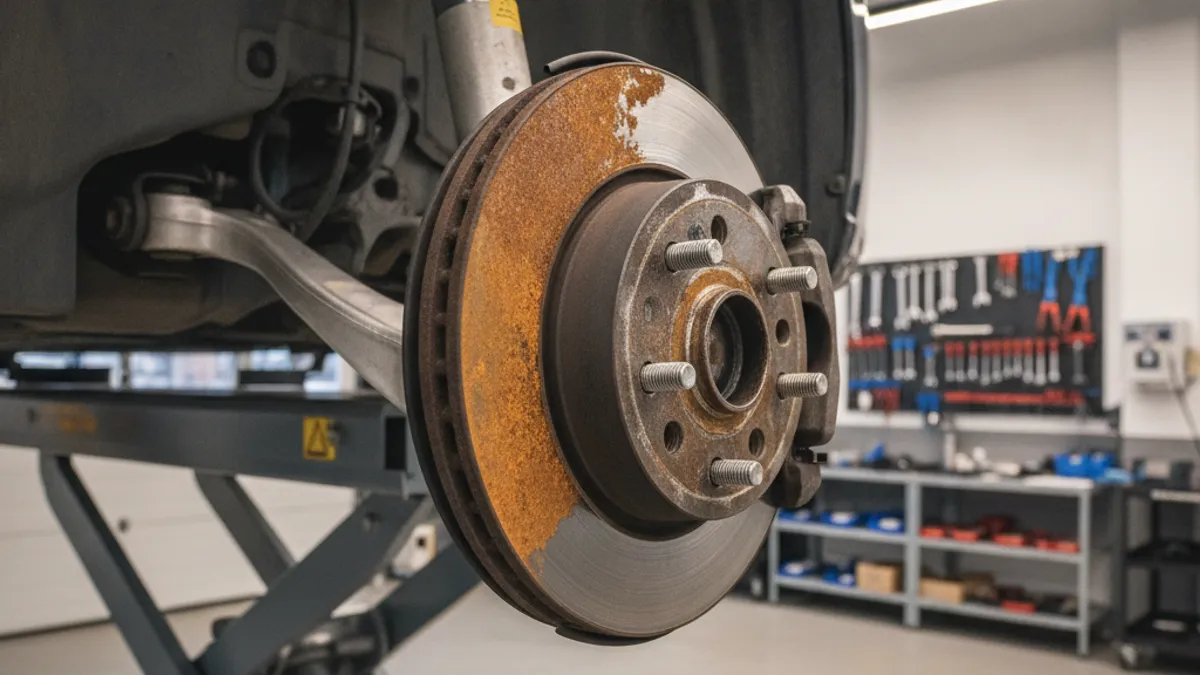
Brake discs begin rusting surprisingly quickly. A few hours of exposure to moisture is enough for a thin layer of surface corrosion to appear on the metal. This is normal and disappears after the first few brake applications: the pads simply wipe away that layer during driving.
The problem arises when the car sits for weeks or longer. After that period, corrosion penetrates deeper into the metal and creates pitting that can no longer be simply wiped away by braking. That pitting causes vibrations and steering-wheel pulsation under braking, and braking force is reduced because the contact between pad and disc is no longer flat.
How quickly corrosion progresses depends on the conditions. A car parked in a garage on dry concrete can go a month without visible consequences on the discs. A car parked outdoors, exposed to rain, morning dew and night-time moisture, develops deep corrosion in two to four weeks. Coastal towns and areas with high humidity accelerate the process further.
Should You Leave the Handbrake On When the Car Sits for a Long Time
The answer is clear: no, if the surface is level. If you leave the handbrake engaged, the brake linings can bond to the drum or disc. This happens because corrosion forms a bond between two metal parts pressed together for weeks. When you try to move the car, the rear brakes are locked or make a banging noise as the lining tears free.
The solution: on a level surface, do not engage the handbrake. Leave the gearbox in first gear or in P for automatics. If you must park on a slight incline, use a wheel chock instead of the handbrake.
Brake fluid is hygroscopic and absorbs moisture from the air even while the car sits in a garage. It is estimated that the fluid absorbs around one to one and a half per cent of water per year. After six months of standing, the moisture content can be high enough to lower the boiling point to a dangerous level. If you are interested in the replacement interval and the differences between DOT standards, we have a detailed guide on the topic.
Tyres and Flat Spots From Long-Term Parking
During normal driving, each tyre completes around 480 rotations per kilometre. That constant change of loading keeps the tyre supple and distributes pressure evenly across the entire tread surface. When the car is stationary, the tyre bears the full weight of the vehicle on one small area of the tread, continuously, without any change, day after day.
The result is called flat spotting, a flat area on the tyre. There are two types and the difference between them is critical.
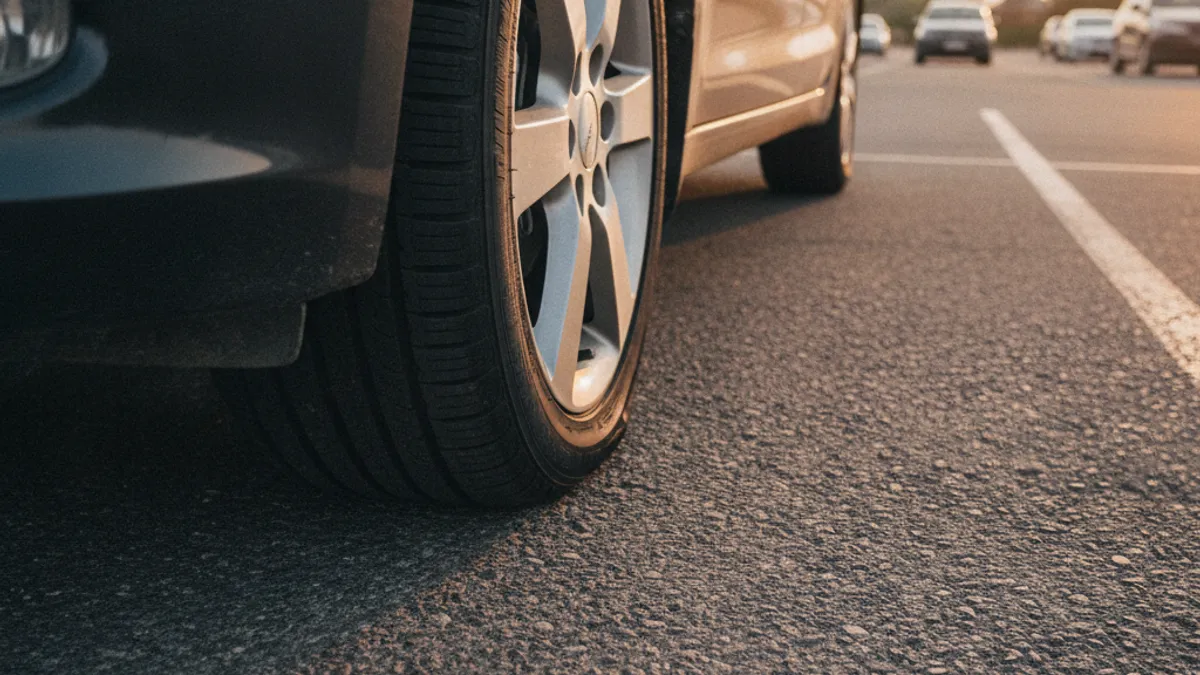
Temporary flat spotting develops after a few days to weeks of standing. The tyre deforms slightly at the point of contact with the surface. When you start driving, you feel thumping and vibration for the first few kilometres. This usually disappears after about twenty minutes of driving at higher speed as the tyre warms up and returns to its original shape.
Semi-permanent flat spotting occurs when a car sits under load for a month or longer, particularly on a cold or concrete surface. In that case, the deformation can become permanent and the tyre never fully regains a perfectly round profile. The consequences are constant vibrations at higher speeds, uneven tread wear and the need to replace tyres that may still have adequate tread depth but can no longer be balanced.
Increasing the pressure by 0.2 bar above the recommended value before long-term parking helps with prevention. Higher pressure reduces the contact patch and lessens the depth of deformation. But tyre pressure drops on its own as well, by roughly 0.05-0.1 bar per month, so after two months of standing the tyres can be well below the recommended pressure even if you inflated them before parking.
For everything about correct pressures, tyre maintenance and signs that replacement is due, see our complete tyre and pressure guide.
DPF Filter on a Diesel That Sits Idle
Every modern diesel car with a DPF filter has a problem with long-term standing. The DPF filter captures soot particles from the exhaust gases and periodically burns them off through a process called regeneration. Automatic regeneration triggers every 300-700 km of driving and requires continuous driving for 15-25 minutes at elevated revs so the exhaust gas temperature exceeds 500 degrees.
Why a Diesel That Sits Idle Has DPF Problems
When the car is stationary, regeneration does not happen. The soot that accumulated during the last drives remains in the filter. If those drives were short urban trips, the filter may already have been half full when you parked the car. Add another few weeks or a month of standing on top, and the filter is overloaded with soot waiting for the first regeneration attempt.
When you start the car after a long period of inactivity, the engine ECU may attempt a forced regeneration. The problem is that forced regeneration requires fifteen to twenty-five minutes of uninterrupted driving on the open road. If you switch the engine off before the regeneration completes, or if you only drive a short distance in town, the regeneration is aborted, the soot remains, and the problem worsens with every interrupted cycle. The DPF warning light comes on, the car enters limp mode with restricted power, and in the worst case the filter needs professional cleaning or replacement.
If you know a diesel will not be driven for more than two weeks, take it for a longer drive before parking it. Thirty minutes on the open road in third or fourth gear, at 2,200-2,800 rpm, is usually enough to trigger and complete a regeneration. For a deeper explanation of how the DPF works, see our guide to the DPF filter. If you want to know what a clogged DPF means when buying a used diesel, see our blog post on DPF filters in used diesels.
Fuel in the Tank, the Shelf Life Most Drivers Forget
Fuel sitting in the tank has a shelf life, and a shorter one than most drivers think. Petrol in the tank should be used within two to three months. After that period, the lighter fractions evaporate, the octane rating drops, and resinous deposits can form that clog injectors and the fuel pump. An engine running on stale petrol is harder to start, runs unevenly and uses more fuel.
What to Do With Fuel Before Leaving the Car for a Month
The answer is simple: fill the tank to the brim. A full tank has less space for moisture condensation and less surface area exposed to air, so the fuel ages more slowly.
Diesel has a somewhat longer shelf life, three to six months, but it has a different problem. Diesel fuel is susceptible to biological contamination: bacteria and fungi thrive at the boundary between diesel and water that condenses in the tank. That biological growth creates a slimy residue that can block the fuel filter and injectors. The result is a car that stutters, loses power or refuses to start altogether.
If you are leaving a car for more than three months with the same fuel, consider adding a fuel stabiliser. This is an additive that slows oxidation and extends the fuel's shelf life to six to twelve months. It is especially useful for seasonal vehicles, motorcycles and boats, and can be found in most auto parts shops.
Seals, Hoses and Rubber Components
Every rubber component on a car, from engine gaskets to coolant hoses, CV joint boots and silicone joints, is designed to operate under heat and pressure. Paradoxically, rubber parts age faster when they are not working than when they are.
The reason: during normal operation, the oils and fluids circulating through these components keep the rubber supple and hydrated. When the car sits, fluid settles to the bottom of hoses and passages, the upper parts of seals remain dry, and the rubber begins to dry out, harden and eventually crack. Coolant hoses, which are already prone to ageing from engine heat, degrade further on the inside when coolant is not circulating.
Valve cover gaskets, intake manifold gaskets, injector O-rings and crankshaft seals are the most common victims. When you start the engine after a long period of inactivity, those dry seals often cannot immediately adapt to the change in temperature and pressure, so they begin to leak. Oil spots under the car after the first start-up are a classic sign that seals have dried out during storage.
Crankshaft and camshaft oil seals are particularly critical because they operate under oil pressure. If they have dried out, oil leaks as soon as the engine reaches operating temperature. The repair is not complicated, but if missed, enough oil can leak to damage the engine or contaminate the auxiliary belt.
Coolant hoses are especially risky because they age on the inside, invisible from the outside, and a burst hose on the road can lead to engine overheating within minutes. More on how to inspect them and when to replace them in our coolant hose guide.
What to Do Before Leaving Your Car for an Extended Period
If you know the car will not be driven for more than two weeks, twenty minutes of preparation can save you hours of trouble when you return. Here is a concrete checklist.
Battery: if you have access, disconnect the negative terminal. If not, at least check the voltage with a multimeter. Anything below 12.4 V means the battery probably will not survive extended standing without maintenance. If you have a trickle charger, connect it.
Fuel: fill the tank to the brim. For diesels, consider adding a fuel stabiliser if you plan to leave the car for more than three months.
Tyre pressure: increase the pressure by 0.2 bar above the recommended value shown on the sticker inside the driver's door frame. This slows flat spotting and compensates for the natural pressure loss during standing.
Brakes: do not engage the handbrake on a level surface. Leave the gearbox in first or in P. On a slight incline, use a wheel chock instead of the handbrake.
Washing: wash the car before long-term storage. Bird droppings, tree sap and insects are acidic and eat into the paintwork. In sunlight, that damage is accelerated many times over.
Parking location: if possible, park in a garage or under a carport. Direct sunlight accelerates the ageing of tyres, seals, hoses and plastic trim, while heat places additional strain on the battery.
DPF on diesels: if the car has a DPF filter, take it for a thirty-minute drive on the open road a day or two before parking it. The goal is to trigger and complete a regeneration so the filter is as clean as possible when the car stops.
Air conditioning: run the air conditioning for about fifteen minutes before the final shutdown. Circulating refrigerant lubricates the compressor seals and reduces the risk of leaks when restarting after an extended period.
What to Check When You Get Back Behind the Wheel
How to Drive a Car After Long-Term Storage Without Causing Damage
When you get back behind the wheel after weeks or months of inactivity, do not immediately demand full performance from the car. Here is what to check and how to behave during the first few kilometres.
Visual inspection: before starting, walk around the car and look for spots underneath it. Oil, coolant, brake fluid, anything leaking is visible on concrete or asphalt. Check tyre pressures and visually inspect the tyres for visible deformation or cracked sidewalls.
Starting: turn the key to the ignition position and wait for all warning lights on the dashboard to go out. On diesels, wait for the glow plug light to extinguish. Only then crank the engine. If the starter turns slowly, do not force it. It is better to connect a charger for an hour or two than to try to force-start with a weak battery and risk damaging the starter or flooding the cylinders.
First five minutes: let the engine idle for one to two minutes. Listen for unusual sounds: squealing from an auxiliary belt that has dried out, ticking from hydraulic lifters filling with oil, uneven running on one cylinder. Check underneath the car for leaks that were not visible before starting.
Brakes: for the first few hundred metres, brake gently and frequently. Surface corrosion on the discs needs to be wiped away by the pads. You will feel pulsation and squealing during the first few applications; this is normal and disappears after five to ten brake applications. If the vibrations do not subside after a kilometre or two of driving, the discs may be more deeply damaged and need a workshop inspection.
Tyres: for the first few kilometres, at speeds up to forty km/h, pay attention to thumping or vibrations from the suspension. Temporary flat spotting typically manifests as rhythmic thumping matching the wheel rotation frequency. It should disappear after about twenty minutes of driving at higher speed. If it does not, the tyres may have permanent deformation and should be inspected.
Diesel and DPF: for the first thirty minutes of driving, avoid short trips. Drive on the open road if possible, in third or fourth gear, at 2,000-2,500 rpm. Give the engine and DPF filter a chance to reach operating temperature and trigger regeneration. If the DPF warning light comes on, do not switch off the engine; keep driving for twenty to thirty minutes and let the regeneration complete.
Engine temperature: monitor the temperature gauge for the first twenty minutes. If the car has been sitting for a long time, the thermostat can stick in the closed position causing the engine to overheat, or in the open position preventing the engine from warming up sufficiently. Both situations require inspection.
If you are considering buying a used car and want to check whether a candidate has been sitting idle for a long time or has some other hidden history, one layer of protection is checking the documented vehicle history via the chassis number. Using the carVertical service, you can see actual mileage readings by date, recorded accidents and indicators of theft or total loss from international registries. We consider this an essential step before buying any used car. When paying for the report you can use the code GAGA for a 20% discount.
If you have left the car for a month or more and notice anything unusual during the first drive, do not continue driving with doubts. Book a workshop inspection; it is better to check and confirm everything is fine than to ignore the signs and pay many times over when the problem escalates.
If you drive infrequently but when you do drive, you only drive short distances, that is actually a separate problem with its own specific consequences. Short trips damage a car in a different way to long-term standing; see our article on how short trips destroy your car.
Frequently Asked Questions
How long can a car sit parked without problems?
Two to three weeks is a safe threshold for most cars with a healthy battery. After that period, problems begin with the battery, disc corrosion and tyre flat spots. With proper preparation, that period can be extended to a month or more.
Should you disconnect the battery when a car sits for a long time?
Yes, disconnecting the negative terminal is the most effective measure. Parasitic draw from the electronics drains a battery in two to three weeks, but with the terminal disconnected the battery loses only about five per cent of its charge per month. The only inconvenience is resetting the clock and stored radio stations.
Why do the brakes squeal when you start the car after long-term standing?
Surface corrosion on the brake discs forms within just a few hours of exposure to moisture. That layer of rust causes squealing and pulsation during the first few brake applications. It is normal and disappears after five to ten applications. If the vibrations persist, the discs may be more deeply damaged.
Should the handbrake be left engaged when a car sits for a long time?
No, if the car is on a level surface. The handbrake presses the linings against the drum or disc, and corrosion can bond them together over weeks of standing. Instead, leave the gearbox in first gear or in P for automatics. On an incline, use a wheel chock.
What happens to the DPF filter when a diesel sits idle for a long time?
The DPF filter captures soot from the exhaust gases and periodically burns it off through regeneration. When the car is stationary, regeneration does not trigger and soot accumulates. On first start-up after long-term standing, the filter can be overloaded, causing the DPF warning light to illuminate or the car to enter limp mode.
How long can fuel sit in the tank?
Petrol should be used within two to three months, diesel within three to six months. Stale fuel makes the engine harder to start and causes uneven running. Diesel is additionally susceptible to biological contamination; bacteria and fungi create residue that blocks the fuel filter. Fill the tank to the brim before long-term storage to slow fuel ageing.