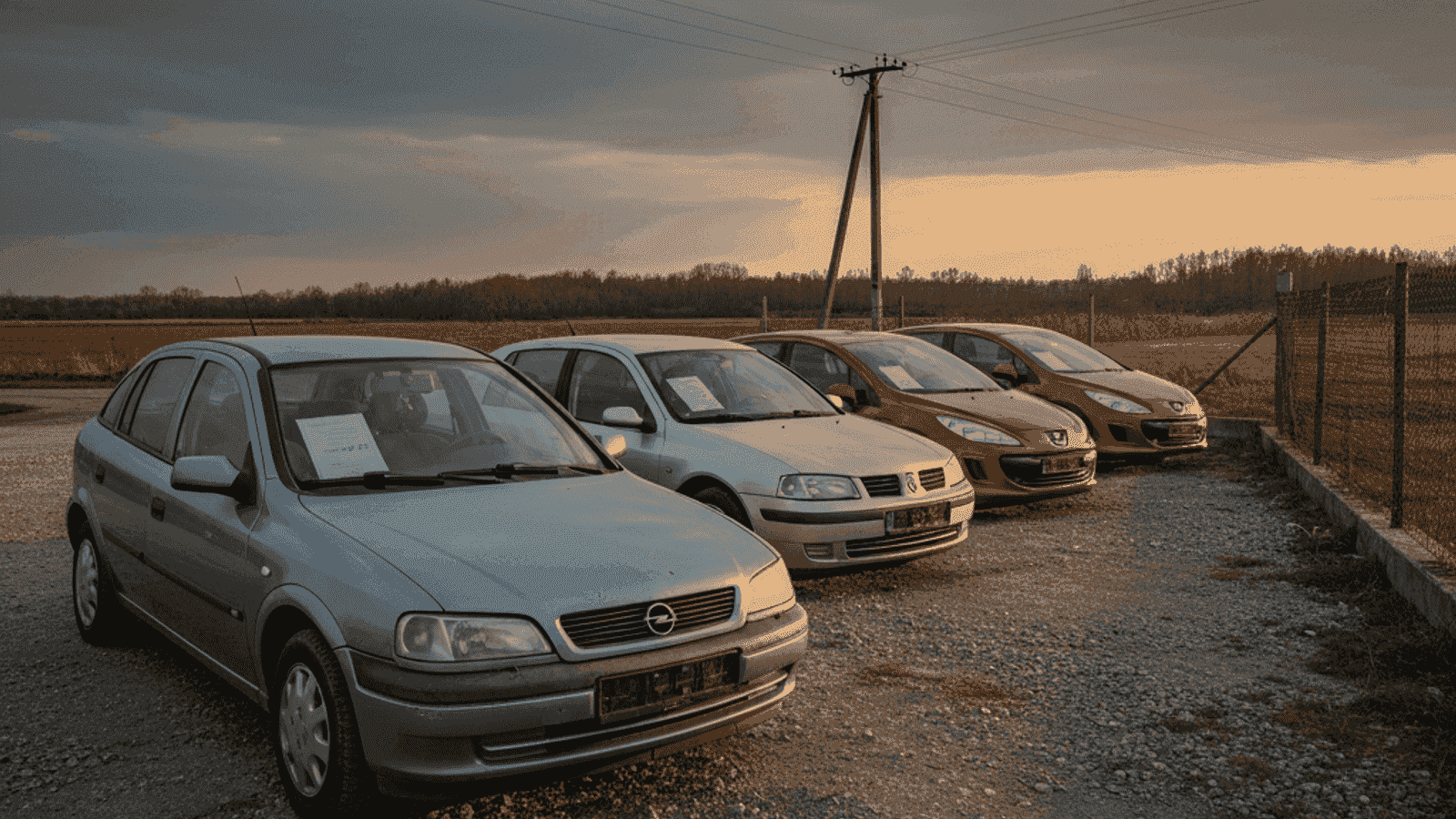
The biggest cost of car ownership in BiH is not fuel, not registration, and not even servicing. It is used car depreciation, the silent loss of value that ticks away every day and only becomes visible when it is time to sell. Five years after purchase, the average car loses over 40 per cent of what you paid for it. Some models lose over 60. Others, if chosen and maintained well, lose less than a third.
This guide was compiled by the Auto Gas Gaga workshop in Banja Luka, drawing on the iSeeCars database (950,000 transactions), the Auto Bild and Schwacke benchmark study, the BiH automobili.ba analysis, and the Autovista 2026 forecast, as well as years of hands-on experience with pre-purchase inspections at our workshop.
This article is part of the series "Car Ownership Costs in BiH 2026" - five detailed breakdowns (insurance, registration, fuel, servicing, and depreciation) plus a full calculator by vehicle class, drivetrain, and entity. The complete synthesis, with a worked example for the Golf 7 (roughly 484 KM per month) and a table for four owner profiles, is in the annual cost of car ownership in BiH 2026 - full calculator by class.
Table of Contents
- What Is Car Depreciation and Why It Matters
- The Depreciation Curve Over the First Five Years
- Why the BiH Market Behaves Differently From the EU
- Best Value Holders by Segment
- Models That Lose the Most Value in BiH
- What Kills a Car's Value
- What Preserves a Car's Value
- Absolute Amount in KM Versus Percentage
- How to Calculate Your Car's Annual Depreciation
- Frequently Asked Questions
- Related Articles
What Is Car Depreciation and Why It Matters
Depreciation is the difference between the price you paid for a car and the price you can sell it for. If you paid 20,000 KM, drove it for five years, and sold it for 12,000 KM, your depreciation is 8,000 KM - or 1,600 KM per year on the loss of value alone. In many cases, that is more than you spend on fuel and more than you pay for all servicing combined.
The reason most owners in BiH never see this cost is psychological. You pay for fuel, registration, and servicing out of pocket - they are tangible transactions. Depreciation is invisible: the car sits in your driveway, looks the same, but its value keeps falling. When you sell it and get less than expected, you blame the market, when in reality the depreciation curve started the day you took delivery.
According to an AutoHUB.ba analysis, the average car loses around 11 per cent of its value the moment it leaves the showroom - before it has even had its first service. After that, it loses between 15 and 25 per cent of the remaining value each year during the first five years. Only after the seventh or eighth year does the curve flatten, with the car losing 5-8 per cent annually - but only because it has already shed most of what it was going to lose.
The Depreciation Curve Over the First Five Years
According to the iSeeCars 2026 database, which tracks 950,000 transactions, the average car in Western markets loses 41.8 per cent of its value after five years. The spread between the worst and best models is dramatic. The Nissan Leaf loses 63.1 per cent in five years; the Porsche 718 Cayman just 9.6 per cent. Most family cars you will encounter in Banja Luka fall in the 35-55 per cent range for five-year depreciation.
The curve is not a straight line. The first twelve months are the steepest. In the second year, the percentage loss is smaller but still significant. From the third to the fifth year, the curve gradually flattens. Only once a car passes its eighth or ninth year does the annual percentage loss become moderate, because the starting base is already low.

The practical takeaway for a BiH buyer: a car between three and five years old is, on average, the most economical point on the curve. The first owner has already absorbed the steepest part of the drop, while the car is still mechanically young. You pick it up at the point where the daily rate of decline is slowest.
Why the BiH Market Behaves Differently From the EU
The depreciation curve in BiH does not behave the same way as in Germany or France, and if you do not understand why, you can easily misjudge a valuation.
First, the BiH market is fed by used-car imports from the EU. Our prices are a function of European wholesale prices, customs and VAT costs, plus the importer's margin. When European residual values fall - which, according to the Autovista forecast, is happening in 2026 (Germany minus 1.4 per cent, Italy minus 5.2 per cent) - our entry prices drop with a three-to-six-month lag.
Second, the average age of cars on BiH dealer lots is considerably higher than in the EU. According to a TuzlaInfo analysis from February 2026, the most sought-after imported used cars are models over ten years old (Volkswagen, Opel, Fiat Punto, Audi A4, Renault Clio), and the average price of an imported used car is around 20,000 KM. Our market runs about ten years behind Europe, which means buyers look at absolute usability rather than factory freshness.
Third, certain models hold their value better in BiH for reasons that have nothing to do with Schwacke lists. The Volkswagen Golf, Skoda Octavia, Audi A4, and Mercedes E-Class retain value above European benchmarks simply because everyone here knows them and everyone wants them. Models that enjoy cult status in the EU but lack a local parts network in BiH lose more.
Best Value Holders by Segment
Auto Bild and Schwacke conducted a four-year benchmark study in 2021 that remains the methodological reference, while iSeeCars 2026 provides the most recent figures.
| Segment | Model | Five-year depreciation |
|---|---|---|
| Compact SUV | Mazda CX-5 | -28.9% |
| Compact SUV | Hyundai Tucson | -32.6% |
| Compact SUV | Skoda Karoq | -33% |
| Mid-range | VW Golf | -34.9% |
| Mid-range | Skoda Octavia | -35.5% |
| Mid-range | Toyota Corolla | -35.7% |
| Small city car | Toyota Yaris | -37.4% |
| Small city car | Skoda Fabia | -38.2% |
| Small city car | VW Polo | -38.3% |
| Sports | Porsche 718 Cayman | -9.6% |
The three-year cross-section shows the same hierarchy. The Toyota RAV4 Hybrid retains 57.78 per cent of its value after four years according to Schwacke methodology, while the Dacia Sandero Stepway with the TCe 90 engine holds 66.02 per cent of its original price - above many premium models. The reason Dacia scores so high in percentage terms is simple: it starts at a low price, so the absolute amount it can lose is small.
Models That Lose the Most Value in BiH
According to the BiH analysis of 2020-model vehicles after five years, published on automobili.ba in May 2026, the worst value holders in our region are:
| Model | Five-year loss | Example in absolute terms |
|---|---|---|
| Opel Insignia | -59.3% | 40,000 KM → ~16,000 KM |
| Opel Astra | -56% | 25,000 KM → ~11,000 KM |
| Renault Talisman | -55.8% | 35,000 KM → ~15,500 KM |
| Peugeot 308 | -55.8% | 22,000 KM → ~9,700 KM |
| Hyundai i30 | -55.6% | 22,000 KM → ~9,800 KM |
A special category belongs to models with the PSA 1.2 PureTech engine. The timing belt runs in oil, and when it needs replacing (most commonly between 80,000 and 100,000 kilometres), the cost of the repair often exceeds the car's remaining value after ten years. The result: the Peugeot 208 loses 61 per cent over ten years, the Citroen C3 as much as 65. For comparison, the Volkswagen Polo 1.2 TSI of the same vintage loses 48 per cent. The difference is not about the badge - it is about the long-term maintenance burden behind the engine.
Our workshop regularly sees PureTech owners who bought their car at what seemed like a great price, only to face a repair bill at 90,000 kilometres that exceeds the car's residual value. If you are considering any of these PSA models, a pre-purchase inspection is absolutely essential.
What Kills a Car's Value
From our workshop experience, we see seven things that consistently push a used car's selling price lower than the owner expects.
Missing service history is the biggest value killer. A buyer who cannot see what was done and when always comes back with a lower offer.
Non-original parts in visible areas such as headlights, bumpers, or wing mirrors in a different colour directly signal that the car has been in an accident and the repair was not done carefully.
Rolled-back odometer is something every serious buyer checks today, and when it is discovered the loss of value is dramatic. An experienced dealer can hide a lot: a rolled-back odometer, a write-off repainted and sold as a "German import", welds hidden under paint, even theft with a tampered chassis number. A pre-purchase inspection catches some of this, but the easiest way to verify a car's actual history is through carVertical. Using the chassis number, it pulls documented history from international registers: odometer readings by date, recorded accidents, number of previous owners, and indicators of theft or total loss. We consider it essential before buying any used car - and before selling yours, too, because sending a report to a prospective buyer proactively builds trust and helps you get the full asking price. When purchasing a report, you can use the code GAGA for a 20% discount.
Smoking inside the car leaves a smell that no amount of cleaning fully removes - typically 5-10 per cent off the price.
Neglected interior with stains, worn upholstery, and scuffed plastic trim signals the car was poorly treated.
Non-functional air conditioning is a small issue that immediately puts the buyer on the defensive. An AC recharge is a cheap job compared to how much it can erode your negotiating position.
A mechanical fault at the time of listing (a dual-mass flywheel that knocks, a DSG that jerks, an EGR code on the diagnostics) takes significantly more off the price than the repair actually costs. Fix these before listing, not during negotiations.
What Preserves a Car's Value
The other side of the same coin. Six things that consistently keep the price at the top of the range.

Complete service history - a tidy service book with stamps and, where possible, invoices for major work. In BiH, receipts for every minor job are often not collected, but the more documentation you have, the higher the value at resale. A car with a full service book can command 10-15 per cent more than an identical car with no records. This is the single biggest factor that the owner controls.
Regular engine and gearbox oil changes ahead of the manufacturer's schedule. Engine oil every 10,000-15,000 kilometres instead of the factory-recommended 20,000-30,000; gearbox oil in a DSG or conventional automatic every 60,000-90,000 kilometres depending on driving conditions. The cost is small; the signal to the buyer is large.
Garage parking or at least a covered spot. Paint that has not been exposed to years of sun retains its colour, plastics do not turn grey, and rubber components do not crack.
A conservative colour. Black, silver, grey, and white sell faster and at higher prices in BiH than yellow, green, or unusual metallic shades.
A standard, popular configuration. In BiH, the VW Golf 1.6 TDI Comfortline sells faster than the same Golf in 1.4 TSI Highline DSG guise. The more factory options and the more complex the drivetrain, the more potential buyers drop off out of concern about future repair costs.
Pre-sale detailing and a technical service. A car that has been cleaned inside and out, its paint polished, oil changed, AC recharged, and every bulb working - that car sells quickly and close to the asking price. The same checklist applies as for a pre-trip inspection.
Absolute Amount in KM Versus Percentage
A trick many owners do not grasp, leading them to make the wrong decision. A Dacia Sandero that loses 34 per cent of its value in four years sounds far better than a Mercedes S-Class that loses 50 per cent. In percentage terms, yes. In absolute convertible marks, it is the other way round.
A Sandero that cost 18,000 KM new and lost 34 per cent amounts to roughly 6,100 KM of loss over four years, or 1,525 KM per year. A Mercedes S-Class that cost 130,000 KM new and lost 50 per cent amounts to 65,000 KM of loss, or 16,250 KM per year. The S-Class "consumes" the price of a brand-new Dacia in depreciation every year.
The practical takeaway: look at both the percentage and the absolute figure. The budget category (Sandero, Polo, Fabia, Yaris) shows high percentages but small absolute numbers. The premium category (S-Class, 7 Series, A8, Cayenne) shows moderate percentages but enormous losses. For most BiH buyers who cover 15,000-25,000 kilometres a year, the mid-range segment (Golf, Octavia, Tucson, Corolla) is the mathematical optimum.
Another practical tip: buying a five-year-old car instead of a two-year-old one. A five-year-old car has already "survived" the steepest part of the curve, so every subsequent year in your ownership means a slower absolute loss than what the first owner experienced.
How to Calculate Your Car's Annual Depreciation

The simplest calculation in three steps.
Step one: find three or four current listings for a car of the same model, year, and approximate mileage as yours. Look at the average asking price. Knock off 5-10 per cent, because sellers ask more than they ultimately get.
Step two: subtract that market price from the price you paid for the car. That is your total depreciation to date.
Step three: divide that figure by the number of years you have owned the car. You now have the average annual loss of value.
Example: you bought a Golf 7 1.6 TDI in 2019 for 19,000 KM. It is now 2026, you have owned it for seven years, and the market price for the same model and year with your mileage is around 11,000 KM. Total depreciation: 8,000 KM. Annual: 1,143 KM, or just under 100 KM per month on the loss of value alone.
Compare that figure with what you spend annually on fuel, registration, insurance, and servicing. For most BiH drivers covering 15,000-20,000 kilometres a year, depreciation exceeds registration and rivals servicing. That is why the true annual cost of car ownership is not what you see on receipts - it is what you see only when you sell.
This is the fifth and final instalment of our series on car ownership costs in BiH for 2026. For the full picture, see: car insurance and comprehensive cover, registration costs by entity, annual fuel costs, and servicing costs for a used car. All five categories together reveal the true cost of driving that an owner only sees at the time of their next purchase.
If you are thinking about selling your current car or about to buy a used one, book a pre-purchase inspection at our workshop or message us on WhatsApp before you put down a deposit.
Frequently Asked Questions
How much value does a Golf lose per year?
The Volkswagen Golf in BiH loses between 6 and 9 per cent of its value per year during the first five years, placing it in the better half of mid-range models. Five-year depreciation is around 35 per cent according to iSeeCars 2026 data, meaning a Golf that cost 35,000 KM new is worth roughly 22,500 KM after five years. The main reason it holds value relatively well in our region is that everyone wants one and BiH has a strong network of services and parts.
Does diesel or petrol lose less value?
The gap between diesel and petrol in terms of depreciation is narrower today than it was five years ago. Diesel models still hold value well in BiH thanks to lower fuel consumption and a preference for open-road driving, but in Western Europe they lose value faster due to regulatory restrictions and concerns about DPF issues. Petrol cars with small turbo engines (1.0-1.4 TSI/THP) depreciate slightly faster than diesels of the same vintage. The slowest decline belongs to hybrids (RAV4 Hybrid, Yaris Hybrid), because they are in demand in the West, but in BiH the effect is not yet pronounced.
How much is a car worth after 100,000 kilometres?
A car with 100,000 kilometres on the clock is typically worth around 55-70 per cent of its original price, depending on age, model, and service history. The key factor is not the mileage itself but the timeframe over which it was accumulated. 100,000 km over eight years (~12,500 km per year) retains value better than the same 100,000 km over three years (~33,000 km per year), because the latter suggests intensive urban or commercial use.
Which car colour loses the least value?
Conservative colours - black, silver, grey, and white - sell faster and at higher prices than unusual colours in BiH. The difference can be as much as 5-8 per cent. Yellow, purple, orange, and niche metallic shades shrink the pool of potential buyers, which directly affects the price. Red and dark blue hold value well for sportier models but less so for family saloons.
Does a service book increase a car's value?
A well-maintained service book with stamps from authorised or independent workshops raises a used car's selling price by 8-15 per cent compared with an identical car that has no records. The reason is that the buyer can verify when each oil change was done, when the timing belt was replaced, whether the filters were serviced, and what major repairs were carried out. In BiH, receipts for every minor job are often not collected, but every stamp in the book and every saved invoice for a larger job lifts the price at resale. The time spent gathering documentation before selling is the most cost-effective pre-sale investment you can make.
How well does the Dacia Sandero hold its value?
The Dacia Sandero, particularly the Stepway variant with the TCe 90 engine, retains 66 per cent of its original price after four years according to the Schwacke benchmark - above many premium models in percentage terms. In absolute convertible marks, the loss is small because the starting price is low. A Sandero that cost 17,000 KM new is worth roughly 11,200 KM after four years, a loss of approximately 1,450 KM per year. It is a mathematically very efficient car for owners who prioritise low-cost mobility over prestige.