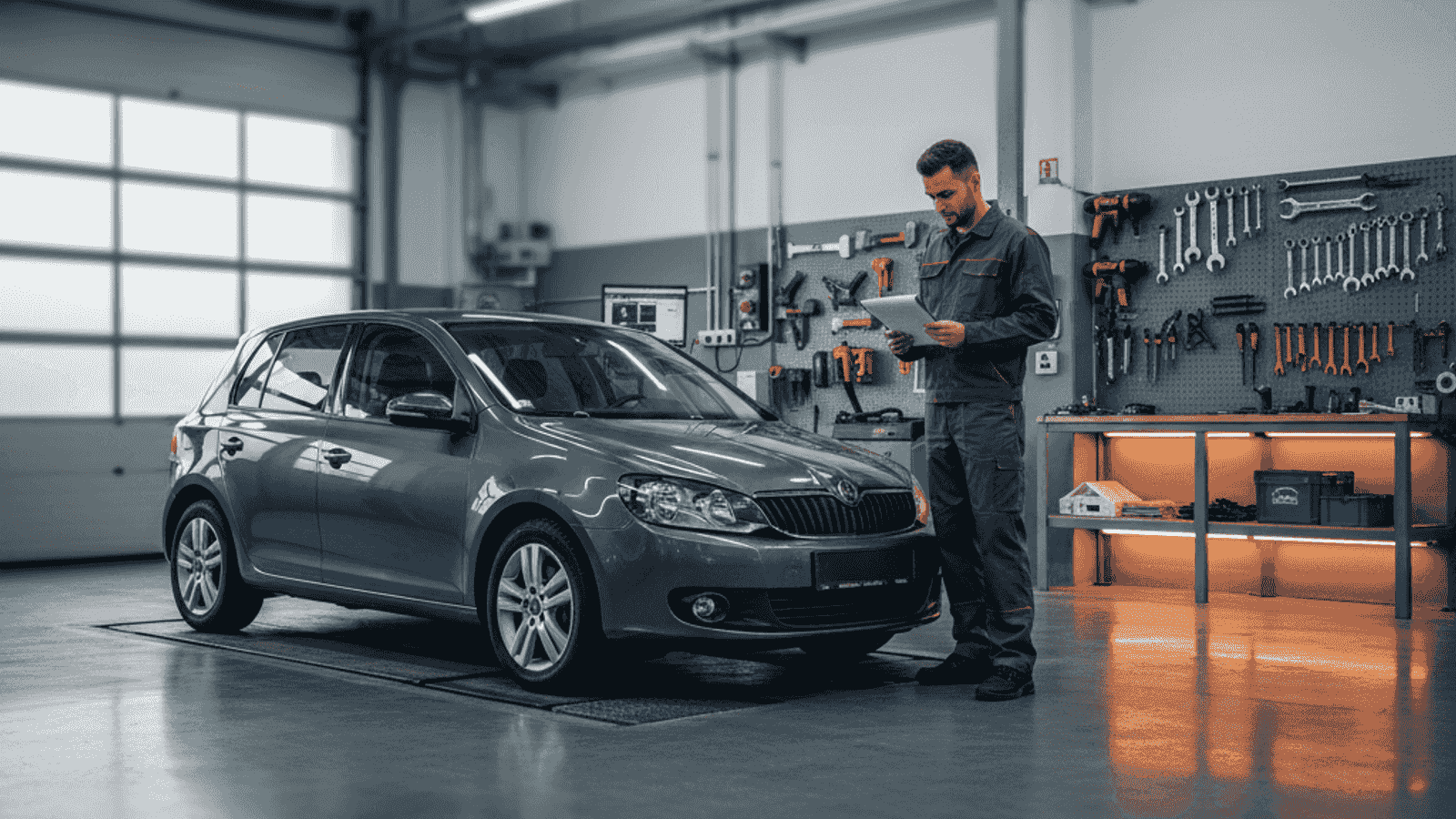
The bill for annual registration in BiH today runs through eleven separate items, each with its own law, its own entity, and its own fund. A full registration for a mid-class car in FBiH most often lands between 550 and 800 KM, in Republika Srpska between 500 and 600 KM, and in Brčko District between 270 and 350 KM. The difference is large and not accidental. Each entity has its own environmental tax, its own tax rates and its own utility charges, so the same car costs a different amount depending on where the driver is registered as a resident.
The analysis was prepared by the Auto Gas Gaga workshop from Banja Luka, based on official price lists of BiH institutions and years of experience with owners who go through registration renewal each year.
Table of Contents
- What We Actually Pay for in Annual Registration
- Typical Bill in FBiH Item by Item
- Typical Bill in Republika Srpska
- Why Registration in Brčko District Is the Cheapest
- Vehicle Inspection and Emissions Test as a Unified Price List
- Motor Vehicle Tax How It Is Calculated
- Environmental Tax, Road Toll, Water Fee
- Third-Party Liability Insurance as the Biggest Item and How to Reduce It
- Hybrids, Electric Vehicles and Old Petrol Cars
- How to Legally Save at Renewal
- Frequently Asked Questions
- Related Articles
What We Actually Pay for in Annual Registration
Many drivers in BiH pay for registration, take their sticker, and never look at how the total breaks down. The bill is not made up of one or two items, but of eleven different fees, charges and obligations, ranging from small amounts for the sticker and postage to the largest single item, mandatory third-party liability insurance.
A typical annual bill for a mid-class passenger vehicle in BiH includes the following:
- Mandatory third-party liability insurance (TPL premium)
- Vehicle inspection
- Emissions test (exhaust gas control)
- Motor vehicle tax, an entity-level item calculated by engine displacement
- Environmental tax or environmental protection fee
- Road toll, an annual lump-sum item separate from the motorway toll
- Water fee
- Green card, international insurance as a short annual confirmation
- Registration sticker
- Administrative fees (vehicle registration certificate, certifications, postage)
- Help-info or agency service that processes the paperwork
That is eight different recipients, from the insurance company through the entity ministry, Environmental Protection Fund, road management agencies, to the post office and utility services. So when a driver asks "how much does registration cost", the accurate answer always depends on two questions: where is the residence and what kind of car. Everything else is detail.
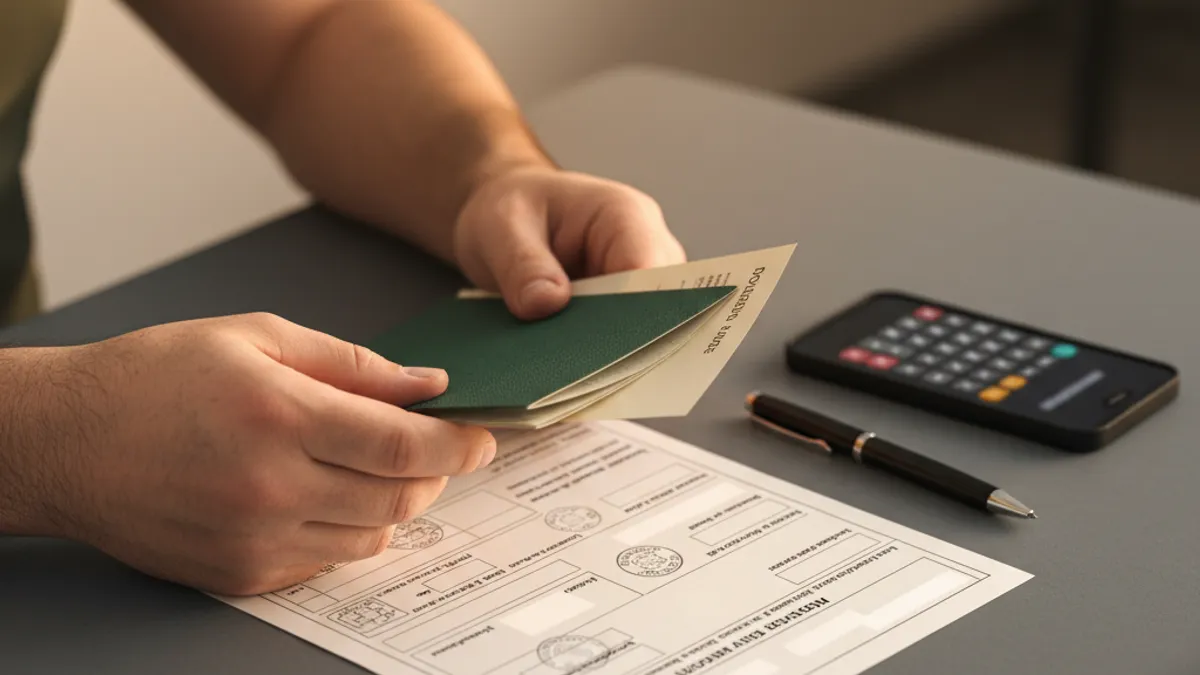
It is important to understand that since 3 March 2022 a vehicle inspection performed outside FBiH is not recognised in FBiH. The vehicle must be registered in the entity of the owner's registered residence, as noted by the driver.ba portal. In other words, you cannot "export" your registration to a cheaper entity just because the tax there is lower. The paperwork follows residence, not the calculator.
Typical Bill in FBiH Item by Item
The most transparent real-world example is the breakdown for a Volkswagen Golf 2010, 1.6 TDI, 77 kW, in the Federation of BiH. The Radio Sarajevo portal published the full bill for this vehicle on 14 February 2025, which is still used today as a reference framework for 2026. Year-on-year variations are small, because individual items are fixed by regulations and tariffs.
The bill for a Golf 1.6 TDI 77 kW in FBiH looks like this:
| Item | Amount (KM) |
|---|---|
| TPL insurance (with 50% bonus) | 307.00 |
| Road toll | 60.00 |
| Water fee | 20.00 |
| Motor vehicle tax | 50.00 |
| Help-info service | 8.00 |
| Sticker | 5.00 |
| Administrative fee | 10.00 |
| Green card | 4.00 |
| Vehicle inspection | 91.00 |
| Environmental tax | 16.50 |
| Postage | 10.00 |
| Total | 581.50 |
The bill is from 2025, but the structure is just as important in 2026. You can see that the TPL premium alone carries more than half of the total amount. Everything else consists of smaller items, but there are many of them and they add up mechanically.
How Much Does Registration Cost in FBiH 2026
For an average mid-class passenger vehicle in FBiH the realistic range for 2026 is 550 to 800 KM. The lower bound applies to a driver with the maximum insurance bonus (50% off TPL), smaller displacement (1.4 to 1.6 litres) and lower power (up to 80 kW). The upper bound is for vehicles with 2.0 to 2.5 litre displacement, more than 100 kW of power and no bonus.
Three things push the bill upward in FBiH:
- TPL premium in FBiH is on average slightly higher than in RS, because the insurance market is structured differently
- The environmental tax of 16.50 KM per year, introduced after 2021 (Klix.ba reported at the time that the FBiH Government collects around 27 million KM annually through this charge)
- Road toll and water fee are calculated as flat amounts for passenger vehicles and cannot be avoided
If a car has a larger engine, for example 2.0 TDI 110 kW, the motor vehicle tax jumps from around 50 KM into the 100 to 150 KM range, and the TPL premium into the 350 to 450 KM range. That way the bill easily climbs over 700 KM, even with a bonus.
Typical Bill in Republika Srpska
In Republika Srpska the structure is very similar, but the amounts are somewhat lower. Primarily because the environmental tax uses a different formula and is significantly smaller in practical amounts for an older mid-displacement vehicle, and because the TPL insurance market is also somewhat more competitive.
A typical bill in RS for a mid-class passenger vehicle for 2026:
| Item | Amount (KM, indicative) |
|---|---|
| TPL insurance (with bonus) | 270-340 |
| Road toll | 60-70 |
| Motor vehicle tax (entity rate) | 60-120 |
| Water fee | 15-20 |
| Registration service (SUP/MUP) | 15 |
| AMS fee | 15 |
| Bank commission | around 11 |
| Sticker | 5 |
| Administrative fees | 10-15 |
| Vehicle inspection | 47-55 |
| Emissions test | 22-36 |
| Green card | 4-6 |
| Total | 500-600 |
How Much Does Registration Cost in Republika Srpska 2026
For an older mid-class vehicle (Golf 5/6, Octavia Mk2, Astra H/J, Peugeot 307/308 era), the realistic range is 500 to 600 KM. For larger displacement vehicles (over 2.0 litres), the range climbs to 600 to 750 KM. M&B Banja Luka and Sistemi Toi have publicly available calculators where the exact structure is visible. Administrative items in RS, such as the SUP registration service 15 KM, AMS fee 15 KM, bank commission around 11 KM and sticker 5 KM, do not depend on the car and are fixed for all drivers in the entity.
The difference between RS and FBiH on the same car most often comes down to two things: the environmental tax (16.50 KM in FBiH against a practically smaller amount in RS) and a different motor vehicle tax rate. Both entities use a calculation by cm³ of displacement, but with different coefficients. In practice that means a difference of 50 to 100 KM per year for the same vehicle.
Why Registration in Brčko District Is the Cheapest
Brčko District has a special legislative status in BiH and this directly reflects on the registration price list. The realistic range for a mid-class passenger vehicle in 2026 is 270 to 350 KM, meaning practically half of what it is in FBiH.
Three reasons why this is the case:
- The District does not have the same road toll and water fee structure as the entities, so the flat-rate items are smaller
- Motor vehicle tax is calculation-wise more favourable than in FBiH for most displacement categories
- TPL premium in the District is often lower because more insurers actively offer competitive prices
What does this mean in practice for a driver? If a driver has residence in FBiH or RS, they cannot simply "register the car in Brčko" and pay 280 KM. The paperwork follows residence. District pricing only applies to people who are actually registered as residents in the District.
What can be done is changing the entity of residence, but that is a serious step. Property tax, local utility obligations, voting, all of that comes with it. There is no sense doing it just for cheaper registration. A difference of 200 to 300 KM per year is not a reason to relocate your paperwork.
Vehicle Inspection and Emissions Test as a Unified Price List
This part of the price list is probably the most orderly in all of BiH. The BiH Ministry of Communications and Transport publishes the Unified Price List for Vehicle Inspection Services, which applies at all stations. So the difference in price for the vehicle inspection from station to station is virtually none.
Vehicle Inspection Price BiH 2026
For an M1 passenger vehicle, a classic passenger vehicle for up to 8 occupants, the typical price is around 47 to 55 KM excluding VAT. With VAT and accompanying items, the final amount the driver pays for the inspection itself usually lands between 80 and 100 KM. The difference arises due to additional certifications, auxiliary checks, or the emissions test that is usually performed alongside.
The emissions test, exhaust gas control, ranges from 22 to 36 KM, depending on the fuel and the vehicle's emission standard. Diesel vehicles by rule have a slightly more expensive emissions test than petrol cars because it includes opacity measurement. Older petrol cars with a catalyst without a lambda sensor can have an even more complicated emissions test with additional checks.
Vehicle inspection stations in BiH are required to operate by the same criteria, but service quality still varies. Technicians who conscientiously look at things, rather than just "sign and go", are worth their weight in gold. Especially for a used car. If a station spots something that needs fixing, that is a signal to take it to a serious workshop before a small thing turns into a big one.
Motor Vehicle Tax How It Is Calculated
This is the item that confuses the largest number of drivers, because it is calculated by a formula that is not shown on the bill. The principle is as follows.
Motor Vehicle Tax BiH How It Is Calculated
The tax rate is expressed in KM per cm³ of engine displacement, and ranges from 0.05 KM per cm³ for old, low-displacement vehicles, to 1.50 KM per cm³ for new, high-displacement vehicles. The rate depends on two axes: vehicle year and engine displacement. The newer and more powerful the vehicle, the higher the rate per cm³.
In practice that means:
- Vehicles from 1.0 to 1.4 litres, 5-15 years old: tax 50 to 100 KM per year
- Vehicles from 1.6 to 1.9 litres, 5-15 years old: tax 80 to 150 KM per year
- Vehicles from 2.0 to 2.5 litres, mid-age: tax 150 to 250 KM per year
- New or semi-new vehicles over 2.5 litres: tax 250 KM and up
The exact amount is calculated from the table of the entity finance ministry, and differs between FBiH and RS in the rates. For an average mid-class vehicle (1.6 to 2.0 litre, 8 to 12 years old), the realistic amount in FBiH is around 50 to 80 KM, and in RS around 60 to 120 KM per year.
What a driver cannot do is "lower" the motor vehicle tax. It is an entity tax fixed by law for each vehicle based on the VIN number and technical data. The only way to reduce it is to switch to a vehicle with smaller displacement or a different category, for example a hybrid or electric.
Environmental Tax, Road Toll, Water Fee
These are three items that drivers often lump together in their heads as "various fees", but each has a separate fund and a separate logic.
Environmental Tax for Vehicles FBiH 2026
The environmental tax, or environmental protection fee, is paid by drivers in FBiH and goes to the Environmental Protection Fund of the Federation of BiH. For a passenger vehicle the amount is 16.50 KM per year, according to 2025 data. The amount is defined by an FBiH Government regulation and is calculated based on displacement, year and fuel type. Vehicles with larger displacement and older vehicles have a somewhat higher amount, but for most passenger vehicles the item stays in the 16 to 30 KM range.
When the environmental tax was introduced in 2021, Klix.ba reported that the FBiH Government planned to collect an additional 27 million KM annually through it. The funds go to land reclamation, air protection projects and pollution damage compensation. In RS the environmental tax does not follow the same formula. There is a similar item, but through a different calculation as part of the motor vehicle tax.
Road toll is separate from the one paid on the motorway. In registration the road toll is paid by all drivers in the entity as a flat annual amount, which in FBiH is 60 KM, and in RS around 60 to 70 KM, depending on the vehicle category. Funds go to road management agencies.
Water fee is a smaller item, 15 to 20 KM per year, and the funds go to public water utility companies. The principle is that motor vehicles contribute to water pollution through disposal of oil and other fluids, so through registration they offset part of that impact.
All three items are entity-level obligations and cannot be avoided through legal means. Smaller displacement gives a slightly lower amount, but the difference in practice is small, 5 to 15 KM per year.
Third-Party Liability Insurance as the Biggest Item and How to Reduce It
Mandatory third-party liability insurance (TPL) is by far the largest single item on every bill. It often carries between 50% and 60% of the total registration cost. That is why it is also the biggest area for savings.
The TPL premium is calculated by a combination of several parameters: engine power in kW, displacement, driver age, bonus-malus from previous years, region of residence and the tariff of the specific insurance company. A driver with the maximum bonus of 50% pays half as much as a driver with no bonus at all, on the same car.

How the TPL premium works in detail by kW brackets, what exactly the bonus-malus system does, and how much a comprehensive (casco) policy really costs, has already been covered in a separate article, Car Insurance in BiH 2026 and How to Cut the Annual Cost. There you can see the exact table by kW brackets and what can be done for 50+ KM in savings per year on this item alone.
Quick summary: three proven things that work in practice. Compare offers from a minimum of 3-4 insurance companies before renewal, because the same categories have different prices. Use your full bonus if you have it, drivers forget to activate the bonus when switching insurers. And think about whether you really need comprehensive (casco) insurance for a car older than 10 years with a market value below 6,000 KM.
The green card, which you only need if you plan to drive outside BiH, is now a mandatory annual item, but cheap, 4 to 6 KM through regular registration. Valid for a year.
Hybrids, Electric Vehicles and Old Petrol Cars
The vehicle category significantly changes the bill.
- Hybrids and plug-in hybrids in FBiH pay around 700 to 800 KM per year, according to the driver.ba portal. The TPL premium is similar to a petrol car of the same power, but the emissions test and motor vehicle tax are calculated by a different formula, often lower. In Brčko a hybrid climbs to 400 to 500 KM, because the District does not yet have a special preferential treatment for hybrids.
- Electric cars go through registration more favourably because they do not have a classic emissions test (only electronics are measured), but the TPL premium stays similar to a standard car. The total amount in FBiH for an EV usually lands at 700 to 800 KM per year, and in RS at 600 to 700 KM.
- Older petrol cars over 15 years of age often have a very low motor vehicle tax, because the formula is degressive with age. But they are more expensive in the emissions test and potentially in a higher TPL premium if they have larger displacement. As a rule they are still more favourable overall than newer vehicles of the same displacement.
Hybrid Car Registration BiH Price
Specifically, for a hybrid Toyota Yaris or Auris of mid-generation, the total annual amount in FBiH is around 720 KM, and in RS around 650 KM. The difference between a hybrid and a classic petrol of the same power is around 80 to 120 KM per year, primarily due to the lower motor vehicle tax rate and a more favourable emissions test.
How to Legally Save at Renewal
Now concretely, what a driver can realistically do to lower the bill without resorting to the grey side.
First: compare TPL premiums. This is the easiest saving. Three to four insurance companies in BiH (Sarajevo-osiguranje, Triglav, Croatia, Wiener, Asa, UNIQA) often have differences of 40 to 80 KM per year on the same car and the same bonus. Five minutes of calls or online forms before renewal, and in 70% of cases you find a cheaper option. Important: do not switch insurers if it means losing your bonus. Ask the old insurer for written confirmation of the bonus before transferring the policy to a new one. The bonus is transferable by law, but the paperwork has to be in order.
Second: activate your bonus if you have one. Many drivers who have not had claims for years have never used their full bonus, because they switched insurers without transferring history. Ask the old insurer for written confirmation of the bonus (50% maximum) and hand it over to the new one. The saving can be 200 KM per year.
Third: think about the comprehensive (casco) policy. For a car older than 10 years with a market value below 6,000 KM, casco often makes no economic sense. The premium is 300 to 500 KM per year, and in case of a total loss the insurer only pays out the current market value. The math is often the same as if you put those 400 KM aside as a service reserve. Younger cars (up to 7 years) with a value above 12,000 KM are a different category, there casco makes a lot of sense.
Fourth: vehicle inspection at a station that actually checks. This is not about saving on the inspection price, since the unified price list applies everywhere, but about saving on repairs. A station that conscientiously tells you "change the rear brake pads now, but do not drive on these" is cheaper per year than one that just signs off. Station quality is most easily recognised by how thoroughly the technician inspects the axles, alignment and braking system.
Fifth: pre-purchase inspection before changing cars. If you are thinking about swapping your car for another used one, a pre-purchase inspection at a workshop can save you from a much larger investment in a hidden fault that the competent technician would only uncover at the inspection in January. AGG regularly performs pre-purchase inspections, and that is not marketing, that really is the cheapest way to know what you are getting into.
Sixth: do not let the fine for an unregistered car become planned. Driving with expired registration in BiH is punished with 150 to 400 KM per offence, plus possible removal of the vehicle from traffic. Nobody plans to be late with registration, but a calendar helps. Set a reminder 30 days in advance, because that is the realistic timeframe for paperwork if something gets complicated, for example if you have to do a repair before the inspection.
An experienced seller can hide a lot when selling a used car. Odometer rolled back by tens of thousands of kilometres, recorded crashes covered up with paint, registered thefts with a re-stamped chassis number. Part of this you catch at a pre-purchase inspection at a workshop, but the documented history of the car itself is most easily verified through carVertical. Using the chassis number from international registries it pulls the entire history of the vehicle: real odometer readings by date, recorded accidents, number of previous owners and indicators of theft or total loss. We consider it mandatory before buying absolutely any used car, because later that cannot be undone. When paying for the report you can use the code GAGA and get a 20% discount.
Looking for a second opinion before putting a deposit on a used car, or did the technician at inspection suspect something? Book a pre-purchase inspection at Auto Gas Gaga or contact us directly with the listing link. Better half an hour of inspection than a year of regret.
Frequently Asked Questions
Can I register a car in Brčko if I live in Banja Luka?
No. Registration follows the residence of the vehicle owner. Since 3 March 2022, a vehicle inspection performed in one entity is not recognised in another, and registration is carried out in the entity of residence. Changing entity just for cheaper registration makes no economic sense, since a difference of 200 to 300 KM per year does not cover the costs and complications of changing your registered residence.
Can registration be renewed online in BiH?
Currently it is not possible to complete the entire process online in BiH. The vehicle inspection and signing of the insurance policy are done in person. Some insurance companies offer online quotes and policy preparation, with the signature later done on location. AMS and certain agencies offer "armchair registration" services where an agent comes to collect the documents, which is useful for drivers with less free time.
What if I have to register an imported car, not renew an existing registration?
The first registration of an imported car is a different process. It includes customs clearance, homologation, translation of documents and special certifications. We have published a detailed guide through that procedure in the article Registering an Imported Car in BiH 2026 Step by Step. This article only covers the annual renewal of an existing registration.
What happens if I miss the deadline for registration renewal?
The fine for driving a vehicle with expired registration in BiH is 150 to 400 KM per offence, with possible removal of the vehicle from traffic by police. You can complete the vehicle inspection after expiry, but you cannot drive the car on the road until registration is renewed. The recommendation is to perform the inspection a minimum of 15 days before expiry.
Can I pay for registration in instalments?
Directly with institutions (tax authority, environmental fund, road agency) no. But the TPL premium, which is the largest item, with most insurance companies goes in 2 to 4 instalments through the current year. You need to submit a request with the insurer before renewal. This eases the payment burden, but does not reduce the total amount.
Is registration in RS always cheaper than in FBiH?
For most mid-class passenger vehicles yes, the difference is 50 to 150 KM per year in favour of RS, primarily due to a lower environmental tax and a different motor vehicle tax rate. But for high-displacement vehicles (over 2.5 litres) the difference can shrink, because in RS the motor vehicle tax rises almost linearly with displacement. Check your insurer's calculator for the exact amount before renewal.