In 2026, fuel is the single largest variable item in the annual budget of any driver in BiH, and the only one that shifts from week to week. Earlier articles in this series covered the fixed costs of insurance and registration; this article gives you a concrete annual fuel bill for four vehicle classes over a realistic 15,000 kilometres, with a per-litre tax breakdown and an honest comparison of diesel, petrol and autogas. The figures were pulled on 18 May 2026 and reflect a snapshot of the market on that date.
The analysis was prepared by the Auto Gas Gaga workshop in Banja Luka, based on publicly available fuel price data for BiH on 18.05.2026, the tax policy of the Indirect Taxation Authority of BiH, and many years of experience installing and servicing autogas systems.
Table of Contents
- Fuel Prices in BiH in May 2026
- What You're Paying for in a Litre of Fuel
- Real-World Consumption vs Factory Figures
- Annual Fuel Cost by Vehicle Class over 15,000 km
- Diesel vs Petrol When Each Powertrain Pays Off
- LPG in 2026 When Conversion Pays Off for a Used Car
- How to Cut Your Annual Fuel Bill
- Frequently Asked Questions
- Related Articles
Fuel Prices in BiH in May 2026
The market snapshot as of 18 May 2026 looks like this. Diesel at BiH stations ranges from 2.20 to 3.50 KM per litre, with the cheapest zone around Cazin and the most expensive around Teočak. B95 petrol sits at 2.19 to 3.13 KM per litre, with a similar geographic spread. Autogas (LPG) sells for 1.15 to 1.71 KM per litre, roughly half the price of diesel in the same town and a little under half the price of petrol.
The gap between the cheapest and the most expensive station is drastic: more than one KM per litre for the same fuel. For a driver who pumps 1,500 litres a year, choosing the right station can mean a difference of over 1,500 KM annually, more than the full registration of a mid-size car. Apps and sites like cijenegoriva.ba update this map daily, so it pays to check before any longer trip or before tanking up ahead of a long drive.
Prices in BiH in 2026 are 15-20% higher than in the same month of 2024, primarily due to higher customs and excise charges and a weaker euro against the US dollar in which oil is purchased. The trend is upward, not downward, and any 2026 annual cost planning must factor that in.
What You're Paying for in a Litre of Fuel
The price at the pump is just the final number. Underneath it sit three layers most drivers never see: excise, road levy and VAT. This is the official structure under the Indirect Taxation Authority of BiH.
| Item | Diesel | B95 | B98 | LPG |
|---|---|---|---|---|
| Excise per litre | 0.30 KM | 0.35 KM | 0.40 KM | 0.00 KM |
| Road maintenance levy | 0.15 KM | 0.15 KM | 0.15 KM | 0.15 KM |
| Motorway levy | 0.25 KM | 0.25 KM | 0.25 KM | 0.25 KM |
| VAT (17% on net) | variable | variable | variable | variable |
The road levy is a fixed 0.40 KM per litre for every liquid fuel. The excise varies by fuel type and is deliberately lower for diesel because diesel powers most freight traffic. LPG is the only motor fuel with no excise, which is the main reason autogas remains structurally the cheapest option in BiH.
How Much Tax Is in a Litre of Petrol in BiH 2026
A concrete example: at a B95 petrol price of 2.80 KM per litre, around 1.06 KM on average goes to the state through excise, road levies and VAT, roughly 38% of the final price. The station's margin is 0.15 to 0.30 KM per litre, with the rest being the cost of the fuel itself (crude oil, refining, transport, storage). In other words, when you pump 50 litres of petrol and pay 140 KM, about 53 KM goes to fiscal charges. This ratio does not change materially between RS and FBiH; prices differ because of distribution and margins, not because of different taxes.
For a driver who pumps 1,500 litres a year, that is roughly 1,590 KM going straight into public budgets. Understanding this breakdown helps you gauge how much room there is to save by choosing a different powertrain. The diesel-versus-petrol gap is only 0.05 to 0.10 KM per litre at the excise level, while the petrol-versus-autogas gap at the excise level is a full 0.35 KM per litre in autogas's favour.
Real-World Consumption vs Factory Figures
The factory brochure says one thing, your odometer says another. The gap is typically 20 to 35% in favour of higher real-world consumption, and that is not a manufacturer scam but the difference between a WLTP test in controlled conditions and the reality of Bosnian driving.
Real-World Consumption of a Golf 1.6 TDI in City Driving
A concrete case from real tests: the Volkswagen Golf 1.6 TDI from the 2012-2019 generation has a factory combined consumption of 3.8 L/100 km. Real-world testing gives 5.1 L/100 km, and normal everyday driving sits around 4.5 L/100 km. That is between 18% and 34% above the factory number, depending on driving style and terrain. A Banja Luka driver who covers the hilly Krajina region, with cold mornings and urban congestion, sits closer to the upper bound. A driver who mainly does open-road kilometres on the flatter parts of RS sits closer to the lower one.
The same applies across every class. A Polo 1.0 TSI rated at 4.8 L/100 km will deliver 6.5 to 7.5 in real driving. A Passat 2.0 TDI rated at 4.5 actually consumes 6.0 to 7.5. SUVs like the Tiguan or Sportage 2.0 TDI rated at 5.2 actually demand 7.5 to 9.0 L/100 km. That is why this article calculates annual cost on real consumption, not the brochure.
Difference in Consumption Between Summer and Winter
The same vehicles burn 10 to 20% more fuel in January and February than in May and June. Three reasons: a cold engine runs on a richer mixture until it reaches operating temperature, heating instead of air conditioning still adds load, and winter tyres on cold tarmac increase rolling resistance. If you are building an annual budget, assume an even distribution of kilometres across the months or add 5 to 8% on top of the summer average as a winter factor.
Annual Fuel Cost by Vehicle Class over 15,000 km
For this calculation I use the BiH market snapshot as of 18 May 2026: diesel around 2.80 KM per litre, B95 around 2.75 KM per litre, LPG around 1.40 KM per litre. A driver in the cheaper regions will pay less, a driver in Teočak more. The figures are rounded to the nearest ten KM and represent fuel and fuel only, with no registration, insurance, servicing or depreciation (those costs sit in other articles in this same series).
Small City Class (Polo, Fabia, i20, Yaris)
Real-world consumption of 6.0 to 7.5 L/100 km on petrol (mostly 1.0 to 1.2 petrol engines). Annual cost over 15,000 km, with an average consumption of 6.75 L:
- B95 petrol: 1,012 litres per year × 2.75 KM = about 2,780 KM
- LPG conversion: 6.75 L of petrol equates to roughly 8.1 L of LPG (20% more), × 1.40 KM = about 1,700 KM per year, saving around 1,080 KM
The small class is the worst candidate for diesel because diesel engines in this segment are rare and usually more expensive to maintain than the fuel savings justify.
Mid-Size Class (Astra, Focus, Megane, 308)
Real-world consumption over 15,000 km, depending on the powertrain:
- Diesel 1.5/1.6: 5.5 to 6.5 L/100 km. With an average of 6.0 L: 900 litres × 2.80 KM = about 2,520 KM
- Petrol 1.4/1.6: 7.0 to 8.5 L/100 km. With an average of 7.75 L: 1,163 litres × 2.75 KM = about 3,200 KM
- LPG on a petrol engine: 7.75 L of petrol equates to roughly 9.3 L of LPG, × 1.40 KM = about 1,950 KM, a saving versus petrol of around 1,250 KM
The mid-size class is the segment where diesel and LPG land in the same annual cost zone. The difference comes down more to which specific car you have and how much you drive it than to the fuel itself.
Family Class (Passat, Octavia, Insignia, Mondeo)
Real-world consumption over 15,000 km:
- Diesel 2.0 TDI: 6.5 to 7.5 L/100 km. With an average of 7.0 L: 1,050 litres × 2.80 KM = about 2,940 KM
- Petrol 1.8/2.0 TSI: 8.5 to 10.0 L/100 km. With an average of 9.25 L: 1,388 litres × 2.75 KM = about 3,820 KM
- LPG on a petrol engine: 9.25 L of petrol equates to roughly 11.1 L of LPG, × 1.40 KM = about 2,330 KM, a saving versus petrol of around 1,490 KM
The family segment is traditional diesel territory in BiH for good reason: over 15,000 km a year, diesel costs roughly 880 KM less than petrol on fuel alone. But LPG on the petrol version is roughly 610 KM cheaper per year than diesel, and that is without diesel's maintenance costs.
Fuel Cost for an SUV over 20,000 km a Year
SUVs with 4×4 or larger 2.0+ engines drink more than family saloons. Over 15,000 km:
- Diesel 2.0 TDI/CRDi: 7.5 to 9.0 L/100 km. With an average of 8.25 L: 1,238 litres × 2.80 KM = about 3,470 KM
- Petrol 2.0 TSI/T-GDI: 10.0 to 12.0 L/100 km. With an average of 11.0 L: 1,650 litres × 2.75 KM = about 4,540 KM
- LPG on a petrol engine: 11.0 L of petrol equates to roughly 13.2 L of LPG, × 1.40 KM = about 2,770 KM, a saving versus petrol of around 1,770 KM
And for drivers who do 20,000 km a year (common with an SUV: a family that hits the road every weekend, or commutes for work), the numbers scale proportionally. A 2.0 TDI diesel over 20,000 km: around 4,620 KM in fuel alone. A 2.0 TSI petrol: around 6,050 KM. LPG on the same petrol engine: around 3,700 KM. That is a difference of over 2,300 KM a year between the most and least expensive options for the same car.
Summary Table
| Class | Powertrain | L/100 km (real) | Annual cost over 15,000 km |
|---|---|---|---|
| Small city | Petrol | 6.0-7.5 | around 2,780 KM |
| Small city | LPG (on petrol) | 7.2-9.0 LPG | around 1,700 KM |
| Mid-size | Diesel | 5.5-6.5 | around 2,520 KM |
| Mid-size | Petrol | 7.0-8.5 | around 3,200 KM |
| Mid-size | LPG | 8.4-10.2 LPG | around 1,950 KM |
| Family | Diesel | 6.5-7.5 | around 2,940 KM |
| Family | Petrol | 8.5-10.0 | around 3,820 KM |
| Family | LPG | 10.2-12.0 LPG | around 2,330 KM |
| SUV | Diesel | 7.5-9.0 | around 3,470 KM |
| SUV | Petrol | 10.0-12.0 | around 4,540 KM |
| SUV | LPG | 12.0-14.4 LPG | around 2,770 KM |
The figures are averages with prices as of 18.05.2026. Your actual number will vary depending on city, station, driving style and month.
Diesel vs Petrol When Each Powertrain Pays Off
The old 1990s rule that diesel only pays off above 25,000 km a year no longer holds, because used diesels have become relatively cheaper and the gap in per-litre price has narrowed. A practical rule for BiH in 2026:
- Up to 10,000 km a year: a petrol car is usually cheaper overall (fuel plus servicing plus depreciation). DPF, EGR and piezo injectors on a diesel do not pay off if the car drives little, because it rarely reaches operating temperature and the system clogs up.
- 10,000 to 18,000 km a year: a balance. The decision is driven by the condition of the specific car, the engine, prior service history and how much you do in town versus open road.
- Over 18,000 km a year, especially on open roads: diesel is typically the most economical, particularly in the family and SUV classes. Fuel savings outweigh the higher servicing costs.
The second factor is the driving profile. Diesel hates short urban trips. The operating principle is similar across all modern diesel engines, but the implementation, software, oil, DPF filter and typical faults differ from manufacturer to manufacturer. A car that constantly runs cold and never spends time at higher gears under proper load will accumulate soot in the EGR and load up the DPF, and within two to three years the bills wipe out anything saved at the pump. A Banja Luka driver who covers 4 km to the school and 4 km back every day in an old 2.0 TDI Passat spends less at the pump but more at the workshop than his neighbour with the same Passat in petrol.
Servicing and maintenance of a diesel in BiH in 2026 remains noticeably more expensive than the equivalent petrol. That does not mean diesel is always the wrong choice; it means the fuel savings must be large enough to offset the difference, and that only happens at higher annual mileages and with a diesel that is regularly driven on open roads. For a detailed comparison of the two powertrains see the guide Diesel or petrol - which is better in 2026.
LPG in 2026 When Conversion Pays Off for a Used Car
Autogas in BiH remains the structurally cheapest powertrain for one simple reason: it is the only motor fuel with no excise. Of the full 1.40 KM per litre price, just 0.40 KM goes to the road levy and VAT. At the equivalent petrol price of 2.75 KM, roughly 1.04 KM goes to the state. That is a structural gap that will not close any time soon.
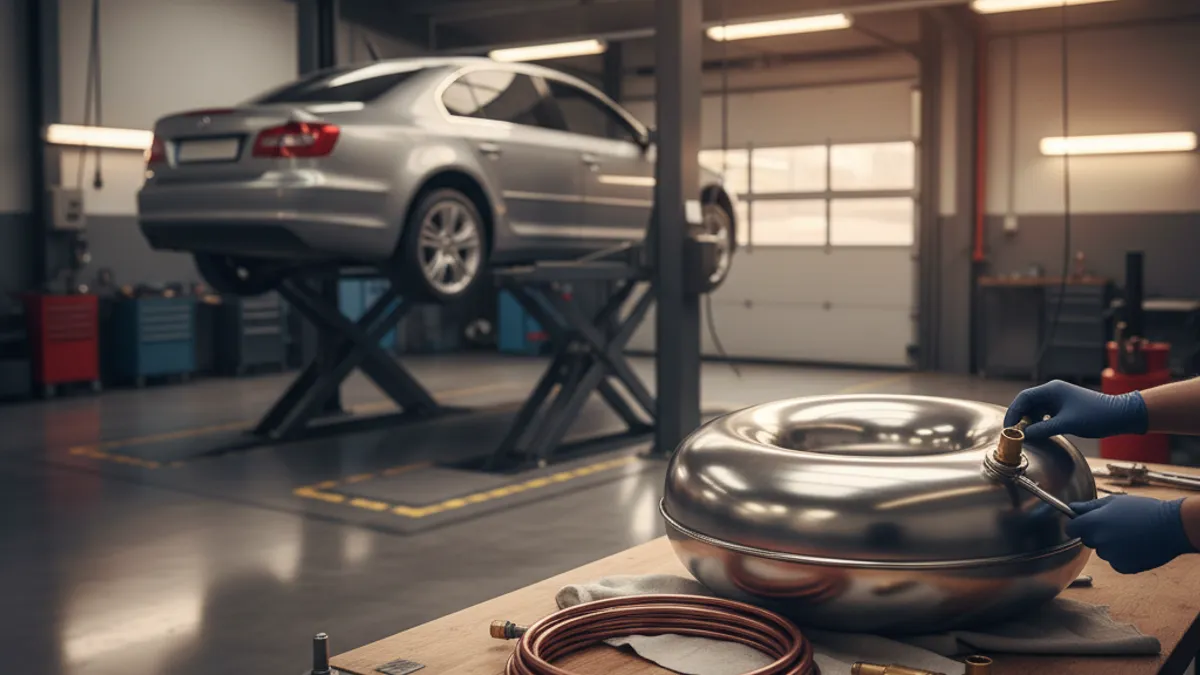
LPG consumes 20 to 25% more litres per 100 km than equivalent petrol operation, because it has a lower energy density per volume. Your car that burns 8 litres of petrol per 100 km will need 9 to 10 litres on gas. But because a litre of gas is almost 2.5 times cheaper than a litre of petrol, the total cost per 100 km drops roughly by half. In the spring 2026 market snapshot, 100 km on petrol costs around 20.51 KM, on autogas around 9.66 KM, a saving of nearly 11 KM per 100 km driven.
LPG Conversion Payback in 2026
The investment in a quality LPG conversion in BiH in 2026 runs 800 to 1,200 KM for MPI systems (classic multi-point injection, suitable for naturally aspirated petrol engines), and 1,400 to 1,800 KM for sequential systems for GDI/TSI engines with direct injection. These are the realistic ranges we see in the workshop in spring 2026; the exact figure depends on the system manufacturer, the number of cylinders, the tank type and the complexity of the installation. For an estimate on your specific engine, get in touch.
By the same calculation, over 20,000 km a year, autogas savings against petrol come to around 2,170 KM. At that driving tempo, an MPI installation pays back in 9 to 10,000 km of driving on gas, typically 6 to 8 months for a driver who really uses the car. A GDI/TSI system pays back in 13 to 17,000 km, typically a year.
A realistic calculation also has to include the mandatory LPG system certification. Under current BiH regulations, an LPG vehicle is certified at installation and recertified every 5 years. The recertification costs around 300 KM, which over a five-year period adds about 60 KM a year to the real bill. Even with that item, the overall payback remains compelling.
When LPG Does Not Pay Off
LPG is not the answer for everyone. We do not recommend conversion if:
- You drive less than 8,000 km a year; payback runs over 2 years, longer than most owners keep that used car.
- You have a diesel; LPG installations on diesel are rare, expensive and technically sensitive, and they do not offer the same saving factor because diesel already runs on a low per-litre price.
- You have a very old petrol engine with worn valves and low compression; LPG will put additional strain on the system.
- You have a car whose used market value is below 4,000 KM; an investment of around 1,000 KM does not pay back in proportion to the short remaining life of the car.
For everything else (medium and larger petrol engines, used family cars, SUVs doing 12,000 km or more a year), autogas is mathematically the cheapest powertrain in BiH 2026. More on choosing a system, installation and certification is in our guide on choosing an autogas system, and the full payback maths is worked through in Is an LPG conversion worth it in 2026.
How to Cut Your Annual Fuel Bill
Seven concrete moves that work, with no magic additives and no changing cars.
- Check tyre pressure every two weeks. A car with tyres 0.4 bar underinflated burns 3-5% more fuel. Over 1,500 litres a year that is 50 to 80 litres, or 140 to 220 KM thrown away.
- Track station prices before filling up. The gap between the cheapest and most expensive station in the same town can hit 0.30 KM per litre. Across the year for a typical driver, that is 300 to 500 KM.
- Drive steadily between 80 and 100 km/h on the open road. Above 110 km/h aerodynamic drag rises exponentially; the consumption difference between driving 100 and driving 130 km/h is 15 to 20% for the same distance.
- Do not keep a roof box up when you do not need it. A roof rack with a box adds 10 to 15% to consumption on the open road. Take it off outside the ski season.
- Service spark plugs, the air filter and the fuel filter on the manufacturer's schedule. A clogged air filter adds 3-7% to consumption. Old spark plugs on a petrol engine add even more. This is the subject of our guide How to reduce fuel consumption.
- Consider LPG if you drive over 12,000 km a year on petrol. For a detailed calculation on your model, get in touch.
- Avoid aggressive driving. Sharp accelerator-brake cycles in town raise consumption by 20 to 30% compared with anticipatory driving. Keep distance, watch the lights two blocks ahead, lift off downhill. Small moves with a large cumulative payoff.
A driver who applies even half of these seven moves will cut the annual bill by 200 to 600 KM, without buying a new car and without sacrificing comfort.
Frequently Asked Questions
How big is the diesel price gap between Banja Luka and Sarajevo?
The gap is typically 0.05 to 0.15 KM per litre, with Banja Luka and the wider Krajina region on average cheaper than Sarajevo. The reasons are distribution, margins and local station competition, not different tax rates. The largest spreads within BiH reach around 1 KM per litre between the cheapest locations (Cazin, Velika Kladuša) and the most expensive (Teočak, some stations in eastern Herzegovina) on the same day.
Why does the factory brochure show lower consumption than I actually burn?
Factory figures are measured in the WLTP test, in a laboratory, with a specific acceleration and braking cycle, on a flat path, with a stable engine temperature, no air conditioning, no passengers and no load. Real BiH driving (hills, cold mornings, air conditioning, payload, aggressive drivers in a queue) yields 20 to 35% more. That is not a measurement error, it is the difference between the test and real life.
Does switching from petrol to diesel pay off today?
If you drive less than 15,000 km a year, usually not. The per-litre price gap has narrowed while the gap in diesel maintenance has not. A used diesel with a faulty DPF, EGR or dual-mass flywheel can in a single year eat up everything you saved on fuel over five years of driving. A used diesel only makes sense with full service documentation and the key systems in good order.
How much extra does an LPG system really consume compared with petrol?
Typically 20 to 25% more litres per 100 km, because LPG has a lower energy density than petrol. Your car that burns 8 litres of petrol will need 9 to 10 litres on gas. Since a litre of gas is almost 2.5 times cheaper, the total cost per kilometre still drops by roughly half, depending on the quality of the installation and how well the system is tuned.
How much does LPG system certification cost and how often is it required?
Under current BiH regulations, an LPG vehicle is certified at first installation and recertified every 5 years. In practice the recertification runs around 300 KM in 2026 and covers a visual and technical inspection of the system, a leak test, and confirmation that the tank and components still meet the regulations. It is a mandatory item in any realistic calculation of total LPG vehicle cost.
Does an electric car really reduce the annual fuel bill in BiH?
At current electricity prices and current used electric car prices in BiH in 2026, savings on "fuel" exist, but the capital gap in purchase price and the specific battery questions around a used electric car make the overall calculation more complicated. The electric car is a topic for a separate analysis. For most used-car buyers in BiH in 2026 the choice still lies between diesel, petrol, and petrol with an LPG conversion.