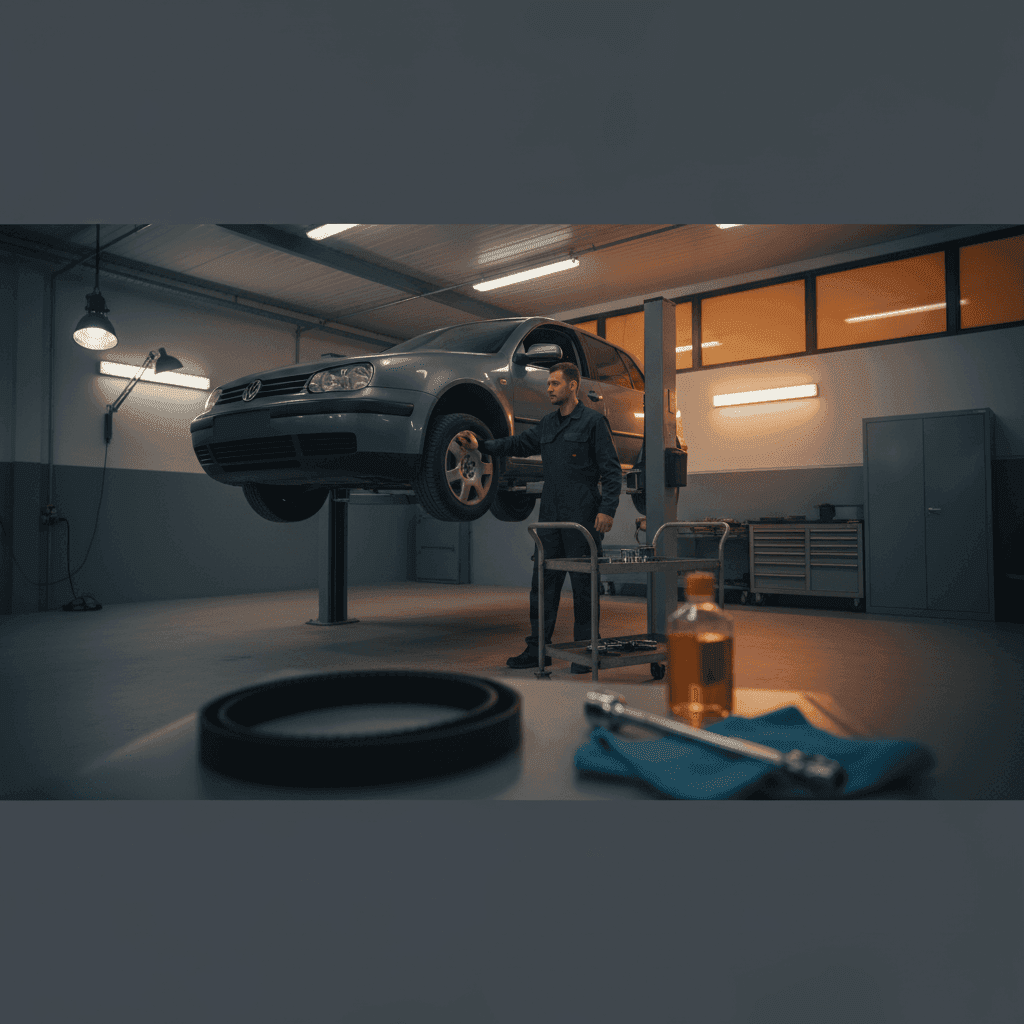
The 150,000 km service is the point at which a used car in BiH either proves it has been maintained regularly or starts opening bills that can exceed the value of the car itself. The timing belt on older VAG diesels is entering its second round, the oil in the DSG gearbox should have been changed twice already, and the EGR, DPF, shock absorbers and clutch are slowly shifting from "still working" to "could fail at any moment". This article is a concrete list of what needs to be done at this mileage and which warning signs you must not skip.
This guide was prepared by the Auto Gas Gaga workshop in Banja Luka, based on years of experience with used cars in the 100,000 to 200,000 km range.
Table of Contents
- What Makes the 150,000 km Service Different from the 100,000 km One
- Timing Belt, Second Round on Older VAG Diesels
- DSG and Automatics, Oil That Should Have Been Changed
- Brakes, Shock Absorbers and Suspension at the End of Their First Life
- EGR, DPF and Cooling on a Euro 5 Diesel
- Clutch and Dual-Mass Flywheel, the Expensive Clock Starts Ticking
- Fluids That Must Not Be Forgotten
- Red Flags That the Car Was Neglected
- Frequently Asked Questions
- Related Articles
What Makes the 150,000 km Service Different from the 100,000 km One
At 100,000 km most used cars are still operating within factory intervals. The first timing belt, the first new brake pads, the first serious diagnostic check - everything is being done for the first time. At 150,000 km the picture is different. The original owner has sold the car in the meantime, the new owner has no service history, and parts that should already have been replaced have already passed their service life.
The second round means that some items are now going in for the second time, while others appear as a problem for the first time. The timing belt on 1.9 TDI engines with a 150,000 km interval is a textbook example of what comes back around, while the EGR valve, DPF and dual-mass flywheel are textbook examples of what is only now starting to cause trouble. The car is not serviced by the service book, because the service book is either missing or incomplete. It is serviced by condition and by engine code.
In our shop, on the lift we first check whether anything is leaking, how the oil looks, whether the dual-mass flywheel is rattling at idle and whether the chassis is behaving normally. That is the difference between a routine "drop the oil filter and move on" and a serious second round of servicing.
Timing Belt, Second Round on Older VAG Diesels
The timing belt is a part that gives no warning. When it snaps, the valves hit the pistons and the engine is done. The cost of a new engine or a rebuild often exceeds the value of the used car itself, so sticking to the interval is one of the few items where skipping is not an option.
Intervals vary by engine code more than drivers realise. A Volkswagen Passat B6 with the 1.9 TDI engine has a factory recommended interval of 150,000 km, which means a used car reaching 150,000 km is completing its first round. If the car has already covered 200,000 or 250,000 km, the second round on the belt is either overdue or imminent. Newer 2.0 TDI Common Rail engines have longer intervals, some even beyond 200,000 km, so a combination of age and mileage is considered. Older 1.9 TDI engines with the ALH code (Golf 4, Octavia 1, first-generation Audi A3) are traditionally recommended every 90 to 120 thousand km.
Timing Belt on the 1.9 TDI ALH, When for the Second Time
The ALH is an engine that is still on the road in BiH. Cars with over 250,000 to 300,000 km are not rare, which means this belt is on its second or third round. The rule from the workshop is simple. When you change the belt, you also change the tensioner, the water pump and the accessory drive belt. Saving on a tensioner that lasts another 20,000 km and then takes out the whole kit is the worst saving in car maintenance. If you do not know when the belt was last done, treat it as if it was not. A more detailed engine-code guide is available in our advice on timing belt and chain intervals. The price depends on the specific situation, get in touch for an estimate with your engine code and mileage.
DSG and Automatics, Oil That Should Have Been Changed
A used car with a DSG gearbox reaching 150,000 km without a single recorded oil change is the norm, not the exception. The "lifetime oil" myth that VW itself put out really only meant that the gearbox would survive the warranty period.
The DSG DQ200, a seven-speed dry-clutch gearbox that VAG fitted to weaker petrol engines and diesels up to the 1.6 TDI, has two separate fluids - oil for the gears and oil for the mechatronics. Our recommendation, in line with what is written on the DSG gearbox service advice page, is to change both in the 60,000 to 90,000 km range, depending on driving style and thermal conditions. A car at 150,000 km that has never had a gearbox service has two missed changes behind it. The wet DSG DQ250, fitted to stronger engines (2.0 TDI 140 to 170 hp, 1.8 TSI, 2.0 TSI), typically runs on a shorter 50,000 to 60,000 km range.
DSG DQ200 Oil, Price in BiH
Classic torque-converter automatics (Mercedes 7G, ZF 6HP and 8HP, Aisin in Opel and Ford) also have oil that ages. If a car has covered 150,000 km without a change, we first inspect for slipping or jerking, then plan the change. CVT gearboxes are a story of their own and require dedicated CVT fluid, not universal ATF. The price depends on the specific type, get in touch for an estimate. If the change is skipped, repairing the mechatronics or clutches later means a bill that runs into the thousands.
Brakes, Shock Absorbers and Suspension at the End of Their First Life
Brake pads are replaced based on wear, not mileage, but at 150,000 km most cars are already past their second set, while the original discs are entering the replacement zone. Brake callipers on axles that rarely do work tend to seize, so on a service we check the slide pins and overhaul them if they are sticking.
Shock absorbers are an item that BiH roads hit particularly hard. The service life of a shock absorber in countries with good roads is around 150,000 km, while here, especially on lower-class cars, that life is in practice cut in half. A bounce test (press the front corner of the car down, release it, see how many times the car bounces) is the first check on the lift. If the car bounces more than once after being released, the shock is no longer working. Details in our guide on shock absorbers and the bounce test.
Shock Absorbers at 150,000 km, How to Spot Them
Alongside the bounce test, we check whether oil is leaking from the shock, whether tyres are worn unevenly in waves and whether the car sways in corners. Tie rods and end links from the same period add knocking on bumps. Silent blocks and engine mounts are rarely replaced preventively, but at 150,000 km the rubber often shows signs of softening.
EGR, DPF and Cooling on a Euro 5 Diesel
A used Euro 5 diesel at 150,000 km most often crosses over from "drives normally" to "starts causing trouble". The EGR and DPF work in tandem and ruin each other. A faulty EGR lets too much soot back into the intake manifold, combustion becomes irregular, the DPF fills up more often, goes into forced regeneration, and in the final step the engine drops into limp mode with as little as 60 to 70 horsepower.
Preventive cleaning of the EGR every two to three years or in the 40,000 to 60,000 km range can prevent complete seizure. We go deeper in our advice on the EGR valve, and on the DPF in our advice on the DPF filter and regeneration.
EGR Cleaning or Replacement at 150,000 km
If diagnostics confirms the EGR is seized or its electronics have burnt out, it goes for replacement. If it is just clogged with soot and the electronics are alive, cleaning solves the problem for another 30,000 to 40,000 km. Bundling the steps (EGR clean, DPF check, crankcase breather and turbo inspection for soot) is cheaper than chasing each fault as a separate case.
The engine cooling system ages faster than the manufacturer assumes. The plastic pipes of the cooling system, the connectors on the radiator, the thermostat housings - all of it has a shelf life. The typical scenario is coolant leaking down the engine block, a drop in the expansion tank level and overheating that ruins the cylinder head. An inspection of the radiator, fans, thermostat and plastic joints is part of the standard second-round package.
Clutch and Dual-Mass Flywheel, the Expensive Clock Starts Ticking
A clutch on a manual gearbox lasts between 150,000 and 250,000 km on a normally driven car. The 150,000 km mark is the point at which the clock starts. The car may still pull away nicely, but you can sense that the clutch is biting at the top of the pedal travel, that on a hill the revs climb faster than the speed, that occasionally there is a burning smell and, the worst scenario, that it slips under harder acceleration.
Klix.ba, in its article on clutch prices in BiH from 5 May 2026, gave a range that matches what we see on the ground. Small petrol cars like the Clio or Fabia are at the lower end, the Golf 6 1.6 TDI sits in the mid range, while stronger diesel SUVs with a dual-mass flywheel are at the upper end, because the flywheel itself takes up a good part of the bill. Mechanic labour is an additional item, because the gearbox has to come out. The price depends on the specific model, get in touch for an estimate with your engine code.
Clutch on the Golf 6 1.6 TDI, Price in BiH
The rule is that when you pull the gearbox for a clutch, you also look at the dual-mass flywheel. If the flywheel has play or rattles at idle, the worst financial decision is to put it back in alongside a new clutch. Within a year the gearbox comes out again and you pay for the job twice. A more detailed description of slipping symptoms is in our advice on clutch slipping.
Fluids That Must Not Be Forgotten
Engine oil is the only fluid that most drivers track. The rest age in silence. For a used car from 2020 or newer, with a factory-extended interval of 30,000 km or two years for TDI engines, reaching 150,000 km means five oil changes, not ten. Older 15,000 km intervals are different maths, but the rule is the same. Not a single change may be skipped.
Coolant (antifreeze G11, G12, G12++, G13) is typically changed every 4 to 6 years, some manufacturers specify 5 years or 240,000 km, whichever comes first. Old antifreeze loses its anti-corrosion properties, settles in the radiator and speeds up the deterioration of plastic connectors and the water pump.
Brake fluid is hygroscopic, meaning it absorbs moisture from the air, and within two years it can cross the threshold at which corrosion of the ABS block and callipers begins. The rule from our advice on brake fluid and DOT classes is replacement every two years or whenever a refractometer shows more than 3 percent water.
The oil in the differential and rear axle, on 4x4 or rear-wheel-drive cars, is changed in the 50,000 to 80,000 km range, which means most used-car owners have not touched that section at all. Old oil loses its viscosity and accelerates gear wear.
Red Flags That the Car Was Neglected
When a used car at 150,000 km comes in to the lift for the first time under a new owner, there are signs we look for before we even lift the bonnet. A dry and cracked timing belt with cracks on the teeth means the belt has not been touched in the last 80,000 to 100,000 km. Oil leaking from the crankcase breather down the engine block is a signal that the engine is breathing more than it should, most often a sign of worn rings or piston rings.
A dual-mass flywheel rattling at idle, even slightly, means the reserve time has already been used up. An EGR that looks as if carbonised tar has been collected in it means the car only does short city runs and that the intake manifold behind it is very likely in the same state. Slow reactions in the DSG gearbox and jerking when pulling away mean the mechatronics oil is old.
If you are buying a used car in this mileage range, this checklist is a solid umbrella for a pre-purchase inspection. A short cross-section of the used-car market by class is available in our guide to choosing an estate, SUV or saloon, and the car history itself is most easily checked by VIN. carVertical pulls a documented history from international registers, recorded odometer readings by date, registered accidents, number of previous owners and indicators of theft or total loss. We consider this a mandatory layer of verification before you put down a deposit on a car in this mileage range, because service books in BiH are often missing or incomplete. When paying for the report you can use the code GAGA and get a 20 percent discount.
The cheapest way for a used car to survive the next 50,000 km is an inspection at a workshop that works by engine code. If your car has just crossed 150,000 km, book the second round of service or write to us via the contact page with your engine code and mileage.
Frequently Asked Questions
Does the timing belt have to be replaced even if the car shows no symptoms?
Yes, the timing belt is a preventive item. It gives no warning before it snaps. The interval specified for your engine is the upper limit and beyond it the risk rises exponentially. If you do not know when the belt was last done, treat it as if it was not and replace it together with the tensioner and water pump.
How often is the oil in a DSG gearbox changed?
The dry DSG DQ200 runs in the 60,000 to 90,000 km range, the wet DQ250 and stronger units in the 50,000 to 60,000 km range. The oil type is strictly specific, you cannot use universal ATF. A used car that has covered 150,000 km without a change most often already shows jerking when pulling away or delays during gear shifts.
Can I do the 150,000 km service myself?
Filters, engine oil and brake pads are items the owner can replace on their own if they have the tools and the know-how. The timing belt, DSG oil, dual-mass flywheel and clutch, EGR and cooling all need a lift, special tools, diagnostics and parameterised reset. Attempting the timing belt yourself on the wrong engine is the most expensive path to an engine rebuild.
What if the car has no service history?
That is the most common situation with a used car in BiH. You treat all preventive items as if they were not done, you start with the timing belt, DSG oil and brake fluid, and then through diagnostics you check the EGR, DPF, cooling and chassis. An experienced mechanic working by engine code can put together a priority list in an hour on the lift.
Is the 150,000 km service also a major service at the same time?
Most often yes. Timing belt, all fluids, spark plugs (if it is a petrol), filters in full, brake check, suspension and injection. By the Serbian and Bosnian practice, the first major service is often done between 150,000 and 210,000 km, after which it is repeated roughly every 80,000 km.
What comes after 150,000 km, when is the next round?
The next critical mileage is in the 200,000 to 220,000 km range. There we look at the clutch if it has not been done, the next DSG oil change, a new timing belt on engines with a 60,000 to 90,000 km interval, a more serious inspection of the turbo and the high-pressure pump on diesels and, on some engines, the first zone for timing-chain wear.