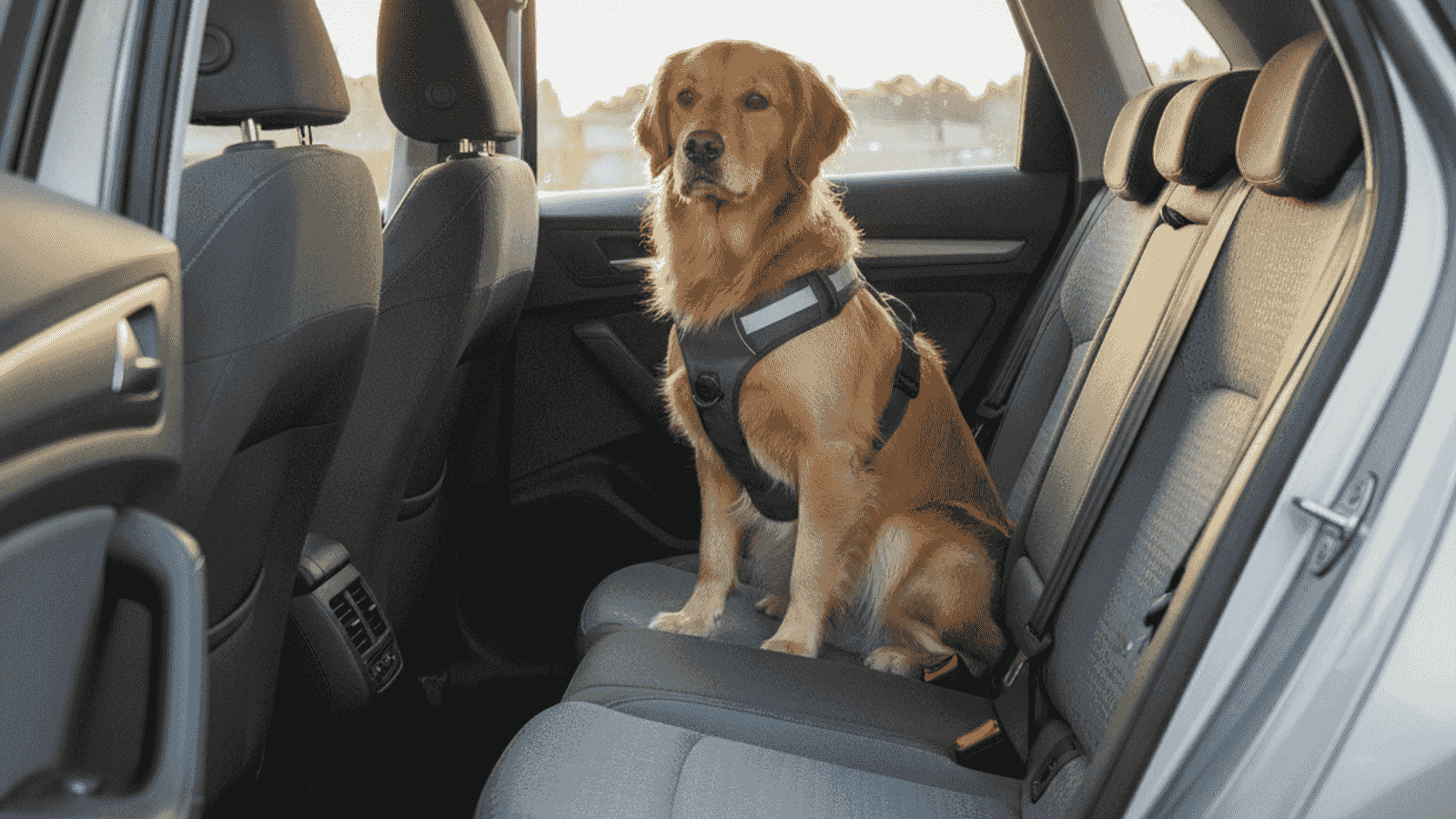
A 20 kg dog generates an impact force of over 500 kg in a collision at 50 km/h. That is not an exaggeration — it is the result of an ADAC crash test that showed an unsecured pet on the back seat becomes a projectile aimed at the driver or front passenger. One in three car owners regularly transports a dog in the vehicle, and one in five does so without any restraint at all. If you are planning to travel with a dog by car to the seaside this summer, or even a shorter trip with a cat, this guide covers three things you need to know: how to physically secure the animal in the car, what paperwork you need to cross the border from BiH, and why even five minutes in a parked car in the sun is not harmless.
This guide was compiled by the Auto Gas Gaga workshop in Banja Luka, based on ADAC crash test data and years of experience preparing vehicles for summer road trips.
Table of Contents
- Why Securing Your Pet in the Car Is Mandatory
- How to Properly Secure a Dog or Cat in a Vehicle
- Carrier or Harness for a Dog in the Car: Which Is Safer
- Documents for Crossing the Border with a Pet from BiH
- Heat and a Parked Car: How Quickly It Becomes Deadly
- Symptoms of Heatstroke in a Dog in a Car
- Practical Checklist for Travelling with a Dog to the Seaside
- Frequently Asked Questions
- Related Articles
Why Securing Your Pet in the Car Is Mandatory
Physics does not forgive. A 20 kg dog in a frontal collision at 50 km/h generates an impact force of over 500 kg. An animal sitting calmly on the back seat becomes a mass flying forward at the speed the vehicle was travelling — no seatbelt, no cushioning. ADAC crash tests have documented this with clear results: an unsecured pet endangers both itself and every occupant in the vehicle. Larger dog, greater mass, greater force. A 35 kg Labrador in the same collision generates a force approaching one tonne.
The problem is not limited to collisions. An unsecured cat or small dog can jump onto the steering wheel, under the pedals or onto the driver's hand while driving. The Croatian Supreme Court (ruling Kr 183/11-4, January 2012) examined a case in which a cat jumped onto the steering wheel and caused a fatal accident. The court dismissed the driver's defence and confirmed that the driver is responsible for securing every animal in the vehicle. The ruling is clear: if an animal distracts the driver and an accident follows, the fault lies with the owner.
BiH traffic safety legislation does not prescribe an explicit fine for an unsecured pet, but Articles 112 and 113 of the Road Traffic Safety Act regulate the obligation to secure cargo in the vehicle. A pet roaming freely around the cabin breaches that obligation. The Animal Welfare and Protection Act in BiH additionally obliges owners to ensure safe transport of animals. In Spain, by comparison, the fine for improperly secured pet transport runs to several hundred euros. It is not a question of whether BiH will introduce similar fines, but when.
Securing a pet in the car is not a legal formality — it is a measure that protects both the animal and the people in the vehicle. An unpleasant conversation with a vet after a collision in which the dog was injured because it flew around the cabin is a situation you do not want to experience.
How to Properly Secure a Dog or Cat in a Vehicle
ADAC recommends three basic methods for transporting a dog by car, each with a different level of protection and practicality. The choice depends on the size of the animal, the type of vehicle and the length of the journey.
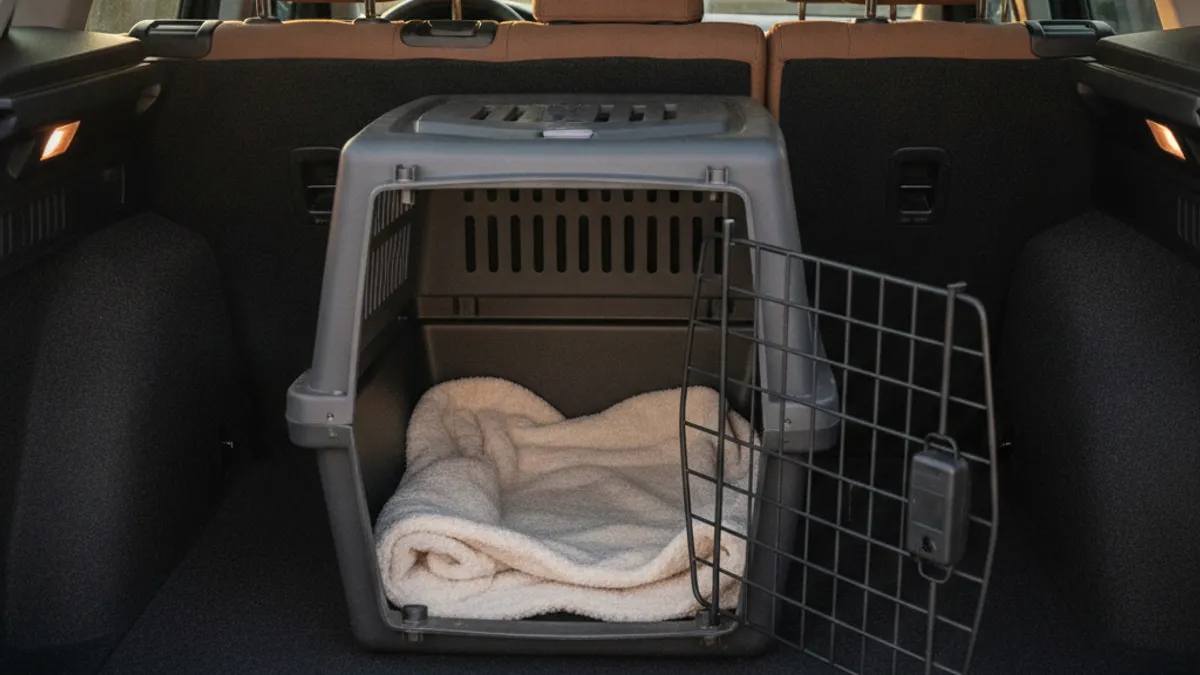
A carrier (crate) in the boot is the safest transport method. A hard plastic carrier is placed in the boot, directly behind the rear seat backrest, and secured with a strap or net to the tie-down points in the boot floor. The animal inside has enough room to lie down and turn around but is fully protected in the event of a collision. The carrier absorbs part of the impact energy and prevents the animal from becoming a projectile. Size matters: the dog must be able to stand up, turn around and lie on its side. A carrier that is too narrow causes stress; one that is too wide offers no protection because the animal is thrown around inside during a collision.
A safety harness for dogs uses a carabiner that clips onto the dog's chest harness, with the other end going into the vehicle seatbelt buckle. The dog sits on the back seat with a limited range of movement. Sounds good in theory, but the ADAC test revealed a serious problem: the carabiner on one of the tested harnesses snapped during the crash test. The dog dummy flew towards the front seat like a projectile. Harnesses with a standard carabiner are not reliable in a serious impact.
A safety net or barrier divides the cabin into a passenger zone and a pet zone. The net prevents forward movement but not lateral movement, which means that in a side collision or sharp swerve the animal can still be injured or thrown from its space. A barrier is sturdier than a net but requires professional installation tailored to the specific vehicle model. A combination of a barrier and a carrier in the boot is the ideal solution for larger dogs on longer journeys.
For cats, the only sensible option is a carrier. A cat moving freely around the cabin is dangerous both to itself and to the driver, as cats tend to hide under the pedals, jump onto the dashboard or wedge themselves into the space beneath a seat where they are difficult to retrieve. A cat carrier can sit on the floor in front of the passenger seat or on the back seat, secured with the seatbelt.
Carrier or Harness for a Dog in the Car: Which Is Safer
Short answer: the carrier. The ADAC finding about the carabiner snapping on a dog harness is not an isolated incident. It is a structural problem with the entire product category that uses standard carabiners instead of reinforced safety clips. A carrier in the boot is the only solution that showed consistent protection for both the animal and the cabin occupants in crash testing.
A practical compromise for large dogs that do not fit in a carrier: a quality chest harness for dogs with reinforced fittings (not a carabiner, but a rotating steel clip with a locking mechanism) combined with a safety net between the boot and the cabin. Two layers of protection compensate for the weakness of each individual system. The harness holds the dog in place; the net prevents the animal from entering the cabin space if the harness fails.
Carrier prices vary depending on size and quality. For specific recommendations by dog size, ask your vet or a specialist pet shop. Investing in a quality carrier is a one-off expense, and you will use it for years.
Documents for Crossing the Border with a Pet from BiH
BiH is a third country in relation to the EU, which means that stricter rules apply for a pet entering Croatia, Montenegro or any EU member state than for movement within the EU. Without complete documentation, your pet will not be allowed across the border, and turning back does not count as a pleasant experience.

Pet Passport from BiH for Croatia: What You Need
To travel from BiH to Croatia (EU), your pet must have three things:
- A microchip compliant with ISO 11784/11785. The chip must be implanted BEFORE vaccination. If the chip is older and uses a different standard, you must bring your own reader or ask your vet to implant a new one.
- A rabies vaccination administered at least 21 days before crossing the border. The vaccination must be recorded AFTER the microchip is implanted; otherwise it is not recognised. Twenty-one days is the minimum period that must pass from vaccination to travel, with no exceptions.
- A veterinary health certificate issued no earlier than 10 days before crossing the border. It is issued by an authorised veterinarian in BiH. The certificate confirms that the animal is healthy and that all vaccinations are up to date.
Pets from BiH may only enter Croatia through border crossings that have a veterinary inspection point. This is regulated by EU Regulation 576/2013 on the non-commercial movement of pet animals. You may transport up to 5 pets that are not intended for sale. If you plan to cross with more than five animals, the procedure is entirely different and requires a commercial permit.
Before your trip, check with your vet that all documents are complete and within their validity period. Requirements can change, and your vet has up-to-date information about which border crossings have an active veterinary inspection during the summer season. Some smaller crossings do not have a permanent inspection point, so you may be redirected to a larger crossing — that means lost time and frustration.
For Montenegro, the rules are somewhat less strict because Montenegro is not an EU member state, but a microchip and proof of rabies vaccination are still mandatory. Check the current requirements before your trip, as the regulations differ from the BiH-to-EU procedure.
Practical tip: prepare all documents at least one month before your trip. Vaccination requires a 21-day waiting period, the veterinary examination for the certificate can only be scheduled close to departure, and queues at vets in June and July are common. Leaving the paperwork to the last day is a recipe for a cancelled trip.
Heat and a Parked Car: How Quickly It Becomes Deadly
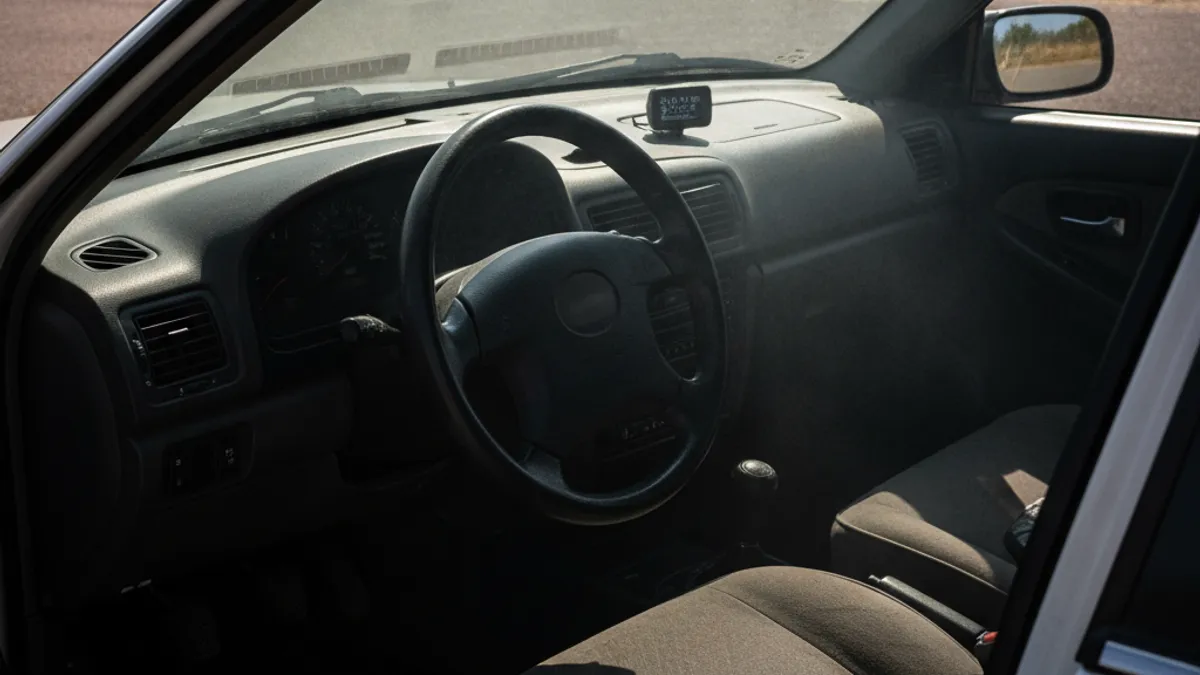
This is the section that saves lives, and every driver who transports a dog by car needs to know it by heart. At an outside temperature of 35 degrees, the interior of a car reaches 50 degrees in 10 minutes. After 20 minutes the temperature climbs to 65 degrees. After 30 minutes it hits 72 degrees. These are measured values, not estimates.
A dog can suffer fatal heatstroke within 20 to 30 minutes under these conditions. Dogs do not sweat like humans. Their only cooling mechanism is panting, and in an enclosed space at 50+ degrees that mechanism simply cannot keep body temperature within a safe range.
| Outside temperature | Inside after 10 min | Inside after 20 min | Inside after 30 min |
|---|---|---|---|
| 25 degrees | 36 degrees | 46 degrees | 50 degrees |
| 30 degrees | 43 degrees | 56 degrees | 62 degrees |
| 35 degrees | 50 degrees | 65 degrees | 72 degrees |
An open window does not help enough. Even fully lowered windows do not prevent temperatures from rising to dangerous levels when the car is in direct sunlight. The colour of the car also affects the rate of heating: dark cars heat up faster than light ones, but the difference is only in speed, not the end result. A white car in the sun also becomes dangerous for an animal.
The only solution is not to leave your pet in a parked car, not even for a minute. If you need to stop for fuel, a toilet break or coffee, one of the passengers stays in the car with the air conditioning running, or the pet comes with you. "Just for a minute" is a phrase that has killed too many animals. There is no exception to this rule.
Particularly dangerous situations are rest stops on motorways in BiH or Croatia in summer. A car park at a rest area in the sun, with no shade, on tarmac that radiates additional heat. If you are travelling alone with your pet and need to stop, take the animal with you or find a parking spot in the shade and leave all windows open.
Symptoms of Heatstroke in a Dog in a Car
Recognising heatstroke can save your dog's life. Symptoms develop rapidly and progress from warning signs to critical within minutes.
Early warning signs:
- Intense, rapid panting that does not stop even in the shade
- Thick, sticky strings of saliva
- Restless pacing, seeking a cooler spot, pawing at the floor
Serious symptoms that require immediate action:
- Red or dark gums and tongue (normal colour is pink)
- Disorientation, staggering, unsteady gait
- Vomiting or diarrhoea
- Collapse and loss of consciousness
If you notice any of the serious symptoms: move the dog to shade immediately, offer a small amount of water (not ice-cold), dampen its paws and ears with a wet towel and drive straight to the vet. Do not attempt rapid cooling methods such as immersion in ice water, as this can cause shock and worsen the situation. Gradual cooling is the only safe approach.
Practical Checklist for Travelling with a Dog to the Seaside
This list covers complete preparation and the drive itself. You can save it on your phone and tick off each item.
One month before the trip:
- Visit the vet: health check, update vaccinations
- Check the microchip: confirm it is active and readable
- Schedule a rabies vaccination if needed (21 days must pass before the border crossing)
- Get a carrier of the right size if you do not already have one
One week before the trip:
- Collect the veterinary certificate (valid for 10 days, so do not get it too early)
- Check which border crossing has a veterinary inspection point and plan your route
- Check that the air conditioning in the car is working properly — before a long summer trip this is essential for people and animals alike
- Pack a pet travel bag: water bowl, food for the journey, favourite toys, motion sickness medication (if recommended by the vet), waste bags, wet towels, a seat cover
The day before the trip:
- Fill a thermos with water so it stays cool during the journey
- Fit the seat cover on the back seat if the dog is not travelling in a carrier
- Check all documents: microchip, vaccination, certificate, your personal ID
- A short test drive with the pet in the carrier if it is the first time
On the day of the trip:
- A light meal 3 hours before departure, never right before the trip
- A 20-minute walk before getting into the car
- Set up the carrier or fasten the harness, then set off
- Break every 2 hours: water, short walk, toilet stop
- Never leave the pet alone in the car, not even for a minute, even with the windows open
During the drive:
- Air conditioning at a moderate temperature, do not aim it directly at the animal
- Avoid driving during the hottest part of the day (12:00 to 16:00) if possible
- Monitor your pet's behaviour: excessive panting, restlessness or lethargy are signs that something is wrong
- Keep the window open enough for fresh air, but not so much that the dog can stick its head out (risk of eye and ear injury from wind and insects)
If your air conditioning is not working before the trip, this is not just about passenger comfort. For an animal in an enclosed vehicle, a functioning air conditioning system is a matter of survival in the heat. Before every longer summer trip, check the overall condition of your vehicle and pay special attention to the cooling system and air conditioning.
If you are planning a longer trip with extra luggage, a pet in a carrier and a full car, also pay attention to your vehicle's maximum payload. An overloaded vehicle is harder to control and takes longer to brake — an additional risk when you have a living being in the boot.
Summer car preparation for a trip with a pet includes everything you should be checking anyway: tyres, brakes, cooling system, air conditioning. The complete summer car preparation guide covers each of those items in detail.
Need an air conditioning check or vehicle preparation for a longer summer trip? Book an appointment at our workshop or get in touch and we will check whether your car is ready for the journey with your four-legged companion.
Frequently Asked Questions
Can a dog sit in the front seat?
Technically yes, but it is not recommended. The airbag on the passenger side can injure or kill a dog when it deploys. If the dog must sit in front (single-seat van, two-seat car), deactivate the airbag on that side and use a chest harness for dogs clipped into the seatbelt buckle.
How quickly does a car become dangerous for a dog in the sun?
At an outside temperature of 30+ degrees, the car interior reaches a dangerous 50 degrees in 10 minutes. Without air conditioning and air circulation, a dog can suffer heatstroke within 20 to 30 minutes. Even an open window does not solve the problem in direct sunlight.
Does a dog need motion sickness medication for a long trip?
Some dogs are prone to kinetosis (motion sickness), especially younger ones. Speak to your vet about medication before the trip. A light meal 3 hours before departure, fresh air and frequent breaks help even without medication.
Can a cat travel outside a carrier?
No. A cat outside a carrier in a car is dangerous both to itself and to the driver. Cats react to stress unpredictably and can jump onto the steering wheel, under the pedals or hide in an inaccessible spot. A carrier is mandatory, no exceptions.
What is the fine for an unsecured dog in a car in Croatia?
Croatia does not have an explicit fine specifically for pet transport, but the Road Traffic Safety Act regulates the obligation to secure cargo. Police can issue a fine for endangering traffic safety if an unsecured pet distracts the driver. In Spain, such fines run to several hundred euros.
Which border crossings from BiH should you use with a pet heading for Croatia?
Pets from BiH (a third country) may only enter Croatia through crossings with a veterinary inspection point. Before your trip, check the current list with your vet or on the veterinary inspection authority's website, as schedules can change seasonally.