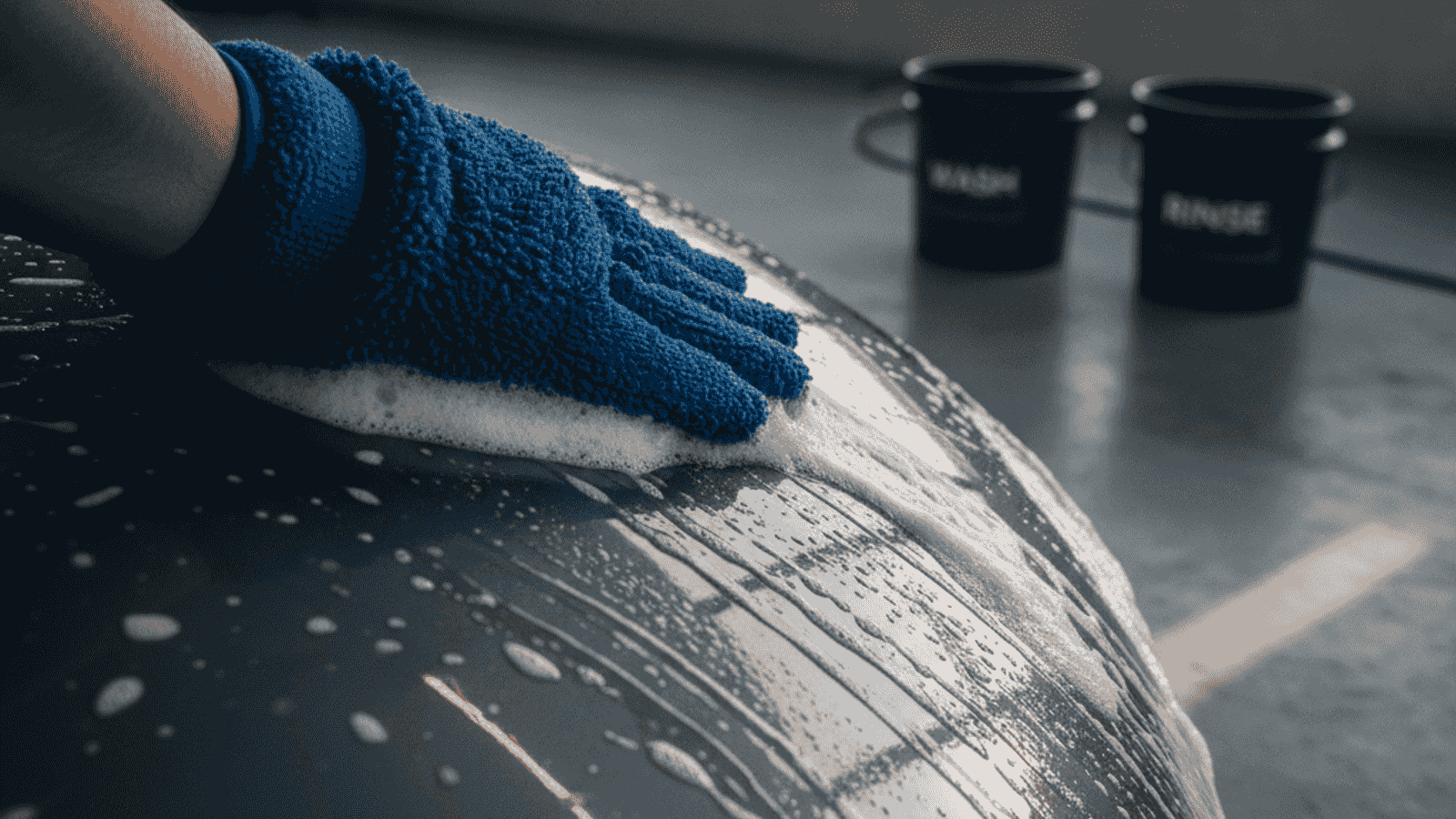
Every car wash that ends with a dry cloth dragged across a dusty body leaves a mark. Not metaphorically, but literally. Micro-scratches caused by improper washing become visible the moment sunlight hits the surface at the right angle, and after a hundred or so washes like that the paint looks dull and aged regardless of the car's year. Washing your car properly is not complicated, but it does require knowing exactly what damages the paint and how to avoid it. This guide covers the six most common mistakes, the only correct hand-washing method, a comparison of car wash types available in BiH, and a problem BiH drivers know better than most Europeans: hard water and the spots it leaves behind.
This guide was prepared by the Auto Gas Gaga workshop in Banja Luka, drawing on years of experience with bodywork preparation and protection on vehicles of all makes.
Table of Contents
- Why Washing Your Car Damages the Paint More Than You Think
- Six Mistakes That Leave Scratches on Your Paint
- Two-Bucket Car Washing Method Step by Step
- Hand Car Wash, Self-Service or Home Washing
- Automatic Car Washes and How They Affect Your Paint
- Hard Water in BiH and Water Spots on Paint
- How to Dry Your Car Properly After Washing
- Frequently Asked Questions
- Related Articles
Why Washing Your Car Damages the Paint More Than You Think
Factory paint on a modern car is roughly 100 to 150 microns thick. For comparison, that is thinner than a sheet of paper. This thin layer consists of the base coat, which provides colour, and a clear coat on top of it. When someone says "the paint is scratched," they usually mean that top clear coat. Once you damage it deeply enough, the only fix is professional machine polishing or a full respray.
The problem arises when any hard particle gets trapped between the cloth and the paint. Dust, sand, fine gravel, road salt, dried insects. Under the pressure of your hand and cloth, each of those particles acts like sandpaper at the micro level. One pass leaves one scratch. A hundred passes leave a web of scratches that, in sunlight, appears as a hazy, cloudy surface instead of a deep gloss.
These scratches are called swirl marks because they form from circular motions during washing or polishing. Black and dark-coloured cars show them most prominently, but they exist on white and silver cars too. The difference is purely one of visibility. On black paint they are visible even under overcast skies; on silver, only under strong direct sunlight.
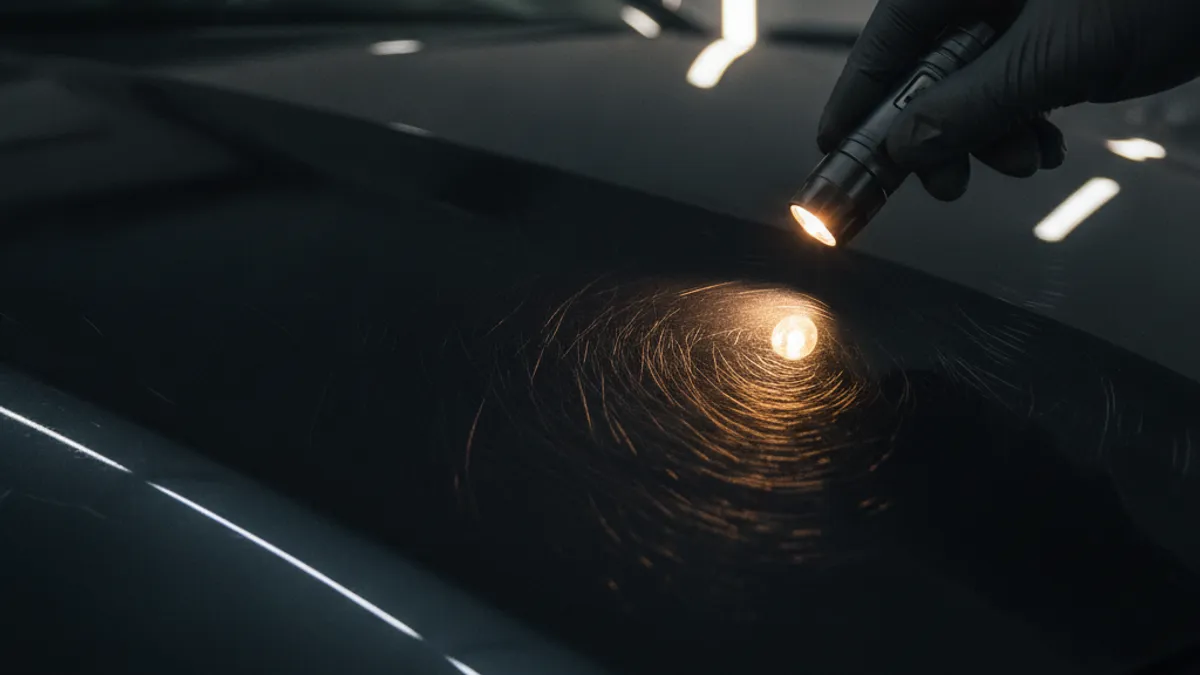
The key point: washing your car properly is no more expensive or difficult than doing it wrong. The difference lies in the order of steps and the tools you use. And once swirl marks appear, removal requires machine polishing, which costs many times more than the wash itself.
Six Mistakes That Leave Scratches on Your Paint
Washing without a pre-rinse
This is mistake number one and the most widespread in BiH. You grab a sponge or cloth, apply some soapy water and start scrubbing a body covered in a layer of dust, sand and salt. Every particle under the pressure of your hand cuts into the paint. A pre-rinse with pressurised water (or at least a garden hose) removes 80-90% of loose surface dirt before any cloth even touches the paint. This single step, which takes two minutes, makes the biggest difference between a wash that preserves the paint and one that destroys it.
Using household detergent instead of car shampoo
Washing-up liquid is designed to break down grease. That means it strips not only dirt but also any protective wax or coating layer from the paint. One wash will not cause a disaster, but regular use leaves the paint with no protection at all, exposed to UV rays and acid rain. Dedicated pH-neutral car shampoos clean dirt without attacking the protective layer. A bottle of quality car shampoo costs about as much as a couple of professional washes and lasts for months.
Circular scrubbing motions
A circular motion concentrates dirt in a small area and drags it round and round across the paint. The result is the characteristic swirl marks, spiral circles visible under direct light. The correct technique is to wash in straight, parallel strokes from top to bottom, because even if a particle does leave a mark, it is far less noticeable than a circular one.
Using a single bucket of water for the entire car
When you rinse your wash mitt or sponge in the same bucket you draw your soapy water from, all the dirt you have just removed goes straight back onto the washing tool. By the time you reach the second panel you are washing the car with dirty water. The solution is the two-bucket method, covered in detail below.
Washing in direct sunlight or on a hot body
On hot metal the soap dries before you can rinse it off. Dried soap becomes a sticky film that holds dirt against the paint, and when you try to wipe it away that mixture scratches again. On top of that, rapid drying of water leaves mineral spots that are hard to remove. Ideally, wash in the shade or early in the morning when the body is cool to the touch. You can read more about protecting your car from the sun in the first part of this series.
Leaving bird droppings and tree sap on the paint
Bird droppings are acidic and will etch the clear coat if left for more than a day or two. Tree sap bakes on and chemically bonds to the surface. Both demand a quick response. Wet the area with water or a detailer spray and gently lift the contamination with a microfibre cloth. Do not scrape with a fingernail, plastic card or dry cloth, as you will cause more damage than the droppings themselves.
Two-Bucket Car Washing Method Step by Step
The two-bucket method is the standard in professional detailing and the only way to minimise scratches during a hand wash. The principle is simple: one bucket holds soapy water, the other holds clean water for rinsing the wash tool.
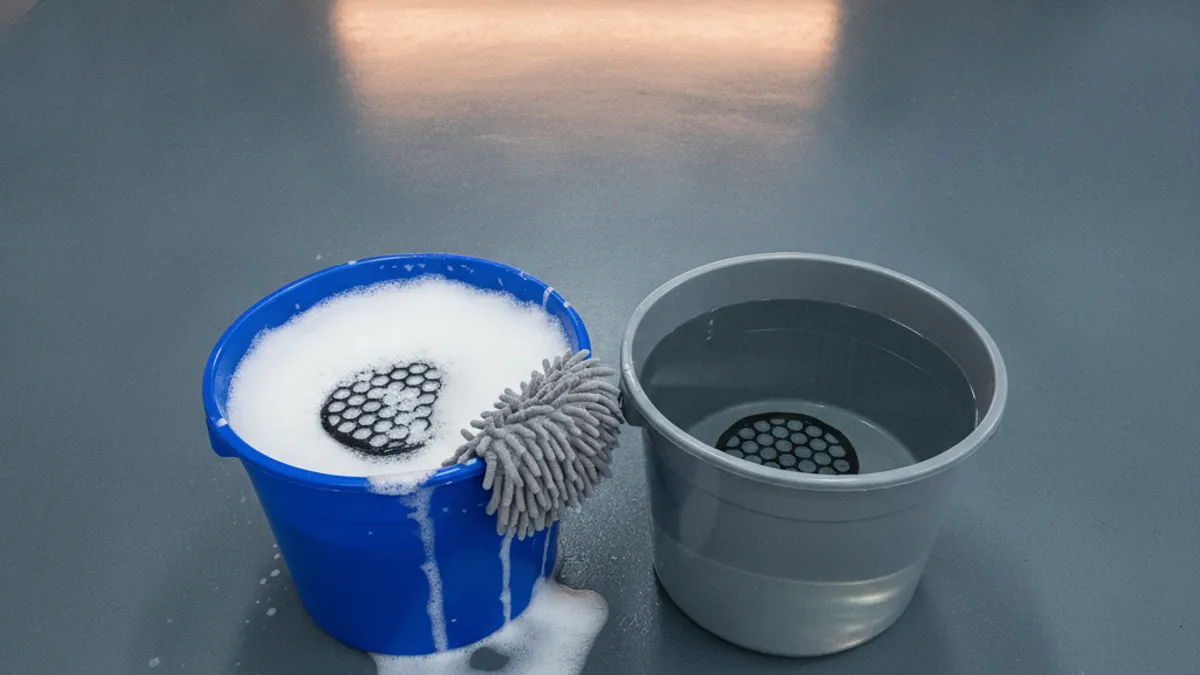
What you need:
- Two buckets (at least 15 litres each)
- A grit guard insert for the bottom of each bucket that traps dirt and prevents it from being picked up again
- A microfibre wash mitt (not a sponge, not a floor cloth)
- pH-neutral car shampoo
- A hose or pressure washer
- Two to three clean microfibre drying towels
Steps:
-
Pre-rinse. Rinse the entire car with pressurised water or a hose. The goal is to remove all fine sand, dust and mud before anything touches the paint. If you have a foam cannon, apply a layer of active foam and let it dwell for 3-5 minutes. The foam softens and lifts dirt from the surface.
-
Fill the buckets. Add car shampoo to one bucket according to the manufacturer's instructions and fill with water. Fill the other with clean water only. Place a grit guard in the bottom of each.
-
Start from the roof. Dip the mitt into the soapy water and start washing from the top of the car downwards. The roof is the cleanest part of the body, while the lower sections (sills, bumpers, wheel arches) are the dirtiest. Use straight strokes, not circular ones.
-
Rinse the mitt after every panel. Wash one panel (roof, door, wing), then rinse the mitt in the clean-water bucket, rub it gently against the grit guard to release trapped dirt, and only then dip it back into the soapy water. This step is the essence of the method and the only thing standing between you and scratches.
-
Rinse the car with water. Once the entire body has been washed, rinse off all soap with clean water, again from top to bottom.
-
Dry properly. This is covered in detail in the final section of this guide.
A microfibre wash mitt traps dirt particles within its fibres instead of pushing them across the paint the way a conventional sponge does. Professional detailers use microfibre exclusively for exactly this reason. A sponge, regardless of quality, has a flat surface that pushes particles ahead of it across the paint.
Hand Car Wash, Self-Service or Home Washing
The three most common options for washing your car properly in BiH each have their advantages and drawbacks. The choice depends on your budget, available time and how much you care about the paint.
Hand car wash is the most convenient option. You drop the car off, wait, and drive away clean. Basic exterior washing with interior vacuuming in BiH ranges from 15 to 25 KM depending on car size and location. The problem is that you have no control over the tools or the method. Some car washes use quality microfibre and the two-bucket method. Others use the same dirty cloth on five cars in a row. Before choosing a car wash, look at what they wash with. If you see a worn-out sponge and a single bucket of grimy solution, your paint is paying the price. A good hand car wash can be recognised by the fact that it uses multiple cloths, changes water between cars and does not rush.
Self-service car wash gives you control. For 3-5 KM you get access to a pressure washer, foam and rinse water. Pre-rinsing and rinsing are excellent because you are working under pressure. The critical mistake here is using the brush that is attached to the machine. That brush is used by everyone, on every vehicle, including mud-caked SUVs, lorries and tractors. Dirt from previous washes stays in the bristles and scratches your paint. If you go to a self-service wash, use only the pressure washer and foam, and bring your own microfibre mitt and bucket for the contact wash.
Home washing is free apart from equipment costs, but requires preparation. You need at least two buckets, a microfibre wash mitt, car shampoo and a water hose. If you do not have access to running water, washing from a single small bucket is a worse option than a self-service wash. The advantage of home washing is complete control over the process and tools, but only if you do it properly. To get started, a kit of two buckets, grit guards, a mitt and shampoo costs less than five professional washes.
| Wash type | Cost | Quality control | Risk to paint |
|---|---|---|---|
| Hand car wash | 15-25 KM | Low (depends on the wash) | Medium to high |
| Self-service | 3-5 KM | High (if you bring your own tools) | Low to medium |
| Home washing | Equipment only | Complete | Low (with two-bucket method) |
Automatic Car Washes and How They Affect Your Paint
Automatic car washes fall into three categories by the type of contact material they use: hard brushes, textile strips and foam strips. ADAC and DEKRA conducted one of the most comprehensive studies on this topic, testing all three types on black test cars over 23 wash cycles each. The result: hard brushes cause the worst paint damage, leaving the surface visibly dulled and scratched. Foam strips are the gentlest option, but they too leave micro-scratches visible under strong light. Textile strips sit somewhere in between.
The key finding of the study: a high-pressure pre-rinse before entering the automatic car wash significantly reduces abrasion. The reason is the same as with hand washing. If sand and dust remain on the body when the strips start working, they act like sandpaper. Most automatic car washes in BiH offer a pre-rinse option, but many drivers skip it to save a few minutes.
If you use an automatic car wash:
- Choose one with foam or textile strips, not hard brushes
- Always pay for the high-pressure pre-rinse (most automatic washes offer this option)
- Avoid programmes with a "drying" pass at the end, as the plastic drying strips also scratch
- Understand that even the best automatic car wash will not preserve the paint the way a careful hand wash with the two-bucket method does
For a driver who washes the car once a week and has no time for the two-bucket method, an automatic wash with a pre-rinse is an acceptable compromise. But for someone who values their car or drives a dark-coloured vehicle, hand washing is the only option that preserves the paint long-term.
Hard Water in BiH and Water Spots on Paint
BiH has water hardness of 10-19 dH, which is considered moderately hard to hard. This means the water contains calcium carbonate, magnesium carbonate and silica. When water droplets dry on the bodywork, those minerals do not evaporate with the water but crystallise on the surface. The result is white rings or spots that cannot be removed with an ordinary wash. This is a problem specific to BiH, particularly pronounced in areas with limestone bedrock, which covers a large part of the country.
There are three types of water spots ranked by severity. The first are mineral deposits, white rings sitting on the surface that can be removed with an acidic water-spot remover. The second type is chemical etching, where minerals react with the paint and leave a matt mark that requires polishing. The third and worst type are baked-on rings that chemically bond to the paint under strong sunlight and require multi-stage professional polishing.
How to avoid water spots:
- Do not wash the car in direct sunlight. The water dries too quickly and leaves spots
- Immediately after rinsing, dry the car with a microfibre towel. Do not leave it to air-dry
- If you have access to demineralised water (some self-service machines offer this as a final rinse option), use it for the last rinse
- If spots have already formed, try diluted vinegar on a small, inconspicuous area first. For stubborn spots you will need a mineral-deposit remover or polishing
Drivers in Banja Luka and the surrounding area know this particularly well. If you leave the car wet in the sun after washing, half an hour later you have a map of mineral spots that looks worse than the dirt itself. That is why drying, the next step in the process, is just as important as the wash itself.
How to Dry Your Car Properly After Washing
Drying is the step most people skip or do incorrectly, yet this is where a large proportion of scratches and water spots actually originate. Three common drying mistakes:
Air drying. Let the car dry on its own and you end up with water spots, especially in BiH with its hard water. This is never a good option unless you use demineralised water for the final rinse.
Drying with an old cloth or towel. A terry towel or old T-shirt lacks the structure to trap particles. They slide across the paint with any remaining dirt and scratch. This is a common sight with home washing, when someone grabs "an old cloth that is ready for the bin anyway." On the paint, that cloth leaves more scratches than the wash itself.
Dragging the cloth across the paint in one long pass over an entire panel. Even with a quality microfibre, if you drag it in long strokes across the whole roof, the chance of picking up a particle and dragging it across two metres of paint increases.
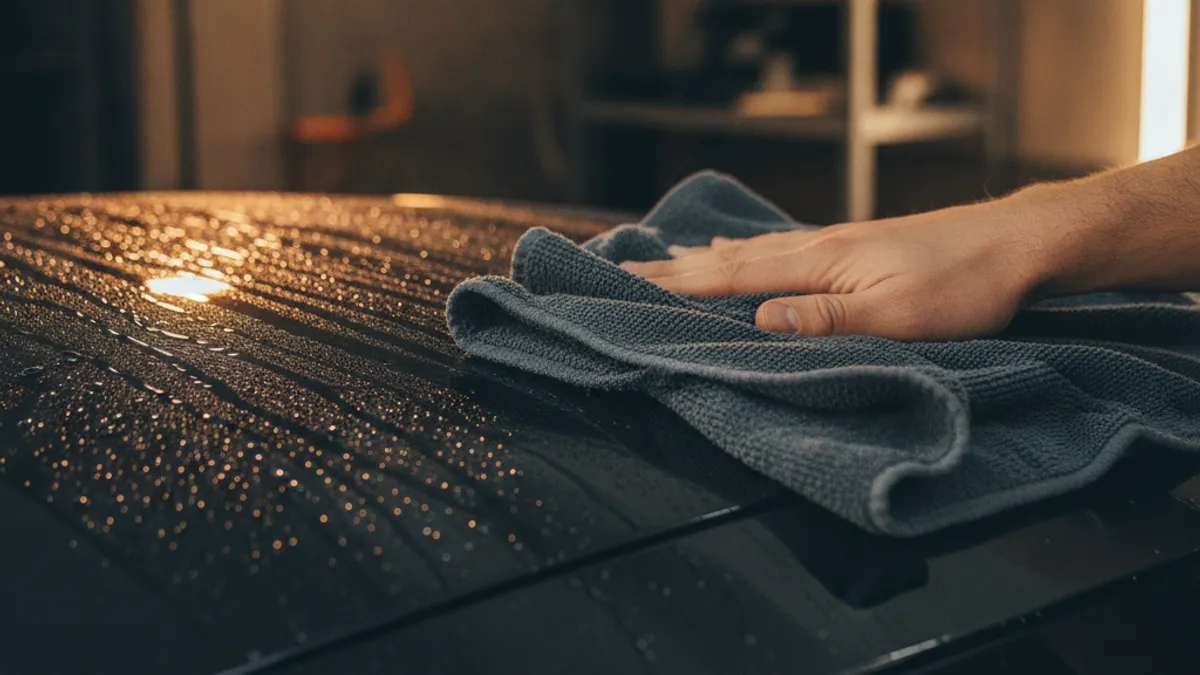
The correct drying technique:
Use a large, clean microfibre drying towel, preferably with a waffle weave that absorbs large amounts of water. Instead of dragging, lay the towel gently on the wet surface and pat. Let the towel absorb the water, lift it, turn it to the dry side and repeat. Work panel by panel, from the roof downwards.
An alternative is an air blower (leaf blower or dedicated car dryer) that blows the water off without any contact with the paint. This is the safest method and increasingly popular among people who take care of their cars. It is especially useful for hard-to-reach areas such as mirrors, trim and door jambs, where water lingers and drips onto a freshly dried surface.
After drying, inspect the paint under angled light. If you see circular marks or dulling, that is a sign something in the washing process was not right. Preparing your car for summer heat and regular bodywork inspections can help you catch problems before they become serious.
Found scratches on the paint after washing? With regular maintenance and proper technique you can prevent new ones, and for existing damage get in touch for an assessment so we can see what can be fixed without a full respray.
Frequently Asked Questions
How often should you wash your car to avoid paint damage?
Once every two weeks is a good rhythm for most drivers in BiH. If the car is parked outdoors and exposed to dust, pollen or bird droppings, you may need to wash more often. The key is that every wash is done correctly, because one improper wash causes more damage than a month of sitting idle.
Does a sponge damage paint more than a microfibre wash mitt?
Yes. A sponge has a flat surface that pushes dirt particles ahead of it across the paint. A microfibre wash mitt has a dense fibre structure that traps particles within itself and does not return them to the surface. Professional detailers use microfibre exclusively and consider the sponge an outdated tool for washing bodywork.
Can a pressure washer damage the paint?
It can, if you hold the nozzle too close (under 15 cm) or aim it at a sharp angle towards panel edges, around stickers or at areas where the paint is already damaged. At a distance of 30-40 cm with a fan nozzle, a pressure washer is safe and extremely useful for the pre-rinse.
What should you do if swirl marks have already appeared on the paint?
The only way to remove swirl marks is machine polishing. Polishing removes a thin layer of clear coat, thereby levelling out the scratches. Deeper scratches require multi-stage polishing. This is not a DIY job because excessive polishing can cut through the clear coat entirely. After polishing, always apply a protective coating to preserve the result.
Does a ceramic coating protect against wash scratches?
A ceramic coating increases surface hardness and provides additional protection, but it is not impenetrable. A car with a ceramic coating can still get scratches if you wash it with a dirty sponge and skip the pre-rinse. The coating makes washing easier because dirt adheres less strongly, but it does not replace proper technique.
Why is a black car harder to keep looking clean?
Black paint does not attract more dirt than a light colour. The difference is visibility. On a black surface every swirl mark, every water spot and every micro-scratch reflects light differently from the surrounding paint and becomes visible. On a silver or white car the same scratches exist, but they are harder to notice with the naked eye.