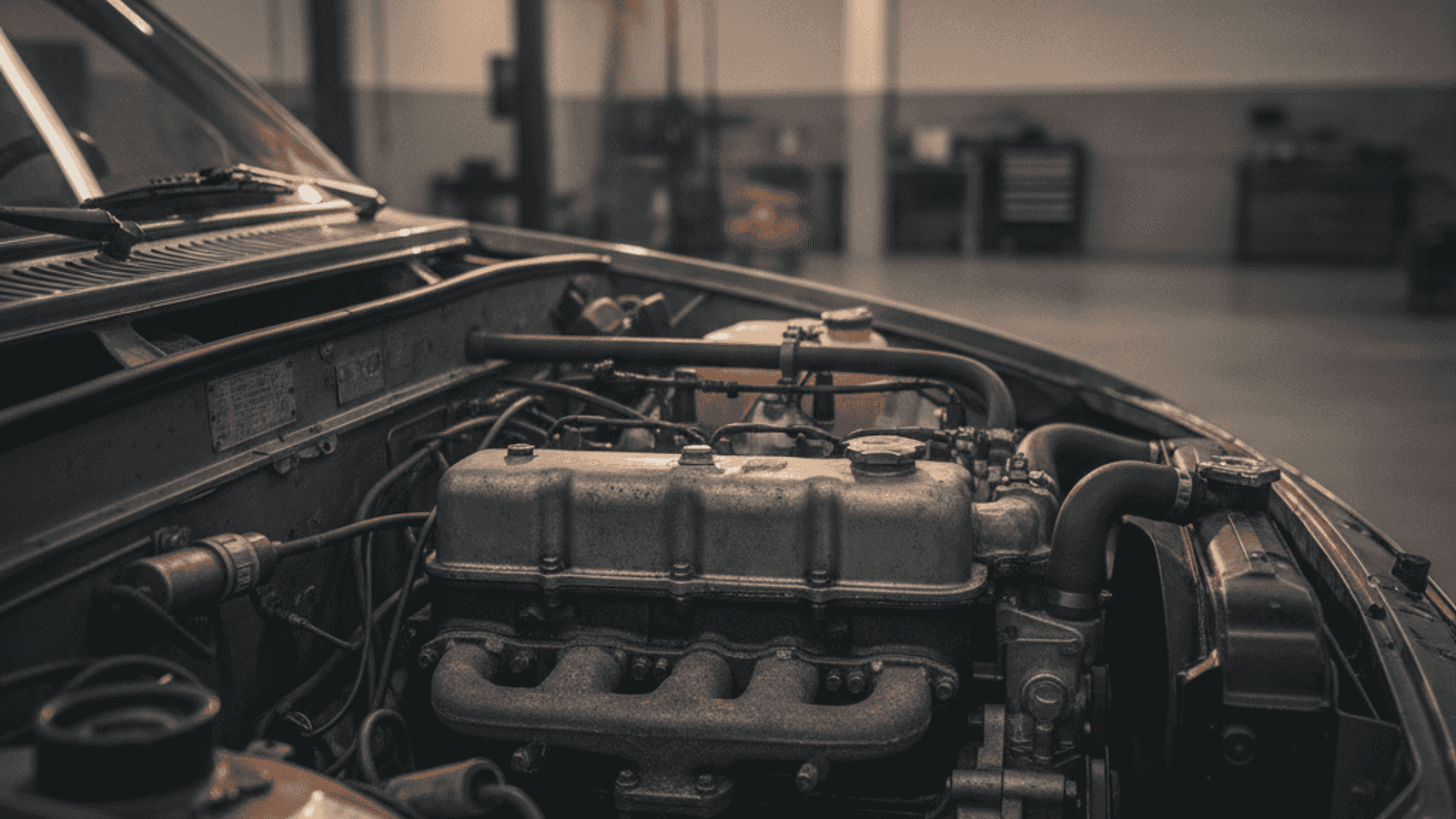
In the US alone, fire departments respond to nearly 196,000 vehicle fires annually, resulting in 579 deaths and $2.2 billion in direct damage. BiH has no dedicated statistics, but regional data from Serbia and Croatia confirms the same pattern: summer is the season when cars catch fire most often. The reason is not heat alone. High temperatures accelerate the onset of faults that have been quietly progressing under the bonnet for months without the owner noticing. A worn fuel hose that finally gives way at engine temperatures of 90 to 100 degrees, degraded cable insulation that causes a short circuit, oil dripping onto a hot exhaust manifold. This guide covers the specific causes, warning signs, six checks every driver can perform at home, a step-by-step extinguishing procedure, and everything about the fire extinguisher that is not legally required in BiH but should be in every car.
This guide was compiled by the Auto Gas Gaga workshop in Banja Luka, drawing on years of experience servicing older European cars.
Table of Contents
- Why Cars Catch Fire in Summer and How Common It Is
- Five Most Common Causes of Car Fires
- Warning Signs Before It's Too Late
- Six Checks That Prevent Fire on a Used Car
- What to Do If Your Car Catches Fire
- Car Fire Extinguisher: Which One to Choose
- Insurance and Vehicle Fire in BiH
- Frequently Asked Questions
- Related Articles
Why Cars Catch Fire in Summer and How Common It Is
There is a common misconception that summer heat itself sets cars on fire. That is not true. High temperatures merely accelerate a process that started much earlier. A rubber hose already cracked from age at 25 degrees might last another season. At 40 degrees ambient and 95 degrees under the bonnet, that same hose can fail within a week. The same logic applies to cable insulation, fuel system gaskets, and rubber components beneath the bonnet.
The American NFPA reports that mechanical failures — not collisions — cause roughly 45% of all vehicle fires. Fuel leaks, electrical short circuits, and component overheating are the three leading causes. Most fires occur while the car is parked or in normal driving, not during a crash. This means prevention is in the hands of the driver and mechanic, not chance.
BiH has no centralised vehicle fire statistics, but regional media in Serbia regularly report waves of car fires during July and August. Every summer the same pattern: older used cars, neglected maintenance, heat as the final trigger. The problem is identical across the Balkans because we drive the same fleet, of the same age, with the same maintenance habits.
Five Most Common Causes of Car Fires
Oil Leaks onto a Hot Engine as a Fire Cause
The most common scenario we see in practice: oil slowly leaking from the valve cover gasket or crankshaft seal drips onto the hot exhaust manifold. On engines with 200,000-plus kilometres on the clock, this is almost the rule. A drop of oil on a manifold whose surface temperature is 300 to 400 degrees Celsius does not ignite immediately but produces smoke and a burning smell. If the leak worsens, the drip becomes a stream, and then an open flame is only minutes away.
The problem is that owners often live with a minor oil leak for years. They top up half a litre between services, wipe the stains off the driveway and do nothing about it. Then summer arrives, the engine runs at higher temperatures, and the amount of oil on the manifold reaches a critical level.
Worn Fuel and Coolant Hoses
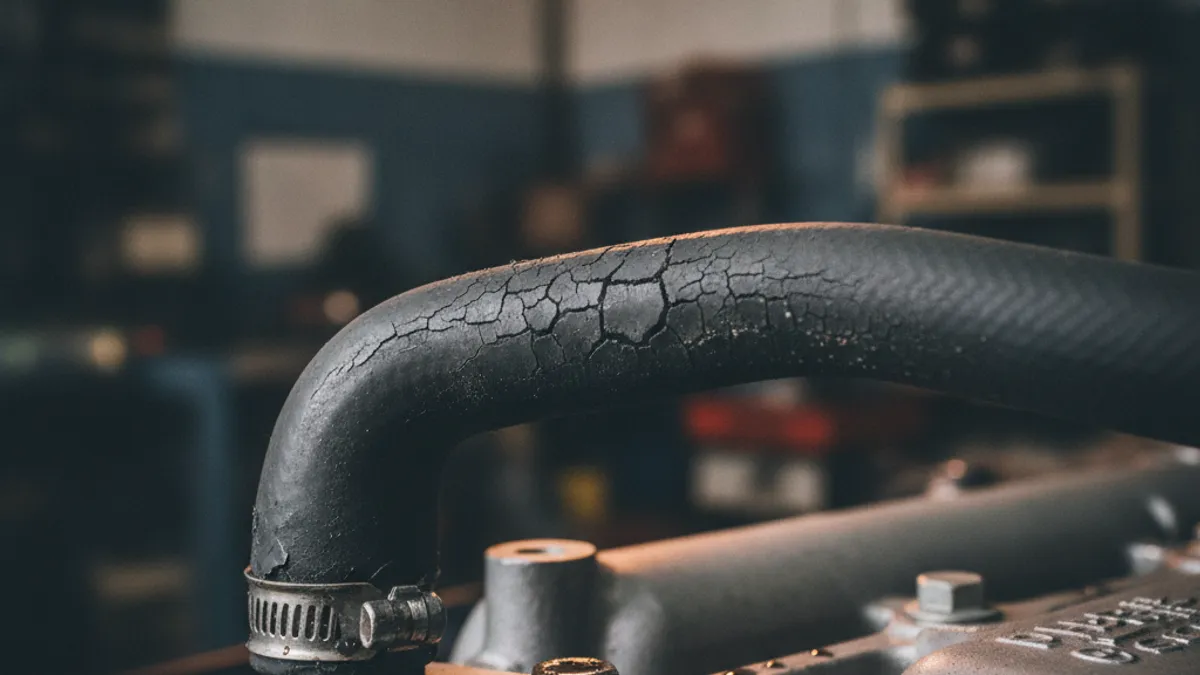
Rubber hoses on engines aged ten years or more are a potential time bomb. Pressurised fuel spraying onto hot metal engine parts is the fastest path to a fire. Fuel hoses on older petrol engines are particularly risky because petrol evaporates faster than diesel and ignites more easily. A single cracked hose at engine temperatures of 90 to 100 degrees can rupture and start a fire in under one minute.
Coolant hoses do not carry flammable fluids (antifreeze is difficult to ignite), but their rupture leads to overheating, and overheating can cause deformations that open a path for oil or fuel to reach hot surfaces.
Electrical Wiring and Short Circuits
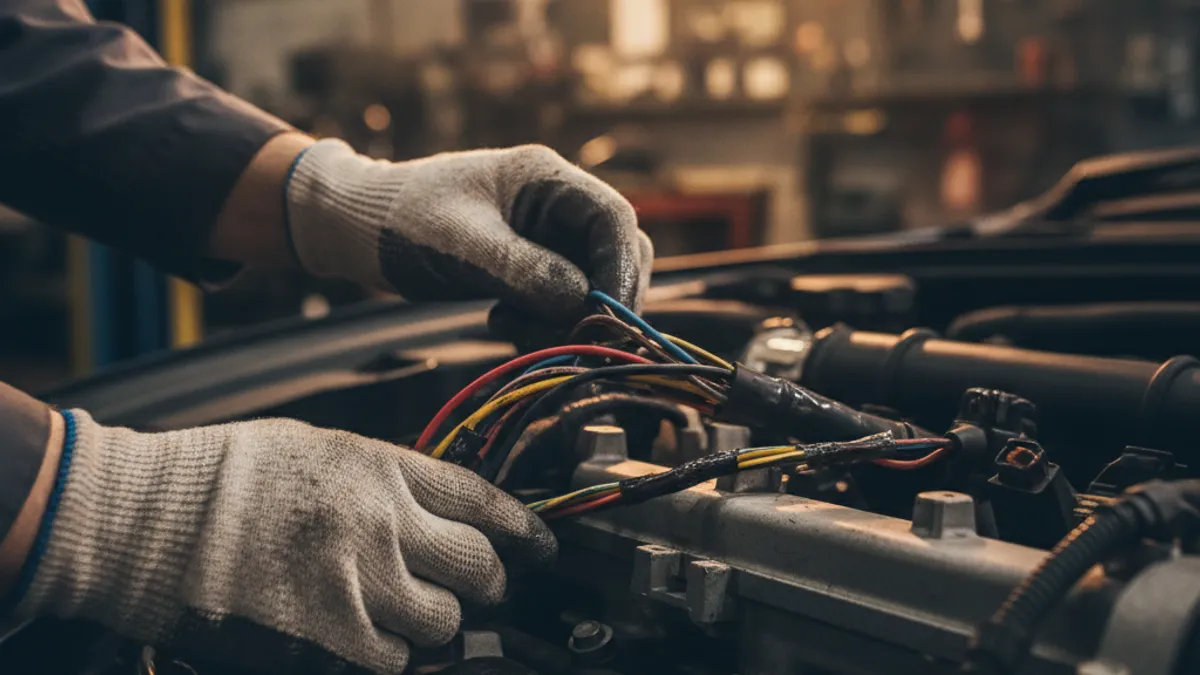
Older cars have hundreds of metres of wiring under the bonnet, beneath the dashboard, and along the entire body. Insulation dries out and cracks with age and heat. When two bare wires touch or a damaged wire makes contact with ground (a metal body part), a short circuit occurs. A short circuit generates enormous heat in a small area — enough to ignite surrounding plastic and insulation. If the fuse is faulty or bypassed with wire, the protective mechanism is gone and the fire spreads unchecked.
Aftermarket devices pose a particular risk: alarms, amplifiers, LED strips, seat heaters. When installed by someone unfamiliar with the vehicle's wiring diagram, wires are joined without fuses, without heat-shrink sleeves, and without respecting the correct cable cross-section. That is a ticking time bomb.
Clogged DPF Filter and Ignition Risk
On older diesels with a DPF (diesel particulate filter), there is a specific risk. When the filter clogs, the ECU initiates regeneration — a process in which exhaust gas temperatures rise well above normal levels to burn off soot. If regeneration is frequent and incomplete, if the driver mostly does short urban trips, or if the ECU cannot complete the cycle, exhaust system temperatures can climb to dangerous levels. A car parked on dry grass or leaves may generate enough heat to start a fire from the outside.
Aerosol Cans in a Sun-Heated Car and Explosion Risk
This is the least discussed cause, yet it can be dangerous. Pressurised aerosols — including deodorants, air fresheners, cleaning products, and spray sunscreen — can explode when the temperature inside a closed car exceeds 40 degrees. In direct sunlight, the cabin can reach 70-plus degrees within an hour. An aerosol explosion can shatter glass, ignite upholstery, or trigger a chain reaction if a lighter or another aerosol is nearby.
The rule is simple: nothing pressurised stays in the cabin during summer. Not in the glove box, not in the seat pockets.
Warning Signs Before It's Too Late
A car fire rarely happens without warning. There are almost always signs that precede the flames, but the driver ignores or fails to recognise them.
Burning smell. If you smell burning rubber, plastic, or oil while driving or after parking, that is the clearest sign something is wrong. Do not assume it is coming from another car. Pull over somewhere safe and look under the bonnet.
Smoke under the bonnet that is not steam. Steam from the cooling system is white, light, and disperses quickly. Smoke from oil on the manifold is darker, thicker, has a distinctive smell, and does not dissipate quickly. If you see smoke that is not steam and the engine has not overheated, there is a strong probability that something is leaking onto a hot surface.
Oil stains under the car. Every new stain in your parking spot deserves attention. A dark stain under the engine could be oil, power steering fluid, or fuel. Fuel is recognisable by its smell — it is a clear liquid and evaporates quickly. A fuel leak is an emergency: do not drive the car to a workshop; have it towed.
Unstable electrical behaviour. Flickering lights, fuses that blow frequently, a burning plastic smell from around the dashboard — all signs that somewhere in the system a wire is losing its insulation and making intermittent contact with ground.
Overheating with no visible cause. A temperature gauge that climbs while the antifreeze level is fine may mean a faulty thermostat, but it can also mean that airflow through the engine bay is blocked, raising the temperature of all components — including hoses and wiring.
Six Checks That Prevent Fire on a Used Car
This is the part you can do yourself, in your driveway, without tools, in twenty minutes. If you find any of the following, take the car to a workshop before setting off on a longer journey.
Check 1: Fuel hoses. Open the bonnet and locate the hoses running from the fuel filter to the engine (petrol cars) or from the filter to the common-rail rail (diesels). Squeeze them with your fingers. They should be firm yet flexible. If they are hard and cracked, or soft and sticky, it is time for a replacement. Pay attention to the fittings — that is usually where leaks start.
Check 2: Cooling system hoses. Same rule. Rubber hoses running to and from the radiator are under pressure and at temperatures around 90 degrees. Swollen, soft hoses, or those showing white crystalline deposits at the joints (antifreeze residue), need replacing.
Check 3: Oil traces on hot parts. Look beneath the valve cover, around the turbo (if fitted), and around the bottom of the engine. Oil traces are dark, greasy, and usually visible to the naked eye. If you see oil dripping or spreading toward the exhaust manifold, that is a workshop priority.
Check 4: Cable insulation condition. Inspect the thick cables running from the battery and the thinner wires around the engine. Insulation must not be cracked, worn, or stripped. Pay particular attention to the ground cable to the body and the positive cable to the alternator. On older cars, these cables are often neglected yet carry high current.
Check 5: Battery. Cable terminals on the battery must be clean and tight. Corrosion (white-green deposits) on the battery posts increases resistance, and resistance generates heat. In hot weather, this can lead to the cable and surrounding plastic overheating. Clean the posts and coat them with petroleum jelly or contact spray.
Check 6: Cabin. Remove all aerosol cans, lighters, cleaning-product bottles, power banks, and anything containing a lithium battery or under pressure from the car. These items must not remain in a closed car in the sun.
What to Do If Your Car Catches Fire
This is a procedure you need to know in advance. When smoke and flames appear, there is no time for deliberation or searching for advice.
Step 1: Pull over safely and turn off the engine. As soon as you notice abnormal smoke, find the nearest safe spot and turn off the engine. Do not stop at a petrol station; do not halt in the middle of the road without warning. Switch on your hazard lights, pull over safely, and remove the key.
Step 2: Evacuate all passengers. Everyone out of the car, immediately. Move at least 30 metres from the vehicle. If the car is burning, there is a risk of fuel tank, plastic component, and tyre explosions. Do not go back for documents or a phone.
Step 3: Call the fire service. In BiH, the fire service number is 123. Describe your location and state that a vehicle is on fire. While you wait, do not attempt to fight a fire that has spread beyond the engine bay.
Step 4: If you have a fire extinguisher, use it correctly. If the fire is in its early stage (smoke, small flames under the bonnet) and you have a fire extinguisher, you can attempt to put it out. But there is one critical rule: do not open the bonnet suddenly. The rush of oxygen can cause the fire to flare up instantly. Prepare the extinguisher, raise the bonnet slightly (just enough to insert the nozzle), and aim the powder at the base of the flame. Use short bursts, not one long squeeze.
Step 5: If the fire persists, back away. A 1 kg extinguisher provides roughly 6 to 8 seconds of active discharge. If the fire is still burning after the first extinguisher, leave the area and wait for the fire service. Your life is worth more than any car.
Car Fire Extinguisher: Which One to Choose
In BiH, a fire extinguisher is not legally required for private passenger vehicles. It is mandatory for buses and commercial vehicles. The fine for missing mandatory equipment in BiH ranges from 30 to 100 KM, but that fine applies to equipment that is mandatory (warning triangle, reflective vest, spare tyre), not to a fire extinguisher.
Nevertheless, every car should carry one. One kilogram of ABC dry powder in a small extinguisher can put out a fire in its early stage and prevent a total loss. Here is what to know when choosing.
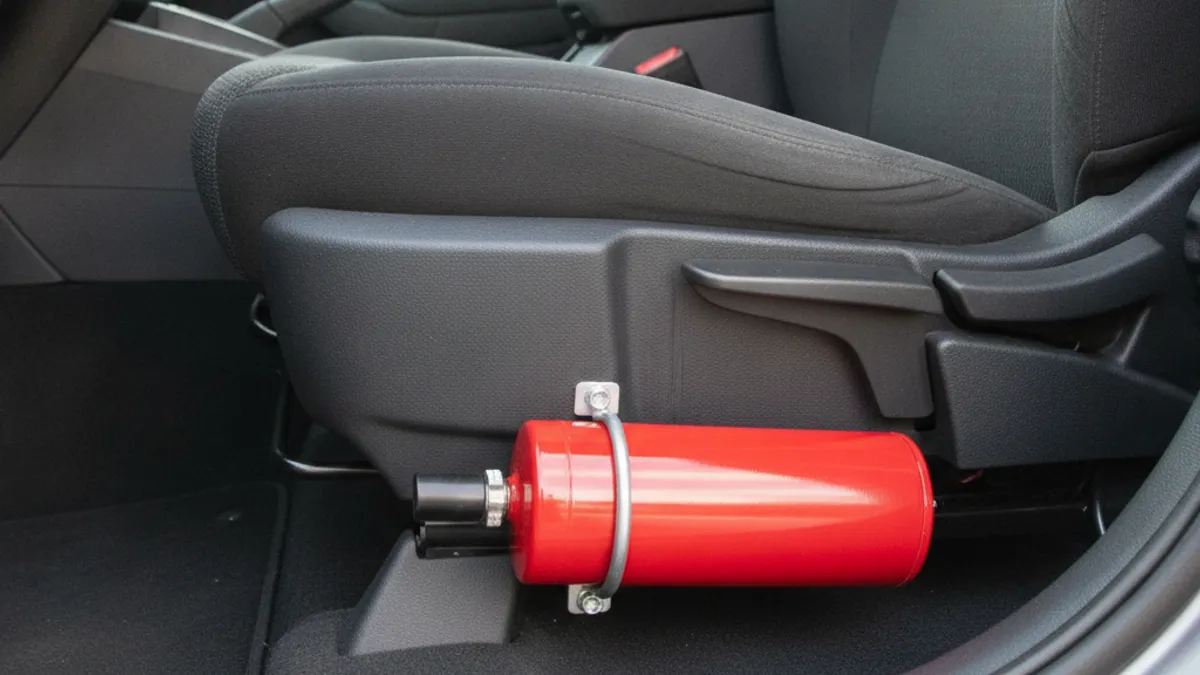
ABC dry powder, 1 kg. The most common type for passenger vehicles. Extinguishes Class A (solid materials), Class B (flammable liquids), and Class C (gases) fires. Compact and fits under the seat. Drawback: the powder makes a mess of the interior and engine bay and is difficult to clean up.
CO2 extinguisher with a separate cartridge. More reliable than models with a permanent-pressure cylinder because the cartridge maintains pressure independently of the valve. Leaves no residue on the extinguished material. Drawback: more expensive, somewhat larger, and does not fight Class A fires as effectively as powder.
Which Fire Extinguisher to Buy and How Much It Costs
For most drivers, a 1 kg ABC dry powder extinguisher is perfectly adequate. The price varies by manufacturer and retailer. Get in touch for a recommendation — in practice we see that quality varies. The extinguisher should be serviced once a year, usually at the end of summer or beginning of autumn. The service date is marked on the label.
Where to keep the extinguisher? Under the driver's seat, secured with a strap or bracket. Never in the boot — in the event of an engine bay fire you do not have time to walk around the car, open the boot, and dig the extinguisher out from under luggage. Under the seat means it is within reach in three seconds.
Insurance and Vehicle Fire in BiH
A vehicle fire is an insured event, but only under certain conditions. Basic motor third-party liability insurance (compulsory insurance) does not cover fire damage to your own vehicle. It covers damage you cause to others.
Does Insurance Cover a Car Fire in BiH
For fire damage to your own car to be covered, you need comprehensive (casco) insurance or supplementary fire cover. Casco policies usually cover fire, but with several important caveats.
First, the insurer will look for evidence that the fire was not caused by gross negligence. If the car was in an obviously defective state — if a mechanic documented a fuel leak and the owner ignored it — the policy can be disputed.
Second, vehicle age affects the payout. Casco on a car older than ten years typically carries a high depreciation rate, meaning the payout may be significantly lower than the car's market value.
Third, procedure matters. Call the fire service and police to the scene. Wait for the official report. Photograph the vehicle before moving it. Report the damage to your insurer within the deadline stated in the policy (usually 3 to 7 days). Without fire service and police reports, a damage claim has no basis.
One practical tip: if you drive an older car worth less than a few thousand KM, casco often does not make financial sense. But a fire extinguisher that prevents a total loss always pays for itself.
Frequently Asked Questions
Can a car catch fire on its own while parked?
Yes. Roughly 45% of vehicle fires occur while the car is parked or in normal driving, not during a crash. The most common causes in a parked car are an electrical short circuit (especially if the battery is not disconnected), fuel leaking onto hot engine surfaces that are slowly cooling, or an explosion of pressurised items in an overheated cabin. This is why it is important not to park on dry grass in summer and to remove aerosol cans and lighters from the cabin.
How fast does a car fire spread?
Faster than most people expect. From the first small flames to the entire engine bay being engulfed can take 3 to 5 minutes. Once fire reaches the cabin, the car can burn out completely in 10 to 15 minutes. That is why the first 60 seconds are critical. If you have a fire extinguisher and the fire is in its early stage, you have a realistic chance of putting it out.
Is a fire extinguisher mandatory in a car in BiH?
No, a fire extinguisher is not legally required for private passenger vehicles in BiH. It is mandatory for buses and commercial vehicles. The fine for missing mandatory equipment is 30 to 100 KM, but it applies to the warning triangle, reflective vest, and first-aid kit. A fire extinguisher is a matter of common sense and a recommendation from every workshop, including ours.
Can engine overheating cause a fire?
Engine overheating on its own does not mean fire. An engine that overheats typically suffers head gasket damage and may develop deformation and antifreeze leaks. But if overheating is accompanied by oil or fuel leaking onto hot parts, the transition from a mechanical fault to an open flame is short. That is why you should always stop when overheating occurs, turn off the engine, and check whether there is also a leak.
What if I don't have a fire extinguisher and my car is on fire?
Turn off the engine immediately, evacuate all passengers, and move at least 30 metres away. Call the fire service on 123. Do not attempt to fight the fire with bottled water or clothing. Water on fuel and oil makes the situation worse. Covering a small flame with earth or sand can help, but only if the fire is truly in its earliest stage. In every other case, distance is the only safe decision.
Does an LPG car have a higher fire risk?
No, a properly installed and serviced LPG system does not carry a higher fire risk than a petrol fuel system. LPG tanks are engineered to withstand temperatures and pressures well above normal operating conditions. They have a safety valve that releases gas in a controlled manner if pressure exceeds the permitted limit. The risk only increases if the installation is unprofessional, if hoses are damaged, or if the system is not serviced. At the Auto Gas Gaga workshop, every LPG system undergoes a complete inspection, including a leak test and safety valve check.