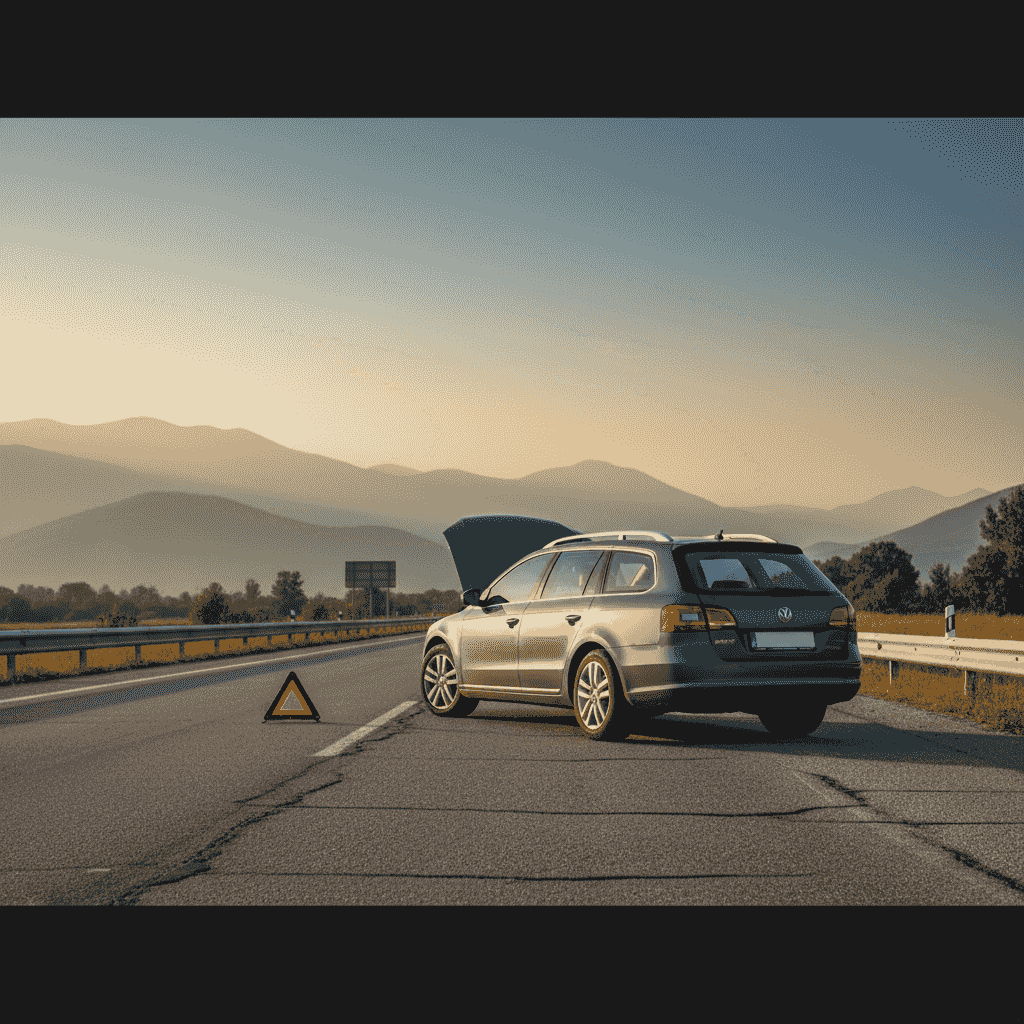
ADAC logged almost 3.7 million roadside-assistance calls in 2025, and in nearly every other case (45.4%) the culprit was the 12V battery. The most common roadside breakdowns are no mystery - six things bring drivers to a stop year after year, and most of them give warning signs days in advance. This guide walks through those six, the first symptoms, and what to do when one strikes.
This guide was put together by the Auto Gas Gaga workshop in Banja Luka, based on ADAC 2026 statistics and our experience preparing vehicles for summer trips.
Table of Contents
- Statistics on What Most Often Stops You
- 1. Battery and 12V System: Nearly Every Other Breakdown
- 2. Engine Overheating and the Cooling System
- 3. Tyres: Punctured, Burst or Aged
- 4. Alternator and Starter: When You Cannot Set Off
- 5. Fuel and AdBlue: Faults We Cause Ourselves
- 6. Air Conditioning and Small Faults That Ruin a Trip
- What to Carry in the Car So a Breakdown Does Not Become a Drama
- Five Checks the Day Before Departure
- Frequently Asked Questions
- Related Articles
Statistics on What Most Often Stops You
Every year ADAC publishes the call statistics from its "Yellow Angels" - the cleanest picture available of what stops a driver on a European road. For 2025 it logged almost 3.7 million interventions, an annual increase of 1.6%. The breakdown: 12V battery 45.4% of all faults, engine and engine electronics 21.8%, tyres 8.9%. Three things explain more than three quarters of every callout.
The American AAA, which helps around seven million drivers a year in the summer months, picks out the same three summer culprits: engine overheating, tyre blowouts, and a flat battery. Those figures are from 2017 and are not directly comparable with newer ADAC data, but the categories overlap. The most common roadside breakdowns are largely not new technologies but things that had been giving warning signs for weeks before they finally failed.
The six sections that follow are ordered by how likely each one is to stop you: symptoms, what to do, and what to check before you leave.
1. Battery and 12V System: Nearly Every Other Breakdown
Nearly every other call for assistance is the battery. It does not fail overnight; it loses capacity over months, and at one point - usually a cold morning or after two hours with the air conditioning running - it no longer has enough to turn the starter.
Typical signs are slow cranking in the morning, headlights dimming when you switch on the blower, occasional "phantom" warnings on the dashboard that disappear after a restart, and the central locking unlatching for no reason while the car sits parked. There is more detail in our guide on how to spot a battery near the end of its life, and on the difference between AGM and conventional batteries in our AGM/EFB battery guide.
How to Test the Battery with a Multimeter Before a Trip
With the engine off for 8 hours or more, measure the voltage across the terminals: a healthy battery shows at least 12.55 V, ideally between 12.6 and 12.9 V (Bosch Car Service recommendation). Below 12.2 V the battery is no longer reliable on the motorway. With the engine running, the voltage at the terminals should be between 13.8 and 14.4 V; lower means a weak alternator, higher means a faulty voltage regulator. Bosch warns that a battery often gives no sign of imminent failure, so a multimeter test is the only reliable check. If the battery is more than four years old, take it for a load test before a summer trip.
What to do if it leaves you stranded: if the car will not start and the starter "clicks" once and goes silent, it is most likely the battery. Jump-starting from another car with cables works in most cases. If the car starts and then immediately dies, or you smell something acidic from the battery, the battery needs replacing. The price depends on the specific case - get in touch for a quote.
2. Engine Overheating and the Cooling System
Overheating is the second most common summer fault and the most dangerous of all: HAK warns that a small problem in the morning can turn into a written-off engine by the evening. The main causes are a stuck thermostat, a faulty radiator fan, coolant loss from cracked hoses or a leaking gasket, and a failed water pump.
The first sign is the temperature gauge passing the halfway mark in city traffic and creeping towards three quarters. The second is a falling coolant level in the expansion tank. The third is a sweet, sticky smell under the bonnet after driving (antifreeze vapour from a micro-crack). A more detailed guide is in our article on the radiator, thermostat and engine temperature.
What to Do When the Engine Overheats on the Motorway
The moment the gauge enters the red, move into the right-hand lane, switch off the air conditioning, turn the heater up to maximum (paradoxically, it pulls heat away from the engine), and find the hard shoulder. Do not switch the engine off straight away - on the hard shoulder leave it idling for 5 to 6 minutes so the pump keeps the coolant circulating.
Once the gauge drops, switch the engine off and open the bonnet (do not lean over the radiator - the coolant is under pressure). Never open the expansion tank cap while it is hot. Do not restart the engine. The car must be towed to a workshop, because restarting with a faulty cooling system can end with a blown head gasket.
3. Tyres: Punctured, Burst or Aged
Tyres are responsible for almost 9% of all breakdowns according to ADAC, but they are first in real-world danger. The main causes of summer tyre failure are under-inflation, sidewall damage from a kerb, excessive age (five years or more, even with good tread), and an overloaded vehicle with family and luggage on board.
Check tyre pressure when the tyres are cold, in the morning before you leave. The correct pressure is on the placard inside the door jamb - with a fully loaded boot use the "full load" figure (usually 0.2 to 0.3 bar higher). More on this in our guide tyres: pressure, maintenance and signs for replacement. The legal minimum tread depth is 1.6 mm, but for a summer motorway run it is reasonable to insist on at least 3 mm.
A Tyre Has Burst While Driving: What Now
Hold the steering wheel firmly with both hands, do not make any sudden movements, ease off the throttle (do not brake hard), and let the car slow itself. Switch on the hazard lights. Only use the brake once the speed drops below 50 km/h.
Once you have stopped, put on the high-visibility vest before you get out of the car and place the warning triangle at least 100 metres behind the vehicle. Only then take out the spare wheel. If you have no experience changing a wheel on the side of a motorway, do not be embarrassed to call for assistance. Check the pressure in the spare wheel before you set off too - the classic mistake is for a driver to lift the boot floor only when they actually need it.
4. Alternator and Starter: When You Cannot Set Off
Drivers often confuse the alternator, the starter, and the battery, and end up paying to replace the wrong one. The battery stores electricity, the alternator charges it while you drive, and the starter is the electric motor that cranks the engine when you start. We cover the difference in detail in our guide alternator and starter: symptoms of failure.
How to Tell the Alternator Is Failing
The classic sign of a weak alternator is headlights at night that dim and brighten in time with engine revs, or the red battery warning light flickering on the dashboard, especially at idle. The second sign is a new battery that needs charging every few days. The third is a whining noise from the alternator that rises with engine speed.
A weak starter looks different: the car starts normally but occasionally (once every twenty starts or so) turning the key produces only a "click" even though the battery shows the correct voltage.
What to do: if the alternator fails while driving, the battery will keep things going for another 30 to 60 minutes - enough to get you off the motorway. Switch off the air conditioning, the radio, and any non-essential lights. If the starter fails, jump-leads will not help; calling for assistance is the only option.
5. Fuel and AdBlue: Faults We Cause Ourselves
In the workshop this is its own category because these are faults the driver creates: an empty tank, the wrong fuel (diesel in a petrol car or vice versa, especially at filling stations abroad), and AdBlue that has not been topped up. On modern diesels, driving on the reserve can suck sediment from the bottom of the tank, clog the fuel filter, and damage the high-pressure pump. Rule of thumb: as soon as you drop below a quarter of a tank, refuel at the next station.
AdBlue Warning on the Road: Can I Carry On
Every diesel from roughly 2015 onwards (especially models from 2017 and later) has a separate AdBlue tank of 12 to 24 litres, with its own blue filler neck. Without the fluid the diesel cannot meet the Euro 6 standard, and the on-board computer counts the kilometres down to a full no-start lockout. There is a detailed write-up of the system in our guide AdBlue and the SCR system on diesel engines, and BiH-specific repair pricing in our AdBlue 2026 guide.
If the AdBlue warning lights up, carry on driving and top up at the next major service station. AdBlue is sold in 5 or 10 litre cans across the region. Do not mix it with fuel or with windscreen washer fluid. If the counter falls below 100 km, do not switch the engine off - in that case the car will not restart until it has AdBlue. The wrong fuel can only be dealt with by draining the tank; do not start the engine.
6. Air Conditioning and Small Faults That Ruin a Trip
Air conditioning is not statistically the most dangerous fault, but it is psychologically the worst - few families want to repeat a trip in 38 degrees with no air conditioning. The most common problem is low refrigerant, the second is a clogged cabin filter, and the third is a worn compressor clutch.
If the air conditioning has lost cooling power before a trip, do not wait until you reach the seaside to find an empty system. We cover seasonal air-conditioning service and price ranges in BiH in our guide to car air-conditioning service in BiH 2026.
The "small faults that ruin a trip" category also includes blown bulbs, worn wiper blades (in a downpour above the Velebit pass that is not cosmetic, that is safety) and an empty washer-fluid reservoir. All three are sorted in 15 minutes the morning before you leave.
What to Carry in the Car So a Breakdown Does Not Become a Drama
The mandatory equipment in BiH and neighbouring countries is not bureaucratic box-ticking. The high-visibility vest and the warning triangle are the difference between a safe roadside stop and being hit by another vehicle on the hard shoulder.
- High-visibility vest within the driver's reach, not in the boot
- Warning triangle (on the motorway at least 100 metres behind the vehicle)
- First-aid kit within its expiry date (checked at the border)
- Spare bulbs
- Jack and wheel brace plus a serviceable spare
- A 5-litre can of AdBlue if the car is a Euro 6 diesel and the trip is over 1,500 km
- Jump leads and a phone car charger
Some destinations also require chains, a second triangle, or a tyre repair kit instead of a spare. The country specifics are in our guides for Croatia, Montenegro, Italy, Greece, Slovenia and Austria, and Turkey.
Five Checks the Day Before Departure
The British AA publishes five checks that they run with drivers ahead of the season - the list is universal and applies just as well to a departure from Banja Luka in May.
- Tyres - pressure on all four plus the spare, tread depth, a visual check of the sidewall for cracks, year of manufacture (DOT code on the sidewall - first two digits the week, second two the year; tyres older than five years are a risk regardless of tread).
- Fluids - engine oil, antifreeze, washer fluid, brake fluid, AdBlue if it is a Euro 6 diesel.
- Lights and wipers - all lights working, wiper blades wiping without streaks, washer jets working.
- Battery - clean terminals with no white powder, multimeter test as described above.
- Fuel level - a full tank before departure. Filling stations along the route can be further apart than they look on the map.
The checks take 20 to 30 minutes. The cost of the alternative - towing off the motorway, an unplanned overnight stay, a missed reservation - is serious enough to make those 30 minutes worth it. If you are travelling with small children, it is also worth reading what extra to check and how to prepare the car for a trip with kids.
Spotted a suspicious symptom before your trip? Book a pre-trip inspection or message us on WhatsApp - half an hour in the workshop beats five hours on the hard shoulder.
Frequently Asked Questions
What Is the Most Common Motorway Breakdown in Summer?
According to ADAC statistics for 2025, the battery is the cause of 45.4% of all breakdowns. Second most common are problems with the engine and engine electronics (21.8%), and third are tyres (8.9%). In summer the battery is put under additional load by the air conditioning and high temperatures.
Can I Keep Driving with an Overheating Engine to Reach a Petrol Station?
No. The moment the temperature gauge enters the red, the car needs to be stopped, the engine left to idle for 5 to 6 minutes with the air conditioning off, then switched off and not restarted. Driving with an overheating engine for just a couple of minutes can destroy the head gasket and the engine itself. The car must be towed to a workshop.
What Should I Do If a Tyre Bursts While Driving?
Hold the steering wheel firmly with both hands, do not make any sudden movements, gently ease off the throttle and let the car slow down. Switch on the hazard lights and gradually move towards the hard shoulder. Only use the brake once the speed drops below 50 km/h. Once stopped, put on the high-visibility vest before getting out of the car and place the warning triangle at least 100 metres behind the vehicle.
Can I Carry On Driving If the AdBlue Warning Light Comes On?
Yes, while the counter still shows 1,000 km or more to lockout. Top up AdBlue at the next major service station - it is sold in 5 or 10 litre cans across the region. AdBlue has its own blue filler neck; do not mix it with fuel. If the counter falls below 100 km, do not switch the engine off.
What Is the Mandatory Equipment for a Trip to the Coast?
A high-visibility vest within the driver's reach, a warning triangle, a first-aid kit within its expiry date, spare bulbs, a jack and wheel brace, and a spare wheel or tyre repair kit at the correct pressure. Some destinations also require chains or a second triangle - check the country-specific details in our country guides.