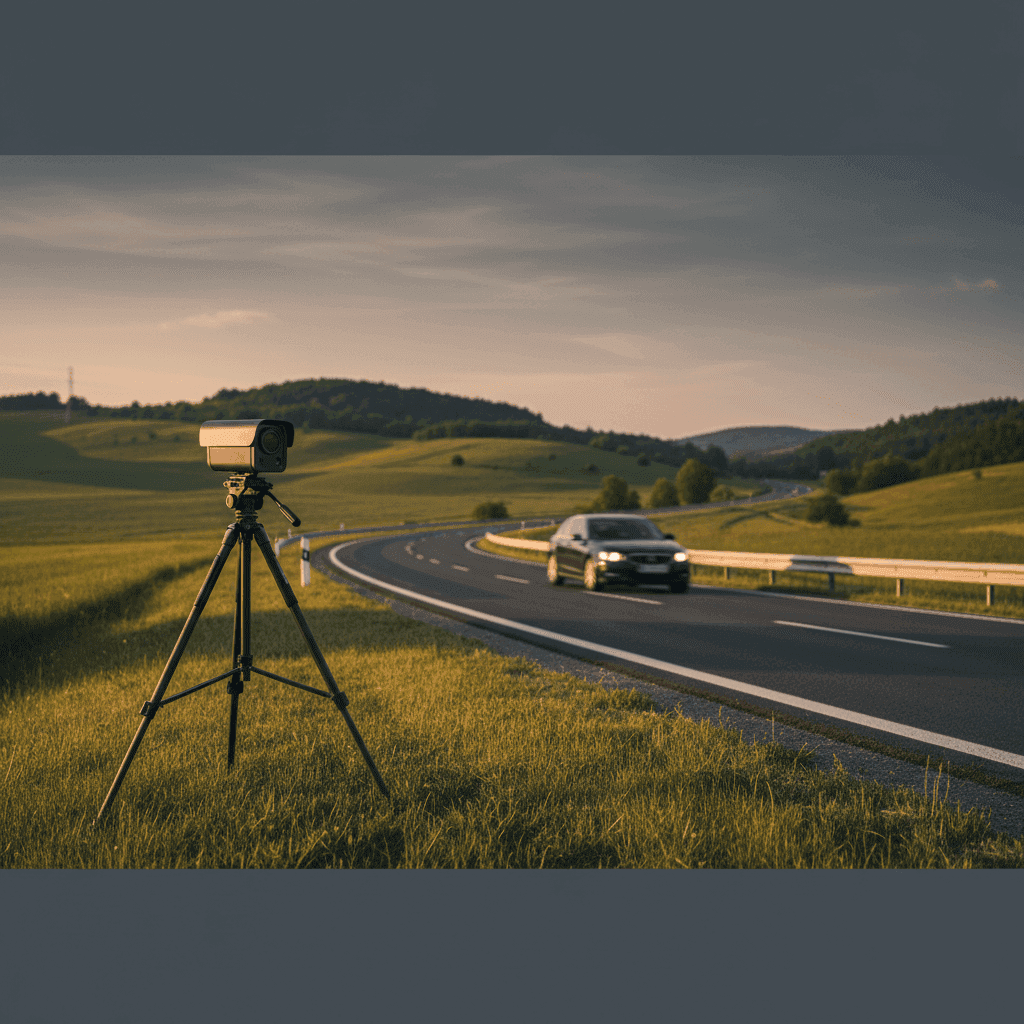
Fifteen km/h over the limit in central Banja Luka, thirty on the road to Karlovac, then a hundred euros fine in Maribor. Speeding fines in BiH in 2026 can be mild, but the moment you cross the border, the figures climb, and in Austria and Italy they can run into thousands of euros. This is a guide covering BiH and the eight countries a Bosnian driver most often passes through.
This guide was put together by the Auto Gas Gaga workshop in Banja Luka, with a focus on what a Bosnian driver can realistically expect at a roadside check or at the border on the way back.
Table of Contents
- Speed Limits in BiH and What the Law Actually Says
- Speeding Fines in BiH 2026
- Penalty Points and Driving Bans in BiH
- Special Categories: Alcohol, Young Drivers, Professionals
- Croatia on the Way to the Coast
- Serbia and the 50 Percent Discount for Quick Payment
- Montenegro and New Prison Threats
- Slovenia and the Fast Track to a Suspended Licence
- Austria Among the Strictest in Europe
- Germany, Flensburg and Fahrverbot
- Italy, the Autostrada and the Night-Time Doubling
- Hungary and Cameras Without Tolerance
- What to Do Before and After a Speeding Fine
- Frequently Asked Questions
- Related Articles
Speed Limits in BiH and What the Law Actually Says
In BiH two layers of regulations apply at the same time. The first is the federal Law on the Basics of Road Traffic Safety in BiH (ZOBS), which applies across the whole country and prescribes basic limits and minimum fines. The second is the Republika Srpska Law on Road Traffic Safety, which tightens certain penalties for the RS territory, especially for serious offences. In practice, the same speed in Banja Luka and in Tuzla does not necessarily lead to the same fine.
The basic speed limits in BiH, set by the federal ZOBS:
- In built-up areas the limit is 50 km/h, unless a sign says otherwise (often 30 or 40 in residential zones).
- On open roads (outside built-up areas) the limit is 80 km/h for passenger vehicles.
- On expressways that are not motorways, 100 km/h.
- On the motorway 130 km/h, as confirmed by JP Autoceste FBiH.
A young driver (B category for less than two years) is not allowed to exceed 110 km/h even on a motorway. Vehicles with trailers and trucks over 3.5 tonnes have lower limits. Snow and fog mean the driver is expected to adapt on their own.
Speeding Fines in BiH 2026
The table below brings together amounts from the federal ZOBS as a general framework for the whole of BiH, with the note that Republika Srpska prescribes stricter amounts for serious offences. The figures are taken from publicly available fine overviews (kakokako.com snapshot 05/08/2025, kazne.ba snapshot 29/01/2026).
| Excess speed | Fine (FBiH/federal) | Fine (RS, for serious offences) | Penalty points | Driving ban |
|---|---|---|---|---|
| Up to 10 km/h | around 30 KM | similar to federal | 0 | none |
| 11-20 km/h | around 50 KM | similar to federal | 0-1 | none |
| 21-30 km/h | around 100 KM | similar to federal | 2 | up to 1 month |
| Over 30 km/h in built-up area | 100-300 KM | 400-1,000 KM | 2 or more | 1-4 months |
| Over 50 km/h outside built-up area | 100-300 KM | 400-1,000 KM | 2 or more | 1-4 months |
The gap between the federal range and the RS range can be drastic. A driver in Banja Luka caught doing 95 km/h in a built-up area (45 km/h over the limit) realistically faces a fine at the upper end of the RS range, a one to four month licence suspension, plus penalty points entered into the record.
Two things often get overlooked. First, speeding fines in BiH 2026 are not applied to the raw measured speed, but to the measured speed after the legally permitted radar tolerance is deducted (in BiH, the practice is to deduct 3 to 5 km/h). Second, if the police hand you a report on the spot, that is not the final ruling but a charge submitted to the misdemeanour court, where the amount and any mitigating circumstances are debated.
Penalty Points and Driving Bans in BiH
BIHAMK confirms that penalty points are kept in a unified record and that, at a certain threshold, the driver automatically loses their licence. The logic is similar to the German Flensburg system: every serious offence carries points, they accumulate, and once a certain number is reached, suspension follows.
How Many Penalty Points for Speeding in BiH
The rule under the federal ZOBS and the RS Law on Road Traffic Safety:
- Up to 20 km/h over the limit: as a rule no penalty points, only a fine.
- 21-30 km/h: 2 penalty points and a short driving ban (up to 30 days).
- Over 30 km/h in a built-up area or 50 km/h outside: 2 or more points, plus a 1-4 month ban.
- Very serious offences: 5 or more points, with an immediate driving ban.
When Penalty Points Are Deleted
Points stay on the record for 1 to 2 years from the date they were issued, depending on entity-level rules. If you do not pick up a new offence in that period, the old ones are gradually deleted. Once the threshold is reached (in practice 18 points for most drivers, fewer for young drivers and professionals), the licence is taken away for at least 30 days, and in serious cases permanently, requiring a psychophysical test and a re-sit of the driving exam.
Special Categories: Alcohol, Young Drivers, Professionals
Three groups of drivers pay more. A young driver (B category for less than two years) drives under a 0.0 promille rule; a combination of alcohol plus speeding doubles the amounts. A professional (C, D, E, taxi drivers, bus drivers) also drives at 0.0 promille and with stricter limits because the offence is compounded with their responsibility for passengers. Anyone who repeats a serious offence within a year almost always gets a ban at the top of the legal range.
The worst combination is speeding, alcohol over 0.8 promille, and refusing a breath test. That is no longer a fine but a criminal offence, where prison sentences come into play.
Croatia on the Way to the Coast
Croatia is the country a Bosnian driver passes through most often, and the Croatian Ministry of the Interior (MUP) has published its amounts clearly. In built-up areas the fines are:
- Up to 10 km/h over the limit: EUR 30.
- 10-20 km/h: EUR 60.
- 20-30 km/h: EUR 130.
- 30-50 km/h: EUR 390-920 plus possible penalty points.
- Over 50 km/h in a built-up area: EUR 1,320-2,650, or up to 60 days in jail in aggravating circumstances.
The Croatian measurement tolerance is set: 10 km/h for measured speeds up to 100 km/h, or 10 percent for anything over 100 km/h. That tolerance is deducted before the fine is issued; meaning, on the motorway you might see 138 km/h on the radar, but the fine is issued for 124 km/h.
A Bosnian driver in Croatia can pay the fine on the spot. If paid within a short window (usually 8 days), the amount can be lower. If unpaid, the driver enters the Register of Unpaid Fines, and at the next border crossing can be stopped and brought before a misdemeanour court, which can convert the fine into a short prison term. The statute of limitations in most EU countries is 4 years.
Serbia and the 50 Percent Discount for Quick Payment
Serbia has a legal provision that works in a Bosnian driver's favour: the fine can be paid with a 50 percent discount if settled within 8 days of being issued. The amounts are in dinars:
- Up to 20 km/h in a built-up area: 3,000-5,000 RSD (around EUR 25-45), no penalty points.
- 21-50 km/h in a built-up area: 6,000-20,000 RSD (around EUR 50-170), with a minimum of 4 penalty points.
- 51-70 km/h in a built-up area: 15,000-30,000 RSD (around EUR 130-255), 7 points, short ban.
- Over 70 km/h in a built-up area: 30-60 days in jail, 14 points, licence revocation.
The amounts come from an overview published 15/01/2025 (zelenisignal.rs). The 50 percent discount does not apply to serious offences that go to court. A Bosnian driver stopped in Serbia is almost always offered the chance to pay on the spot and avoid later complications with the Register of Unpaid Fines.
Montenegro and New Prison Threats
Bosnian drivers used to see Montenegro as a soft zone for years, but that is no longer true. The Law on Road Traffic Safety, adopted on 24/01/2019, prescribes a mandatory prison sentence for speeding by 70 km/h or more in a built-up area, or 90 km/h or more outside, alongside drastically increased fines. Amounts as of the 2019 snapshot (volimpodgoricu.me, source date 24/01/2019, more recent amendments possible):
- Up to 20 km/h over the limit: around EUR 60-120.
- 21-30 km/h: around EUR 150-250.
- 31-50 km/h: EUR 250-500 plus licence revocation.
- Over 50 km/h in a built-up area (60 km/h outside): heavy fines and a mandatory ban.
- 70 km/h or more in a built-up area (90 km/h or more outside): a mandatory prison sentence.
Montenegrin amounts are subject to revision; check the latest snapshot before travelling. The border crossings with BiH (Hum, Šćepan Polje, Sitnica) and the coastal road from Herceg Novi to Bar are where checks happen most often, especially in summer.
Slovenia and the Fast Track to a Suspended Licence
Slovenia is consistent in its fines and converts speeding into points that quickly lead to licence suspension. On the motorway, per the overview from 12/09/2024 (n1info.si):
- Up to 10 km/h over the limit: EUR 40.
- 10-30 km/h: EUR 80.
- 30-40 km/h: EUR 160.
- 40-50 km/h: EUR 250 plus 3 penalty points.
- 50-60 km/h: EUR 500 plus 5 penalty points.
- Over 60 km/h: EUR 1,200 plus 9 penalty points.
An accumulation of 18 penalty points leads to licence suspension; just two more extreme offences (over 60 km/h, 9 points each) can strip a Bosnian driver of Slovenian licence validity. Slovenia also has a mandatory vignette, which compounds: driving without a vignette plus speeding is paid double.
Austria Among the Strictest in Europe
Austria further tightened its fines in March 2024. Per the overview from 15/04/2024 (mautwelt.de), for severe speeding over 60 km/h in town or over 70 km/h outside town, the fine can reach EUR 7,500 (the previous upper limit was EUR 5,000). For more moderate cases:
- Up to 20 km/h over the limit: EUR 30-70.
- 20-30 km/h: EUR 70-150.
- 30-50 km/h: EUR 150-300.
- Over 50 km/h: EUR 300 and up, to the upper limit of EUR 7,500, with vehicle impoundment in extreme cases.
Austrian police are not lenient with BiH plates. The fine is usually paid on the spot in cash or by card; if the driver cannot pay and has no Austrian address, the vehicle can be impounded until payment is made. A vignette is mandatory on motorways and expressways, and the fine for driving without one is an additional EUR 120 or more.
Germany, Flensburg and Fahrverbot
Germany uses the Bußgeldkatalog system for fines, points in Flensburg for the record, and Fahrverbot (driving ban) for serious speeding. Per the catalogue in force from 01/01/2026 (bussgeldinfo.org):
- Up to 10 km/h in a built-up area: EUR 30.
- 11-20 km/h: EUR 50-70.
- 21-25 km/h: EUR 115 plus 1 point in Flensburg.
- 26-30 km/h (outside built-up area or in a 30 zone): EUR 180, 1 point, possible 1 month ban.
- 31-40 km/h: EUR 260, 2 points.
- Over 50 km/h: EUR 480-800, 2 points and a mandatory 1-3 month ban.
Points in Flensburg start at 1, and at 8 points the licence is taken away. A Bosnian driver who is not a German resident also enters the Flensburg system if the offence was committed on German territory. The German radar tolerance is 3 km/h for speeds up to 100 km/h, or 3 percent above, which is stricter than in Croatia.
Italy, the Autostrada and the Night-Time Doubling
On 14/12/2024 Italy introduced amendments to the Codice della Strada that hit Bosnian drivers directly. Per the overview from 20/01/2025 (dwfgroup.com):
- Up to 10 km/h over the limit: EUR 42-173.
- 11-40 km/h: EUR 173-694.
- 41-60 km/h: EUR 545-2,182, 1-3 month licence revocation.
- Over 60 km/h: EUR 845-3,382, 6-12 month revocation.
The most important new rule: fines double if the offence is committed between 22:00 and 7:00. In practice, a Bosnian driver doing 150 km/h on the autostrada at night (limit 130) is looking at a doubled fine. On top of that, the Italian ZTL (Zona a Traffico Limitato) in city centres triggers a separate fine for every entry without a permit; those fines arrive by post months after you have returned home. The radar tolerance in Italy is 5 percent, with a minimum of 5 km/h.
Hungary and Cameras Without Tolerance
Hungary is particularly harsh on Bosnian drivers because it combines densely placed cameras with almost no tolerance above the limit. Per the overview from 10/03/2025 (schillerrent.hu), camera-issued amounts are:
- Up to 10 km/h over the limit: 30,000 HUF (around EUR 75).
- 11-25 km/h: 45,000-60,000 HUF (around EUR 115-150).
- 26-35 km/h: 90,000 HUF (around EUR 225).
- 36-45 km/h: 130,000 HUF (around EUR 325).
- 46-65 km/h: 200,000 HUF (around EUR 500).
- 65-75 km/h: 260,000 HUF (around EUR 650).
HUF to EUR is approximate and moves with the daily rate. A Hungarian camera does not deduct any tolerance the way the Croatian MUP does; the moment you go 1 km/h over the limit, the system snaps you. Drivers crossing Hungary most often pay in the EUR 75-225 range because they fail to notice that, in roadwork zones, the limit has dropped to 80 km/h instead of 130.
What to Do Before and After a Speeding Fine
Before the trip. Look up current amounts for the countries you will pass through (the source date is essential, do not rely on articles from 2019 if they quote 2026 figures). Check vignettes for Slovenia, Austria and Hungary, because the combination of driving without a vignette and speeding costs double. An inspector who pulls you over for speed often also checks the equipment (tyres, lights, hi-vis vest, warning triangle), which can push the amount up further.
At the moment of the check. Ask for the report in your own language (in BiH, Croatia and Slovenia you can get one). Check the measured speed on the device and the exact location of the measurement. Do not argue about the amount on the spot; that is the misdemeanour court's job, not the officer's. Paying on the spot or within a short window almost always brings a discount (50 percent in Serbia, shorter windows in Croatia and Italy).
After the fine, if it is large or disputed. In BiH you have the right to appeal to the misdemeanour court within the period stated in the report, usually 8 days. In Croatia and Slovenia the same. If you do not pay a fine from abroad, you enter that country's register of unpaid fines, which can catch up with you at the next border crossing, even 4 years later.
To make sure the vehicle is ready for the trip and can pass any equipment check, it is worth doing a pre-trip inspection and a timely roadworthiness inspection before setting off. If you are heading to the coast through Slovenia and Austria, it is also worth checking vignettes and equipment for Slovenia and Austria in 2026, because vignette fines stack on top of speeding fines.
Frequently Asked Questions
How big is the fine for going 30 km/h over the limit in a built-up area in BiH?
Under the federal ZOBS the fine is in the 100-300 KM range, with 2 penalty points and a driving ban of 1 to 4 months. In Republika Srpska the fine for the same offence ranges from 400-1,000 KM, which is significantly stricter than the federal minimum.
Can a Bosnian driver pay on the spot in Croatia?
Yes, the Croatian MUP explicitly provides for on-the-spot payment with a discount if the fine is settled within 8 days. If unpaid, you are entered into the Register of Unpaid Fines, which on your next entry into Croatia can mean being brought before the misdemeanour court.
What is the radar tolerance in BiH and Croatia?
In Croatia the tolerance is set: 10 km/h for measured speeds up to 100 km/h, or 10 percent for over 100 km/h, which is deducted before the fine is issued. In BiH the practice is to deduct 3 to 5 km/h, depending on the device and the measurement method, but there is no strict regulation.
When are penalty points deleted in BiH?
Penalty points in BiH are kept on record for 1 to 2 years from the date issued, depending on entity-level rules. If you do not get a new offence in that period, the old ones are gradually deleted. An accumulation of around 18 points leads to automatic suspension of the driving licence.
What if I do not pay a fine abroad?
You enter that country's register of unpaid fines. The statute of limitations in most EU countries is 4 years, which means at the next border crossing during that period you can be stopped, brought before a misdemeanour court, and in extreme cases the fine can be converted into a short prison term. The best solution is to pay on time or to file an appeal.
Which is the strictest country in Europe for speeding?
By the size of the fines, Austria is among the strictest, with an upper limit of EUR 7,500 since March 2024 for serious offences. Italy is also strict, especially with the 22:00-7:00 night-time doubling. Montenegro has prison sentences for speeding by 70 km/h or more in a built-up area.