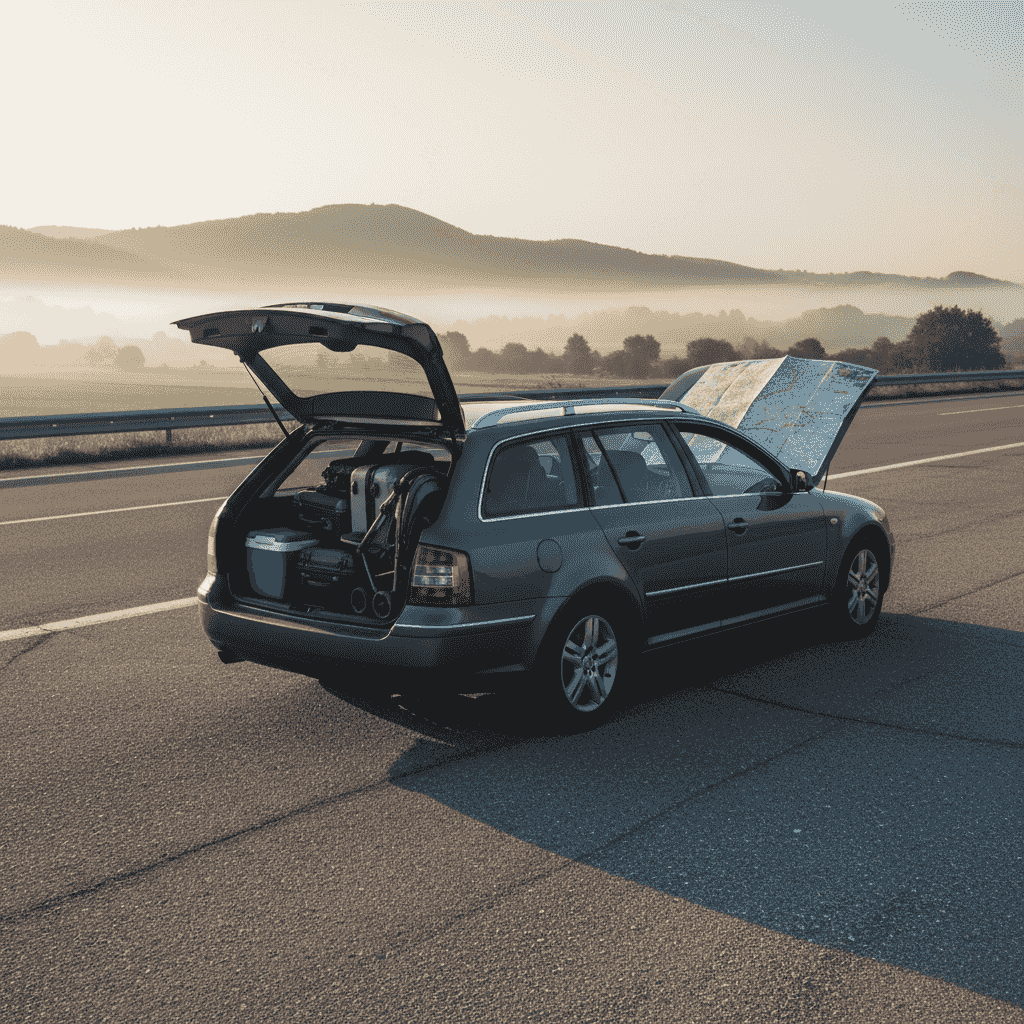
A driver from Banja Luka, Sarajevo or Mostar preparing to drive from BiH in 2026 needs to have the same short list ready: documents for the countries they pass through, vignettes and tolls for the routes they use, equipment as required by law and a properly prepared car. This complete guide ties together everything we have published for the 2026 season in our series on car preparation and destinations, with concrete numbers, dates and workshop advice. Wherever you need to go deeper, there is a link to a more detailed tier guide for that destination or topic. We checked prices and rules in May 2026, but you should always verify them on the official portals just before departure, since vignettes and tolls can change mid-season.
This guide was prepared by the Auto Gas Gaga workshop in Banja Luka, based on BIHAMK sources, official portals (DARS, ASFINAG, HGS, Egnatia Odos), ADAC breakdown statistics for 2026 and our workshop experience preparing vehicles for summer trips.
Table of Contents
- State of BiH Summer Travel in 2026
- Guide by Destination
- Documents and Equipment by Country
- Vignettes, Tolls and ENC by Country
- Vehicle Preparation Before the Trip
- AC, Tyres and Battery Before Departure
- Travelling with Children and Mandatory Car Seats by Country
- Most Common Breakdowns on the Road and How to Prevent Them
- Frequently Asked Questions
- Related Articles
State of BiH Summer Travel in 2026
The 2026 summer season looks different than it did a few years ago, on three concrete points that any BiH driver should notice before pulling the car out of the driveway.
First, paperwork for the EU has genuinely become easier. For most countries BiH drivers head to for holidays (Croatia, Slovenia, Italy, Austria, Greece, Hungary), the registration plate is sufficient proof of international insurance, because BiH participates in the so-called MGA regime of the Council of Bureaux. In practical terms, this means you do not have to bring a green card to the Croatian border, and the border police will not ask for one. The plate serves as proof, and the compulsory insurance policy you hold in BiH automatically covers those countries as well. You still must carry a green card (IMIC) only for eight countries, and of those that we frequently visit, primarily Albania, North Macedonia and Turkey.
Second, vignettes and tolls in 2026 are noticeably more expensive. Austria raised its vignette price by about 2.9 percent in January 2026; the annual paper sticker costs 106.80 EUR, the 10-day version 12.80 EUR (the most common option for BiH summer trips), and 2026 is the last year the paper version can be bought, since from February 2027 only the digital version will be available. Slovenia froze prices at the 2025 level, with the weekly e-vignette at around 16 EUR, monthly at 32 EUR and annual at 117.50 EUR. The Greek toll on Egnatia Odos has risen nearly a quarter since 1 January 2026; the full route from Igoumenitsa to Evros now costs 30.45 EUR instead of the old 24.45 EUR, and tariffs are also rising on other Greek motorways. Bulgaria froze the e-vignette at last year's level, with weekly at 7.67 EUR and monthly at 15.34 EUR. The Turkish HGS system has not raised prices, but since 2025 it is fully electronic, must be bought in advance at a petrol station or post office, and must be loaded with a minimum of about 60 TL credit. Italy has not changed its tariffs but has expanded the Free Flow regime to A33, A36, A59 and A60, sections without physical barriers where the driver must pay within 15 days or face fines.
Third, more serious roadside breakdowns are not rare, and the statistics confirm it. According to ADAC's Pannenstatistik for 2026, published in April, the battery is the cause of 45.4 percent of all roadside callouts, the engine and electronics together 21.8 percent, and the alternator, starter and lighting another 10.4 percent. Tyres account for 8.9 percent, with everything else combined (transmission, brakes, auxiliary systems) about 13 percent. In total, close to 3.7 million callouts in a year, around 1.6 percent more than in 2025. The battery and AC can ruin half your holiday, and the breakdown breakdown shows clearly which parts a driver can influence with a pre-trip inspection. That is why skipping vehicle preparation is unwise, since around two thirds of the risk of a breakdown on the road is eliminated by a quality workshop check before departure.
In addition to these three trends, BiH drivers in 2026 also have one piece of news in their favour: tariffs on Croatian motorways still offer a 21.74 percent seasonal discount for ENC device users, category IA package S, which for a long trip from Banja Luka to Split or Dubrovnik is undisputed savings compared to paying at the toll booth.
Guide by Destination
Every BiH driver has their own "go-to" destination. Some go to Neum or Makarska every summer, some to Montenegro, some to Greece or Turkey. What follows is a synthesis, but each destination also has a dedicated tier guide with concrete numbers for borders, route sections, ZTL zones, specific fines and tested routes. Open the one you need before you leave.
Coast in general (Croatia, Montenegro and Greece, summarised without going into individual destination details): Driving from BiH to the Coast 2026 - documents, vignettes and equipment. The best choice if you have not yet decided where to go, or if you are visiting several destinations in the same season and need a quick overview.
Croatia (the most common BiH destination, focusing on ENC, tolls, summer border peak and mandatory equipment): Driving from BiH to Croatia 2026 - documents, equipment, advice. This tier guide goes into all the details you need for routes from Banja Luka towards Split, Zadar, Šibenik or Makarska.
Montenegro (Sozina tunnel, Šćepan Polje and Sitnica border crossings, summer fines, equipment): Driving from BiH to Montenegro 2026 - border, toll, equipment. Montenegro is unique in having no national vignette; instead, individual sections are tolled (Sozina around 2.50 EUR per direction, Bar - Boljare motorway 1.50 to 3.50 EUR per section).
Greece (Egnatia Odos, tolls at 11 booths between Thessaloniki and Athens, two competing routes through North Macedonia or Bulgaria): Driving from BiH to Greece 2026 - documents, vignettes and tolls. Greece in 2026 has become measurably more expensive for transit due to the Egnatia price rise, especially for those used to driving the full Igoumenitsa - Evros route.
Italy (routes through Slovenia or Croatia, Free Flow A33 and A36, ZTL zones in Rome, Florence, Milan): Driving from BiH to Italy 2026 - documents, equipment and advice. The tier guide explains in particular Free Flow tolling, which in 2026 expanded to more motorways and is becoming the biggest trap for drivers without a Telepass device. ZTL zone fines run from 80 to 300 EUR plus rental admin fees of 30-50 EUR if you are driving a hired car.
Slovenia + Austria (the most common transit route for everyone going to Italy, Germany or Croatia via Slovenia, or further north): Slovenia Austria Vignette 2026 - vignettes, equipment, fines. The tier guide also covers the so-called section toll in Austria, paid separately on top of the vignette (Tauern 15 EUR, Brenner 12.50 EUR, Gleinalm 12 EUR, all increased from 1 January 2026), as well as the Karawanken entry from Slovenia (around 8.80 EUR per direction).
Turkey (the only popular destination where the green card is mandatory, plus the specific HGS system that cannot be bought at the border): Driving from BiH to Turkey 2026 - documents, equipment, advice. The route from Banja Luka to Istanbul is around 1,350 km through Serbia and Bulgaria, and you must buy the HGS sticker at a Shell, Petrol or PTT station in advance.
AC checked before the trip (a service post that complements all destination guides, since the car AC must cool when faced with summer rain and 35 degrees): Car AC Service in BiH 2026 - when to do it and how much it costs. It explains in detail the difference between R134a and R1234yf gas, how to recognise a proper service from a cheap "top-up", and why a 30+ minute vacuum cycle is the difference between quality service and a compressor failing on arrival in Pelješac.
If you are driving through North Macedonia, Albania, Hungary or Slovakia, we have not covered them with tier guides, but for specific sections and toll stations rely on BIHAMK service information. The central source for tolls in 28 European countries is the BIHAMK toll portal, which we use in our workshop as the primary source whenever someone asks about a route through a country we do not cover with a dedicated guide.
Documents and Equipment by Country
The most common confusion among BiH drivers: they think they need a green card for Croatia or Italy, when they really only need to check whether their compulsory insurance policy covers travel abroad. According to the BiH Council of Bureaux, the BiH registration plate serves as proof of international insurance in all EU/EEA countries and in another 38 countries under the MGA regime. In practical terms, this covers everything you need for Croatia, Slovenia, Italy, Austria, Greece, Hungary, Slovakia, Czech Republic, Germany and France.
A green card (IMIC) is mandatory when entering eight countries: Albania, Azerbaijan, North Macedonia, Morocco, Moldova, Tunisia, Turkey and Ukraine. Of these, three are realistically relevant to us: Albania, North Macedonia and Turkey. If you are driving to Turkey or Albania, make sure to stop by your insurance company and get a green card before departure. It does not cost much, but without one you can be turned back at the border or pay for expensive border insurance, which is regularly several times more expensive than the regular green card.
In addition to the insurance policy, for any destination in the region you should always carry:
- Vehicle registration document in the driver's name or a notarised authorisation from the owner if the car is not yours (e.g. a parent's car). Border crossings increasingly check this document
- Driving licence. The BiH driving licence is valid in all the countries on this list, but for Turkey, Morocco and Albania it is wise to also carry an international driving permit, which can be issued in a few days at the BIHAMK office
- Comprehensive insurance policy if you have one (recommended, not a legal requirement)
- ID cards and passports for all passengers. A passport is mandatory for the EU, since BiH is not in the EU. Children must have their own passport or be entered in the passport of one of the parents
- Vignette or e-vignette purchased in advance for countries where it is mandatory (Slovenia, Austria, Hungary, Bulgaria, Czech Republic, Slovakia, Romania)
Equipment requirements are fairly uniform, but there are nuances. A practical table of what regulations require by country:
| Country | Green card | Vignette | Reflective vest | Triangle | Fire extinguisher | First aid kit | Spare bulb |
|---|---|---|---|---|---|---|---|
| Croatia | no | no | yes, for all passengers within arm's reach | yes | recommended | yes | recommended |
| Slovenia | no | yes, e-vignette | yes | yes | recommended | yes | yes |
| Austria | no | yes, paper or digital | yes | yes | recommended | yes per DIN 13164 | recommended |
| Italy | no | no (open tolling) | yes, for all passengers | yes | recommended | recommended | recommended |
| Montenegro | no | no (per section) | yes | yes | yes | yes | recommended |
| Greece | no | no (open tolling) | yes, S2 standard | yes | yes, 80 EUR fine if missing | yes | recommended |
| Bulgaria | no | yes, e-vignette | yes | yes | yes | yes | recommended |
| Turkey | yes, IMIC | no (HGS per section) | yes | yes | yes | yes | recommended |
| North Macedonia | yes, IMIC | no | yes | yes | yes | yes | recommended |
| Albania | yes, IMIC | no | yes | yes | yes | yes | recommended |
Worth remembering before departure: in Greece a fire extinguisher with the S2 marking is required (a smaller extinguisher does not count, fine 80 EUR), in Austria the first aid kit must conform to the DIN 13164 standard (not the older generation), and in Montenegro and Greece there are bans on entering inner city centres except for residents, similar to Italian ZTL zones. A more detailed paperwork protocol by destination and what exactly border police check is in each individual destination guide linked above.
Vignettes, Tolls and ENC by Country
The numbers you really need to know before leaving, for passenger vehicles up to 3.5 t and category 2A:
| Country | System | 2026 prices (approximate) | Note |
|---|---|---|---|
| Croatia | open tolling + ENC | per section, per kilometre | ENC package S gives 21.74 percent off in summer season |
| Slovenia | e-vignette (digital) | 16 EUR week, 32 EUR month, 117.50 EUR year | DARS portal evinjeta.dars.si, Škofija - Izola exempt |
| Austria | paper or digital vignette | 9.60 EUR daily, 12.80 EUR 10 days, 32 EUR 2 months, 106.80 EUR year | 2026 last year of paper, plus section toll |
| Italy | open tolling on motorways | around 9 EUR per 100 km, plus Free Flow A33 / A36 / A59 / A60 | ZTL zones in city centres, fines 80-300 EUR |
| Montenegro | Sozina tunnel and individual sections | Sozina tunnel around 2.50 EUR per direction, motorway 1.50-3.50 EUR | no national vignette |
| Greece | open tolling + Egnatia | Egnatia full route 30.45 EUR from 1.1.2026, Thessaloniki-Athens around 33.25 EUR | up 24 percent |
| Bulgaria | e-vignette | 4.09 EUR daily, 7.67 EUR weekly, 15.34 EUR monthly | check payment by SMS or online |
| Turkey | HGS (electronic only) | sticker 5 TL or card 15 TL, plus minimum credit around 60 TL | 15 day grace period, fine 10x toll |
| Hungary | e-vignette | 2,620 forints daily, 5,450 weekly | mandatory before entry, online |
European vignettes are most easily bought online an hour or two before departure. The Slovenian and Austrian digital vignettes are linked to the registration plate; you can buy them from your phone the day before and skip the petrol station. For Turkey, HGS is a different system: you must visit a Shell, Petrol or PTT station and buy a sticker or card, and load a minimum of about 60 TL credit. Without this, HGS automatically puts you in debt after entry, and you must pay within 15 days, otherwise the fine can be up to ten times the toll for the route, which for the Istanbul - Ankara motorway can amount to over 1,500 TL per vehicle.
ENC in Croatia is worth it for any BiH driver who travels to the Croatian coast at least once a year and crosses one of the longer motorway sections (Banja Luka - Split, Banja Luka - Zadar, Banja Luka - Dubrovnik). Package S for passenger vehicles returns 21.74 percent on all summer tolls, which means even a single Bosanska Gradiška - Vrgorac trip (which we typically do twice per season) without ENC costs noticeably more. The device is ordered from the HAC or Bina-Istra portal in advance, and credit top-up is done through the app.
Telepass in Italy has similar logic, but for most BiH drivers it is not worth getting for a single holiday. It is simpler to pay Free Flow tolls online, with the car's registration plate, within 15 days of crossing. Italian tolls are almost exclusively open type (you take a ticket on entry, pay on exit), but Free Flow A33, A36, A59 and A60 have no barriers and you must pay yourself.
A complete overview of tolls for all countries, with linked portals for payment and verification, is available on the BIHAMK toll portal, which we use in our workshop as the primary source whenever someone asks about a route through a country we do not cover with a dedicated guide.
Vehicle Preparation Before the Trip
A car for a summer trip is not the same as a city car. Open road, hot tarmac, full boot and family load, AC running for an hour without a break, sometimes a roof rack with bikes or a camper top box. All of this draws out weak spots you would not notice in everyday driving. We have two preparation packages. A minimal one you can do yourself in half an hour, and a recommended one done at the workshop ideally a week or two before departure.
Minimal package (do it yourself before departure or at the petrol station):
- Tyre pressure set to the value from the manual for FULL load, not for half. The difference is usually 0.2 to 0.3 bar, which on a summer trip to the coast with a full car means stability through corners and a shorter braking distance
- Tyre condition visually: tread depth (under 3 mm on a summer tyre is already the limit), sidewall cracks, uneven wear, year of manufacture on the DOT marking (tyres older than 6 years, even with sufficient tread, no longer have adequate grip)
- All fluids topped up: antifreeze at the expected operating temperature, engine oil between min and max, washer fluid, brake fluid not below min
- All bulbs working: low and high beam, all four indicators, brake lights, fog front and rear, plate light, third brake light
- Mandatory equipment in the car: a valid first aid kit (check the sterilisation date), an unbroken triangle, a reflective vest for all passengers within arm's reach (not in the boot), a spare wheel or repair kit with a working pump
Recommended package (done at the workshop, ideally 7 to 14 days before departure, since if the mechanic spots a fault that needs a part from abroad, you need the time):
- AC checked and recharged: cooling normally on low setting, compressor running quietly, no strange smell from the vents, cabin filter clean or replaced. Recharging with 30+ minutes vacuum and leak check takes a couple of hours
- Battery tested with a load tester which shows actual condition, not just voltage. A voltage meter shows resting voltage (12.55 to 12.9 V is normal), but a load tester shows how much the battery can actually deliver to crank the engine
- Brakes: front and rear pad thickness, disc condition (ridges, corrosion spots), brake fluid level and colour (darkened means replace), handbrake holds on a slope
- Timing belt or chain if you are near the interval. Do it BEFORE the trip, not after. A timing belt failure on the motorway is one of the most expensive scenarios (bent valves, engine repair 1,500-3,000 EUR)
- Oil and antifreeze leaks visible on the engine and underneath the car, easiest to spot from a cold start and lifting the car on a ramp
- AdBlue on diesels with SCR system: top up to max before the trip, since an empty AdBlue tank on an Italian or German motorway means the car enters "limp home" mode or will not start at the next ignition
A more detailed workshop checklist by component, in the order we work through it at Auto Gas Gaga, is in the tier post Preparing Your Car for Summer in BiH - checklist for drivers, which also covers what specifically the mechanic should do, and the difference between a city inspection and one for a 2,000 km trip.
AC, Tyres and Battery Before Departure
Three components carry around 70 percent of the breakdown risk on the road. According to ADAC data for 2026 (battery 45.4 percent, tyres 8.9 percent, plus AC which, although it does not damage the engine, seriously affects driver comfort and safety on hot tarmac), it is exactly these three items that pay off to check before departure. Briefly on each.
AC. Car AC loses gas even without a fault, around 10 to 15 percent per year. If the AC this summer is cooling weaker than last summer, the gas is lower than it should be and the compressor is overworking, which in the long run means a more expensive repair or compressor replacement. Recharging with a vacuum cycle and leak check takes a couple of hours during summer season; this is regular maintenance, not a fault. Modern car ACs use two types of gas: the older R134a (cars produced up to 2015, sticker usually in the engine bay) and the newer R1234yf (cars from 2017 mandatory). The price difference for the service is significant because R1234yf gas itself is several times more expensive, as is the equipment used for it. Details on the process, what to check, how to tell a proper service from a cheap "top-up from a can" and why the cabin filter should be replaced before the trip are in the tier post Car AC Service in BiH 2026.
Tyres. Before driving from BiH in 2026, first check the tread depth. Below 3 mm on a summer tyre, your safety margin on wet tarmac is already seriously reduced, and most accidents on the motorway towards the coast happen exactly during summer rain when wet surface response time is half a second slower. Set the pressure to the value from the manual for full load, not for solo driving. The difference visually is very small (the pump shows you 0.2-0.3 bar more), but that difference means stability through corners and prevents tyre overheating on 35 degree tarmac with a full car.
Also check the spare wheel. This is often forgotten, and a punctured tyre on the motorway with an empty spare is literally a halted holiday. A flat spare in the boot is a careless habit I see every season. If the car only has a repair kit (instead of a spare), check the expiry date of the sealant (often three to five years from manufacture) and that the pump works.
Battery. Top of the road breakdowns according to ADAC statistics. Summer heat dries out the electrolyte, the AC constantly loads the system, and a battery older than four to five years usually does not survive the summer peak. A workshop load test shows whether the battery is at its end or can still crank the engine, which a voltage multimeter alone cannot. If the car has not been starting properly in the last few weeks (you feel "heaviness" when cranking, brief starter whine), do not push it to the coast. Test it now. A more detailed technical guide to recognising a dying battery is in the advice How to Recognise a Dying Battery, which also covers the difference between AGM, EFB and classic lead-acid batteries.
In addition to these three components, also add a quick check of brakes and the cooling system, since long mountain descents (e.g. the descent to Pelješac, crossing Velebit) and an air-conditioned summer day seriously load both the radiator and the pads. A thermostat stuck open is often unnoticed at 30 degrees on the motorway, but in slow-moving traffic at a border crossing engine temperature spikes and the car overheats. The radiator should be clean of butterflies, leaves and dust, easiest done with a gentle compressed-air rinse at the workshop.
Travelling with Children and Mandatory Car Seats by Country
The car seat rule in 2026 is uniform across practically the whole EU around the R129 standard (i-Size). The old R44/04 standard was discontinued for sale in the EU on 1 September 2024. Any new car seat you buy in 2026 must be R129. Differences: i-Size classifies seats by child height, not by weight; rear-facing is mandatory up to 15 months of age; ISOFIX and side-impact testing are mandatory, which the old R44/04 did not have. Seats you bought before September 2024 that are R44/04 are still valid and legal to use; only new ones cannot be sold under that standard.
Practical points for driving through the region:
- Croatia, Slovenia, Italy, Austria, Greece, Montenegro, North Macedonia, Albania require a proper car seat (R129 or still-valid R44/04 bought before September 2024) for children up to 135 cm height or 12 years of age
- Austria is the strictest of the popular destinations: it requires a car seat for children up to 14 years of age or 1.50 m height, a higher threshold than in BiH
- Turkey requires a car seat for children up to 150 cm height or 36 kg weight, with fines of up to about 1,000 TL
- Riding in the front seat: children under 12 years or 135 cm in practically all countries in the region must ride in the back; the passenger airbag must be deactivated if you place a rear-facing seat in the front (and only as an exception, since a car with a rear seat always takes priority)
- Child passport or identification: for travel outside BiH, the child needs a passport or to be entered in one parent's passport; consent from the other parent is recommended when travelling with only one, since border police sometimes check
In addition to the car seat, the vehicle for travel with children must be ready for somewhat quieter driving conditions. Breaks every two hours are mandatory for small passengers, and an AC that cools steadily is a safety issue, not comfort (in a hot car stuck in traffic, temperature can rise quickly). For travel with children, add to your luggage a travel first aid kit with anti-nausea medicine (ginger is proven effective in children over two years), a thermos for cold water, wet wipes and at least two spare portions of nappies or shoes. Everything else, from packing the cooler to seat packing order and motorway breaks with children, is covered in the tier post Driving with Children 2026 - what to check and how to prepare the vehicle.
Make sure to check ISOFIX points in the car before installing the seat. In most cars they are marked with plastic "ISOFIX" tabs on the rear seats or seatback, but in some cars they have to be searched for under the upholstery. Proper installation is key, since statistics say that around 52 percent of belt-installed seats are fitted incorrectly, and ISOFIX reduces the likelihood of error.
Most Common Breakdowns on the Road and How to Prevent Them
According to ADAC's Pannenstatistik for 2026, the breakdown distribution on the road is almost identical to last year, with a slight rise in callouts:
- Battery and charging system: 45.4 percent of all callouts
- Engine and electronics: 21.8 percent
- Alternator, starter and lighting: 10.4 percent
- Tyres: 8.9 percent
- Other (brakes, auxiliary systems, transmission): around 13.5 percent
What of this can you prevent with a pre-trip inspection: the battery, alternator and starter, tyres, part of the electronics and the AC. That is realistically 65 to 75 percent of the risk eliminated by a workshop check before departure. Engine and serious electronics (turbocharger, EGR, DPF on diesels with short-distance use) unfortunately cannot always be caught by an inspection, since faults come in waves and may show up for the first time on the motorway under full load. That is where basic comprehensive insurance and an AMSS or BIHAMK roadside assistance card come in, getting you off the motorway and arranging towing to the nearest workshop.
The six most common specific breakdowns that bring BiH drivers back to the workshop after summer, from our experience as a workshop in Banja Luka:
- Battery dead in the queue at the border crossing: the car sits 30-60 minutes with the AC on, a battery older than 4-5 years cannot withstand two-three starts in a row, the booster pump weakens
- Engine overheating on slow uphill driving: the thermostat or temperature sensor sticks, the radiator fan does not engage, waiting in a queue leads to a foul coolant smell and a warning light
- Exhaust and DPF on diesels: if a diesel car is used only for short city trips in winter, the DPF clogs up, and a longer motorway drive can clear it, but if it is already "near the end" it causes a power loss and the engine warning light
- Punctured tyre with a poor spare: a flat spare in the boot or a broken wheel wrench is a common scenario; a service repair kit has a sealant expiry date that people rarely check
- AdBlue empty on a diesel with SCR system: the AdBlue light comes on several weeks in advance as a warning, but is often ignored until "X km until lockout" appears; the motorway is not the place to deal with this
- AC no longer cooling: the gas leaked out in winter, the compressor tries to maintain pressure and overheats, which feels like lukewarm air and a strange noise when the AC is engaged
If something does happen on the road, the most common issues (the car stalls, the warning light is on, the AC has stopped, the engine is overheating) have their own response steps. Do not panic, pull over to safety, set out the triangle and put on the vest, and call assistance. A detailed protocol by type of breakdown, what to do until the tow truck arrives, what NEVER to do with an overheated engine, and how to react in a tunnel if the car stops, all of that we have covered in the tier post Most Common Roadside Breakdowns 2026 - how to prevent them.
An addendum for used-car buyers heading on a long trip. If you are buying a car right before summer and your first long trip is a drive to the coast, a quick workshop inspection is mandatory because you are not the seller and the car's history is unknown to you. Service history and accident history are worth checking via the chassis number. carVertical extracts from international registers the actual mileage by date, recorded accidents, the number of past owners and indicators of theft or write-off. We consider this a mandatory layer of verification before setting off on a thousand kilometres with an unfamiliar car, alongside the physical workshop inspection, since the two checks complement each other (paper history + condition today). When paying for the report you can use the code GAGA for a 20 percent discount.
For a pre-trip inspection in Banja Luka, book an appointment at the workshop a week or two before departure. A short check that costs you a day, but saves your holiday.
Frequently Asked Questions
Do I need a green card for Croatia, Slovenia or Italy?
You do not. For all EU/EEA countries, the BiH registration plate serves as proof of insurance under the MGA regime of the Council of Bureaux. A green card (IMIC) is mandatory only for eight countries: Albania, Azerbaijan, North Macedonia, Morocco, Moldova, Tunisia, Turkey and Ukraine. Of the popular summer destinations, that means primarily Albania, North Macedonia and Turkey.
How much does a vignette for Slovenia and Austria cost in 2026?
Slovenia froze prices at the 2025 level. The weekly e-vignette is around 16 EUR, monthly 32 EUR, annual 117.50 EUR. Austria raised prices by about 2.9 percent: daily 9.60 EUR, 10-day 12.80 EUR (the most common version for BiH summer trips), 2-month 32 EUR, annual 106.80 EUR. 2026 is the last year the Austrian paper sticker can be bought; from 1 February 2027 only the digital version will be sold. Everything is bought online via the official portals (DARS evinjeta.dars.si for Slovenia, ASFINAG for Austria).
How long before departure should the pre-trip service be done?
Best one to two weeks before departure. That way you have time to react if the mechanic finds something that needs fixing, and the car is still "warm" from service when you set off. A pre-trip inspection at Auto Gas Gaga takes half a day to a day and covers AC, battery, brakes, tyres, fluids and basic electronics. If a more serious fault is spotted that requires a part from abroad (e.g. timing belt on certain models), two weeks of buffer save your holiday.
What equipment is mandatory in the car for travel through Croatia?
Triangle, vest for all passengers within arm's reach (not in the boot, since when you stop it must be ready), first aid kit (with a valid sterilisation date), spare bulb, tools and a spare wheel or repair kit. Croatian police on summer checks ask for this equipment and fines range from 30 to 100 EUR per offence. Details in the Croatia tier post.
How to pay Free Flow A33 in Italy without a fine?
Free Flow A33 (Asti - Cuneo), as well as A36, A59 and A60, have no physical barriers. The drive is recorded via the registration plate and you have 15 days to pay online on the Telepass or Pedemontana site, with the car's plate and the entry/exit number. If you do not pay in time, the fine can reach 100 EUR, plus admin fees of 30-50 EUR if you are driving a hired car. Detailed procedure and payment links are in the Italy tier post.
Battery before the trip - what to do?
If the car has a battery older than four years, take it for a load test at the workshop. The tester shows how much it can actually deliver to crank the engine, not just resting voltage. If the test passes on the edge, replace it now and not on the motorway. According to ADAC statistics for 2026, the battery is the cause of nearly half of all roadside breakdowns, and replacement at the workshop is an hour or two of work.
Do I need ENC for Croatia if I only go once a season?
It pays off even for a single trip if you cross longer sections (e.g. Bosanska Gradiška to Split or Dubrovnik). ENC package S for passenger vehicles gives 21.74 percent off summer tolls, which on the return route Banja Luka - Split means savings of around 15-20 EUR. The device is ordered online before departure and can be returned. For a single short trip (e.g. just Bihać - Plitvice - Bihać) it does not pay off.
What to do if the AC breaks down on the trip?
Turn down the fan and open the windows on shaded sections, since a faulty compressor under high pressure can be damaged further under load. The car will not stall because of the AC, but comfort drops, and with children it becomes a safety issue. Do not try to "top up" the AC yourself with a can of gas bought at a petrol station, since the wrong amount and absence of vacuuming can do more damage than the fault itself. The nearest workshop with AC equipment is the answer, and until then drive with extra breaks.