Five stars on a Euro NCAP test have long been a clear signal that a car is safe. From 2026 that signal becomes significantly stricter. The Euro NCAP 2026 new tests introduce four entirely new assessment pillars, bring physical buttons back into focus, add a crash test at a lower speed and, for the first time, evaluate driver-assistance systems on the open road across three countries. For anyone buying a car in BiH, this changes the way you read star ratings.
This article was prepared by the Auto Gas Gaga workshop in Banja Luka, based on official Euro NCAP protocols and years of experience with pre-purchase vehicle inspections.
Table of Contents
- What Is Euro NCAP and Why It Matters for BiH Drivers
- Four New Assessment Pillars from 2026
- Physical Buttons Instead of Touchscreens and Why It Matters Now
- Euro NCAP 2026 New Crash Test at 35 km/h
- Real-Road Testing over 3,000 km Across Three Countries
- Post-Crash Safety and Emergency-Service Access
- Pedestrian, Cyclist and Motorcyclist Protection
- What This Means for Used Cars in BiH
- How to Check the Euro NCAP Rating of Your Car
- Frequently Asked Questions
- Related Articles
What Is Euro NCAP and Why It Matters for BiH Drivers
Euro NCAP (European New Car Assessment Programme) is an independent organisation that tests the safety of new cars and awards them a rating from one to five stars. It was founded in 1997, and the star-rating system we know today has been in use since 2009. Car manufacturers are not legally required to submit their vehicles for testing, but market pressure makes it virtually compulsory. A car with one or two stars is extremely difficult to sell in Europe, so manufacturers invest significant resources in achieving high ratings.
For BiH drivers Euro NCAP is particularly relevant for one simple reason. The majority of cars on our roads are imported from EU countries. When you buy a used car from Germany, Austria or Switzerland, the Euro NCAP rating of that model tells you how safe it was by the standards of the time it was built. The issue is that those standards are constantly tightened, and the 2026 revision is the biggest since the star-rating system was introduced in 2009.
The difference between a Euro NCAP rating and mandatory GSR2 equipment is key to understanding the whole picture. GSR2 (General Safety Regulation 2) prescribes the minimum equipment every new car must have to be allowed on the EU market at all. Euro NCAP goes a step further: it tests how well that equipment actually works in practice and adds requirements the law does not mandate. GSR2 is a pass mark on an exam; Euro NCAP is the grade. A car can pass GSR2 with the bare minimum and still score only two stars on a Euro NCAP test, because one demands the minimum while the other demands excellence.
The Difference Between a Euro NCAP Rating and Mandatory GSR2 Equipment
To make this clearer, here are concrete examples. GSR2 requires every new car to have an autonomous emergency braking system (AEB). Euro NCAP tests how well that AEB actually performs: whether it detects a pedestrian at night, whether it reacts to a cyclist who suddenly swerves, whether it applies the brakes quickly enough and forcefully enough. GSR2 says "you must have AEB." Euro NCAP says "let's see how good your AEB really is." That difference explains why two cars with the same mandatory equipment can end up with completely different Euro NCAP ratings.
Four New Assessment Pillars from 2026
Until now Euro NCAP assessed cars in three areas: adult-occupant protection, child and pedestrian protection, and driver-assistance systems. From 2026 that framework changes completely. Instead of three areas there are four new pillars, each scored out of 100 points.
The first pillar is safe driving. This evaluates how well the car helps the driver avoid a dangerous situation in the first place. It covers systems such as lane-departure warnings, driver-fatigue detection, the quality of information the driver receives from the instruments, and the accessibility of key controls. Physical buttons for essential functions fall under this pillar because they reduce distraction while driving.
The second pillar is crash avoidance. Autonomous emergency braking in front of a pedestrian, detection of a cyclist or motorcyclist, radar and cameras monitoring traffic ahead and around the vehicle. This tests how effectively the electronics react in the final seconds before a potential collision. The tests cover a range of scenarios, from a pedestrian who suddenly steps onto the road to a vehicle that brakes sharply in front of you.
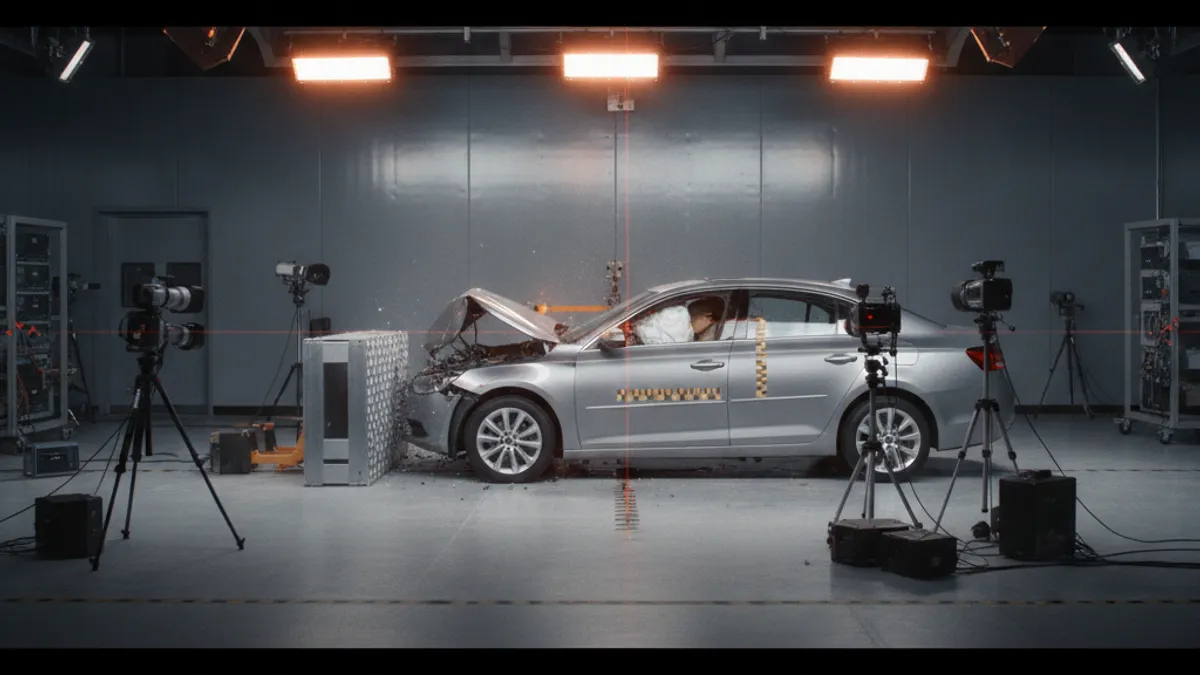
The third pillar is crash protection. This is the classic crash test, but with significant additions. A new test at 35 km/h is added alongside the existing one at 50 km/h, the range of dummy body sizes is expanded (from children to tall adults), and scenarios involving collisions with motorcyclists in urban conditions are also tested. The aim is to cover a wider spectrum of real-world crashes than before.
The fourth pillar is post-crash safety. An entirely new category that did not previously exist in the rating system. It evaluates what happens after a crash has already occurred: whether emergency services can open the doors, whether electric vehicles automatically disconnect the high voltage, whether the system warns of a battery-fire risk. This category is becoming increasingly important as the number of electric and hybrid vehicles on the roads grows.
Each of the four pillars carries up to 100 points. To achieve five stars a car must score highly in all four pillars simultaneously. A weakness in one pillar can bring down the overall rating, even if the car excels in the other three. This is deliberately designed to prevent manufacturers from compensating for weaknesses in one area with high scores in another.
Physical Buttons Instead of Touchscreens and Why It Matters Now
In recent years the trend in the car industry has been clear: put everything on a screen. Climate control, wipers, volume, demisting, even the glovebox release. Some models have removed virtually all physical buttons and replaced them with touchscreen menus. From a design perspective this looks modern and clean. From a safety perspective it is a measurable problem that is now scored.
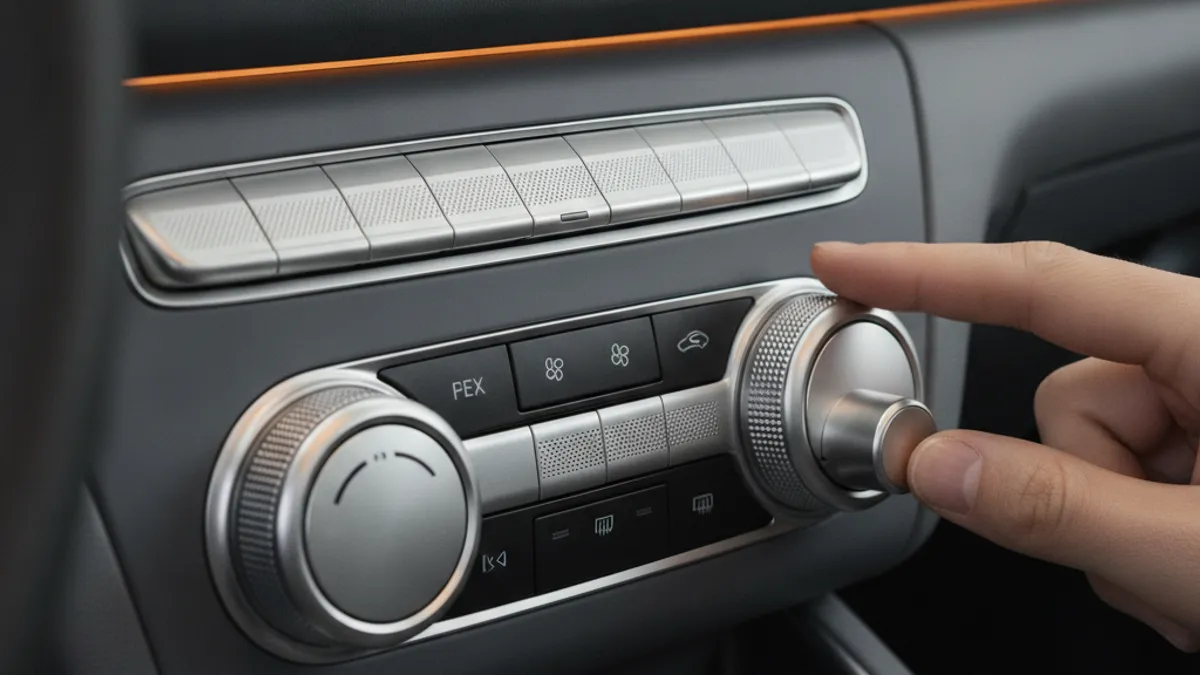
From 2026 Euro NCAP rewards manufacturers that retain physical buttons for four key functions: climate control, wipers, volume and windscreen demisting. The logic is straightforward and backed by research. When a driver wants to turn up the heating or switch on the wipers, a physical button can be found by touch without taking their eyes off the road. Muscle memory does the work. A touchscreen requires you to look at it, find the right menu, open a sub-menu and only then perform the action. At 90 km/h, three seconds of looking at a screen means 75 metres driven without looking ahead. Anything can happen in that distance.
This is particularly significant for the BiH market because many popular models imported from the EU are precisely the ones where manufacturers have most aggressively removed physical buttons in favour of screens. Those same models, if they continue with that approach, will now find it harder to achieve high ratings. That does not mean these cars are unsafe, but it does mean the rating you look at when buying becomes more sensitive to this difference than before.
Which Manufacturers Have Physical Buttons and Which Only Touchscreens
The answer changes from one model generation to the next. In general, some manufacturers have begun bringing back physical buttons for key functions following criticism from drivers, the media and safety organisations. Others still keep almost everything on-screen. Before buying a specific model, sit in the car and check whether it has physical buttons for climate, wipers, volume and demisting. That is now one of the concrete factors influencing the Euro NCAP rating of that model — and also your everyday safety behind the wheel.
Euro NCAP 2026 New Crash Test at 35 km/h
It sounds counter-intuitive, but safety experts make precisely this claim: a collision at a lower speed can cause more severe injuries than you might expect. The existing Euro NCAP crash test at 50 km/h remains in place, but a new test at 35 km/h is added. ADAC expert Volker Sander explains the rationale behind this decision: analysis of real-world crashes shows that collisions at lower speeds quite often result in serious injuries.
The reason lies in the physics of crumple zones. In a crash at 50 km/h the front of the car deforms significantly. The engine, radiator, bumpers and longitudinal body members all crumple, absorbing part of the energy that would otherwise reach the occupants. The crumple zones do the job they were designed for. In a crash at 35 km/h the deformation is less because the impact energy is lower. The vehicle structure remains relatively rigid, but the force is transferred more directly to the occupants — through the seatbelts and seat structure — without sufficient cushioning from body deformation.
In practical terms this means a car that protects occupants excellently at 50 km/h does not necessarily do the same at 35 km/h. The crash geometry differs, the force distribution differs, and the behaviour of seatbelts and airbags depends on the severity of the impact. Seatbelt pretensioners tighten the belt within milliseconds of a crash, but their calibration is optimised for a specific range of forces. Airbags deploy at different rates depending on the force of the impact. The new 35 km/h test checks precisely this grey area where the behaviour of safety systems is not identical to their behaviour at higher speeds.
For drivers in BiH this matters because a large proportion of urban crashes occur in the 30–40 km/h speed range. Junctions, car parks, school zones, roundabouts. The 35 km/h test covers exactly the everyday situations in which the majority of traffic incidents happen.
Real-Road Testing over 3,000 km Across Three Countries
This is perhaps the most significant change in terms of how testing is done, not just what is tested. Until now, advanced driver-assistance systems (ADAS) were tested under controlled laboratory conditions: a closed track, pre-defined scenarios, perfect visibility and surface conditions. From 2026 these systems must prove their functionality on real roads, in real traffic, on a route of at least 3,000 km through three different countries.
Why three countries? Because traffic signs, road markings, speed limits, road-infrastructure quality and driving styles differ from country to country. A system that flawlessly recognises German speed-limit signs must also recognise French, Italian and Spanish ones. A system that reliably keeps the car in its lane on a wide German motorway must also do so on a narrow two-lane mountain road in Italy where the road markings have faded in the sun.
What is especially important for the final score: false warnings and unnecessary system interventions now actively deduct points. If the speed-limit recognition shows 80 km/h on a stretch where the limit is 120, that is not just annoying for the driver — it directly costs points. If the automatic braking system activates without reason on the open road, that is a deduction. If the lane-keeping system unnecessarily corrects the steering on a straight road, that is a deduction. Euro NCAP wants systems that work reliably, not systems that nervously react to everything around them.
For the BiH context this means that cars which pass the new test will have systems proven in diverse conditions. Our roads have characteristics that laboratory tests would never cover: damaged road markings, non-standard traffic signs, sudden changes in speed limits, unusual junction layouts. A car that has passed the 3,000 km test across three different countries is more likely to respond correctly on local roads than one tested only on a closed circuit.
Post-Crash Safety and Emergency-Service Access
The fourth assessment pillar, post-crash safety, introduces requirements that were entirely absent from the rating system until now. Two are critical, and both are linked to modern trends in car design.
The first concerns exterior door handles. An increasing number of manufacturers use electrically powered handles that sit flush with the bodywork and pop out only when you press a button on the key or approach the car with the key in your pocket. From a design standpoint this looks elegant and aerodynamic. The problem arises after a crash: if the electrical supply is cut or the bodywork is deformed in that area, the handles remain flush and emergency services cannot open the doors from outside. From 2026 Euro NCAP requires these handles to remain operational even after an impact, regardless of the state of the electrical system.
The second requirement relates to electric and hybrid vehicles. The high-voltage battery must automatically disconnect its circuit after a crash, and the system must clearly warn the driver and rescuers of a potential battery-fire risk. Given that hybrid vehicles are being imported into BiH with increasing frequency, and electric cars are gradually arriving on the market, this requirement will become more relevant with each passing year.
Pedestrian, Cyclist and Motorcyclist Protection
Pedestrian protection in crash tests is not new, but the approach to date has been limited. The dummies used in tests generally represented an average adult of medium height and build. From 2026 the range is significantly expanded to dummies of different body sizes, from shorter children to tall adults. The aim is to assess how the car protects people of different heights and builds in a collision, since the contact point with the front of the vehicle depends on the pedestrian's height.
Entirely new are scenarios involving collisions with motorcyclists and cyclists in urban environments. Vehicle systems must detect a motorcyclist approaching from the side at a junction and a cyclist moving in the blind spot. A so-called cyclist dooring test is also introduced — a completely new scenario that has never been part of any safety protocol before.
The Cyclist Dooring Test and Why It Is Being Introduced
Opening a door into the path of a cyclist is one of the most dangerous scenarios in urban traffic — familiar to anyone who has ever cycled past parked cars. The driver of a parked car does not see the cyclist approaching from behind, opens the door, and the cyclist hits the edge of the door at full speed. The consequences are almost always severe because a cyclist has no protective bodywork around them.
The new Euro NCAP test checks whether the car has sensors and a warning system that can prevent such an incident. The system must detect an approaching cyclist and warn the driver before they open the door — with a visual or audible signal, or even by briefly blocking the door from opening. This is especially relevant in BiH cities where cycling infrastructure is still developing and cyclists often share lanes with parked cars.
What This Means for Used Cars in BiH
This is the question that interests BiH drivers the most. The short answer: your current car has not become less safe because the tests have changed. The Euro NCAP rating your car received when it was new remains valid for the protocol under which it was tested. However, that rating and the rating of a new car tested under the 2026 protocol are not directly comparable because they measure different things against different criteria.
Why a 5-Star Car from 2025 Might Not Get 5 Stars Under the New Tests
This is the key point to understand. A car that scored five stars under the 2023 or 2024 protocol might receive four or even three stars under the new 2026 protocol. That does not mean the car is poor or unsafe. It means the criteria have become stricter and now cover areas that were not previously part of the test. Five stars from 2020 and five stars from 2026 are not the same thing, just as five stars from 2009 were not the same as five stars from 2015.
For used-car buyers in BiH the practical advice is as follows: when looking at a Euro NCAP rating, pay attention to the year of testing, not just the number of stars. A car with four stars from 2024 may be safer than a car with five stars from 2016 because the standards have risen significantly in the meantime. The test year tells you more than the star count alone. If you want to know from which year particular safety equipment became standard in Europe, see the safety-equipment overview by year.
If you are buying a newer car (model year 2024 or 2025) that will appear on the used market in a few years, it is worth checking whether the manufacturer has already adapted that model to the new Euro NCAP requirements or announced plans to do so. Some manufacturers update software and safety equipment during the production cycle of a model without changing the generation.
How to Check the Euro NCAP Rating of Your Car
Euro NCAP has a public database available at euroncap.com. The process is simple: open the website, select the manufacturer and model, and you get a full rating with detailed results by category. The database covers cars tested from 1997 onwards, which means practically every model currently on BiH roads is included.
For each model you see the overall star rating as well as a detailed percentage score for each category. There you can see where your car is strong and where it is weak. For instance, a car may have excellent adult-occupant protection but a poor score for driver-assistance systems because it is an older model without modern electronics. That is useful information because it tells you what to pay attention to in everyday driving.
One note on generations: Euro NCAP tests specific model generations, not every annual facelift. If your car is a Golf 7 from 2016, the result for the Golf 7 tested in 2012 applies to yours as well, because the generation and body structure are identical. However, if significant safety-equipment updates were made in the meantime (which manufacturers sometimes do mid-cycle), the result may be more conservative than the actual state of your particular vehicle.
If you are planning to buy a used car, checking the documented vehicle history by chassis number reveals what the advert will never tell you. With a carVertical report you can see the mileage by year from international registers, recorded crashes and write-offs, the number of previous owners and theft indicators. We consider it an indispensable step before buying any used car. When paying for the report you can use the code GAGA to get a 20% discount.
When you combine a history check by chassis number with a physical inspection at a workshop, you cover both the past and the present condition of the vehicle. If you need an on-site inspection, book a pre-purchase inspection at the workshop.
Frequently Asked Questions
Does Euro NCAP testing apply to cars sold in BiH?
Euro NCAP tests models sold on the European market. Since BiH drivers predominantly drive cars imported from EU countries, Euro NCAP ratings apply to those same models. However, some equipment variants may differ between markets, so it is always worth checking the exact specification of your particular vehicle.
Will my car lose stars because of the new tests?
No. Your car's Euro NCAP rating remains as it was under the protocol in which it was tested. The new protocol applies to cars tested from 2026 onwards. Your car keeps its original rating.
Why are physical buttons now important for the safety rating?
Because physical buttons for climate control, wipers, volume and demisting allow the driver to perform an action without taking their eyes off the road. A touchscreen requires visual attention and menu navigation, which diverts attention from driving and increases the risk of a crash.
What is the cyclist dooring test?
It is a new test that checks whether a car warns the driver before opening the door when a cyclist is approaching from behind. Sensors must detect the cyclist and trigger a warning to prevent a collision with the open door.
Can I check a Euro NCAP rating for free?
Yes. The database at euroncap.com is public and free of charge. Select the manufacturer, model and generation, and you get a detailed safety-rating report with results for every category.
How often does Euro NCAP change its tests?
Euro NCAP protocols are updated every three years. The 2026 revision is the biggest since the star-rating system was introduced in 2009. Each new revision raises the bar, making five stars harder to achieve than in the previous cycle.