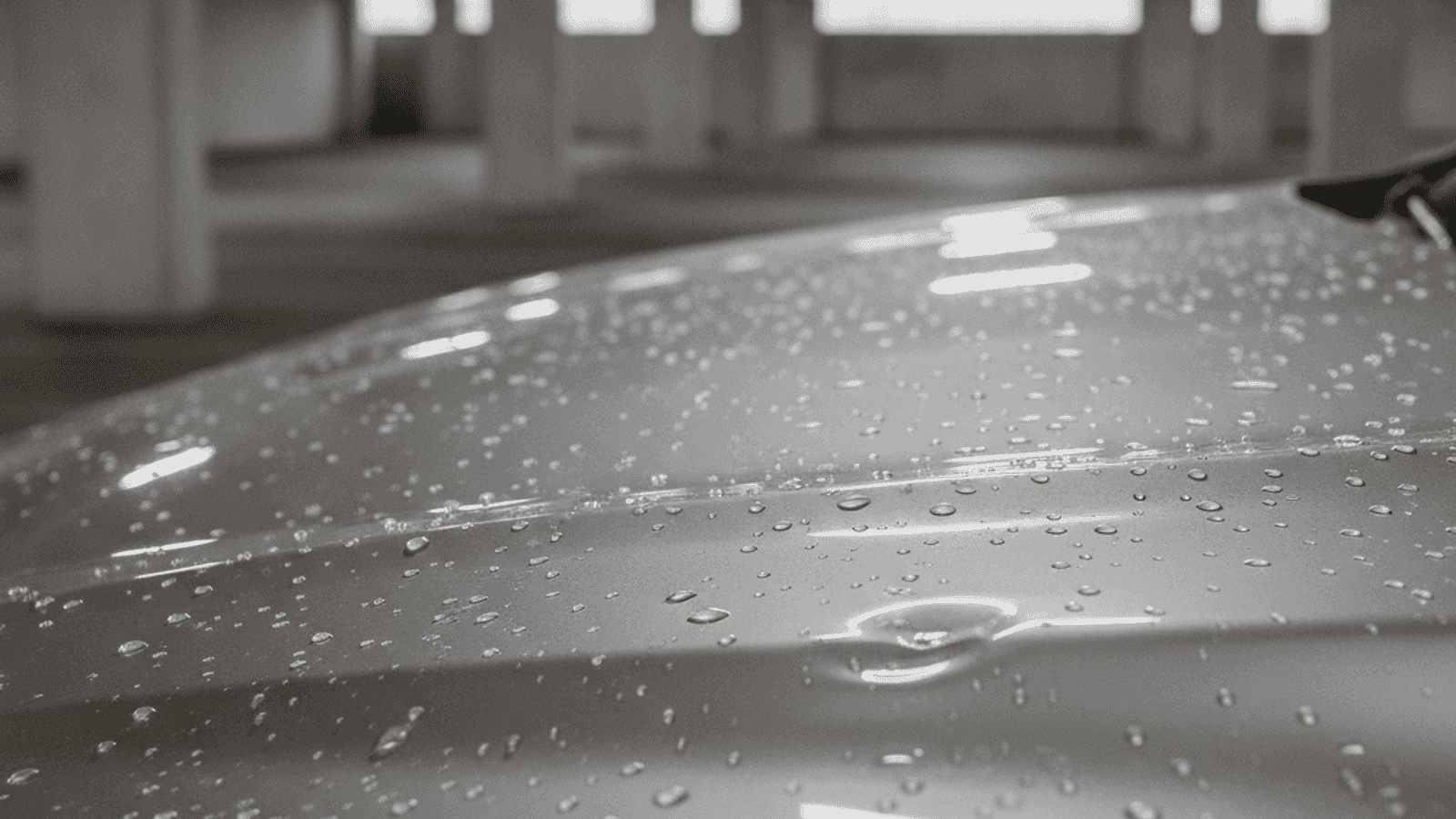
A single burst of large hailstones on your bonnet can cost you many times more than an annual comprehensive insurance premium. Every year between May and September, hail strikes parts of BiH and leaves behind hundreds of cars with dents on roofs, bonnets and doors. If this has just happened to you and hail has damaged your car, do not panic — but act fast. The deadline for reporting damage to your insurer is just 3 days from the date you became aware of the damage, and every missed step complicates the process and increases the cost of repair.
This guide was compiled by Auto Gas Gaga workshop in Banja Luka, drawing on years of experience receiving storm-damaged vehicles and cooperating with panel beaters and PDR technicians across the region.
Table of Contents
- What Hail Does to a Car and Why It Is Not Just Cosmetic
- First Five Steps After Hail Damages Your Car
- Comprehensive Insurance and Hail in BiH
- What If You Do Not Have Comprehensive Insurance
- PDR: Paintless Dent Repair
- Traditional Panel Beating and Repainting
- How to Protect Your Car From Hail in the Future
- Frequently Asked Questions
- Related Articles
What Hail Does to a Car and Why It Is Not Just Cosmetic
Hailstones the size of a hazelnut (roughly 2 cm in diameter) reach speeds of 50–70 km/h as they fall. On a car's sheet-metal panels this translates into shallow, round dents that look harmless but carry three serious consequences every BiH driver should understand before deciding on a repair.
The first is financial. Each dent on its own may seem trivial, but when there are twenty or fifty on a single panel the total repair cost rises steeply. The roof, bonnet and boot lid are the largest flat surfaces and typically sustain the most hits. A full repair of a moderately hail-damaged vehicle ranges roughly from 800 to 4,000 KM on the regional market, depending on the number of panels, dent depth and chosen repair method.
The second consequence is loss of resale value. If you plan to sell the car within the next year or two, unrepaired hail marks are spotted immediately by buyers — even without a paint-thickness gauge. This automatically lowers the vehicle's price, often by more than the repair itself would have cost. Used-car buyers in BiH are especially sensitive to visible bodywork damage because they associate it with poor maintenance.
The third is the risk of long-term corrosion. Deeper dents can create micro-cracks in the factory paint that are invisible to the naked eye in the first few months. Moisture and road salt penetrate through those cracks during winter (which is why a spring vehicle check-up is so important), and corrosion starts from the inside out. Within a year or two you end up with rust blisters that can no longer be fixed without full sanding, filling and repainting — a far more expensive procedure than dealing with the damage right away.
First Five Steps After Hail Damages Your Car
The order matters. Every step you skip or reverse can cost you insurance coverage or a more expensive repair. Here is the exact sequence we recommend to customers who come to us asking what to do after hail in BiH.
Step 1: Get the car under cover. If the storm is still going, every extra minute outside means more damage. A garage, a carport, a covered car park — even a petrol station canopy or a passageway between buildings will do. Anything overhead while the hail is falling.
Step 2: Do not touch the dents. The instinct is to press a finger into a dent to see "how deep it is". Do not. A dirty finger can scratch the paint at the edge of the dent, and pressure can widen the damage or stretch the metal further. Let a professional assess it with proper lighting and tools.
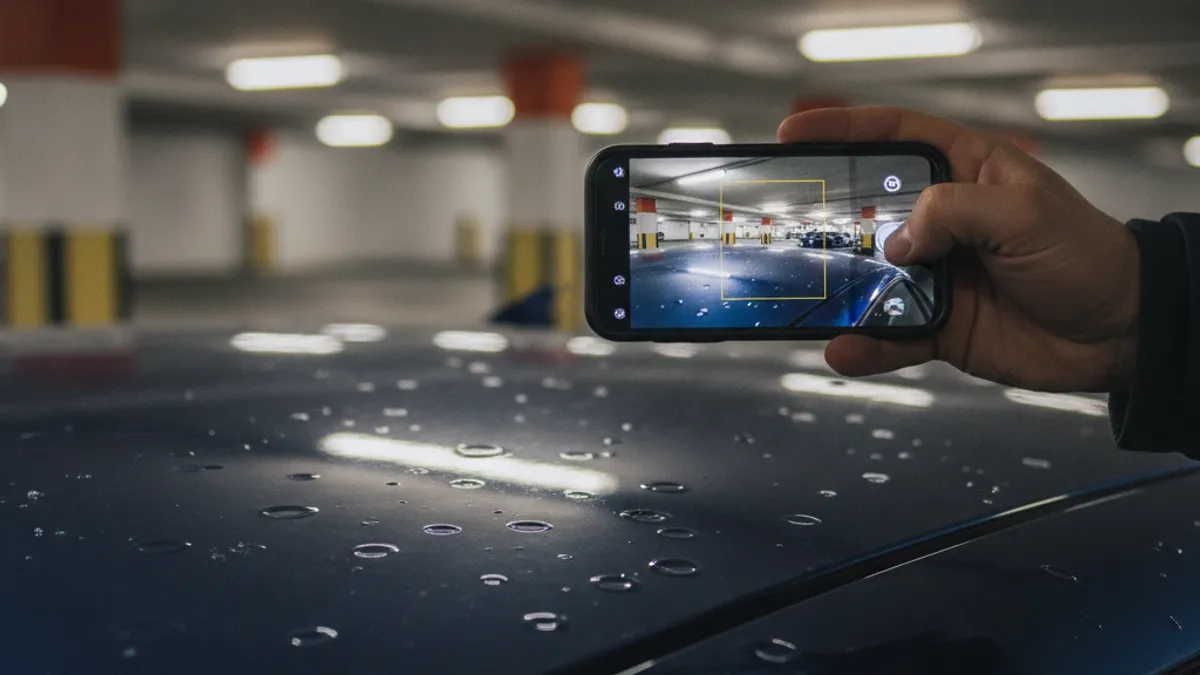
Step 3: Photograph everything. Do this before any washing, polishing or cleaning. Photograph every panel from multiple angles. The most important shots are under oblique light (morning or late afternoon sun, or a garage fluorescent lamp at roughly a 45-degree angle) because dents show up best as shadows on the surface. Take at least 20–30 photos with your phone. Include at least one shot of the entire car for context. Save the weather forecast, a news report about the storm or a screenshot of the phone alert for that day — this serves as proof of the date the damage occurred.
Step 4: Report the damage to your insurer within 3 days. The legal deadline for reporting damage is no later than 3 days from the date you became aware of the insured event. Missing this deadline can mean a complete loss of the right to compensation. Report both by phone and in writing (email or the online form on the insurer's website). In your report state: the exact date and location of the storm, your policy number, a brief description of visible damage by panel, and attach all the photographs you took in Step 3.
Step 5: Do not start repairs before the insurer's assessment. If you have comprehensive insurance, the insurance company sends its own assessor or directs you to an authorised workshop for inspection. If you repair the car before the assessor sees and documents the damage, you risk having your claim rejected or significantly reduced. The only exception is emergency safety repairs (windscreen completely shattered, car unsafe to drive), but even then notify the insurer by phone first.
Comprehensive Insurance and Hail in BiH
Comprehensive (kasko) insurance in BiH explicitly covers damage caused by hail, storms and severe weather. Triglav Osiguranje, for example, offers full comprehensive cover with or without an excess, and hail falls under the natural-forces category covered by a standard comprehensive policy. The same applies to other major insurers operating in BiH.
What comprehensive insurance specifically covers for hail damage:
- Repair of all damaged sheet-metal panels (by PDR or traditional panel beating)
- Replacement of glass broken by hailstones (windscreen, side windows, rear window)
- Repair or replacement of mirrors, aerials and plastic body parts
- In some policies: car-hire costs while your vehicle is being repaired
- In some policies: towing to a workshop if the car is unsafe to drive
How to file a claim step by step:
Call your insurer's contact centre on the same day or within 3 days at the latest. Most companies now also accept claims by email or online form. You will need: your comprehensive policy number, a copy of the vehicle registration document, all damage photographs, and a brief written statement of the circumstances (date, approximate time, vehicle location during the hail). The insurer's assessor will inspect the car within 3–7 working days, depending on capacity and the volume of claims in the region. After a major storm the wait is longer because hundreds of drivers file claims simultaneously.
Excess. If your policy includes an excess (deductible), you pay the first portion of the cost yourself. Typical excess amounts with most BiH insurers range from 100 to 500 KM, depending on policy terms and vehicle age. Everything above the excess is covered by the insurer. If you have a zero-excess policy, the insurer funds the entire repair at no cost to you.
What If You Do Not Have Comprehensive Insurance
Compulsory third-party liability insurance does not cover damage to your own vehicle. It only covers damage your car causes to others in traffic. So if you do not have comprehensive cover, the situation after hail is considerably more difficult and your options are limited. A similar predicament arises with a flood-damaged car, where without comprehensive insurance the driver bears the entire cost.
Option 1: Natural disaster declaration. If the hail hit a wider area and caused significant damage to a large number of people, the municipality or city may declare a natural disaster. In that case the local authority publishes a public call for damage claims. Residents report damaged property (including cars) within the stated deadline, a commission visits the site, verifies the damage and establishes a total amount per claim. The problem is that compensation is distributed proportionally from a relief budget that is almost always smaller than the total reported damage in the municipality. In practice this means the payout covers only a fraction of the actual repair cost — sometimes as little as 10–20% of the verified damage.
Option 2: Pay for repairs out of pocket. If the municipality does not declare a natural disaster (because the damage was not widespread enough), or if it does but your payout covers a negligible percentage of the cost, you are left paying for repairs yourself. In this case PDR becomes especially attractive because it is 50–70% cheaper than traditional panel beating with filling and repainting, and for lighter damage the result is virtually identical.
Option 3: Live with the dents. If the damage is shallow (depth under 1 mm) and the paint is not broken anywhere, some drivers decide not to repair at all. It is unsightly but technically not dangerous as long as the paint retains its integrity. If you choose this option, inspect the dents every 6 months, especially before and after winter. Look for signs of paint flaking or the appearance of rust in the centre of a dent.
PDR: Paintless Dent Repair
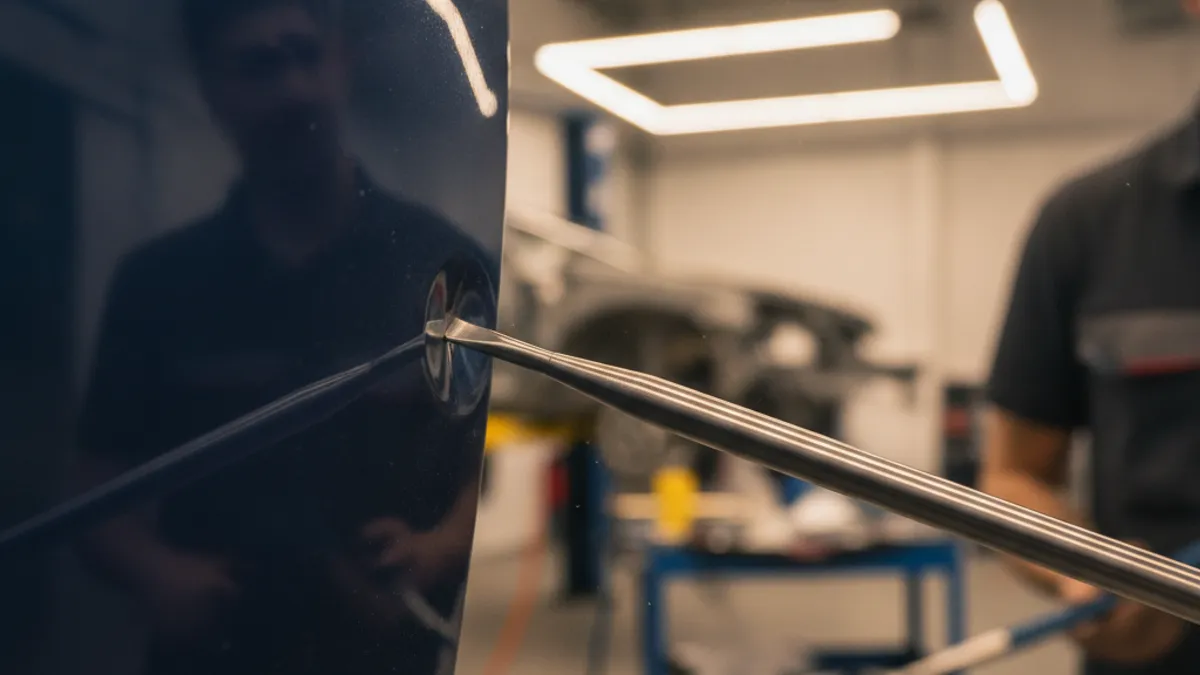
PDR (Paintless Dent Repair) is a technique for pushing dents out of sheet metal without sanding, filling or repainting. The technician uses specialised metal rods of various shapes and lengths, inserting them behind the panel through existing access openings (lock holes, hinge gaps, trim edges) and applying careful, controlled pressure to return the metal to its original shape.
Why PDR is often the better choice for hail damage in BiH:
The original factory paint remains completely untouched. This is a huge advantage because factory paint is higher quality, more uniform and more durable than any subsequent respray. The car retains its full market value, a paint-thickness gauge at a future sale shows factory readings, the assessor does not record "resprayed panel", and there is no risk of a colour-shade mismatch between the repaired and surrounding panels.
The cost is noticeably lower. PDR repair is roughly 50–70% cheaper than the traditional process with filling and repainting, because the entire sequence of interior dismantling, sanding, filler application, primer, multi-coat painting and final polishing is eliminated. Fewer materials, fewer labour hours, lower price.
The turnaround is significantly faster. Minor hail damage (up to 10–15 dents on a single panel) can be resolved by a PDR technician in 3–6 hours. A moderately damaged car with several affected panels takes about one working day. Severe damage where nearly every panel has 30–50 dents takes 2–3 working days. Compare that with 5–10 days for traditional panel beating of the same scope.
When PDR is not possible:
- If the paint has already cracked, chipped or is flaking at the dent location
- If the metal is overstretched (very deep dents with sharp profiles)
- If the dent is on the very edge of a panel or on a crease line where the technician cannot reach from behind
- If an aluminium panel is damaged (PDR is harder on aluminium as it resists plastic deformation)
- If plastic parts are damaged (bumpers, spoilers, plastic trim) — plastic does not respond to the PDR technique
How Much Does PDR Hail Repair Cost
Prices vary depending on the extent of damage, panel accessibility and the specific workshop. As a rough guide on the regional market: minor PDR work starts from around 80 KM per panel, while a full repair of an entire hail-damaged vehicle can range from 800 to 4,000 KM depending on the total number of dents and their depth. These are market prices that differ from workshop to workshop and city to city. For a specific car, the only accurate answer is an inspection by a PDR technician who will count the dents panel by panel and provide a precise quote.
Traditional Panel Beating and Repainting
When PDR is not an option because the paint has cracked, the dents are too deep or a plastic body part is damaged, traditional panel beating with repainting remains the only way to restore a panel to its original condition.
The traditional repair process:
- Removal of damaged panels or masking of surrounding areas with tape and film
- Sanding the damaged paint down to bare metal at all dent locations
- Straightening the metal by panel beating (pulling, hammering against a dolly)
- Applying filler to level out any remaining unevenness
- Sanding the filler to a perfectly flat surface (by hand and machine, through several grits)
- Applying primer and allowing it to dry
- Painting in the vehicle's colour (mixed to formula from the colour database for your model and year)
- Applying clear protective lacquer
- Polishing to a high gloss and removing masking tape
Drawbacks compared with PDR:
The cost is higher because the process involves expensive materials (filler, primer, base coat, lacquer, abrasive papers of various grits, thinner) and considerably more labour hours. The turnaround is longer — typically 5–10 working days for a moderately hail-damaged vehicle, because each layer (filler, primer, paint, lacquer) must dry completely before the next is applied.
The most significant drawback for the owner: a panel that has been resprayed is never "original" in the eyes of an assessor or a paint-thickness gauge. At resale, the buyer or their technician reveals it through measurement, and assessors record "resprayed panel" in their report. The vehicle's value drops even when the work has been done flawlessly, because the buyer asks "why was it resprayed — was it in a crash?".
When traditional panel beating is still worthwhile:
If you have comprehensive insurance that covers the full repair cost, traditional panel beating can be the more pragmatic choice for severe damage because the result is a visually perfect panel and the financial burden does not fall on you. Also, on vehicles older than 10–12 years where the original paint already shows sun spots, scratches and stone chips, the difference between PDR and traditional panel beating loses its significance because the paint is no longer in factory condition anyway.
How to Protect Your Car From Hail in the Future
Once you have lived through hail damage and paid for repairs out of pocket or gone through the insurance process, the motivation for prevention becomes very real. Here is what actually works in practice, from most effective to least.
Garage or carport. The simplest and most effective protection. If you do not have a garage at home, find covered parking at your regular locations (work, shopping centre, market). Even a tree above the car provides partial protection from lighter hail, although branches can cause their own damage in strong wind — so a concrete roof overhead is always more reliable.
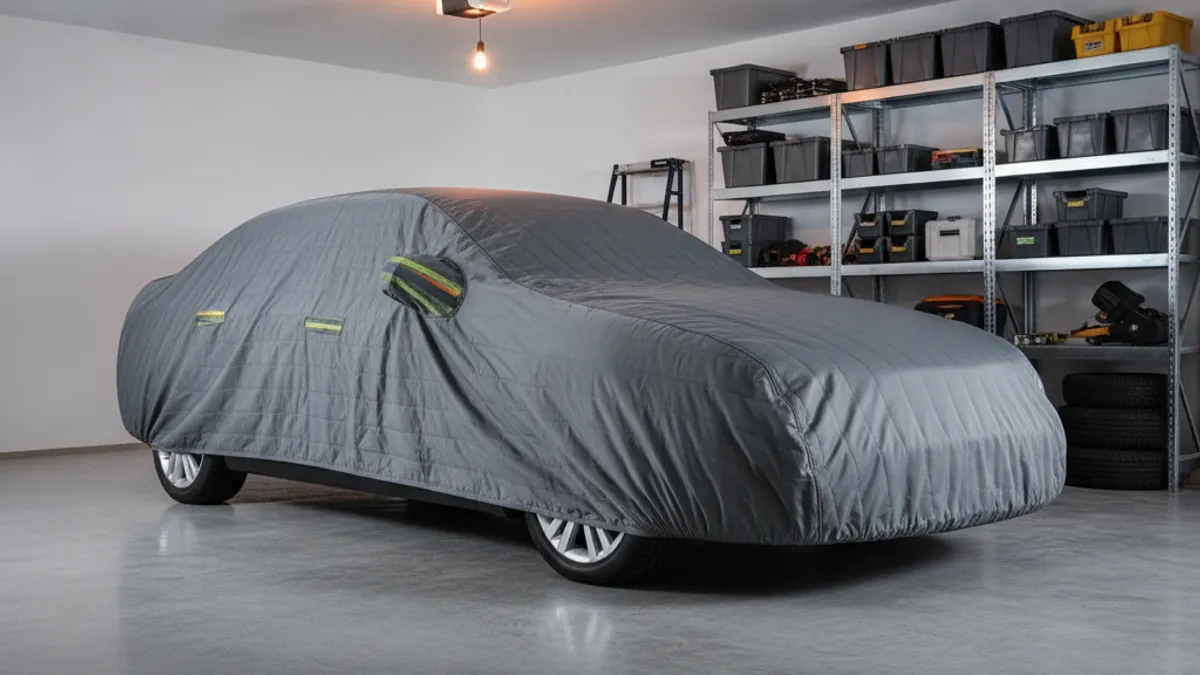
Protective car cover with padding. A thick protective cover with a foam or felt lining effectively absorbs hailstone impacts and prevents dents in the metal beneath. The key is that the cover must be thick enough — a thinner waterproof cover without padding protects against sun and rain but not against hail impacts. A cover slips on quickly (2–3 minutes for a whole car) and lasts for years with minimal maintenance.
Monitor forecasts actively. The BiH meteorological service (RHMZ BiH) and mobile weather apps issue severe-storm warnings with hail typically 1–3 hours in advance. When you see a hail warning for your area, act immediately. Two minutes to move your car under cover or pull on a cover can save you thousands of KM. Set up weather-alert notifications on your phone for your municipality.
Comprehensive insurance with hail cover. If you live in a part of BiH that is regularly hit by hail (the Vrbas valley, Posavina, the Tuzla area, Semberija), comprehensive cover with hail protection is an investment that pays for itself with the first serious storm. The annual premium is usually many times lower than the cost of repairing even a single panel by traditional panel beating. Consider policies with an excess — they are noticeably cheaper, and with hail the excess typically represents a small percentage of the total damage.
Paint protection film (PPF). Thicker PPF (8–10 mil) offers a degree of protection from lighter hail. It will not prevent a dent in the metal from heavier hailstones, but it reliably protects the paint from cracking at the point of impact. This means PDR remains viable even after a more severe hailstorm because the paint beneath the film stays intact. PPF is not primarily designed as hail protection, but it is a useful bonus alongside the aesthetic and protective function it provides anyway.
Spotted hail damage on your car and not sure how serious it is? Get in touch with the workshop with photographs of the damage or book an inspection, and we will tell you whether PDR is an option or traditional panel beating is needed.
Frequently Asked Questions
How long do I have to report hail damage to my insurer?
The deadline is no later than 3 days from the date you became aware of the damage. If hail falls while you are away and you only notice the damage when you get home, the deadline starts from the moment you saw the damage. Do not wait — hail dents do not fix themselves.
Does compulsory insurance cover hail damage to my car?
No. Compulsory third-party liability insurance only covers damage you cause to others in traffic. To have hail damage to your own vehicle covered, you need comprehensive (kasko) insurance.
Can I repair the car before the insurer's assessor arrives?
You can, but you risk a reduction or outright rejection of your claim. The insurer has the right to send an assessor to establish the extent of damage. If you have already repaired the car, the assessor has nothing to inspect and document. The exception is emergency safety repairs, but even then you must notify the insurer by phone first.
How long does PDR repair of a whole car take after hail?
For minor damage (up to 15 dents per panel on 2–3 panels) a PDR technician completes the job in 3–6 hours. A moderately damaged car with several affected panels takes about 1 working day. Severe damage with 30–50 dents per panel across nearly the entire car takes 2–3 working days.
Does PDR leave visible marks on the car?
Quality PDR by an experienced technician leaves no visible marks. The metal is returned to its original shape, the factory paint remains untouched, and a paint-thickness gauge shows factory values. Only with exceptionally deep dents may a minimal unevenness remain, visible only under a very specific angle of lighting.
Is it worth getting comprehensive insurance just because of hail?
If you live in a part of BiH that is regularly hit by hail between May and September, comprehensive insurance pays for itself with the first serious storm. A single moderately severe hailstorm can cause damage that far exceeds the annual comprehensive insurance premium. Check policies with an excess — they are noticeably cheaper than full comprehensive cover.