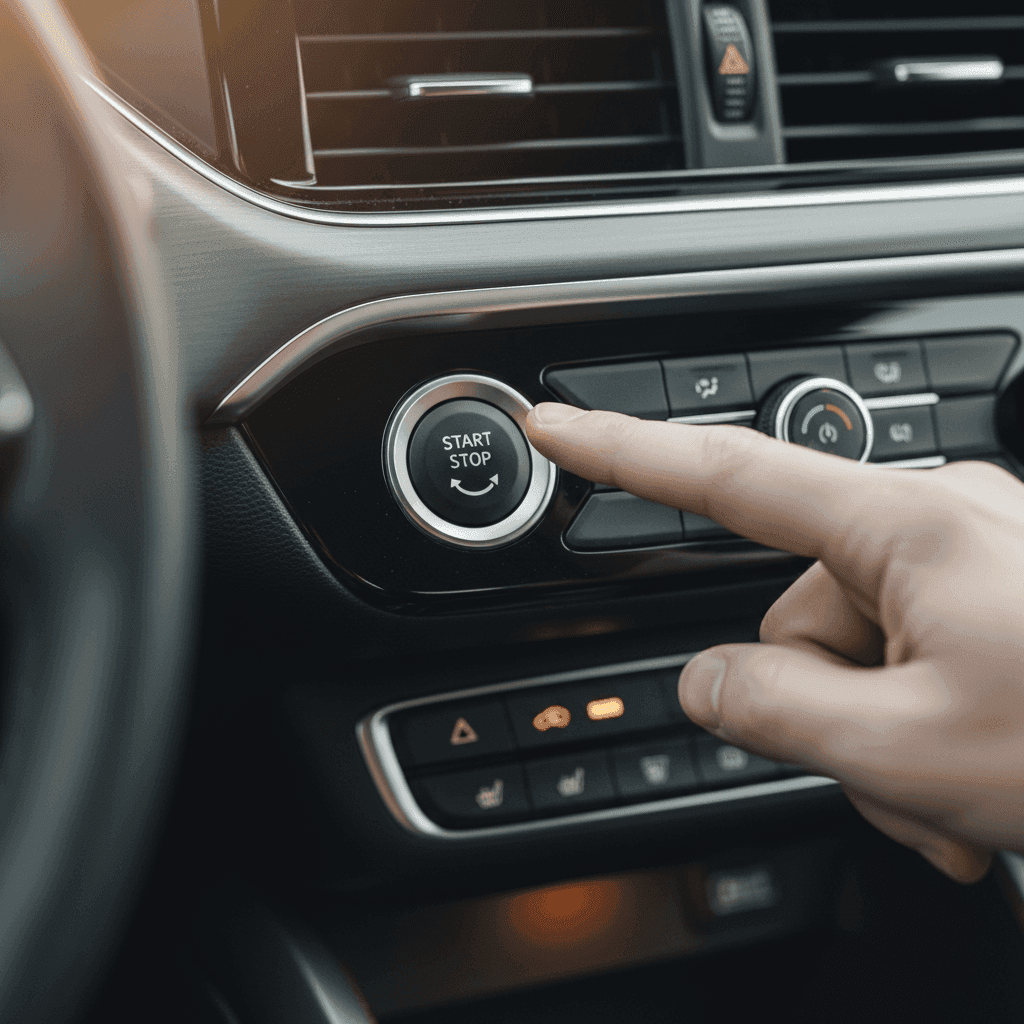
You sit down in a fairly new used car, turn the key, and the moment you stop at the first traffic light, the engine shuts off on its own. You release the brake and it fires back up. Half of BiH drivers buying their first start-stop car will first check whether the car is actually fine, then look for a way to switch that button off for good. The fair question, before anything else, is how much the system really saves and what it costs you elsewhere.
This analysis was prepared by the Auto Gas Gaga workshop in Banja Luka, based on routine servicing of used cars with start-stop systems and the questions we keep hearing from owners.
Table of Contents
- What Start-Stop Is and Why Almost Every New Car Has It
- Real Fuel Savings: What Independent Tests Show
- Five Things Start-Stop Puts Extra Strain On
- The Battery Is the Main Item, AGM, EFB and Why a Standard One Will Not Do
- What to Check When Buying a Used Car With Start-Stop
- Whether and How to Switch Off Start-Stop in Daily Driving
- Permanent Disabling, Memory Module and the Software Option
- Frequently Asked Questions
- Related Articles
What Start-Stop Is and Why Almost Every New Car Has It
Start-stop is the electronics that automatically shuts the engine off when the car comes to a halt (traffic light, jam, end of the garage) and fires it back up the moment the driver releases the brake or presses the clutch. The idea is simple: an engine that is not running burns no fuel and emits no exhaust. In city driving that adds up to a few minutes of idle time per hour of driving that the engine would otherwise spend running for nothing.
The technology is not new. It first appeared in series production in the eighties (Volkswagen Polo Formel E), but only spread widely after 2010. The reason is regulation, not savings. European emissions tests (NEDC, later WLTP) run in the lab show large benefits from start-stop, so manufacturers use them to push down their official fuel consumption and CO2 figures and avoid penalties. That is why almost every new car today has the system, including petrols, diesels, small hatchbacks and large saloons. Wards Auto reports that by 2023, 65% of new vehicles in the US had start-stop, compared with 1% in 2012.
The system only kicks in once a set of conditions is met: the engine is at operating temperature, the battery is charged enough, the air conditioning is not at full load, the driver is buckled, the doors are closed, the road gradient is not too steep. If any of that is off, the system stays inactive and the engine runs as normal. That is why someone will sit in the car convinced the system is broken, when in fact the car has simply decided this is not the right moment to shut down.
Real Fuel Savings: What Independent Tests Show
This is where the gap between marketing and reality is usually the biggest. Bosch, one of the main start-stop suppliers, quotes up to 8% savings in lab tests and exceptionally over 15% in specific cases of very slow city driving. Those numbers turn up in every brochure.
Reality is more measured. AAA, the US organisation that regularly tests automotive technologies, measured three vehicles in 2014 (Ford Fusion 2013, Mercedes CLS550 2014, Chevrolet Malibu 2013) on the same drive cycle, once with start-stop active and once with it off. The difference came out to 5-7% lower fuel consumption and lower CO2 in the urban cycle. The EPA has long estimated 4-5% improvement, while broader SAE research shows a 3-10% range in city driving, depending on traffic intensity and engine size.
How Much Start-Stop Really Saves in City Driving
For an average BiH driver mixing city and open road, the realistic figure is roughly 0.3 to 0.6 litres less fuel per 100 km in city driving. Over a year of 10,000 km, that is about 30-60 litres of fuel. At spring 2026 fuel prices, that comes out to a sum on the order of a hundred-and-something KM a year. A driver who spends most of their time on motorways and trunk roads, without frequent stops, will not feel a thing, because the system simply does not engage there. On the other hand, a taxi driver in central Sarajevo or Banja Luka who stops a hundred or so times a day can get close to that marketing 8%.
There is also a notable finding from 2017: an ICCT (International Council on Clean Transportation) study showed that real-world CO2 benefits from start-stop are on average 30 to 50% lower than what lab tests promise. That is partly why even the US EPA in 2025 announced it would phase out regulatory credits for the technology, arguing it delivers a modest emissions benefit at a noticeable cost to the starter. A BiH driver should not read politics into that, just the conclusion: the savings are real, but not dramatic, and they depend heavily on where you drive.
Five Things Start-Stop Puts Extra Strain On
If the engine fires up a few times a day, everything copes easily. If it fires up several dozen times every drive, certain parts work a life and a half. Autocar in 2022 ran a number that helps visualise it: the average car without start-stop sees roughly 50,000 engine start cycles over its life. With an active start-stop system, that figure climbs to around 500,000, ten times more. Federal Mogul even developed a special polymer material with iron oxide particles (Irox) for the bearings, with a 50% lower coefficient of friction, to cope with that regime.
In concrete terms, these five components take the worst of it:
- Battery. By far the most visible item. A standard lead-acid battery in a start-stop car lasts six to twelve months and gives up. More on that in the next section, because choosing correctly between AGM and EFB sorts 90% of the trouble.
- Starter. It is reinforced for this duty cycle, but it is not indestructible. The solenoid, brushes, planetary reduction gear, pinion, all of that works far harder than in a regular car. In the workshop, the starter on a start-stop car usually lasts a long time, but when it finally gives up around 150-200 thousand km, replacement is not a small cost.
- Timing chain and sprockets. Every start, the engine has to make it through the moment when oil is not yet under pressure. The chain, tensioners and guides run dry for a fraction of a second every time. On models that already have problematic timing systems (TSI 1.4, older EA888 generations, some PSA engines), start-stop further shortens the interval to the first issue.
- Turbocharger. The principle is similar: the turbine spins at tens of thousands of revolutions per minute, lubricated by oil under pressure. When the engine stops, the oil stops flowing, while the turbine keeps spinning until it slows down. Modern turbo engines have construction and lubrication that handle this, but turbocharger failures on start-stop cars are not unusual. We covered specific habits for extending turbo life in our advice on the diesel turbo.
- Dual-mass flywheel (DMF). The component that damps vibration when the engine starts and stops. Every start and every stop is a small hit on the dual-mass flywheel. On older diesels with start-stop (e.g. some PSA and Ford 1.6 HDi/TDCi, BMW N47), the DMF can become the make-or-break item, with replacement usually pricier than the clutch itself.
Does that mean start-stop kills the engine? It does not. All the components listed above are sized for that duty cycle in cars where start-stop is fitted from the factory. But when something does fail, it fails earlier than it would on the same car without the system. That is worth hearing before you buy a high-mileage used car.
Does Start-Stop Damage the Starter and Engine
Not directly, but it speeds up wear on components that wear with time anyway. The difference is between wear at 200 thousand km without start-stop and the same wear at 130-150 thousand with the system active. Concrete numbers depend on the engine model, the oil used, service intervals and driving style. A driver who changes oil regularly (on shorter intervals than the manufacturer prescribes, in the 10-15 thousand km range on a modern diesel), uses a quality oil brand and does not abuse the engine the moment it starts up will not feel a dramatic difference.
The Battery Is the Main Item, AGM, EFB and Why a Standard One Will Not Do
This is the topic we explain most often in the workshop. A standard lead-acid battery (the kind that has gone into every car for decades) is built to handle a few starts a day. Start-stop hits it with dozens of starts on a single drive, while the air conditioning, radio and seat heating still pull current from it while the engine sits. Capacity drops within a few months, sulphates settle, the driver thinks they got a bad unit. They did not. They got the wrong type.
There are two right choices for start-stop. EFB (Enhanced Flooded Battery) is a reinforced flooded battery with thicker plates, lasts 75-85 thousand starts, and goes in simpler start-stop systems without brake-energy regeneration. AGM (Absorbent Glass Mat) has its electrolyte absorbed in glass fibres, accepts charge faster, lasts 130-140 thousand starts, and is mandatory on systems with brake-energy regeneration (BMW, Mercedes, Audi, many newer Ford and Volvo, anything with richer electrical equipment).
How to Tell Whether Your Car Has an AGM or EFB Battery
Three quick ways. First, the battery itself usually has AGM or EFB printed on the label, alongside the capacity and CCA rating. Second, the owner's handbook (service book) usually carries the battery specification by VIN. Third, if the car has a regenerative system (you can tell because the voltage on the dashboard jumps every time you brake), it is almost certainly AGM. Fitting the wrong type (a standard battery instead of EFB, or EFB instead of AGM) usually ends with the system refusing to work, throwing a warning, or the car struggling to start after a night or two of standing.
If you are planning a replacement, take a look at the more detailed advice AGM or EFB battery for start-stop, which one your car needs where we lay out which type goes in which car and the mistakes we see most often. Replacing a battery on a start-stop car is not expensive in labour, but the battery itself is significantly pricier than a standard one, and there is no skipping that, because a standard one simply will not do.
What to Check When Buying a Used Car With Start-Stop
A used car with start-stop and high mileage (over 150,000 km) calls for a bit of extra care at purchase. The list below is no substitute for a pre-purchase inspection at the workshop, but it points to what to look at and what to ask the seller:
- Whether the system works at all. A 20-30 minute test drive around town is non-negotiable. The car needs to reach operating temperature, then the engine should shut off at a traffic light. If the system never engages, there is a reason, most often a weak battery or a fault in the module.
- Battery, which type and how old. Look at the label. If the start-stop car has a standard lead-acid instead of AGM/EFB, that is a warning sign that the previous owner did not follow specification. A battery older than five years will soon need replacing, and on a start-stop car that is not a cheap swap.
- Starter, how the car cranks. Listen to the cranking. Slow cranking, uneven turning, clicking, all of it points to a starter with plenty of hours behind it.
- Timing chain, if the car has a chain. Check the previous service. If the car runs a chain (not a belt) and mileage is around 150-200 thousand, ask whether it has been replaced. On some start-stop models (TSI 1.4, certain BMW engines), the chain gives up earlier.
- Turbocharger and dual-mass flywheel. Tell-tale symptoms are whistling on acceleration and knocking on engine start or stop. We went into more detail in our advice on the dual-mass flywheel.
- Service history. A start-stop car wants shorter oil intervals (say, 10-15 thousand km instead of the 20-30 the manufacturer prescribes). If those intervals were stretched, assume the engine is more worn than its mileage suggests.
And one honest one: on a used car, history matters more than the inspection itself. Mileage rolled back by tens of thousands of kilometres is not at all uncommon on the BiH market, and a single previous owner who drove aggressively in the city can shorten engine life more than two extra years on the clock. Before you put down a deposit, it pays to check the VIN through carVertical. It pulls a documented history from international registers: actual odometer readings by date, recorded accidents, number of previous owners, and theft or total-loss flags. We treat it as a mandatory layer of checking before buying any used car, especially one with complex electronics like start-stop. When paying for the report, you can use the code GAGA for a 20% discount.
When you find a car you are seriously considering, book a pre-purchase inspection before you put any money down. An hour and a bit on the lift can save you thousands later.
Whether and How to Switch Off Start-Stop in Daily Driving
Almost every car has a button to temporarily disable start-stop, usually marked with that A-in-a-circle symbol with an arrow, and an LED that shows the status. Pressing the button switches the system off until the next time you turn the engine off. The next time you start the car, the system is active again. Permanently disabling it (so the car remembers your choice) is a separate story, see the next section.
Our recommendation is nuanced. The system is worth leaving on in these situations:
- city driving with lots of stops (traffic lights, jams),
- long open-road trips (it will not engage anyway, because you are not stopping),
- in the garage or in front of the house (one or two cycles is nothing).
The system is worth switching off in these situations:
- short drives of 5-10 minutes where the engine barely reaches operating temperature, because a cold engine wears itself faster on each stop and start,
- extreme heat or cold, when the load on the air conditioning or heater is at its peak,
- driving through tight roundabouts or in parking manoeuvres, where the engine can lock up just as you release the brake (frustrating, and not great for the nervous system),
- if you hear unusually heavy cranking or knocking on restart, so as not to make things worse before you go in for a check.
A driver who uses their head and presses the button when it suits them gets practically the same fuel saving as one who lets the system run 100% of the time, because the system would not engage in the conditions where you consciously switch it off anyway. The difference is that the first driver protects components, the second does not.
When Start-Stop Does Not Engage (Cold Engine, Air Conditioning, Weak Battery)
The system has about ten built-in conditions, all of which need to be met for it to engage. The most common reasons it does not engage in daily driving are:
- the engine has not yet reached operating temperature (the first 5-10 minutes of driving),
- the battery is below a certain charge threshold (the system protects itself),
- the air conditioning is at full load (heat or cold at maximum),
- the defroster is on,
- the roof is closed or open (convertible),
- the driver is not buckled, or doors are open,
- the road gradient is too steep (the car would roll),
- the engine temperature is too high (overheating prevention).
If the system never engages even in ideal conditions, the most common culprit is a battery near the end of its life. We covered checking battery voltage in the advice How to tell that your battery is near the end, so that is the first step before going in for module diagnostics.
Permanent Disabling, Memory Module and the Software Option
Many drivers want the system permanently disabled so they do not have to press the button every time. There are two routes, both available in BiH.
Memory Module (Hardware Solution)
A small electronic device that fits onto the wiring of the start-stop button. It remembers your last choice and automatically presses the button for you on every start. The system is still physically present and you can switch it back on whenever you like, the module just remembers. The advantage is that you do not change the car's software, which means a later service at an authorised dealer will not throw up issues. Installation cost varies by model and module availability. The price depends on the specific car, get in touch for a quote.
Software Disabling (Coding)
The other option is to disable the system by changing parameters in the engine module (ECU) or body module, via the OBD-II port, with specialised software (VCDS, OBDeleven, authorised BMW/MB/PSA tools). The system then behaves as if it never existed. The job is quick, but it requires equipment and know-how, and not every car is equally open to it (newer models can lock this option down, some require SFD authorisation).
A small technical note: if the car is still under warranty and you plan to sell it or have it serviced at an authorised dealer, the memory module is the safer choice. If the car is your own and you have no plans to visit an authorised dealer, the software solution is cleaner.
Frequently Asked Questions
Does the Start-Stop System Really Save Fuel?
Yes, but modestly. Independent tests (AAA, EPA, SAE) show 3-7% lower consumption in urban driving, which for an average BiH driver works out to roughly 30-60 litres of fuel a year over 10,000 km. The marketing 15% is not the reality for most drivers, it is the upper bound in extremely slow traffic.
Does Start-Stop Damage the Engine?
Not directly, but it accelerates wear on components that wear anyway: battery, starter, timing chain, turbocharger and dual-mass flywheel. Those components are designed for the duty cycle, but they fail earlier than on the same model without start-stop. Shorter oil intervals (10-15 thousand km) ease that wear.
Can I Put a Standard Battery in a Start-Stop Car?
Technically yes, but it will last 6-12 months and then give up. The system needs an EFB (simpler) or AGM (with regeneration) type. If you fit the wrong one, the system can stop working or throw a warning. The specification is on the battery itself and in the service book.
How Much Does Disabling Start-Stop Cost?
The price depends on the specific car model and on whether a memory module is fitted or the system is disabled in software. Get in touch for a quote with the model and year and we can give you a range before you come into the workshop.
Is It a Safety or Technical Problem if Start-Stop Does Not Engage?
Most often it is not. The system has about ten built-in conditions (operating temperature, charged battery, air conditioning, gradient, buckled driver) and if any of them is not met, the engine runs as normal. If the system never engages over 30 minutes of city driving with a warm engine, it is worth checking the battery and reading fault codes.
Is It Sensible to Buy a Used Car With Start-Stop?
Yes, if the car is well maintained and you check the battery (type and age), the way it cranks, the service history and the system on a city test drive. A pre-purchase inspection on the lift and a vehicle history check via VIN add another layer of certainty. A car with shortened oil intervals and an original AGM/EFB battery is just as good a used buy as one without the system.