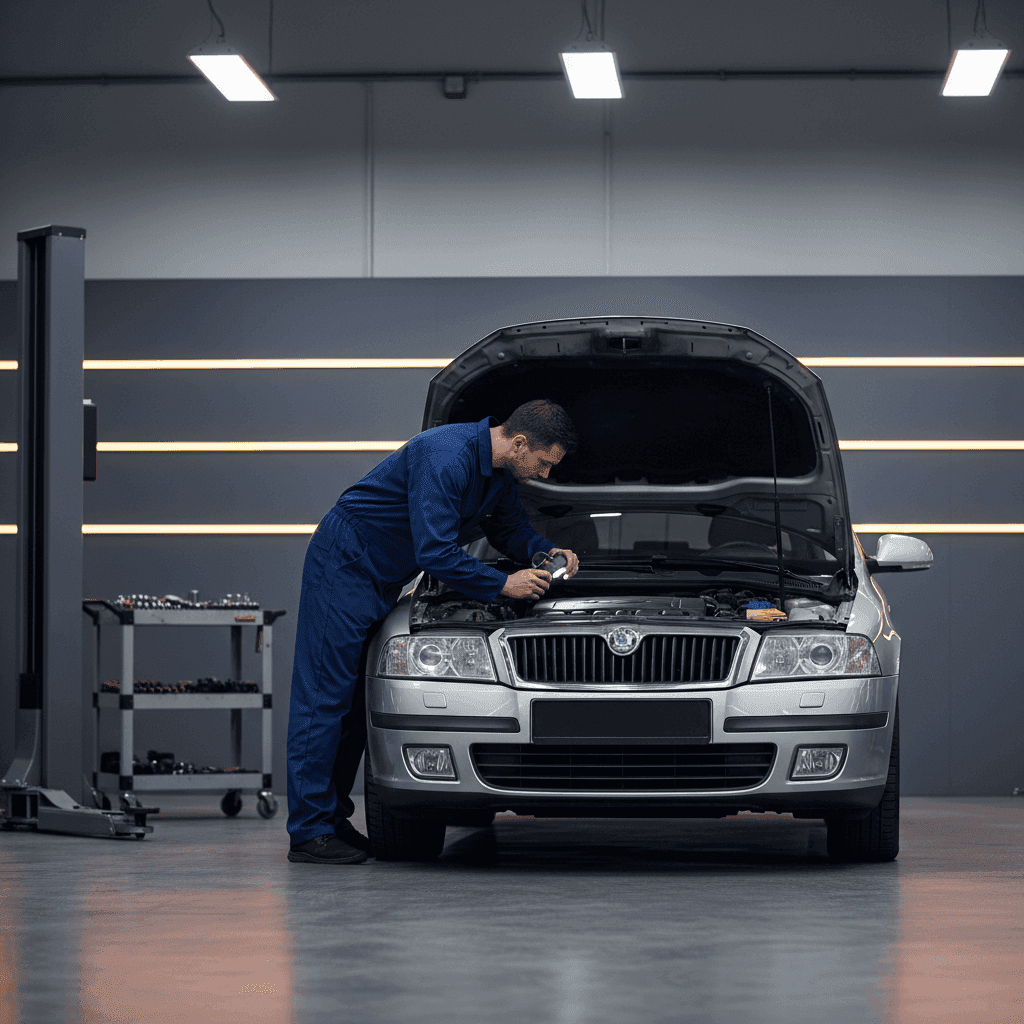
Škoda Octavia 2 common faults are a topic we open almost daily in our workshop. The second-generation Octavia (internal code 1Z, produced 2004-2013) is the best-selling used family car in BiH - spacious, reliable when properly maintained, cheap for spare parts. But not every Octavia is the same: the difference between a good and a bad purchase depends almost entirely on the engine code, gearbox condition, and service history. This guide was written to lay out, in one place, exactly what to buy and what to avoid.
This guide was prepared by the Auto Gas Gaga workshop in Banja Luka, based on years of experience with this model.
Table of Contents
- Why Octavia 2 Is So Common on the BiH Market
- Generations and Facelift
- Diesel Engines by Code
- 1.9 TDI PD - The Old Workhorse
- 2.0 TDI PD BKD and BMM - Caution
- 2.0 TDI Common Rail CBAB and CFHC
- 1.6 TDI CAYC - Economical but Sensitive
- Petrol Engines - 1.6 MPI, 1.4 TSI and 1.8 TSI
- Gearboxes - Manual vs DSG
- Bodywork, Electrics and Suspension
- Pre-Deposit Inspection List
- Realistic Annual Maintenance Cost
- Frequently Asked Questions
- Related Articles
Why Octavia 2 Is So Common on the BiH Market
The Octavia 2 arrived in Europe in 2004 on the VW group PQ35 platform - the same one that underpins the Golf 5, Audi A3 (8P) and Passat B6. For a buyer in BiH that means one important thing: spare parts are shared across four brands, so they are available everywhere and at accessible prices. Every serious car mechanic knows the mechanical side of this car.
The model is spacious, consumes reasonably, has a large boot (liftback 585 litres, estate 605 litres), and in combined driving the diesel versions easily hold 6 to 7 litres. That is a combination that fits the BiH driver perfectly, mixing city and highway use.
This is why it is one of the most searched used cars in BiH - but for that very reason the market is full of examples with hidden problems. A buyer who walks in unprepared can easily end up with a car that needs more investment over the next 12 months than the deposit itself.
Generations and Facelift
The Octavia 2 splits roughly into two phases:
- Pre-facelift (2004-2008) - original styling, engines BXE, BKC, BLS, BKD, BMM, older 1.6 MPI and 2.0 FSI petrols, first-generation DSG DQ250. This is where most of the risk lies, both from the engines and from corrosion.
- Facelift (2009-2013) - creased headlight lines, modernised cabin, Common Rail diesels (CAYC 1.6 TDI, CBAB and CFHC 2.0 TDI), turbocharged TSI petrols, DSG DQ200 (seven-speed dry) alongside DQ250. Quality is on average better, but the facelift series brings its own issues - timing chain on the TSI petrols and DPF on the 1.6 TDI.
If an ad only says "Octavia 2", check the vehicle registration document and the serial number on the coolant expansion tank or on the right rear B-pillar - the engine code is there. Without the code you do not know what you are buying.
Diesel Engines by Code
This is the most important part. In BiH the Octavia 2 is most often bought as a diesel, and the differences between codes are dramatic. Here is the workshop overview, from most reliable to most risky:
- BXE (1.9 TDI PD 77 kW) - workhorse, simple, lasts 400,000+ km with proper maintenance
- CBAB / CBBB (2.0 TDI CR 103 kW) - more mature choice, fewer chronic issues than BKD
- CFHC (2.0 TDI CR 81 kW) - more modest but reliable
- BKD (2.0 TDI PD 103 kW) - popular but risky, demands a very careful inspection
- BMM (2.0 TDI PD 103 kW) - similar to BKD with the same balance shaft issues
- CAYC (1.6 TDI CR 77 kW) - economical but sensitive to DPF and short trips
Each has its own problem profile. Let us go through them in turn.
1.9 TDI PD - The Old Workhorse
If you are torn between the older 1.9 TDI PD and the newer 2.0 TDI PD, for BiH conditions the 1.9 TDI is almost always the safer choice. The engine is simple, without a complicated balance shaft, it copes well with poor fuel, and by its construction it is long-lived.
But not without its own problems. According to service data, on the 1.9 TDI PD increased wear of the pump-injectors has been reported after roughly 190,000 to 240,000 kilometres, along with rising oil consumption. Replacing the complete set of injectors in Western price lists runs from 1,800 to 3,200 USD, here considerably cheaper, but still a serious sum. We have written separately about symptoms of faulty diesel injectors and we recommend reading it before buying any older diesel.
Another common problem is the dual-mass flywheel (DMF). On 1.9 TDI manuals the DMF often starts to rattle on engine start-up and shutdown around 200,000 km. The replacement is not a disaster, but the part itself is noticeably priced.
What to look for on a test drive: even engine idling, no blue smoke even under load, a clean sound with no knocking from the lower part of the engine. If it vibrates unnaturally at idle, suspect the DMF or worn engine mounts.
2.0 TDI PD BKD and BMM - Caution
This is the engine we deal with most often in the workshop when someone brings an Octavia in with a serious fault. Two big problems are well known and documented.
First problem: the hexagonal oil pump shaft. BKD and BMM use a balance shaft module in which the oil pump is driven by a hex-shaped shaft. That shaft wears, the pump head starts to slip, oil pressure drops - and the warning light often comes on too late. The consequence is loss of lubrication to the engine and turbocharger, which means catastrophic damage. On examples over 180,000 km this must be checked with a stethoscope and an oil pressure measurement.
Second problem: micro-cracks in the cylinder head. BKD is known for head porosity - coolant seeps into combustion, white smoke appears from the exhaust, coolant level drops with no visible leak. This is a fault that requires removing the head and either overhauling or replacing it.
Third detail: the timing belt and water pump replacement interval is 150,000 km or 5-6 years. In BiH, due to fuel quality and driving conditions, we stick closer to 150,000 than 210,000 kilometres. Do not buy a BKD or BMM without proof that the belt has been recently changed - we have written in detail about timing belt and chain replacement intervals.
And one more thing: piezo injectors on the 2.0 TDI are prone to failure. Symptoms are hard cold starts, loss of power, increased consumption. A diagnostic test before purchase is mandatory.
2.0 TDI Common Rail CBAB and CFHC
The facelift 2.0 TDI (from 2008-2009 onwards) carries the codes CBAB (103 kW) and CFHC (81 kW). This is a significantly more mature engine - Common Rail injection, a modernised head, without most of the problems of the BKD series.
What you still need to watch for:
- DPF filter. All Common Rail TDIs have a particulate filter. If the car is driven only in town and on short trips, the DPF will not regenerate and will clog. We have a separate article on what a DPF filter is and why it clogs.
- EGR valve and intake swirl flaps. Soot builds up, the intake manifold gets clogged, fault codes P2015 and similar appear. More detail in the article on intake swirl flaps on TDI engines.
- Turbocharger. The VGT turbine geometry clogs with soot if the car is not regularly driven to higher rpm.
If you are choosing between a BKD and a CBAB of the same mileage and year, take the CBAB without hesitation. The price is slightly higher, but that difference easily pays off when you avoid an expensive head overhaul or balance shaft repair.
1.6 TDI CAYC - Economical but Sensitive
The 1.6 TDI (77 kW) has been in the Octavia 2 since 2009 and can be an excellent buy if the owner has been careful. It consumes 4.5-5.5 litres in combined driving, which is impressive for a family car.
Problems:
- DPF is even more sensitive than on the 2.0 TDI because the engine is smaller and transfers less energy into the exhaust for regeneration.
- Timing belt - the factory interval goes up to 210,000 km, but in practice we recommend preventive replacement earlier if you do not know the service history. A belt failure on this engine means bent valves and a full engine overhaul.
- Piezo injectors - more expensive than PD units, they do not tolerate poor fuel.
The CAYC is a smart choice for a driver who does longer trips and who will change the oil more often than the factory interval.
Petrol Engines - 1.6 MPI, 1.4 TSI and 1.8 TSI
In BiH the petrol Octavia 2 is rarer, but it is around. Three basic groups:
- 1.6 MPI (BGU, BSE, BSF) - naturally aspirated, simple, modest performance (75 kW). Fewest faults, ideal for LPG conversion and long service life. If you do not mind that it is not fast, this is the most reliable petrol in the whole range.
- 1.4 TSI - turbo petrol, fun to drive but known for a timing chain that stretches and in some cases skips teeth without warning. Pre-facelift examples are the riskiest. Make sure to verify whether the chain has been replaced.
- 1.8 TSI - more powerful (118 kW), comfortable, but shares the chain problem with the 1.4 TSI and has a known excessive oil consumption issue on certain production batches. It needs oil level checks between every fuel fill-up.
If you are looking for a petrol for LPG, the 1.6 MPI is the first choice. TSI engines with direct injection are more sensitive and require a more careful installation - more on that in the article on direct injection TSI, TFSI, GDI.
Gearboxes - Manual vs DSG
The manual gearbox (5- and 6-speed) is fundamentally reliable. What wears out is the clutch and the dual-mass flywheel. On diesel versions expect a DMF plus clutch replacement somewhere between 200,000 and 280,000 km.
The DSG automatic is a different story. There are two generations:
- DQ250 (6-speed, wet) - used behind stronger engines (2.0 TDI, 1.8/2.0 TSI). Between 100,000 and 160,000 km it shows clutch pack wear and mechatronic overheating. A rebuild in foreign price lists costs 2,200 to 4,500 USD, considerably less here but still expensive.
- DQ200 (7-speed, dry) - paired with weaker engines (1.4 TSI, 1.6 TDI). Known for mechatronic failures and clutch wear.
Critical point: ask the owner when the oil in the DSG was last changed. The factory interval is 60,000 km - if it has never been changed and the car has 150,000+ km, the gearbox is already on borrowed time. On the test drive the DSG must shift smoothly, without jolts, without delay, without strange noises when engaging D or R. If any of that happens, run from the car.
For a deeper dive read when the flywheel causes problems and symptoms of a worn clutch.
Bodywork, Electrics and Suspension
Corrosion on the Octavia 2 is a moderately serious issue, most pronounced on pre-facelift examples (2004-2008) that were driven through winter salt. Critical points:
- lower edges of doors (especially the rear ones)
- sills below the plastic trim
- front fenders around the round side marker
- boot edge near the lock
During the inspection, lift the boot carpet and check the spare wheel well - water tends to collect there.
Electrics: more frequent problems include door central locking failures, parking sensors, heated seats (broken wires), ABS sensors. Not a disaster but a line item.
Suspension: front tie rods and track rod ends need replacing around 120,000-180,000 km. The rear torsion beam axle is reliable aside from wheel bearings that sometimes start to sing before 200,000 km.
Pre-Deposit Inspection List
This is our workshop check before the client puts down a deposit:
- Engine code - visible on the registration document and in the engine bay; avoid BKD and BMM without solid service evidence
- OBD diagnostics - read all modules, not just the engine; DSG, ABS, airbag, climate
- Service history - ask for receipts for the belt, engine oil, DSG oil
- Timing belt replacement date - no older than 150,000 km or 6 years on a TDI
- Oil level and colour - clean, no emulsion (milky = water in oil = head)
- Coolant level - if it drops without a leak, micro-cracks on BKD
- Exhaust smoke - blue (oil), white under load (coolant), black (injectors/EGR)
- DSG test - smooth shifts, no jolts when engaging D/R
- DMF test - turn off the engine at idle, listen for rattling/knocking
- Seat base and boot carpet - moisture means rust or bad seals
- Corrosion - lower door edges, sills, boot lid
- Front suspension - steering wheel shake over bumps, noise over potholes
- DPF status via diagnostics - how clogged it is, when regeneration last ran
If the seller will not let you carry out this check or refuses diagnostics, that is a clear warning sign. A serious owner who has invested in the car will have no objection.
The risk that domestic paperwork does not catch is taxi and fleet history. The Octavia 2 was a favourite for taxi services, driving schools and corporate fleets in Germany and Austria, and such examples often have 600,000 to 800,000 km on them before they are retired and exported. When such an Octavia arrives in BiH, the mileage is often "cleaned up" at re-registration and the ad presents the car as a family vehicle with 200,000 km. A useful way to close that gap is a check via carVertical: from the VIN it pulls the documented history of the car from international registers, typically including the real mileage by date, the countries where the vehicle was registered, recorded accidents and previous commercial use. We treat that as a basic layer of defence against a hidden taxi past before any deposit on an import. When paying for the report you can use the code GAGA for 20% off.
Realistic Annual Maintenance Cost
For a well-kept Octavia 2 with a diesel engine in BiH, a realistic annual budget for regular maintenance (oil, filters, brakes as needed, minor service) stays within modest bounds. Bigger items - timing belt every 5-6 years, DMF plus clutch once every 200,000+ km, occasionally injectors or turbo - come less often but are noticeable.
The cost for a specific Octavia depends on the engine, mileage and the condition you find it in. If you are thinking of buying, get in touch for an assessment and we can look at a specific ad and tell you what to expect.
Do you drive an Octavia and are you looking for a reliable workshop that knows this model? Auto Gas Gaga in Banja Luka handles regular service, pre-purchase inspections and diagnostics - book an appointment.
Frequently Asked Questions
Which is the most reliable Škoda Octavia 2 for BiH conditions?
A facelift (2009-2013) Octavia 2 with the 1.9 TDI BXE or 2.0 TDI CBAB engine and a manual gearbox. The BXE is simple and long-lasting, the CBAB is more mature than the old BKD, and the manual gearbox avoids the complications of the DSG automatic. For a petrol, the 1.6 MPI with LPG is the most economical and most reliable choice.
How many kilometres can the Octavia 2 diesel cover?
With regular servicing, the 1.9 TDI PD engine regularly passes 400,000-500,000 kilometres. The 2.0 TDI CR (CBAB, CFHC) holds up similarly, provided the oil and timing belt intervals are respected. The 2.0 TDI PD BKD is unpredictable - some go a long way, some give up at 200,000 km due to the balance shaft or the cylinder head.
Should you buy an Octavia 2 with a DSG gearbox?
You can, but only with proof that the gearbox oil has been changed regularly (every 60,000 km) and that there are no jolts on the test drive. The DQ250 (6-speed wet) is more durable than the DQ200 (7-speed dry). Without DSG service history, the cost of a rebuild can exceed the value of the car.
How do you spot micro-cracks on the BKD cylinder head?
The main signs are a drop in coolant level without a visible leak, white smoke from the exhaust under load (especially after warm-up), and emulsion or foam on the oil filler cap. A reliable confirmation comes from pressure-testing the cooling system and checking for exhaust gases in the expansion tank.
How often should the timing belt on the Octavia 2 be changed?
Factory intervals vary from 120,000 to 210,000 km depending on the engine. In BiH conditions we recommend replacement closer to 150,000 km, or every 5-6 years. The belt is changed together with the water pump and tensioner - never the belt alone.
Is the Octavia 2 a good base for an LPG conversion?
The 1.6 MPI naturally aspirated engine is excellent for LPG - simple, it handles the gas without problems and saves a lot. TSI petrols with direct injection (1.4 and 1.8 TSI) require a more careful installation and a specific type of system. For details on which vehicles are suitable for LPG conversion we have a separate guide.