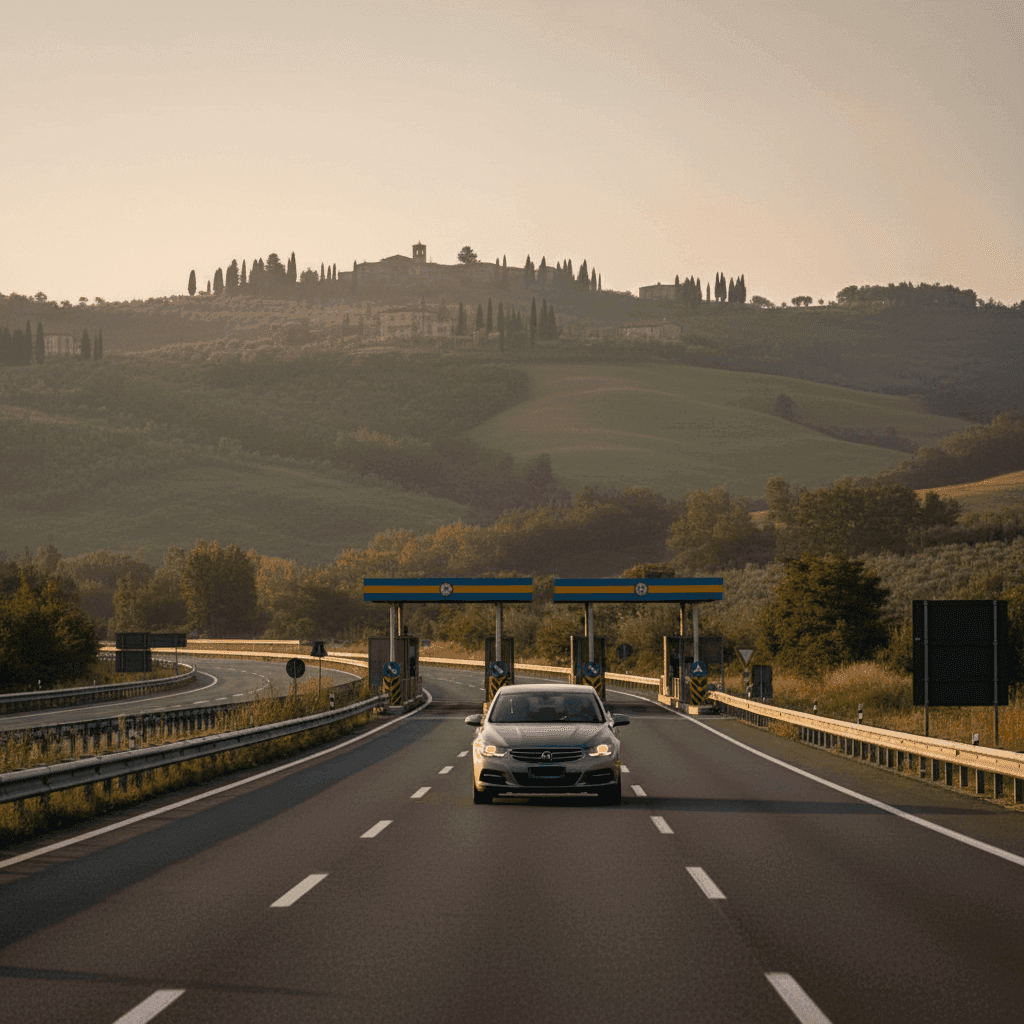
Driving from BiH to Italy in 2026 most often goes through Croatia and Slovenia to Trieste, and then 500 to 900 kilometres along Italian motorways to the Adriatic, Tuscany or the south. We put this guide together for a driver from Banja Luka who does not want a fine from Rome or the A33 to land in their post months later, only to be sorted out through a lawyer. All prices and rules apply as of 1 May 2026.
The guide was prepared by the Auto Gas Gaga workshop from Banja Luka, based on publicly available sources (BiH Green Card Bureau, Tolls.eu, European Consumer Centre, AMSS) and on experience with clients who drive this route every summer.
Table of Contents
- The most popular route - through Slovenia and Trieste
- Documents for driver and vehicle
- Slovenia - e-vignette and the Škofije-Izola exemption
- Italy - tolls, payment methods and Free Flow zones
- ZTL zones in Italian cities
- Mandatory equipment and how it differs from BiH
- Speeds, fines and how they are collected from BiH drivers
- What to check on the vehicle before departure
- Frequently Asked Questions
- Related Articles
The most popular route - through Slovenia and Trieste
The standard route from Banja Luka goes via Bosanska Gradiška or Slavonski Brod into Croatia, then the A1 to Zagreb, the A2 to Macelj, through Slovenia (Maribor, Ljubljana, Postojna), and via Škofije it enters Italy near Trieste. A second variant goes via Rijeka and Pula, then by Pula-Venice ferry in season, or overland through Učka to Trieste. In total, from Banja Luka to Trieste there are about 700 kilometres, with two breaks that means eight to nine hours of driving.
Transit through Croatia has its own rules on green card and tolls that partly differ from the Italian ones, so for details we recommend the dedicated guide Driving from BiH to Croatia 2026. Here we cover Slovenia only as transit, while vignettes for Slovenia and Austria as destinations are left for a separate post in the same series.
Documents for driver and vehicle
Italy is in the so-called MGA regime (Multilateral Guarantee Agreement), which means the BiH licence plate formally serves as proof of insurance. Despite that, the BiH Green Card Bureau explicitly recommends that the driver carry a physical, paper green card with all EU/EEA country marks visible and not crossed out. An electronic copy on the phone is not accepted, and the border police are known to ask for it regardless of the MGA rule.
In addition to the green card, you should have in the car:
- driving licence (the BiH licence is recognised in all EU countries without an international permit)
- vehicle registration certificate (paper, in the driver's name or with a notarised authorisation if you are driving someone else's car)
- ID card or passport for all passengers
- compulsory insurance policy
- for a rental or leased car: a written consent from the owner to leave BiH, notarised
A similar rule applies to other destinations in our series, as in the article on driving to Greece, where the MGA regime also applies.
Do I need a green card for Italy
Formally no, because the MGA agreement makes the BiH plate sufficient. In practice, yes. A border officer may ask for it, and you do not want a dispute at the border while your kids are baking in the car.
Slovenia - e-vignette and the Škofije-Izola exemption
Since 2022 Slovenia has only an electronic vignette, paper ones are gone. For passenger vehicles up to 3.5 tonnes (class 2A) prices in 2026 are: weekly EUR 16, monthly EUR 32, annual EUR 117. It is bought online via the official DARS portal (evinjeta.dars.si) or at petrol stations in Slovenia and neighbouring countries, and the plate is linked to a digital record, so nothing is stuck on the windscreen.
For drivers heading to Italy via Trieste there is an important update. From 1 January 2026 the motorway section from the Škofije border crossing to the Izola exit is exempt from the vignette system. In other words, if you enter Slovenia from Italy only to go to Izola or Koper, you do not need a vignette. But if you are going from BiH to Italy via Slovenia, crossing Maribor, Ljubljana and Postojna, the vignette is mandatory.
The fine for driving without a vignette in Slovenia starts at EUR 300, so saving EUR 16 on the weekly vignette is in no way worth it. Buy it as soon as you arrive, easiest online a day earlier.
How much does the Slovenia vignette cost in 2026
Passenger vehicle up to 3.5 tonnes, class 2A: weekly EUR 16, monthly EUR 32, annual EUR 117 (source: official DARS portal and VignetteGo). For vans over 3.5 tonnes and motorhomes prices are higher and the classification is different.
Italy - tolls, payment methods and Free Flow zones
Italy has no vignette system, the toll is paid per section. The average cost for a passenger vehicle in 2026 is around EUR 9 per 100 kilometres. Classic relations: Trieste-Venice about EUR 13, Milan-Rome (581 km) EUR 45.60, Milan-Bari (879 km) EUR 70, Bologna-Florence about EUR 9 (source: Tolls.eu, as of 9 March 2026).
Operators change tariffs every year on 1 January, and in 2026 prices rose on some sections and fell on others. For real numbers at the time of departure, it is best to check the official Autostrade per l'Italia calculator or Tolls.eu a few days before the trip.
Payment at a classic toll booth is by cash, bank card (contactless on all modern booths), Viacard prepaid card or Telepass device. Telepass is the Italian electronic payment system, similar in principle to the Croatian ENC, but for one week of holiday it is usually more expensive to rent the device than to pay by cash or card.
How to pay Italian Free Flow A33
Since 2024 Italy has been gradually phasing out classic toll booths on certain sections and introducing the so-called Free Flow system, where cameras read the plate as you pass and the driver is required to pay the fee themselves within a set deadline. In 2026 this system is active on the A33 (Asti-Cuneo) and the A36/A59/A60 (Pedemontana Lombarda).
A foreign driver without Telepass has three options: a mobile app (Telepass Pay, MooneyGo and others), Conto Targa (online plate registration with the operator, with a card on file) or payment point locations where you can pay in cash within 15 days.
If the driver does not pay on time, a fine arrives by post months later and is usually several times higher than the original toll. This is a 2026-specific trap, because there are no booths there, only cameras. If you are planning the north-west of Italy (Cuneo, Asti, Lombardy), check the Free Flow section map in advance.
ZTL zones in Italian cities
ZTL is the abbreviation for Zona a Traffico Limitato, a limited-traffic zone in the centre of Italian cities. They exist in Rome, Florence, Milan, Pisa, Bologna, Verona, Siena and a dozen other cities. Only residents and vehicles with special permits may enter these zones, at set hours.
The zone is marked with a round blue-and-white sign reading Zona Traffico Limitato along with the operating hours. At the entrance there is no barrier, no police officer and no warning, only a camera that photographs your car's plate. The fine is generated automatically.
Fine amounts for unauthorised entry range from EUR 80 to EUR 300 per pass, in some cities up to EUR 332 (source: European Consumer Centre). If you enter three times in one day, you will get three fines. Italian authorities have up to 360 days to notify a foreign driver, which means the fine can land in your post even ten months after the holiday.
A ZTL fine arrived by post, what should I do
First, check whether the document is authentic, because there are scams where fake ZTL fines are sent through a rental company invoice. Second, do not ignore the fine, Italian authorities actively use European cross-border collection mechanisms. Third, if you are more than 60 days late, the amount usually doubles.
Practical advice: in Rome, Florence or Pisa park the car outside the city (parcheggio scambiatore, edge car park) and enter the centre by public transport or on foot. The parking cost is far lower than a single ZTL fine.
Mandatory equipment and how it differs from BiH
Italian equipment for a passenger vehicle in 2026 includes:
- warning triangle (one piece)
- reflective vest with CE mark, standard EN 471 or EN 20471 (one for every passenger leaving the vehicle in case of breakdown)
- spare bulb and fuses (recommended, not strictly mandatory for passenger vehicles)
- winter tyres or chains from 15 November to 15 April on signposted sections (catenobbligo marking)
The main difference compared with a properly equipped BiH car: the vest must be within reach inside the passenger compartment, not in the boot, because under Italian rules it must be put on before getting out of the car outside built-up areas, even in daytime. A first-aid kit and fire extinguisher are not mandatory for passenger vehicles in Italy, but are recommended.
Are a triangle and vest enough in Italy
For a passenger vehicle, yes. The V16 light beacon becomes mandatory in Spain from 1 January 2026 (replacing the warning triangle), but in Italy in 2026 the triangle remains mandatory and the V16 is not required. The EU is gradually moving in that direction, but for summer 2026 in Italy a classic triangle and a vest per passenger are enough.
Speeds, fines and how they are collected from BiH drivers
Speed limits in Italy: 50 km/h in built-up areas, 90 km/h outside built-up areas, 110 km/h on expressways and 130 km/h on motorways. In rain and bad weather the motorway limit drops to 110 km/h, which is often overlooked when a downpour suddenly starts.
Fines (source: SpeedingEurope) go in steps: up to 10 km/h over the limit from EUR 42 to EUR 173, 11-20 km/h over from EUR 173 to EUR 695, and over 20 km/h from EUR 532 to EUR 2,127, plus suspension of the driving licence for one to three months. Foreign drivers also pay an additional EUR 20-30 in administrative costs per offence.
Italians have a dense network of radars plus average-speed (tutor system) cameras on a large part of the motorways. Fines arrive by post with a 360-day deadline, and you get a 30% discount if you pay within five days of receipt.
What to check on the vehicle before departure
Before any longer trip to Italy in the summer months we recommend a short technical check at a workshop. The detailed plan is in our tip on inspecting the vehicle before a longer trip, and for this route we would single out:
- Air conditioning. Italy in July and August has 35 to 40 degrees, you drive eight hours, and a faulty AC is not a discomfort but a risk for children and the elderly. Service and refrigerant refill are covered in the article AC in the car - service and refrigerant refill.
- Tyres and pressure. With a loaded car (four passengers, luggage, roof box) the pressure goes 0.2-0.3 bar above standard. Check the spare tyre or the repair kit too.
- Fluids and brakes. Coolant, engine oil, brake fluid, washer fluid. Over 1,500 kilometres downhill along Slovenian and Italian hills the brakes work harder than in city driving.
- Battery. In the heat the battery ages faster. If it is older than four years, check it before departure.
If you are planning a roof box or a bike rack, fit them a day earlier and try a drive around the block. If you would like us to prepare the car for the trip, book an appointment or contact us via the contact page.
Frequently Asked Questions
Do I need an international driving permit for Italy?
No. The BiH driving licence is recognised in all European Union countries, including Italy, without an international driving permit. It only needs to be valid and legible.
How many kilometres is it from Banja Luka to Trieste?
About 700 kilometres, depending on the choice of route. The drive takes eight to nine hours with two breaks, plus queues at the Macelj and Škofije border crossings.
Can I pay the Italian toll by card?
Yes, all modern toll booths accept contactless and standard card payments. Just make sure the booth is not marked only with yellow Telepass signs, because that lane is reserved for users of the Telepass device.
What if I drive through a ZTL in Rome and do not notice?
A fine of EUR 80 to EUR 300 will arrive by post in BiH within 360 days. Do not ignore it. It is more practical in Rome to leave the car at an edge car park and enter the centre by metro or on foot.
Do I need a Telepass device for a holiday in Italy?
No. Telepass is worth it only for drivers who cover thousands of kilometres around Italy each year. For one to two weeks of holiday it is enough to pay by card or cash at the booth.
What is the fastest route from Banja Luka to Venice?
Banja Luka - Bosanska Gradiška - Zagreb - Macelj - Maribor - Ljubljana - Postojna - Trieste - Venice. About 800 kilometres, nine to ten hours with breaks, plus the Slovenia vignette and tolls for the Croatian and Italian sections.