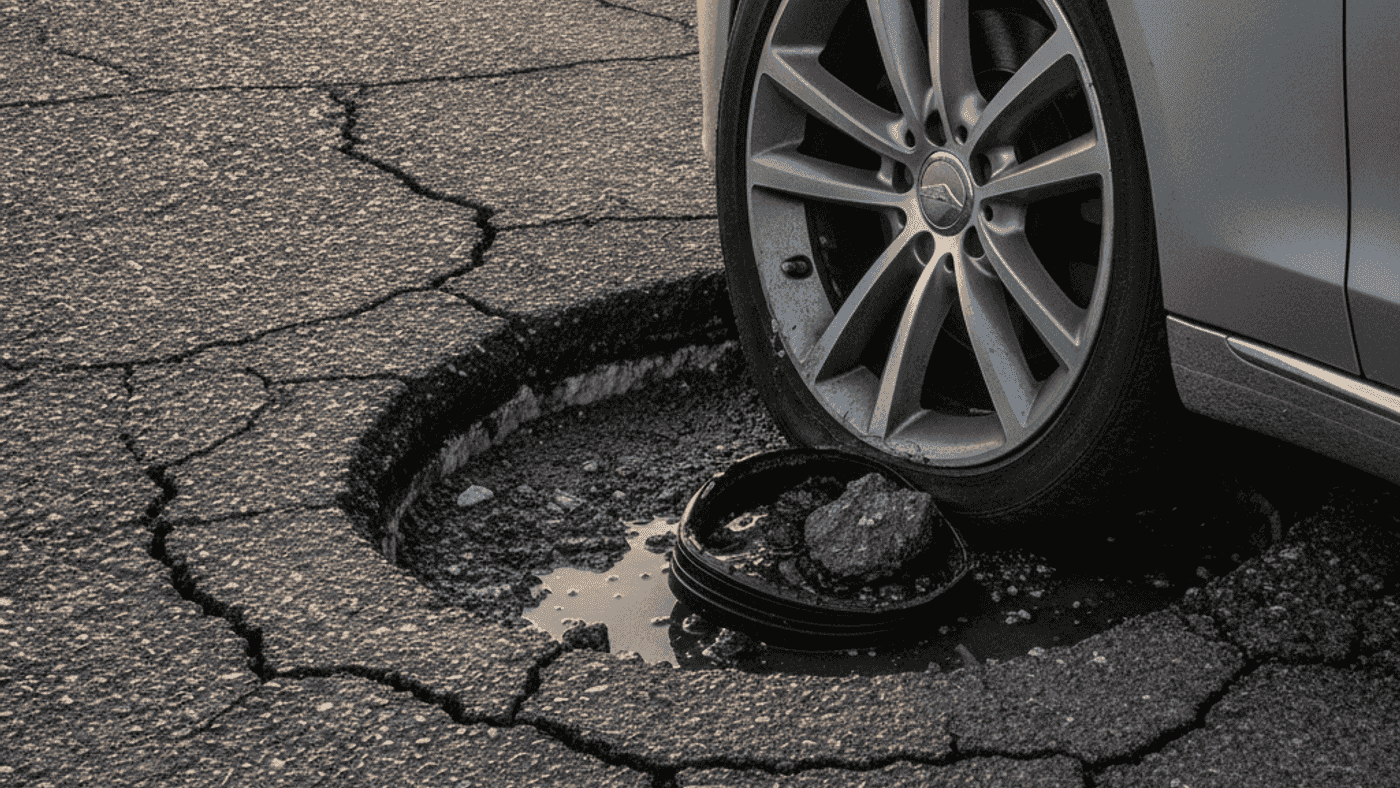
You are driving along a main road, late afternoon, the sun hitting low and blinding you to what lies ahead. Your front wheel drops into a pothole roughly twenty centimetres deep. A thud, a metallic bang, the car pulls to one side. You step out and stare at a rim bent like a tin can and a tyre that has gone flat. This is a situation thousands of BiH drivers experience every year, yet most never learn they are entitled to pothole damage compensation in BiH. The road authority is legally responsible for the condition of the carriageway, and that responsibility is not merely declarative.
This guide was compiled by the Auto Gas Gaga workshop in Banja Luka, drawing on experience with vehicles that come in for repair after pothole and poor-road-surface damage.
Table of Contents
- Why this matters for BiH drivers in 2026
- What typically gets damaged when you hit a pothole
- Step 1: what to do immediately at the scene
- Step 2: documenting the damage and estimating costs
- Step 3: identifying who is responsible for the road
- Step 4: filing a claim with the road authority
- Step 5: what to do if the road authority refuses to pay
- How much does pothole damage realistically cost
- Does comprehensive insurance cover pothole damage
- How to reduce the risk of pothole damage on BiH roads
- Frequently Asked Questions
- Related Articles
Why this matters for BiH drivers in 2026
The average age of motor vehicles in BiH is 17 years, and 38% of registered cars are older than 23 years. That means most cars on BiH roads lack the modern suspension protection found in newer models. Shock absorbers are softer, tyres thinner, rims often aluminium and more brittle. A single serious pothole can cause damage ranging from several hundred to well over a thousand KM on an older car.
At the same time, road conditions in BiH remain problematic. Main roads, regional roads and local carriageways are riddled with potholes, especially after the winter months. Repairs are often superficial and do not last more than one season. Drivers endure all this and pay out of their own pocket because they do not know the law clearly states who is responsible.
The FBiH Road Act (Article 13) and the RS Public Roads Act (Article 16) unequivocally oblige road authorities to maintain the carriageway in a condition that allows safe traffic flow. When a pothole exists and has neither been repaired nor marked, the road authority has breached that obligation. As the injured party, you have the right to compensation.
What typically gets damaged when you hit a pothole
The extent of the damage depends on the depth of the pothole, the speed at which you hit it and the type of vehicle. In practice, these are the most common consequences we see in our workshop.
Rims. Aluminium rims crack or bend at the point of impact. Steel rims deform but rarely crack. A bent rim can sometimes be straightened on a press, but a cracked one must be replaced.
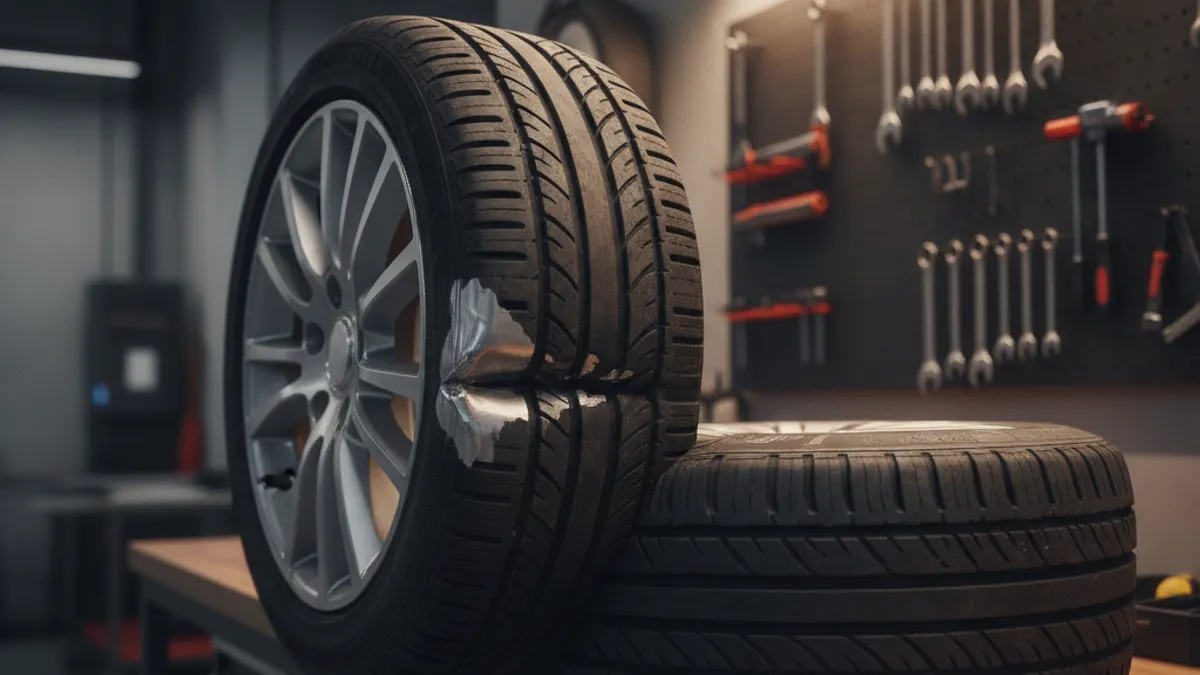
Tyres. The sidewall is the thinnest part of the tyre. A pothole impact can puncture it, tear it or create a bulge (hernia) that means the tyre is no longer safe to drive on. A tyre with a hernia cannot be repaired.
Shock absorbers and springs. A hard impact can damage a shock absorber or snap a suspension spring. This is not immediately visible, but the car begins to respond differently to bumps and leans to one side.
Bushings and track-rod ends. The impact shock travels through the entire suspension system. Rubber bushings can crack, and outer tie-rod ends can weaken. The result is knocking when driving over bumps and an unstable steering wheel.
Wheel alignment. Even when there is no visible rim damage, a single hard impact can throw the wheel alignment out. The car then pulls to one side, tyres wear unevenly and driving becomes unsafe.
In the worst-case scenario, a deep pothole at higher speed can also damage the engine undertray, the plastic bumper or the front section of the exhaust. Such situations are less common but do occur on roads with potholes deeper than 15 centimetres.
Step 1: what to do immediately at the scene
The first ten minutes after hitting a pothole determine how strong your chances of claiming compensation will be. Here is the sequence.
Pull over safely. Switch on your hazard lights, put on a reflective vest and set up a warning triangle. If the car can be moved off the carriageway, do so. Safety comes first.
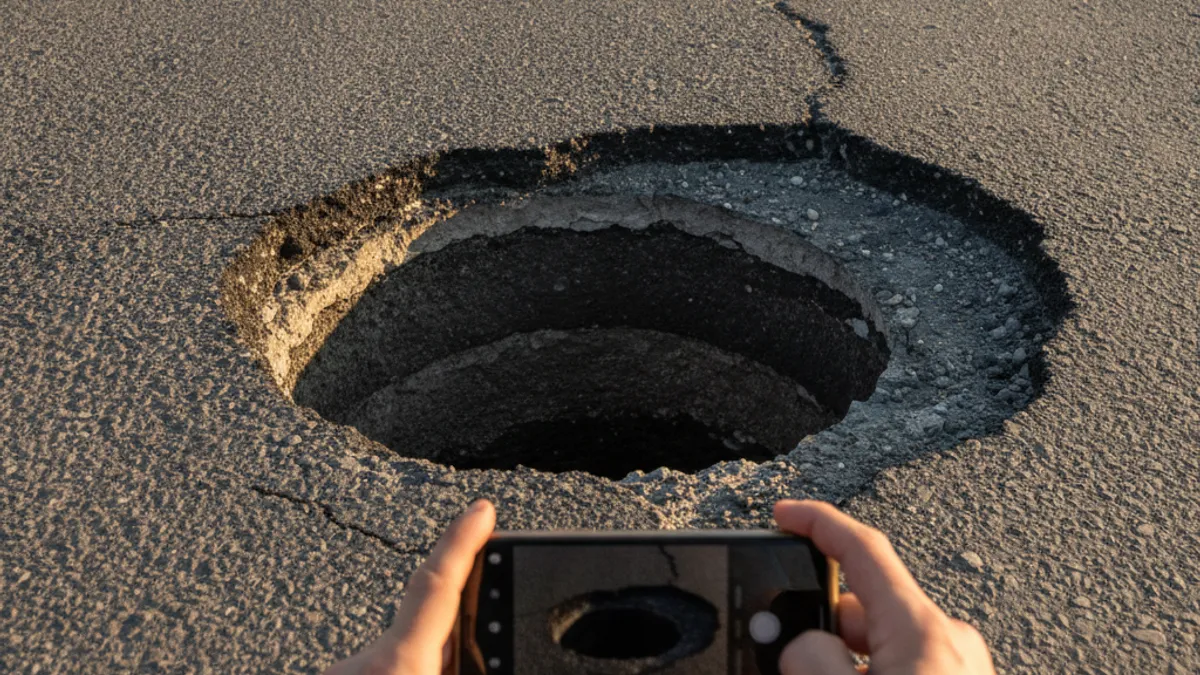
Photograph the pothole. Use your mobile phone, from multiple angles. Take a photo that shows the width and depth of the pothole. Place an object of known dimensions next to it (a cigarette packet, a water bottle, a shoe) so the photograph reveals how deep it really is. Also photograph the surroundings to show there are no warning signs, markings or any indication that the pothole was flagged in any way.
Photograph the vehicle damage. The rim up close, the tyre, any impact marks on the bumpers or undercarriage. The more photos, the better.
Record the location. Open Google Maps or any navigation app and take a screenshot of the exact location. Also note the road name, the direction of travel, the approximate kilometre marker if there is one, and the nearest settlement or junction.
Record the date, time and conditions. Write down or record a voice memo: the date, the time, the weather (rain, dry, dark, fog) and roughly how fast you were driving when you hit the pothole.
Look for witnesses. If someone was in the car with you or the driver behind you saw what happened, get their name and phone number. A witness is not mandatory for a claim, but significantly strengthens your case.
Call the police. This is the crucial step. Call the local police station and ask them to attend the scene and prepare an incident report. A police report with a sketch of the scene and confirmation that the pothole exists is the strongest piece of evidence you can have. Without it, the road authority will find it much easier to dispute your claim.
Step 2: documenting the damage and estimating costs
Once you have secured evidence at the scene, you need a formal assessment of the vehicle damage.
Authorised assessor. Take the car to an authorised damage assessor (a court-appointed traffic expert or a licensed vehicle assessor). They will inspect the vehicle, photograph the damage and prepare a damage report with detailed photo documentation and a repair-cost estimate. This document carries legal weight.
Repair invoices. If you have already repaired the car before engaging an assessor (which happens when you need the car back on the road urgently), keep all invoices. A workshop invoice specifying the work carried out and the parts used is valid proof of expense.
Proof of ownership. Prepare a copy of the vehicle registration document proving you are the owner of the damaged vehicle.
To file a compensation claim you will need: the police incident report with a site sketch and photo documentation, the vehicle damage report from an authorised assessor with photographs, the invoice or repair-cost estimate, and proof of vehicle ownership (the registration document).
Step 3: identifying who is responsible for the road
This is the step most drivers skip, yet it determines who you send your claim to. In BiH there are four public enterprises that manage roads, and responsibility depends on the category of the road where the damage occurred.
In the Federation of BiH:
- JP Autoceste FBiH manages motorways and expressways
- JP Ceste FBiH manages main roads
- Cantonal road directorates manage regional roads
- Municipalities and cities manage local and uncategorised roads
In Republika Srpska:
- JP Autoputevi RS manages motorways
- JP Putevi RS manages main and regional roads
- Municipalities and cities manage local roads
How to find out which institution a road belongs to
The simplest way is to check the road markings. Main roads carry an M designation (M5, M16, M17...), regional roads an R, and motorways an A. If you are unsure, call the municipality on whose territory the road lies and ask who manages that section. The municipality is obliged to provide that information.
Alternatively, JP Ceste FBiH and JP Putevi RS publish road maps with categories on their websites. A single phone call or email can resolve the question.
Step 4: filing a claim with the road authority
Once you know who is responsible, you send a written compensation claim. The claim should contain the following.
Your details. Full name, address, phone number, ID card number.
Description of the incident. Date, time, exact location, description of how the damage occurred, road conditions (unmarked pothole, no warning signs).
Evidence. Attach copies of everything: police report, assessor's findings, photographs of the pothole and the damage, repair invoices, copy of the registration document.
Amount claimed. State a specific amount based on the assessor's findings or the repair invoice.
Response deadline. Request a written response within 15 days.
Send the claim by registered post with a return receipt. The return receipt is proof that you sent the claim and when. Keep a copy of everything you sent. Alternatively, you can deliver the claim in person at the public enterprise's reception desk and ask them to stamp your copy with the date of receipt.

Step 5: what to do if the road authority refuses to pay
In practice, road authorities frequently avoid paying compensation voluntarily. Refusal or silence is the rule rather than the exception. If the road authority refuses to pay or fails to respond within 15 days, you have the right to initiate court proceedings.
Hire a lawyer. Lawyers specialising in damage compensation often take such cases on a contingency basis, charging a percentage of the awarded amount with no upfront fee. This means you do not need money for a lawyer in advance. The lawyer represents you and collects their fee from whatever the court awards.
File a lawsuit. You file the lawsuit at the basic court with jurisdiction over the road authority's registered office or the location where the incident occurred. The lawyer drafts the claim, attaches the documentation and manages the proceedings.
What the court examines. The court establishes whether the pothole existed, whether it was marked, whether the road authority was obliged to repair it, and how much the damage amounts to. Your evidence (the police report, photographs and assessor's findings) is crucial.
Statute of limitations for a lawsuit against the road authority
Under the Law on Obligations, the limitation period for a damage compensation claim is three years from the day the injured party became aware of the damage and the person who caused it. Do not wait until the last moment. The sooner you initiate proceedings, the fresher the evidence and the greater your chances of success.
Note. This is a practical guide, not legal advice. For specific cases, consult a lawyer familiar with local case law. Every case has particularities that affect the outcome.
How much does pothole damage realistically cost
Actual repair costs depend on what was damaged and which car you drive. The price depends on the specific condition, but here is a rough guide based on what we see in our workshop.
Replacing a single aluminium rim on a used car can cost as much as a full set of new tyres. Straightening a bent rim is cheaper, but is not always possible if the material has cracked. If a spring has snapped or a shock absorber is damaged, costs rise because, for safety reasons, you need to replace the pair on the same axle.
The most expensive scenario occurs when a single pothole damages the rim, the tyre and the shock absorber and throws the alignment out. In that case, the combined damage quickly exceeds one thousand KM, especially on vehicles with larger wheels (17 inches and above) where both rims and low-profile tyres are more expensive.
On older vehicles (and the average car in BiH is 17 years old) the situation is further complicated because original parts are harder to source, while aftermarket alternatives vary in quality and price.
For an accurate damage estimate on your vehicle, a workshop inspection is needed. Get in touch for an assessment or take your car to an authorised assessor who will prepare a formal report.
Does comprehensive insurance cover pothole damage
Comprehensive (kasko) insurance in BiH, depending on the policy, may cover damage caused by hitting a pothole. The key factor is the type of policy you have.
Full comprehensive insurance usually covers mechanical damage sustained on the road, including pothole impacts. Check the terms of your policy, particularly the section on "damage caused by road-surface conditions" or "accident without involvement of another vehicle". An excess (deductible) applies, so for minor damage a comprehensive claim may not be worthwhile.
Partial comprehensive insurance usually does not cover pothole damage. Partial cover typically covers theft, fire, natural disasters and broken glass, but not mechanical damage in traffic.
Compulsory motor insurance (third-party liability) does not cover damage to your own vehicle. It covers damage you cause to others.
Important: even if you have comprehensive insurance and file a claim with your insurer, this does not prevent you from simultaneously filing a claim with the road authority. After paying out your claim, the insurer can itself seek reimbursement from the road authority (right of subrogation).
How to reduce the risk of pothole damage on BiH roads
Avoiding potholes on BiH roads entirely is impossible, but you can reduce the chances of a pothole causing serious damage.
Keep your tyres at the correct pressure. A properly inflated tyre absorbs impacts better. An underinflated tyre is more easily punctured because there is less space for deformation between the rim and the asphalt.
Maintain a safe following distance. If you drive too close to the vehicle ahead, you cannot see a pothole in time. Sufficient distance gives you a second or two to react and either steer around the obstacle or at least reduce speed before impact.
Slow down on bad stretches. You know the roads you drive every day. You know which main road is full of potholes, which local road has no drainage and breaks up every winter. On those stretches, 60 instead of 80 km/h can be the difference between a minor inconvenience and a bent rim.
Night driving is the riskiest. Potholes are virtually invisible at night, especially on unlit roads. If you are driving at night on an unfamiliar road, reduce your speed below the limit and brace for uneven surfaces.
Choose tyres with a higher profile. Low-profile tyres (40 or 35 series) look good on the rim but have a thin sidewall that provides minimal cushion between the rim and a pothole. A tyre with a 55 or 60 series profile absorbs impacts better and protects the rim.
Have your suspension inspected regularly. A car whose springs, shock absorbers and bushings are in good condition handles impacts far better. A car with worn suspension suffers greater damage from the same pothole. Book a suspension inspection if you notice knocking, juddering or an unstable steering wheel.
Frequently Asked Questions
Do I have to call the police if a pothole damages my car?
Calling the police is not legally required, but it is highly recommended. A police incident report is the strongest evidence that the pothole exists and was not marked. Without that report, the road authority can claim the pothole did not exist or that it was signposted.
How long do I have to file a claim?
You can file a claim with the road authority at any time, but it is advisable to do so as soon as possible while the evidence is fresh. The statute of limitations for a court lawsuit is three years from the day you became aware of the damage and the responsible party.
What if the pothole was marked but I did not see it?
If the road authority had placed warning signs and marked the pothole, your chances of obtaining compensation are significantly lower. The authority can argue it fulfilled its obligation. However, the quality and visibility of the markings can be challenged, particularly in conditions of reduced visibility.
Can I claim compensation without a police report?
You can try, but your chances are considerably lower. Photographs with location and date stamps, witness statements and an assessor's report can serve as evidence, but a police report carries the greatest evidentiary weight.
Bent rim from a pothole - how much does the repair cost?
The price depends on the type of rim, the extent of the damage and the vehicle model. Straightening a slightly bent aluminium rim is cheaper than replacement, but is not always possible if the rim has cracked. For an accurate estimate, take the rim to a specialist or get in touch for an inspection.
Does the process differ between FBiH and RS?
The principle is the same: the road authority is responsible for the condition of the carriageway. The difference lies in who you file the claim with (JP Ceste FBiH or JP Putevi RS for main roads) and which court has jurisdiction. The legal framework is analogous, but the institutions differ.