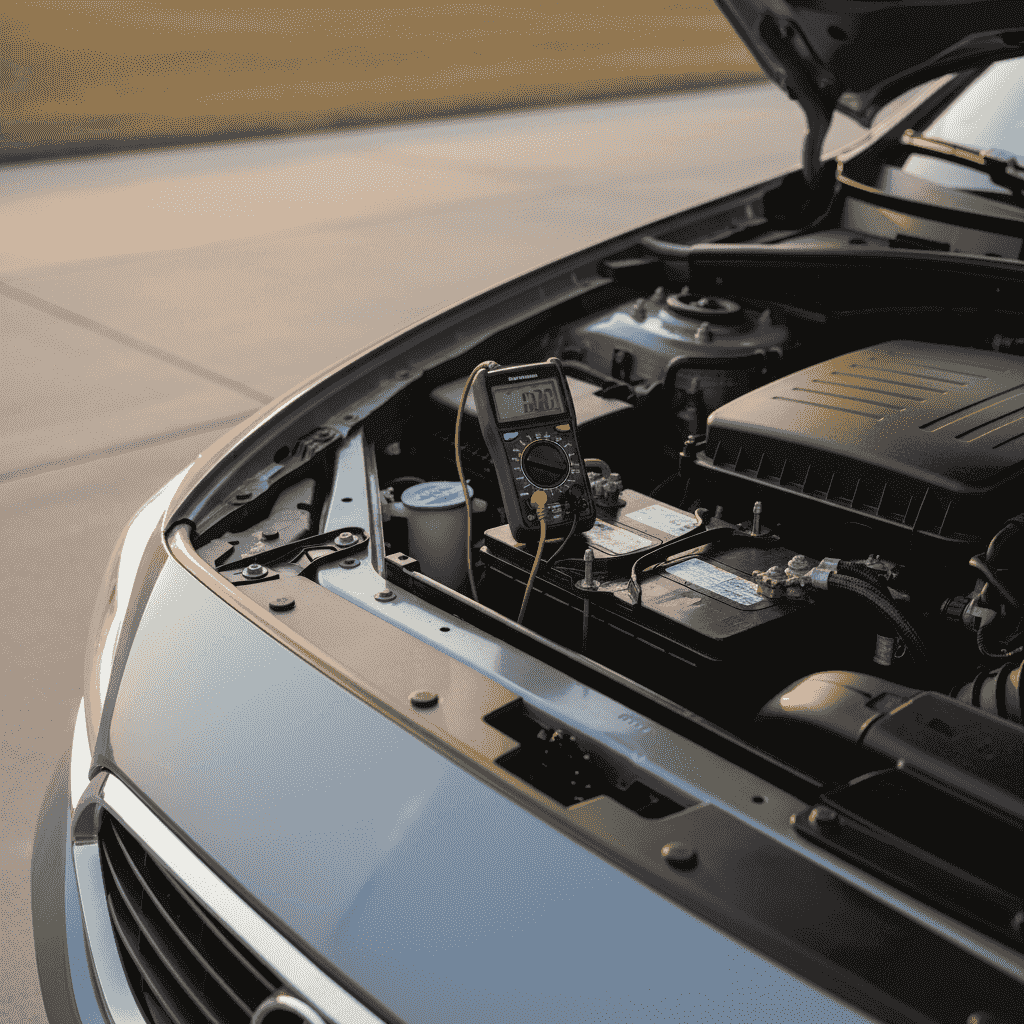
Heading into summer, most drivers in BiH sort out their tyres and air conditioning, but skip the battery. Yet summer is exactly what destroys batteries the most: heat speeds up self-discharge and corrosion of the plates, so cars give out en masse in May and June, or only in October when more current is needed for cold starts. A pre-summer battery check takes five minutes with an ordinary multimeter, costs you nothing, and stops you from being stranded at a petrol station between Banja Luka and Neum.
This guide was put together by the Auto Gas Gaga workshop in Banja Luka, based on years of experience with battery replacements and pre-season vehicle checks before trips to the coast.
Table of Contents
- Why batteries suffer in summer but fail in winter
- Five signs your battery is near the end
- How to check the battery yourself with a multimeter in five minutes
- What 12.6 V, 12.4 V and 12.2 V mean
- AGM and EFB for start-stop systems
- Battery prices in BiH 2026
- Top up or replace, when each makes sense
- What to check before a road trip to the coast
- Frequently Asked Questions
- Related Articles
Why batteries suffer in summer but fail in winter
Most people believe the battery is a winter casualty. Cold morning, the engine struggles, the battery is dead, logically the cold is to blame. The real story is different. Statistics from Germany's ADAC for 2026 show that the 12V battery is the cause of 45.4% of all their roadside assistance call-outs, twice as many as any other fault, regardless of whether the car runs on petrol, diesel or electricity.
And the damage is almost never done at minus ten degrees, but in summer. High temperatures speed up self-discharge, electrolyte evaporation and corrosion of the lead plates inside the battery cells. Klix.ba explained this difference clearly: a battery fails in winter not because the cold finished it off, but because it worked hard all summer at high temperatures, and the winter cold simply exposes the capacity that has already disappeared.
The second reason summer kills batteries is driving style. Short city runs with the air conditioning, heated seats and radio on draw more power than the alternator can put back. To reach a real one hundred percent state of charge, the battery needs a longer continuous drive, not five minutes from home to the shop. In that regime, sulphates settle on the plates and capacity slowly drops.
The third reason is the age of the battery. A factory-fitted battery typically lasts five to six years, while an aftermarket replacement battery usually lives three to four years. After the third year from installation, an annual check is recommended. If your battery is older than five years, summer 2026 is a serious obstacle that not every unit will survive.
Five signs your battery is near the end
A battery almost never fails out of the blue, it gives signs weeks in advance. Five things to pay attention to:
- Slower starter cranking in the morning. When you turn the key, the engine cranks slowly, with a lower tone, as if struggling. Especially if the car has spent the night outside and starts normally during the day.
- Dimming lights. When starting the engine, the cabin lights briefly drop in intensity, and the dipped beam visibly turns "yellower" while the engine idles.
- Air conditioning and music drop when stationary. While stuck in traffic, the AC weakens, the radio restarts or the speaker display flickers.
- Battery warning light on the dashboard. The red battery symbol means the alternator is no longer charging properly. The yellow check engine light can also accompany voltage problems.
- The car is dead after a few days standing. A vehicle that sits over the weekend and won't start on Monday either has a high parasitic drain, or a battery that no longer holds a charge.
If you said "yes, that happens to me" to any two of these five, the battery is probably at the end of its working life. The next step is the multimeter.
How to check the battery yourself with a multimeter in five minutes
A multimeter is a cheap tool every driver can keep in the garage. Voltage checking goes in three steps, and the most important thing is not the action itself, but the preparation. Measuring on a freshly switched-off car gives a false picture, because the battery shows what is called surface charge, which disappears in 20 to 30 minutes.
Step 1, preparation. The car must be switched off for at least 30 minutes, ideally overnight. Open the bonnet, find the battery, clean the terminals if they are full of oxidation (greenish or white powder). Corroded terminals will give you a falsely low voltage.
Step 2, multimeter setup. Set the multimeter to DCV (direct current voltage) on the 20V range. The black probe goes to the minus terminal (marked -), the red probe to the plus terminal (marked +). The probes must sit firmly on the metal of the terminal, not on plastic.
Step 3, reading the value. The multimeter should show something between 12.40 V and 12.90 V. Write down the exact figure. If you can, repeat the measurement in the morning after a cold night, because that is when the battery works in the toughest conditions.
The state of the battery under load (its capacity) is not what you get from this test. A multimeter measures voltage, not capacity. A battery can show 12.6 V and still have only half its capacity, which is only seen on a professional load tester in a workshop that simulates starter cranking.
What voltage a healthy battery should have at rest
According to Motointegrator BiH, a properly charged 12V battery at rest has a voltage of at least 12.55 V, ideally between 12.6 and 12.9 V. Below 12.4 V it is weakened. Below 12.2 V sulphation begins, and that is where you start losing capacity permanently.
What 12.6 V, 12.4 V and 12.2 V mean
The numbers are the most important part of the whole story. The multimeter shows a figure, you need to know what that figure means. The table is a reference you can print on paper and keep in the glovebox:
| Measured voltage (engine off 30+ min) | Battery state | What to do |
|---|---|---|
| 12.7 - 12.9 V | Fully charged, healthy | Nothing, next check in 12 months |
| 12.6 V | Full, normal state | Off you go on your trip |
| 12.4 - 12.5 V | Around 75%, slightly weakened | A longer drive to top up; if that does not help, professional test |
| 12.2 - 12.3 V | Around 50%, seriously weakened | Urgent top-up on a charger, measure again in a few days, replacement likely |
| Below 12.2 V | Sulphation underway, capacity dropping | Battery is near the end, plan a replacement |
| Below 12.0 V | Battery dead | Car almost certainly will not start cold; replacement |
| 13.7 - 14.7 V (engine running) | Alternator working normally | Fine, the system is charging |
| Above 14.8 V (engine running) | Alternator overcharging | Stop, must go to service, overcharging destroys the battery |
All values apply to a car that has been switched off for 30 minutes or more. If after starting the engine the multimeter shows less than 13.7 V while the engine idles, the problem is in the alternator or in the cables leading to it, not in the battery.
The battery shows 12.2 V, what does that mean
The battery is weakened, around half capacity, and sulphation has started inside it. Sulphation is the process where sulphate salts crystallise on the lead plates and block the reaction that produces current. The longer the battery sits below 12.4 V, the harder the sulphation gets and the harder it is to clear with a regular charger. If the multimeter shows 12.2 V in May, the smartest move is not to wait until October.
AGM and EFB for start-stop systems
If you have a car newer than 2010 or 2012, it is very likely to have a start-stop system, meaning the engine switches itself off and on at traffic lights. That system requires a special type of battery. An ordinary lead-acid battery in a start-stop car will probably be "killed" within a year, and that is not the battery manufacturer's fault, it is the wrong type of battery for your kind of vehicle.
Two types matter:
- EFB (Enhanced Flooded Battery) is an improved classic lead-acid battery with reinforced plates. It goes in start-stop cars without regenerative braking. Typical candidates are older-generation Polo, Fabia, Corsa, Clio with a start-stop system.
- AGM (Absorbent Glass Mat) has the electrolyte absorbed into glass-mat fibres. Much more resistant to deep discharge, it withstands many more cycles. It goes in cars with start-stop plus regenerative braking, vehicles with advanced electrical equipment, most newer BMW, Audi, Mercedes and Volkswagen models.
The rule: AGM can go in any car, EFB and classic cannot go in every car. If you are not sure, look at what was fitted from the factory. The battery itself usually says "AGM", "EFB" or nothing (classic). It is safer to fit the same type as before or a better one, never a weaker one. We covered the detailed differences and specific models in our advice on the AGM and EFB battery for start-stop systems.
One more warning we see every week in the workshop: after a battery replacement in a modern vehicle (from roughly 2008 onwards), the system has to be informed about it, which is called a BMS reset or battery coding. Without that step, the alternator continues to charge the new battery using the old state-of-charge profile and the battery dies faster. Classic mechanical workshops often skip this, and the driver then thinks a year later that they got a bad battery.
Battery prices in BiH 2026
Battery prices in BiH vary by manufacturer, capacity, type (classic, EFB, AGM) and shop. The state of play on 7 May 2026, taken from BiH price lists available to buyers, shows the following ranges:
| Capacity | Premium (Varta etc.) | Mid-range (Top Line, VP Power, Schneider) |
|---|---|---|
| 45Ah | around 116 KM | around 80-100 KM |
| 56Ah - 60Ah | 143 - 172 KM | 86 - 147 KM |
| 70Ah - 75Ah | around 187 KM | 146 - 165 KM |
Prices are indicative, pulled on 7 May 2026, and at promotional times can be 10 to 15 percent lower. Specific amounts by shop and model depend on current offers. For the price for your specific configuration, get in touch for a quote before you order.
AGM and EFB are more expensive. Typically, a 70Ah AGM costs 30 to 50 percent more than an ordinary 70Ah, EFB sits somewhere in the middle. The reason is in the materials (glass-mat fibres in AGM, reinforced plates in EFB) and a significantly longer service life, which in the end actually works out cheaper.
What else affects the price besides capacity:
- CCA (Cold Cranking Amps), the cold start current. Higher number, stronger battery, more expensive. For modern 2.0 litre diesels look for at least 600 CCA, ideally 700+.
- Manufacturer's warranty. Quality manufacturers give 24 months, some premium models even 36 months. No-name brands often have only 6 to 12 months.
- Polarity and dimensions. The battery has to physically fit into the housing and the polarity has to match. There is no universal "60Ah", there are about a dozen different dimensions in that capacity.
Top up or replace, when each makes sense
The most common driver question after a measurement: I have 12.2 V, should I buy a new one or use a charger to bring it back up to 12.6? The answer depends on four things.
1. How old the battery is. Under three years and dropped for the first time, topping up makes sense. Over five years, replacement, because the battery has done its normal service life.
2. Whether it holds a charge. If you bring it up to 12.7 V on a charger, disconnect the terminals, leave it overnight, and in the morning it measures below 12.5 V, the battery no longer holds. Sulphation or a short circuit in a cell. Replacement.
3. What kind of car you have. A classic starter on an ordinary battery, topping up can keep things going for months yet. Start-stop system on an ordinary battery, it needs a proper EFB or AGM, topping up does not even make sense.
4. What your plans are. If you are going to the coast with the family in two weeks, it is not smart to push a borderline battery across Herzegovina and the Adriatic.
A professional workshop test runs two checks: rest voltage and capacity under load. The tester simulates engine cranking, measures the voltage drop and gives a concrete grade. If you replace the battery in a modern car, always insist on coding (BMS reset) right at installation. At Auto Gas Gaga we do this as standard with every replacement.
What to check before a road trip to the coast
Five minutes in the driveway before setting off can save you five hours stuck on the road to Mostar. A concrete pre-trip battery checklist:
- Rest voltage measurement. In the morning, before starting, the multimeter should show 12.5 V or more.
- Voltage measurement with the engine running at idle. Should be between 13.7 and 14.7 V. Below means the alternator is undercharging, above means it is overcharging and cooking the battery.
- Visual inspection of the terminals. No corrosion. Terminals firmly tightened, try whether they move by hand.
- Visual inspection of the battery itself. No bulging of the case (a sign of overheating), no electrolyte leakage, no cracks.
- Check of the manufacturing date. The battery usually has the date as a code (e.g. "0223" means February 2023). Older than 5 years, do not count on it surviving a summer over 35 degrees and an hour of AC daily.
The pre-trip check is part of broader vehicle preparation. We have details on the other items in our advice on what to check on the car before a longer trip and how to prepare the car for summer and a trip to the coast.
Are you driving a used car bought less than a year ago? Before a trip to the coast it is worth checking the vehicle history too. The real odometer state by date, recorded crashes and total losses, the number of past owners and theft indicators are easiest to pull through a carVertical report from international registries, based on the chassis number. In our view this is a mandatory step before any longer trip in a newly purchased used car, and with the code GAGA you get 20% off.
If after all that you are not sure whether the battery is ready for 600 km to the coast, bring the car to the workshop. A professional test takes a couple of minutes, and a replacement (with BMS reset for modern vehicles) takes half an hour. Book an appointment or message us on WhatsApp, better a few days early than right before departure.
Frequently Asked Questions
How long does a battery last in the BiH climate?
A factory-fitted battery typically lasts five to six years, while an aftermarket replacement battery usually lives three to four years. The BiH climate with hot summers (over 35 degrees in the valleys) and cold winters is demanding, so even a quality battery can fall to the lower end of that range if driven mostly in the city with lots of short trips.
What does a battery voltage of 12.6 V mean?
It means the battery is healthy and fully charged, measured at rest (engine off 30+ min). That is the target value, off you go on your trip. 12.6 V is often taken as "100% charged" for a lead-acid battery at rest.
Can I top up the battery instead of buying a new one?
You can, but it does not always make sense. If the battery holds the charge after topping up (and shows over 12.5 V the next morning), great, keep using it. If it drops back to 12.2 V or less in a few days, topping up is just delaying the inevitable. Typically, a battery older than 5 years that starts dropping is no longer worth saving.
Can I replace the battery myself or do I have to go to a workshop?
Physically yes, the whole job is 15 minutes. But in a modern vehicle (from roughly 2008 onwards) the new battery also has to be coded into the system (BMS reset), otherwise the alternator continues to charge with the old profile and the battery dies faster. Older car without a start-stop system, you can do it yourself. Newer one, go where they also do the coding.
Which multimeter do I need to check the battery?
Any digital multimeter that has a DCV (direct current voltage) range up to 20 V. You do not need an expensive model. What matters is that the probe is clean and that the multimeter has not been dropped 50 times off the bench.
Why does the battery fail in winter if the damage was done in summer?
In winter the engine needs more current to start (thicker oil, colder metal), so a battery that no longer had full capacity over the summer fails to deliver enough current. Summer does that 20 to 30 percent of hidden damage, winter just delivers the bill.