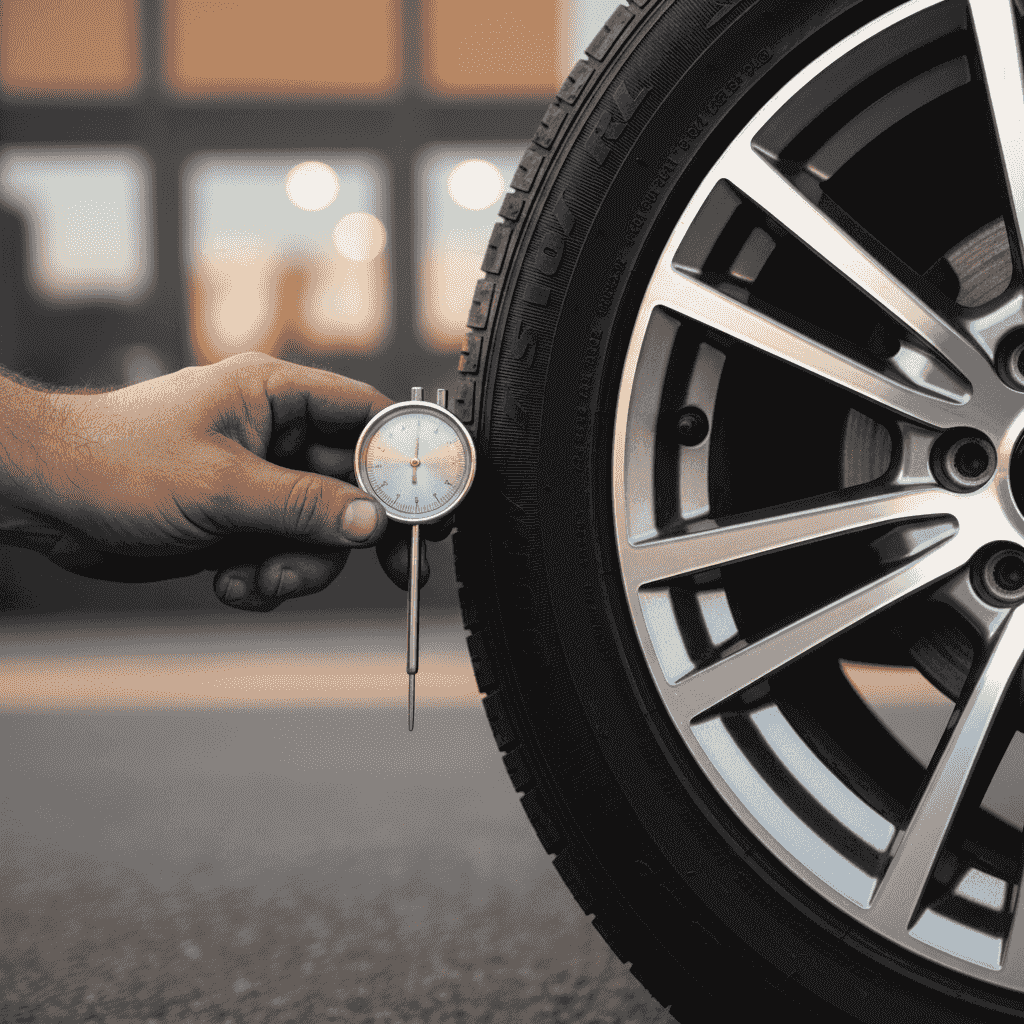
The cheapest mistake on a car is made in the driver's head. The owner sees there is still some tread, glances at the tyre from the side, shrugs and leaves it for another season. The question of when to change your tyres is not solved by eye, but by three criteria: tread depth, age by the DOT code and the type of driving each of us actually does. This guide gives you all three, plus the results of the ADAC 2026 test and the price range on the BiH market in May 2026.
This guide was prepared by the Auto Gas Gaga workshop in Banja Luka, based on BIHAMK and ADAC sources and years of experience inspecting vehicles before a trip.
Table of Contents
- Three Questions Before You Buy New Tyres
- Tread Depth in BiH and What Safety Actually Means
- How to Read the DOT Code and How Old Tyres Can Be
- Summer, Winter or All-Season for a BiH Driver
- ADAC Summer Tyre Test 2026
- Tyre Prices in BiH in May 2026
- Five Signs It's Time for New Tyres
- Frequently Asked Questions
- Related Articles
Three Questions Before You Buy New Tyres
Most drivers in BiH change tyres for one of two reasons: because a tyre fails or keeps losing pressure, or because the annual inspection failed the car for shallow tread. Both are too late. The right moment to replace them is set by asking yourself three questions, in order.
First: how deep is the tread? Second: how old are the tyres by the DOT code? Third: which type of tyre actually suits your driving, urban, motorway or mountain? If the answer to any of these three questions is bad, the tyres come off, regardless of how the other two look. A 4 mm tread on a five-year-old tyre that gets driven over Romanija in winter is not the same story as a 4 mm tread on a two-year-old tyre on a city Polo.
The second thing worth knowing: older tyres wear faster, because a tyre that has aged no longer grips the same. The driver feels the car "slide" and presses harder on the pedal, which speeds up wear.
Tread Depth in BiH and What Safety Actually Means
The legal minimum tread depth in Bosnia and Herzegovina is 1.6 mm for summer tyres and 4 mm for winter tyres, in line with BIHAMK recommendations and the regulations in force in the region. That is the line below which a vehicle is formally not allowed on the road, the annual technical inspection will fail it, and the insurance policy becomes questionable in case of an accident.
It is important to understand what that limit really means. 1.6 mm is the legal floor, not the safety threshold. European tests (ADAC, TCS) have shown the same thing for years: below 3 mm tread depth on summer tyres, the wet braking distance grows by 30 to 50% compared to a new tyre, and the risk of aquaplaning rises sharply. Our practical recommendation in the workshop: replace summer tyres below 3 mm, winter tyres below 4-5 mm. Tread below those values is legal, but that does not mean it is safe for a family on the motorway in heavy rain.
The easiest way to check tread is with a depth gauge, a small metal or plastic tool that costs a few marks and measures precisely. If you do not have a depth gauge, there is a built-in tool on the tyre itself: the tread wear indicator (TWI) at the bottom of each tread groove, a small rubber bridge 1.6 mm high. If the tread surface levels with that bridge, the tyre is at the legal floor. The old coin trick is a rough approximation. The difference between 2 mm and 3.5 mm cannot be seen with the naked eye, but it is huge for safety.
Check the tread on each tyre separately, in several places: the inner, middle and outer side of the tread band. If wear is uneven, that is not just a tyre issue but a signal that wheel alignment is off, or that pressure has been wrong for a long time. We cover pressure maintenance and even wear in more detail in our guide on tyre pressure and maintenance.
How to Read the DOT Code and How Old Tyres Can Be
The DOT code is a four-digit marking pressed into the sidewall of the tyre, usually enclosed in an oval frame. The first two digits indicate the week, the second two the year of manufacture. Example: DOT 1224 means a tyre produced in the 12th week of 2024. The full code is often longer, but for the driver only the last four digits matter.
Why does age matter? Rubber is a chemically complex material that oxidises over time and becomes harder, regardless of how much it is driven. The tread may be almost untouched, while the tyre is already "deadened": wet grip drops, the risk of a sidewall blowout on hot asphalt rises.
Practical guidelines we use in the workshop:
- Up to 5 years from the date of manufacture, the tyre is considered in full condition if properly stored.
- 5 to 8 years, an annual visual inspection is mandatory; we look for small sidewall cracks, hardness of the rubber and signs of ageing. Michelin in its own guidelines calls for a detailed inspection at least once a year after year five.
- 8 to 10 years is the maximum we recommend, change winter tyres no later than at eight years, summer tyres at ten, even when the tread looks great. ADAC research shows performance drops significantly after the sixth year.
- Over 10 years, the tyre is replaced without thinking, including the spare in the boot which often gets forgotten.
A special case: tyres that have sat on the dealer's shelf for years. It is not unusual in BiH for someone to buy a "new" tyre manufactured four or five years earlier. Legally it is fine (the tyre is new, unused), but you are left with fewer years of service life. Always ask for the DOT code before paying, especially on promotions. Workshop rule: do not buy a summer tyre older than two years from its DOT, nor a winter tyre older than one year. Otherwise you pay as for a new tyre and drive as on a used one.
How to Measure Tread Depth Without Tools
If you do not have a depth gauge to hand, the most reliable tool is already built into the tyre, the TWI wear indicators. They sit at the bottom of the longitudinal tread grooves, marked on the sidewall with a small triangle or the "TWI" label. When the top surface of the tread reaches the level of that indicator, the depth is exactly 1.6 mm. Our advice: check the TWI on all four tyres, in several positions. If the tyres are already at the limit, it is too late to deliberate, plan the replacement immediately and do not wait for the annual inspection.
Summer, Winter or All-Season for a BiH Driver
In BiH, winter equipment is mandatory from 1 November to 1 April under the regulations published by BIHAMK. During that period the driver must have one of three: winter tyres on all four wheels; winter tyres on the driven wheels plus chains in the boot; or summer tyres with at least 4 mm of tread along with chains that must be in the vehicle. The last option is legal, but in practice you will end up fitting chains in the snow with your family in the car. We do not recommend it.
A question we get more and more often is about all-season tyres. ADAC has tested them several times and the conclusion is clear: all-season tyres are an acceptable compromise for small city cars with annual mileage of 10,000 to 15,000 km mostly in town. For heavier vehicles, for drivers who go to the coast in summer, or for those who drive towards the mountains in winter, all-season are not the right choice. One tyre for every season brings concessions both in summer and in winter.
What M+S and 3PMSF Markings Mean
On the sidewall of tyres you see two markings that confuse drivers. M+S (Mud and Snow) is an old marking that the manufacturer can assign to itself; it means the tyre has a tread suitable for mud and snow, but there is no standardised test that confirms it. 3PMSF (Three Peak Mountain Snowflake), the mountain peak symbol with a snowflake, is a stricter marking that guarantees the tyre passed a snow traction test. The rule: look for 3PMSF when buying a winter tyre. That is the marking that genuinely means winter performance.
Are All-Season Tyres Worth It for City Driving
For a driver who covers 10,000 to 12,000 km a year, mostly around Banja Luka or a similar city, who does not regularly go to the coast in winter and has no mountain weekend house, an all-season set can make sense, but on one condition: that you buy a quality all-season (Michelin CrossClimate 2, Goodyear Vector 4Seasons Gen-3, Continental AllSeasonContact 2). Cheap all-season tyres are the worst compromise: bad summer, bad winter, short life.
ADAC Summer Tyre Test 2026
On 27 February 2026 ADAC published the results of its summer tyre test, on the 225/50 R17 dimension, which is typical for mid-size family estates and the lower C/D segment. Sixteen models were tested. Important: the results apply to the tested size, differences between manufacturers can shift across sizes, so do not blindly transfer the ranking to a 195/65 R15 Polo set.
The models we recommend from our own workshop as a safe choice:
| Rank | Model | Score | Note |
|---|---|---|---|
| 1. | Continental PremiumContact 7 | 1.9 | Test winner in the tested size, evenly strong |
| 2. | Pirelli Cinturato C3 | 2.2 | Sport-oriented feel, strong braking on dry |
| 3. | Goodyear EfficientGrip Performance 2 | 2.3 | Best balanced price-to-performance ratio |
From the same test, ADAC explicitly warns against budget brands such as Leao Nova-Force Acro and Lassa Revola; wet performance is well below average, which on a family car on the motorway is not a conversation about a few metres more braking distance, but about tens of metres. We understand the temptation to save 60 to 80 KM per piece, but when you add up four wheels and years of driving, that is not a saving. It is shifting risk from the wallet to the people in the car.
The rule is not the brand, but the logic: if you are choosing a tyre for a car that other family members also drive, stick to the upper half of the ADAC ranking. For a weekend Cinquecento, mid-range is a justified compromise.
Tyre Prices in BiH in May 2026
The prices below are indicative, pulled from BiH online offers (gumeonline.ba and similar), state as of 13 May 2026, and refer to a single tyre without fitting. The real workshop price is higher, because mounting and balancing are added, typically 20 to 40 KM per wheel in BiH, plus any valve replacement and disposal of the old tyre.
Typical range for the 205/55 R16 size, one of the best sellers for the middle class (Golf, Octavia, Astra, Focus):
| Segment | Typical range per piece | Examples |
|---|---|---|
| Budget (cautiously) | 150-170 KM | Rotalla, Nexen, Lassa |
| Mid-range | 170-200 KM | Hankook Ventus Prime 4, Yokohama BluEarth |
| Premium | 200-235 KM | Michelin Primacy 4, Continental PremiumContact 7 |
For the 195/65 R15 size (Polo, Yaris, smaller city car) prices are 15-25% lower; for 17 and 18 inch (SUV, BMW 3 Series and larger) 25-50% higher per piece, depending on the profile and speed index.
In May, summer tyre prices are seasonally at their peak, due to winter changeover and the rush of buyers. The most favourable moments to buy have historically been late September and mid-February, shopping off-peak brings 10 to 20% lower prices. The easiest way to get a concrete calculation for your car is to book an appointment or to message us on WhatsApp with the year and tyre size.
Five Signs It's Time for New Tyres
If even one of these signs is present, do not wait for the next annual inspection. The classic situations customers bring into the workshop:
- Tread is below 3 mm on summer or below 4-5 mm on winter tyres. The legal floors (1.6 mm and 4 mm respectively) mean "the car fails the technical inspection". Safety limits are significantly higher.
- The DOT code shows a tyre older than 8 years for winter or 10 years for summer, even if the tread is good. An old tyre is a hard tyre, and a hard tyre brakes worse.
- Fine longitudinal cracks on the sidewall (ozone cracks). A typical sign of rubber ageing and UV degradation. Cracks do not close, they only spread.
- Uneven tread wear, only the inner or outer side wears down, or only the middle section. A signal both for tyres and for suspension geometry. We covered the reasons for uneven wear in our guide on tyre pressure and maintenance.
- The tyre keeps losing pressure and no puncture is visible. Often it means a crack in the sidewall, corrosion on the rim where the tyre seats, or old valves.
A pre-season tyre check catches these signs in time most easily. It fits into a standard spring vehicle inspection after winter, and gives the best results when combined with a battery check; we wrote about that in the guide on battery testing before summer 2026.
If you are thinking about a replacement this spring, the calmest approach is to consult before ordering the set. Bring the car in, we will measure the tread, read the DOTs and decide together whether new ones are needed now or whether they can last another season. Book an appointment or message us on WhatsApp; May is busy, so it pays to get in touch a couple of days earlier.
Frequently Asked Questions
What is the legal minimum tread depth for summer tyres in BiH?
The legal minimum is 1.6 mm for summer tyres and 4 mm for winter tyres. Below those values the vehicle is formally not allowed on the road and fails the technical inspection. The practical safety limit is higher, around 3 mm for summer and 4 to 5 mm for winter tyres.
How do I read the DOT code on a tyre?
The DOT code is a four-digit code pressed into the tyre sidewall, usually in an oval frame. The first two digits are the week of manufacture, the second two the year. DOT 1224 means a tyre produced in the 12th week of 2024.
How many years can I use a tyre if the tread still looks good?
Practical guidelines: maximum 8 years for winter and 10 years for summer tyres from the date of manufacture, even if the tread is good. Performance drops significantly after the sixth year, so tyres older than 5 years should be inspected at least once a year.
Are all-season tyres worth it in BiH?
For drivers with annual mileage up to 15,000 km mostly in the city, with a quality model (Michelin CrossClimate 2, Goodyear Vector 4Seasons), all-season can make sense. For drivers who go to the coast in summer, to the mountains in winter, or who have heavier vehicles, two separate sets (summer and winter) are the safer choice.
Which size is most popular in BiH and how much does it cost?
The 205/55 R16 size covers the middle class (Golf, Octavia, Astra, Focus). In May 2026 the typical range in BiH online offers is 150 to 235 KM per piece, depending on the brand, from budget ranges (Rotalla, Nexen) to premium (Michelin Primacy 4, Continental PremiumContact 7). Prices do not include fitting, which is usually 20 to 40 KM per wheel.
Which is the best summer tyre of 2026 according to the ADAC test?
The 2026 ADAC test (published on 27 February) tested 16 models in the 225/50 R17 size. The winner is Continental PremiumContact 7 with a score of 1.9, followed by Pirelli Cinturato C3 (2.2) and Goodyear EfficientGrip Performance 2 (2.3). Results apply to the tested size.