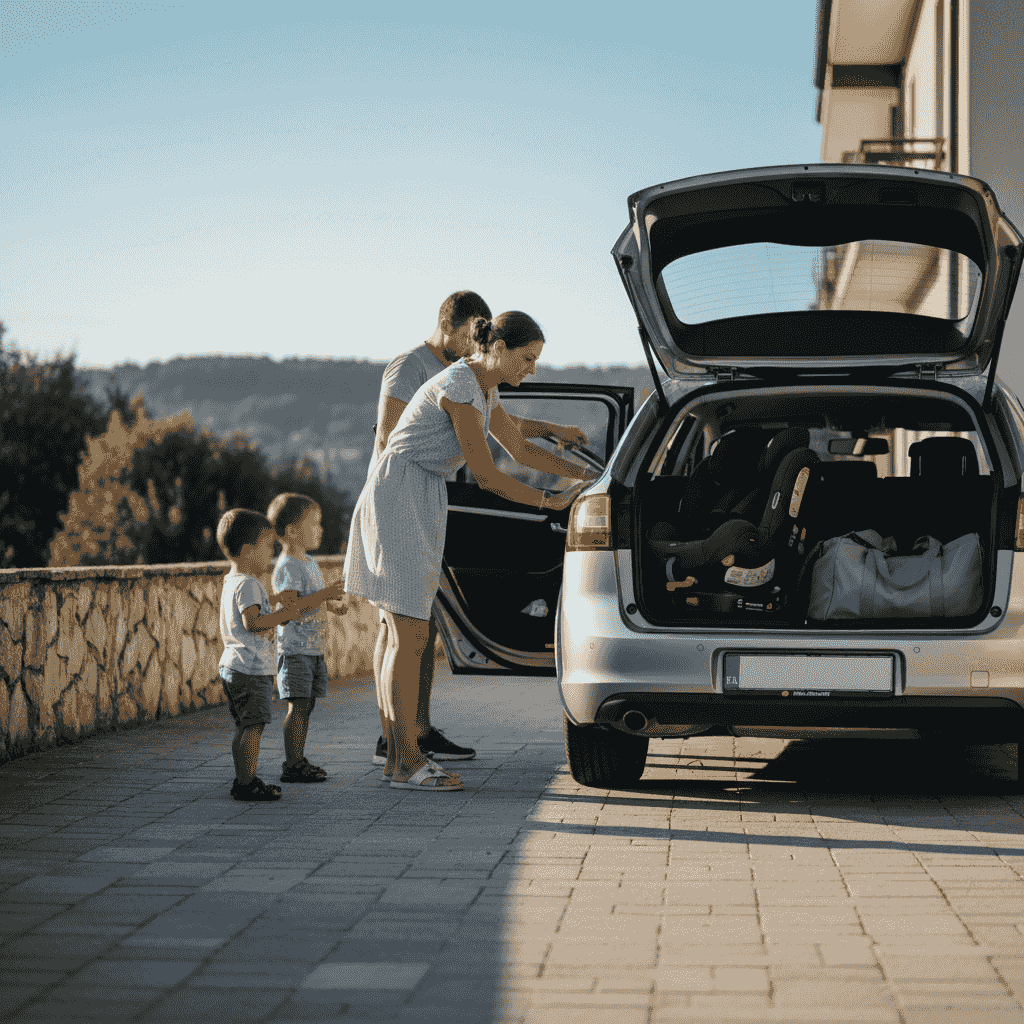
Driving from BiH to the coast with kids is not the same as two adults on the road. The child seat has to meet the right standard and be fitted correctly, the rules change the moment you cross a border, and the car has to handle 600 to 1,200 kilometres in the heat without the AC giving up halfway through Lika. This guide pulls together the law, the equipment and what we as a workshop see first-hand when people bring a car in for a pre-trip check.
This guide was prepared by the Auto Gas Gaga workshop in Banja Luka, based on years of experience with pre-trip inspections and the questions that come up season after season.
Table of Contents
- What BiH law says about transporting children
- The car seat to buy in 2026: R129 (i-Size)
- ISOFIX and proper seat installation
- Differences in rules across regional countries
- What to check on the vehicle before departure
- Travel first-aid kit and motion sickness
- Breaks, food and drink on a long route
- What to keep within reach on the back seat
- Frequently Asked Questions
- Related Articles
What BiH law says about transporting children
The rule to know by heart: in BiH, a child under 12 must not sit in the front seat. The exception is a baby under two in a rear-facing seat, with the front airbag mandatorily deactivated (BIHAMK, evergreen). An active airbag and a rear-facing seat are a fatal combination in a crash.
Up to what age must a child be in a car seat in BiH
All children up to 12 must be secured by a belt suited to their height and weight. In practice that means a seat or booster up to around 150 cm, which falls between the ages of 11 and 13. If the belt sits across the shoulder without a seat, it is too early to make the switch.
Fine for a child without a seat in BiH
A driver carrying a child improperly (without a seat or in a wrongly fitted one) pays a fine of 40 KM. A child in the front seat against the law carries a fine of 400 to 1,000 KM (roditelj.ba, evergreen).
The car seat to buy in 2026: R129 (i-Size)
The old ECE R44/04 standard stopped being sold in the EU on 1 September 2024 (bazzar.hr, September 2024). Every new seat at authorised retailers in BiH and the region carries the R129 mark, better known as i-Size.
R44 vs R129 (i-Size) - what to buy in 2026
R44 classified seats by the child's weight and allowed installation only with a three-point belt. R129 takes a different and better approach:
- Classification by the child's height, not weight. Easier for parents to choose: measure the height, you know the category.
- Mandatory rear-facing up to 15 months. The old standard allowed turning the seat forward as early as nine months, which the field has long considered too early for a baby's neck.
- Mandatory ISOFIX installation. The reason: studies show that around half of seats installed with a classic three-point belt are fitted incorrectly (besafe.hr).
- Mandatory side-impact test. With R44/04 this test was not a requirement; with R129 it is.
An old R44/04 seat did not become illegal overnight; use it until your child outgrows it. But the next seat is R129. A seat that has been in a crash, inherited without paperwork or sitting in the attic for years goes in the bin without a second thought.
When can the seat be turned forward
Under the R129 standard, the seat may only be turned in the direction of travel after 15 months. Paediatricians advise delaying this transition as long as possible, ideally until age two or until the child's head extends past the top edge of the headrest. In a frontal crash a rear-facing seat distributes force across the entire back instead of concentrating it on the neck.
ISOFIX and proper seat installation
ISOFIX is two metal hooks at the base of the rear seat and matching bars on the seat (or base). The system is standardised: any R129 seat fits any ISOFIX-compatible car.
What if the vehicle has no ISOFIX points
Older models (mostly pre-2006) and some budget later ones have no ISOFIX. Most quality R129 seats offer a belt-fit variant, but with a mandatory "support leg" resting on the floor or a "top tether" strap behind the rear seat. Here it is especially important to follow the instructions to the millimetre.
A practical workshop tip: install the base yourself and try to move it left-right by hand. A properly secured base must not move more than two centimetres. If it wobbles, something is not fully locked.
Differences in rules across regional countries
The moment you cross a border, the rules change and the fines with them. The table below summarises the rules for countries on the usual summer routes from BiH to the coast (kolicazabebe.ba, BIHAMK).
| Country | Seat rule | Front-seat limit |
|---|---|---|
| Bosnia and Herzegovina | Seat/booster up to 12 yrs or until belt fits | <12 yrs not in front (except rear-facing baby with deactivated airbag) |
| Croatia | Seat up to 12 yrs or 150 cm | <12 yrs not in front |
| Montenegro | Seat up to 12 yrs | <12 yrs not in front |
| Slovenia | Seat up to 12 yrs or 150 cm | <12 yrs not in front |
| Austria | Seat/booster up to 14 yrs or 150 cm | <14 yrs not in front (except in a seat) |
| Italy | Seat up to 36 kg and 150 cm | <12 yrs not in front (with exceptions) |
| Greece | Children <3 yrs must use ECE R44/03 or newer seat | <12 yrs not in front |
| Turkey | Seat up to 150 cm and 36 kg | <10 yrs not in front |
Austria is the strictest (up to 14 years). If your child is 13 and you are crossing the Austrian border, the booster goes in the car, even if you have not used it at home for a year. Rules change, so before you travel check on the BIHAMK website or the local auto-moto association.
What to check on the vehicle before departure
A hot child in a car at 35 degrees and an AC that fails halfway through Lika is not an inconvenience but an emergency.
Air conditioning. If by the third minute of driving on max the air from the centre vents is not noticeably colder than the outside air, the refrigerant is most likely leaking and a service is needed. We broke this down in the piece on AC service - if your last recharge was more than two seasons ago, the pre-trip is the ideal moment.
Tyres. Adjust the pressure for full load (the manufacturer lists the value on the sticker on the driver's door) and check tread depth. With kids, luggage, a cool box and four passengers you easily add a tonne of load over an empty car - that is a different pressure setting.
Fluids. Engine oil, coolant, power-steering fluid, brake fluid, washer fluid. Check them all cold, in the morning before departure. If any is heading toward the lower mark, top it up before the trip, not on the way.
Brakes. Vibration in the steering wheel under braking or squealing means you must not set off down Velebit or the Mostar valley until it is sorted.
Battery. Heat kills a battery faster than cold. A battery older than four years that turned the engine over slowly on spring mornings can give up in the middle of a car park halfway to your destination.
For a more complete check you have the guide What to check before a long trip, in the order we run a pre-trip inspection in the workshop. And for broader seasonal preparation, the summer prep checklist also covers parts that are not critical only for one trip. This is tier 8 in our series on car prep and travel from BiH; more detailed posts on the route and paperwork are waiting for you in Driving from BiH to the coast 2026.
Travel first-aid kit and motion sickness
A travel first-aid kit for a trip with kids is different from one for adults. What you should always have:
- A thermometer (digital, fast).
- A children's antipyretic in two forms: syrup and suppository (if the child is vomiting, the suppository works where the syrup will not).
- Oral rehydration sachets, for diarrhoea and vomiting.
- An antihistamine for mild allergic reactions.
- Wound cream, sterile gauze, plasters.
- High-SPF sunscreen and after-sun cream.
- A child-safe mosquito repellent (check the age limit).
- The medication the child usually takes, with a reserve.
If the child has a chronic condition (asthma, food allergy, diabetes), pack copies of medical documentation and prescriptions too.
How to prevent motion sickness in a child while driving
Motion sickness is most common between the ages of two and 12. What helps (oryx-asistencija.hr, cybermed.hr):
- Looking at the horizon through the window, not at a screen or a book. A phone or tablet in the car in the morning is a recipe for vomiting on the third bend.
- A light meal before the trip. Crackers, a banana, a bit of bread with cheese. Neither an empty stomach nor a heavy meal.
- Fresh air. Lower the window every 20-30 minutes, or switch the AC to outside-air intake instead of recirculation.
- Ginger. Lollies, gummy jellies or ginger-based tablets work for both children and adults.
- The middle of the rear seat with a forward view helps more than side windows, which speed up motion sickness in sensitive children.
- A break the moment the child says "I don't feel well". Stop, get out, drink some water, walk for five minutes.
Anti-motion-sickness medication for children (for example dimenhydrinate) should be given only after consulting a paediatrician and reading the age limit carefully.
Breaks, food and drink on a long route
The rule the workshop and paediatricians repeat: a break every two hours (oryx-asistencija.hr). Babies must not be kept in the seat any longer, because seats are designed for crash safety, not long-term sitting. Let older children stretch and run for ten minutes; they come back calmer.
What to eat and drink during the trip:
- Plenty of water, cold but not iced. A thermos bottle solves the problem.
- Fruit and vegetables: apple, banana, cucumber, carrot sticks.
- Dry items: crackers, breadsticks, milk biscuits.
- Avoid chocolate (it melts), thick yoghurt (the stomach handles it poorly in the heat) and high-sugar juices (they increase nausea).
If you are picking the route for the first time, the ideal plan is to set off early in the morning (5-6am), the first proper break after two hours, lunch on the third and arrival before the worst afternoon heat. A plan that avoids 12-4pm makes for a calmer child.
What to keep within reach on the back seat
Half the crises during a trip are solved by not having to dig out what you need from the roof or the boot. In a bag on the floor in front of the rear seat, always have:
- Wet and dry wipes.
- A spare T-shirt and underwear for the child (vomiting, spilled water).
- A small bin bag.
- A quiet toy (a picture book, a soft doll, not something battery-powered with music).
- Nappies and cream, if the child is the right age.
- Water in a small bottle, reachable from the front seat.
- Light cotton clothes, because a car with the AC on can be colder than you expect.
All bigger items (suitcase, pushchair, cool box) go in the boot. At a break, before you get out with the child, air out the car: in the sun it crosses 40 degrees inside in five minutes.
Driving this route for the first time and not sure your car is in shape for a long summer trip? Book a pre-trip inspection at the workshop - we go through AC, tyres, brakes, battery and fluids in one visit, so you set off with peace of mind.
Frequently Asked Questions
Does an 11-year-old have to be in a car seat in BiH?
Yes, if the belt does not sit properly across the shoulder and hips. Under BiH law, all children up to 12 must be secured by a belt suited to their height and weight, which for most means a booster up to around 150 cm.
Can I put a baby in a rear-facing seat on the front seat?
Only if the baby is under two and the front airbag has a switch and can be deactivated - check the vehicle handbook. If the airbag cannot be deactivated, the baby goes in the back seat without exception.
Am I allowed to use a seat that has been in a crash?
No. A seat that has been in a moderate or severe crash goes in the bin, even if it looks undamaged on the outside. The internal structure of plastic and foam suffers micro-cracks that reduce protection in the next impact.
What is better, a seat with a base or without a base?
A base with ISOFIX is safer and far quicker for everyday use. For a baby that is carried in and out a lot, a base is almost essential. If you only use the seat for long trips, the belt-fit version is justified, but it must be installed more carefully.
Does a 13-year-old in Austria need a car seat?
Yes, if they are under 150 cm. Austria requires a seat or booster up to 14 years or 150 cm of height, whichever comes first. If your child is 13 and 145 cm tall and you are crossing the Austrian border, the booster goes in the car.
What is the safest seat position in the car?
Statistics show the middle of the rear seat is safest because it is furthest from side impacts. If the middle has no ISOFIX, choose rear right (behind the front passenger) - it is easier for the child to get out on the kerb side.